Feeds:
Posts
Comments

Posts Tagged ‘Encouragement’

(In honor of Black History Month)


Isabella, the daughter of James and Elizabeth Baumfree, was born a slave in New York state about 1797. No one knows the exact date, because birth records weren’t kept for “property.”

Did her parents know the name means, “consecrated to God?” Even if they chose the name for its meaning, those parents could not have dreamed of the future awaiting their Baby Belle.

Her early years were difficult.  Belle was sold five times, several times to cruel masters.

At age eighteen or so, Belle fell in love with Robert, a young slave from a nearby farm. The couple had a daughter. But Belle’s master, John Dumont, forbade her to see Robert again. According to the law, all children of the union would belong to Robert’s master, not Dumont.

Two years later, Dumont forced Belle to marry an older slave. They had three children: Peter, Elizabeth, and Sophia.

In 1826, Belle escaped the Dumont farm with Baby Sophia. In a vision, God showed her a particular home to go to. That home belonged to a Quaker family, the Wageners, who took in the young woman and her baby. They even paid Belle’s price to Dumont and made her a free woman. Belle became a housekeeper, then a maid.

Shortly after her escape from slavery, Belle learned that her five-year old son, Peter, had been illegally sold in Alabama. She took the matter to court and won her case. Peter was returned to New York. That was the first time a black woman challenged a white man in a U.S. court. It was also the first time of many that Belle’s resolve and courage were put on display.

Several years later Belle was falsely accused of poisoning her former employer. In 1835 she took that case to court and won again.

Someone must have encouraged Belle to tell her story of being a slave and becoming a free woman. But she had never learned to read or write, so a friend wrote as Belle dictated. A Northern Slave was published in 1850.

In her book, Belle explained that several years after she was freed, God revealed himself to her, “with all the suddenness of a flash of lightning, showing her, in the twinkling of an eye, that he was all over, that he pervaded the universe, and that there was no place where God was not.”

The book sold many copies and Belle became well-known. She was asked to speak at a women’s rights convention in Massachusetts. Before long, Belle was traveling with abolitionist, George Thompson, speaking against slavery and for human rights.

In 1851, Belle gave a speech at another women’s conference, this time in Ohio. She spoke convincingly (and extemporaneously) about women being every bit as capable as a man:

“I have plowed and reaped and husked and chopped and mowed, and can any man do more than that?”

And, no doubt with a twinkle in her eye, she added:

“As for intellect, all I can say is, if a woman have a pint, and a man a quart — why can’t she have her little pint full? You need not be afraid to give us our rights for fear we will take too much, for we can’t take more than our pint’ll hold. The poor men seems to be all in confusion, and don’t know what to do. Why children, if you have woman’s rights, give it to her and you will feel better. You will have your own rights, and they won’t be so much trouble.”

She concluded by asking: “And how came Jesus into the world? Through God who created him and the woman who bore him. Man, where was your part?”

It’s not surprising that some were displeased with Belle’s speeches. One time she was told that the building where she was to preach would be burned down if she dared to speak. “Then I will speak to the ashes,” she replied.

Belle was also physically assaulted. One brutal attack caused permanent injury, and she had to walk with a cane for the rest of her life.

In 1863, Harriet Beecher Stowe wrote an article about Belle for the Atlantic Monthly:

“I do not recollect ever to have been conversant with anyone who had more of that silent and subtle power which we call personal presence…She seemed perfectly self-possessed and at her ease. An audience was what she wanted—it mattered not whether high or low, learned or ignorant. She had things to say, and was ready to say them at all times, and to anyone.”

Imagine. A slave woman who never had the opportunity to go to school, never learned to read or write. Yet the power of her spoken word helped bring the end of slavery and pave the way for women to be granted the right to vote.

Belle proved:

“There is no difficulty that cannot be defeated.

There is no victory that cannot be achieved,

if you believe in the power of God!”

— Anonymous

Of course, by the time she achieved notoriety, Belle was known by another name.

You see, Belle had asked God for a new name several decades before the Civil War. Again, it was the result of a vision. She said God chose her new first name based on the fact she would travel. Then Belle asked God for a second name, “’cause everybody has two names.” And the Lord granted her request. Her second name proclaimed what Belle always declared from her podium.

Perhaps you remember Sojourner Truth.
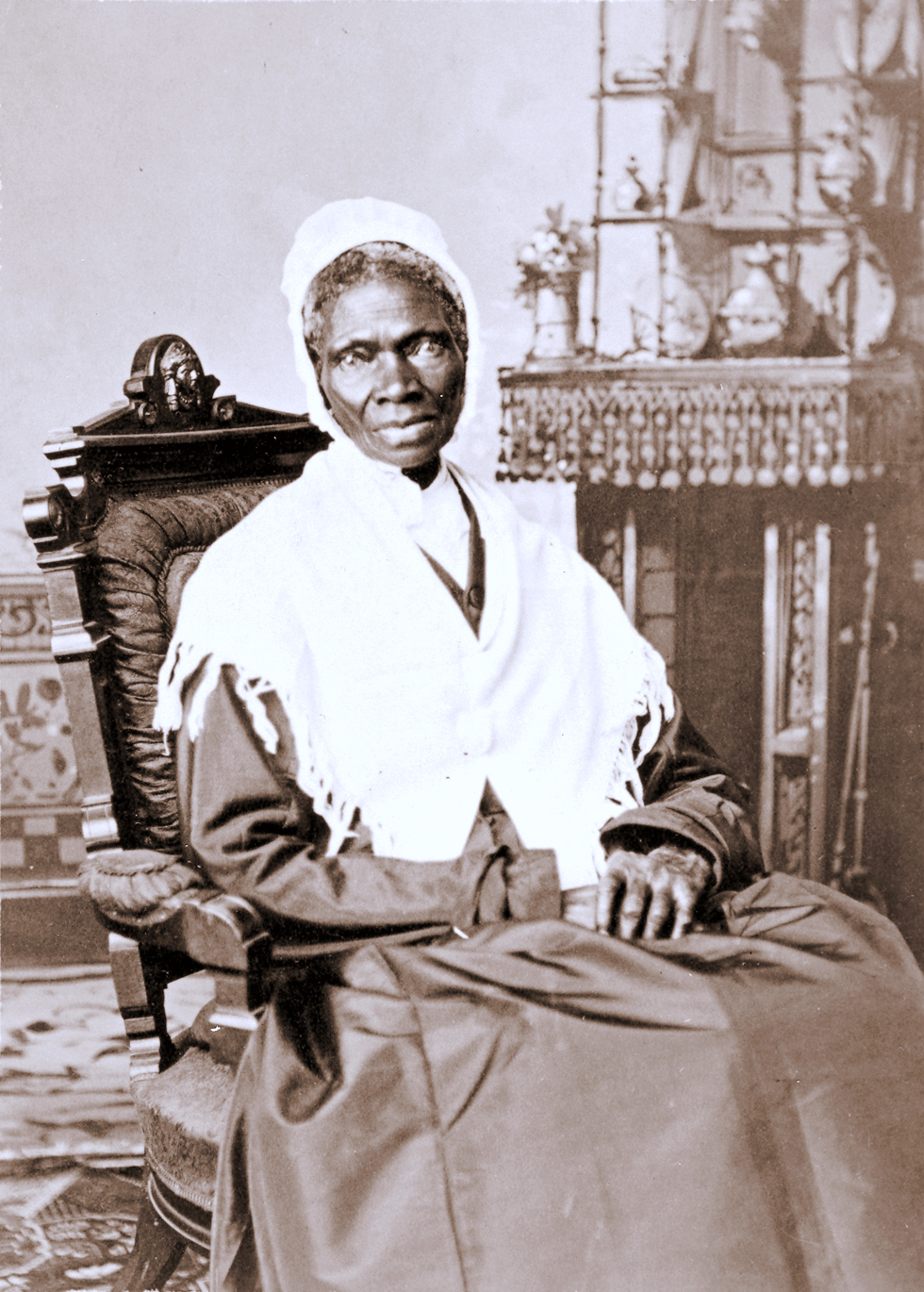
 

Sojourner_truth_c1870

(Photo from http://www.wikipedia.org.)


Sources:  www.biography.com; http://www.sojournertruth.org; http://www.; http://www.blackpast.org; http://www.americanswhotellthetruth.org; http://www.christianitytoday.com.)


Read Full Post »

sepia-praying-woman

Abby has prayed for years that her estranged son would come home.

Stacie has faced the loss of one job and a stressful transition to another–with a broken leg.

Jack has worked hard to qualify for a prized promotion, but the boss’s unpleasant nephew was awarded the position instead.

Tricia can’t seem to shake a gray cloud of despondency, ever since her fiancé broke off their engagement.

Kate goes through the motions at church and even continues with her quiet time. But God seems to have distanced himself. She hasn’t sensed his presence for weeks.

These circumstances and more can cause a downward spiral in our spirits, as debilitating emotions take over–emotions like frustration, anger, hurt, worry, and depression. If we feed these emotions with negative thoughts, our faith in God begins to falter.

The devil’s lies begin to sound like truth:

  • So much time has passed; God is never going to answer your prayer.
  • Bad things keep happening; God has obviously abandoned you.
  • God doesn’t care about your life. Otherwise, why would he allow you to fail?
  • They say God offers love, hope, peace, and joy. Right. None of it is coming your way.
  • It looks like God has forsaken you and to make matters worse, you don’t even know why.

Is it possible to fight against such feelings and fortify our faith? Oh, yes!

Our fight begins with truth—straight from God’s Word. We have to choose fact over feelings—just like a pilot does, as he flies through miles of thick clouds. In order to stay on course, he can’t trust what he feels is proper speed, direction, and altitude; he has to rely on the facts presented by his instruments.

47056693.14

So what scriptural truths might help us maintain our spiritual equilibrium? There are dozens, perhaps hundreds of passages that address our various needs with pinpoint perfection.

Other scriptures provide broad-sweeping truth that covers almost any situation. One example:

“The Lord is faithful to all his promises and loving toward all he has made.  The Lord upholds all those who fall and lifts up all who are bowed down” (Psalm 145:13-14).

If we read the Bible with the intent of finding applicable truth for our circumstance, we will not be disappointed.

april13

(“Such things were written in the Scriptures long ago to teach us.  And the Scriptures give us hope and encouragement as we wait patiently for God’s promises to be fulfilled”–Romans 15:4, NLT.)

 Now the question is: Are we going to take God at his word and then act upon it?

Hebrews 11 gives us a line-up of faith-stars who did just that–based their actions on faith, not feelings.

By faith Noah built at ark (v. 7).   He did not allow feelings of inadequacy to stop him.

By faith Abraham left home with no notion of where he was going (v. 8). He did not allow fear of the unknown to deter him from following God’s direction.

By faith, the parents of Baby Moses hid him from Pharaoh. They did not allow fear of punishment to stop them. “They were not afraid of the king’s edict” (v. 23).

By faith the people of Israel marched around Jericho seven times, even though it didn’t make sense (v. 30).

Bottom line: Faith is the exercise of our minds, based on the stable truth of God’s Word, in spite of what we might feel. Emotions are just the unreliable, fluctuating condition of our minds (J. Clarke, http://www.writtentreasures.org).

On the other hand, God doesn’t ask us to ignore our feelings. Job, David, and the prophets honestly expressed frustration, fear, disappointment, and discouragement. But they didn’t allow their emotions to cripple them.

f7ea3e3945226580cc4cd80213db5133

Also worth noting:  None of these faithful people were perfect, yet God honored their faith.  He doesn’t need perfect people to accomplish his purpose, just willing and faithful ones.


*     *     *     *     *     *     *     *     *     *


Forgive me, Lord, for allowing feelings to impact my faith, to weaken my trust in you. Together with you, may I fit every thought and emotion and impulse into the structure of life shaped by Christ.  Thank you for listening and offering encouragement as I confess to you my feelings.  You even supply strength, peace, and hope.  And finally, I praise you that you preserve the faithful. I am secure in you.  In fact, you, my all-powerful God, are security itself.      

(2 Corinthians 10:5, MSG; Psalm 10:17; Psalm 29:11; Psalm 31:23.)

Art & Photo credits:  www.hem-of-his-garment-bible-study.org; www. pbase.com; http://www.scentoffaith.com; http://www.pinterest.com.

Read Full Post »

Fantasyland_Full_17089

Visit a theme park and you soon learn that part of the adventure is waiting in line–even if you pay extra for fast passes.

Such was our experience at Disney World two years ago. The castle of Beauty and the Beast required wait time—well over an hour. But friends of our daughter had told her, “Don’t miss it,” so we joined the long, looping line.

You may also know that, while you wait, the folks around you can become like friends. Topics such as home state, kids’ ages, and other experiences in the park, get the conversation going. Commiserating over the long line adds to the camaraderie.

Finally we approached the entrance to the castle. Only fifty or so guests were allowed past the gilded rope. This was our first surprise, since most theater-attractions seat hundreds of people. (No doubt there are at least several theaters within the castle, to accommodate the crowds. But each group enters separately, totally unaware that there must be identical venues down alternate hallways.)

First, we were ushered into an outer room, hosted by a footman, I believe. He assigned roles to many of the guests. Among them, the father from Michigan with the four kids became a butler, the little ballerina (who had performed intermittently as we waited in line) became a teacup, our son-in-law, a knight, and our granddaughter, a salt shaker. Each participant was given a colorful placard to identify his or her part. The footman explained what they would need to do, once we entered the library to meet Belle.


Enchanted-Tales-with-Belle1


One particular role seemed completely inappropriate. For the Beast, the footman chose a little girl with an obvious limp.  It seemed cruel to choose such a child for the Beast, of all characters.  As he draped a red cape over her shoulders, I thought, He probably didn’t notice her difficulty walking. But those of us who had become acquainted outside the castle knew full well: this was going to be awkward.

Soon we were ready to enter the library and meet Belle. Our small gathering of almost-friends filed into the dimly lit, cozy room.  Most of us sat close together on benches.

Beautiful Belle, in her yellow satin gown, directed the teacups, salt shakers, and other dancers in a delightful little polka, while the knights stood guard. Such an elegant and charming princess, that Belle.

Then she said it was time for her dance with the Beast.

Our new little friend slowly and carefully approached Belle without any sign of self-consciousness. Her eyes locked with Belle’s, glistening with pleasure and adoration. Gently, they nearly waltzed, Belle being mindful to accommodate Beast’s handicap. And for a few precious moments, that little girl’s physical challenges were forgotten in the inexpressible delight of dancing with Belle.

Suddenly, my eyes filled with tears. That little girl had been the perfect choice for Beast. Her ecstatic joy was obvious in the non-stop smile and luminous eyes. She was the center of attention of a princess—someone whom she dearly loved and greatly admired. Even more poignant, the sweet look of love returned by Belle, her gracious intentness focused entirely upon the child.

Love soon encompassed the entire room. Surely every guest felt it, not just me. We loved the child for her precious innocence. We loved Belle for her warmth and kindness. We even loved each other, as almost-friends, sharing in this  miracle—a once-in-a-lifetime experience, never to be repeated.

But wait.  In actuality such euphoria and reverence is available to us–every day.

We can keep company with Jesus, our Prince of Peace —not just for a few miraculous moments, but  All.  The.  Time.  In fact, like the father of the prodigal son, he waits in eager anticipation for us to come “home” to him and linger there.

We can be transformed, just like that little girl.   For the length of that magical dance, she was blissfully unaware of her handicap. Why? Her attention was riveted on Belle.  Paul challenges us to do the same in the spiritual realm:   “Fix your attention on God,” he said.  “You’ll be changed from the inside out” (Romans 12:2, The Message).

We can experience love beyond imagination. Belle portrayed perfect love for one shining moment; God is perfect love (1 John 4:8). And the love of his Son, Jesus, is wider than any experience we encounter, longer than our lives last here on earth, and higher, purer, and deeper than any other love (Ephesians 3:18).

And then, one glorious gift that even the lovely Belle could not bestow.  We can be healed of our handicap, the handicap of sin.  Jesus paid the price for our sin when he died on the cross.  He sacrificed himself so that we could be healed of the ravages of sin and enjoy a God-enhanced life (1 Peter 2:24; John 10:10).

With ecstatic joy we can revel in all the privileges of one-on-one relationship with our Prince, who loves each of us as if there was only one of us (St. Augustine).

*     *    *     *     *     *     *     *     *     *

Oh, Prince of Peace, what an astounding privilege you grant us, to bask in your perfect love each day.  Thank you for the assurance of your love throughout scripture, reminding us that we are precious and beloved to you.  May our status as your precious ones free us to live unencumbered by self-consciousness, fear, and worry.  And may we never fail to express your gracious love to those around us.


(Photo credits:  www.wdwmagic.com; http://www.galleryhip.com)

Read Full Post »

iStock_000013894567XSmall-300x199


“What traits should you look for when determining if someone is trustworthy?” asked the subtitle of a magazine article.

That question piqued my interest, and I read further.

According to the researcher, integrity is a crucial component, but there’s another trait that’s equally important: competence. The author gave the following scenario as an example: His best friend, Charlie, had proven himself completely reliable, but he wouldn’t want that friend performing an operation on him.  Charlie is not a surgeon.

So a trustworthy person is not only honest and fair, he is also competent for what you need him to do.

Those of us who know God have just such a friend.  Think of all we know from scripture about the character of our virtuous, competent God.  He is:

  • just, faithful, and upright (Deuteronomy 32:4).
  • righteous (Psalm 119:142) and holy (Leviticus 19:2).
  • wise (Daniel 2:20) and good (Psalm 106:1).
  • truthful (Psalm 31:5).

An  enlightened understanding of our trustworthy God should calm our fears and doubts, right?

But perhaps you’re like me—struggling a bit from time to time, asking questions like:

  • Lord, I know you have a plan, but when are you going to reveal it to me?
  • Why hasn’t Bill been healed? We’ve prayed so hard and for so long!
  • Dealing with Meredith day after day is sapping my strength, God.  When will the frustration end?

According to Philip Yancey, faith boils down to the matter of trust in the relationship. Do I have confidence in God or not? If I do stand on a bedrock of trust, the worst of circumstances will not destroy the relationship (Grace Notes, p. 198).

Vintage country


So how can I develop that strong bedrock of trust? Saturating myself in scriptures about the character of God, such as those listed above, is a good place to start. Another worthy study-pursuit: the promises of God, because…

…“God is not a man, that he should lie, nor a son of man that he should change his mind. Does he speak and then not act? Does he promise and not fulfill” (Numbers 23:19)?  No, of course not.

To truly impact my trust quotient, a change of habit is necessary–a habit such as: T-squared. Any time I find doubt or fear creeping at the edges of my thoughts, I want to Turn, Trust, and Thank. T x 3 includes:

  1. Turn away from thinking about the what-ifs, the negative, the hurtful.
  1. Express trust in God through song, prayer, and scripture. “Doubts are dismantled by declarations,” says my good blogger-friend, Jody Collins.*
  1. Thank God for his attributes that he’s bringing to bear on any negative situation.  Thank him also for every scripture-promise that applies.

I think I’ll try it right now.

*     *     *     *     *     *     *     *     *     *

psalm287-nlt1


Oh, Father, I praise you that you are strong, and protect like a shield.   My heart leaps for joy knowing you care for me and will help me. I praise you for surrounding me with your love, because I trust in you. All my life you have proved yourself trustworthy; why would I want to stop trusting you now? Oh, how I praise you that, as I keep my mind steadfast upon you, you will fill me with your peace. You are my trustworthy Rock—reliable and unchanging.      

(Psalm 28:7; 32:10b; 71:5-6; Isaiah 26:3-4)

 *Visit Jody’s blog at http://www.threewaylight.blogspot.com.


(Photo credits:  www.pixgood.com., http://www.katherinepasour.net., http://www.tyndalerewards.com.)

Read Full Post »

desert

Last Thursday we pondered these promises from Isaiah 58:11:

 “The Lord will guide you always,” and

“He will satisfy your needs in a sun-scorched land.”

 Today, more discoveries and encouragement await as we meditate upon the last two promises:

  • “[He] will strengthen your frame.”
  • “You will be like a well-watered garden, like a spring whose waters never fail.”

garden-waterfall-design


Do you long for strength within your frame, that is, inner strength? Perhaps you’re moving as fast as you can, but never quite reaching the end of the to-do list. And you’re bone-weary from the effort.

Perhaps the stresses of life—difficult relationships, a high-pressure job, financial obligations—are squeezing in hard.

Perhaps boredom or depression surround you in a gray shroud, and you haven’t the energy to fight against them.

“He will strengthen your frame.”

But God doesn’t wave a magic wand over us and suddenly turn weakness into strength. Usually he invites us to be part of the process.   And his solutions are radical.

For example, celebrate anything and everything (Philippians 4:4).

3095781994_90a392c03f

Take joy in:

  • Your cozy robe to ward off the morning chill
  • That cute tuft of hair sticking up on your toddler’s head
  • A parking place opening up when and where you need it
  • Licking the stamp just as the mail carrier pulls up in her truck
  • An earring lost last week turns up between the counter and stove this week.

You see, joy and strength are closely related. Ezra told the people of Israel, “The joy of the Lord is your strength” (Nehemiah 8:10).

Those five examples above, and thousands like them, are gifts from your Heavenly Father. “Every good gift and perfect gift is from above, coming down from the Father of the heavenly lights” (James 1:17).

In the same way we can build up physical strength with exercise, we can build up spiritual strength with praise—by expressing gratitude and joy for every good and perfect gift.

And now, the last promise of this verse describes in metaphor the result of living according to God’s design.

“You will be like a well-watered garden, like a spring whose waters never fail.”

TotalChildCareVegetables7 

Visualize a flourishing garden, with rich, green plants overflowing with healthy, ripe produce.

Those can be descriptors of you and me.  We are:

  • Rich in God’s grace, which he has lavished on us with all wisdom and understanding (Ephesians 1:8).
  • Green and flourishing, because we spend time with the Master Gardener and allow him to cultivate our spirits (Psalm 1:2-3).
  • Healthy and prosperous of soul (v. 3). As we soak up God’s Word, we’ll produce actions and attitudes that honor God and bring us inner satisfaction.
  • Ripe and mature, lacking in nothing (James 1:3).

God offers us “a continual source of thirst-quenching, drought-ending, fruit-producing, spiritual hydration” (James MacDonald).

Doesn’t that sound refreshing?  Who could turn down such provision?

*     *     *     *     *     *    *     *     *     *

Thank you, Father, for the precious assurances of these promises: 

  • You are leading me along the path you preordained before time began.
  • Every day of this earthly journey I can count on you to supply my needs.
  • Every day you provide fresh strength. One way is through the exercise of praise.  
  • As I spend time in your presence, I will be transformed–like a garden replenished by hydration. In fact, I can grow into your likeness with ever-increasing glory!

 “Such knowledge is too wonderful for me. It is too lofty for me to attain.” Yet I know it to be true because these are truths from your reliable Word.  My heart overflows with wonder and gratitude.

(Psalm 139:16; Philippians 4:19; 2 Corinthians 3:18; Psalm 139:6)

(Photo and art credits:  www.dayofgrace.me; http://www.anativegarden.blogspot.com; http://www.flickr.com; http://www.naturalearning.org.)


Read Full Post »

blog-prayer-woman


How would you finish this prayer: 

“Oh, Lord, what I need most right now is ____________________.”

What word would you put in the blank?

Guidance?

Provision?

Strength?

Purpose?

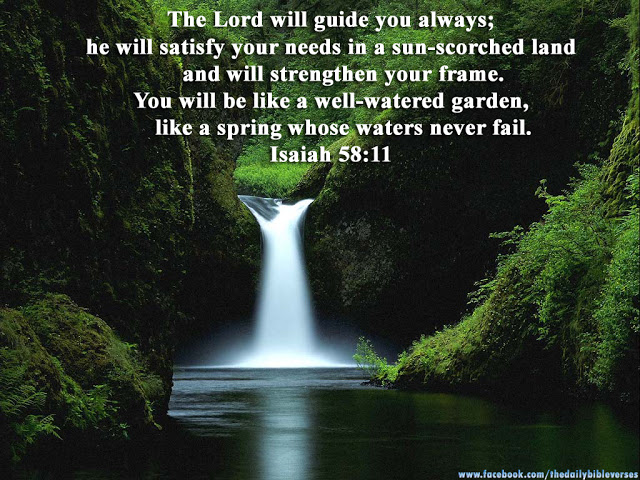
One glorious Bible verse tucked into Isaiah presents four comforting promises that cover each of those needs:


Isaiah58.11 

“The Lord will guide you always;

He will satisfy your needs in a sun-scorched land

And will strengthen your frame.

You will be like a well-watered garden,

Like a spring whose waters never fail” (58:11).

Lots of truth packed into five short lines. Each phrase warrants careful consideration. For example:


1.  The Lord will guide you always.


He’s not a life coach, counselor, or psychologist. The almighty God of the universe promises to be your guide—free of charge! And he’s available 24/7. Think, too, of his astounding attributes that make him the perfect guide:

  • God is omniscient—He knows everything (Psalm 139:1-6), including every detail of your situation and the people involved.
  • God is righteous—Everything he does is good (Deuteronomy 32:4). He can be relied upon to lead you down a perfect path.
  • God is merciful—He responds in loving compassion (Psalm 116:5). He’s your understanding Father, your strongest ally.
  • God is truthful—All that he says can be trusted (Titus 1:2). He will not lead you astray.
  • God is faithful—He keeps his Word (Psalm 33:4). God does not lie or forget what he said. Neither does he change his mind.

Notice that first phrase says God will always be your guide. Not every once in a while when you’re really in a quandary, but always. You are never left alone to your own devices—unless that’s the way you want to live. God is a gentleman; he leaves the choice up to you.


2.  He will satisfy your needs in a sun-scorched land.


Not he might satisfy your needs if he feels like it. He will. 

No matter what the landscape of your life looks like, God will see that your needs are met.

Have you ever been surrounded by sun-scorched land, perhaps a desert or wilderness where no life is visible?

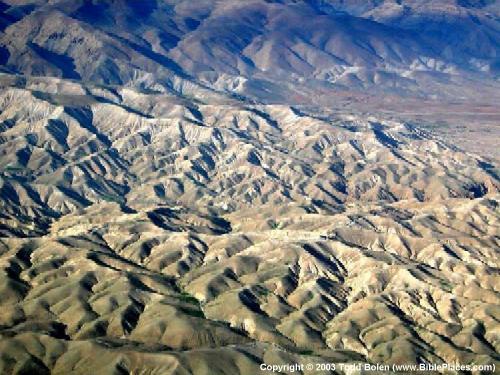
Steve and I visited Israel a number of years ago. One of our tour stops was in the Judean wilderness—a desolate and foreboding sight to behold. Not a single tuft of grass. No bushes or plants of any kind—not even cactus. Only two things are visible when standing in the midst of this desert: sky and pale gray-brown mountainous rock, as far as the eye can see.


judean_wilderness_west_of_jericho_ariel_tb_q010_03


Should you decide to live there, you’d have to bring with you everything necessary for survival: all your food, water, and clothing. For shelter, you might find a cave.

Ah! But what if there was Someone there ahead of you? Someone who already had at his disposal the supplies you required? And they would never run out? That’s the life-giving, unfailing provision of your Heavenly Father.

Let’s you and me rest in the assurance that the essentials—and even many delights!—will be generously supplied. If something is meant to be, he will take care of it—just as he’s been doing since each of us was born.

Think how he has led you through the wilderness of broken relationships and difficult circumstances. His grace has been sufficient for every challenge (2 Corinthians 12:9), right?

Now project that assurance into the future. Even if we walk through the valley of the shadow of death, we have no need to fear. Our all-powerful God is with us (Psalm 23:4)–guiding and providing.

(Please remind me of that when I come to a wilderness-patch, will you?)


*     *     *     *     *     *     *     *     *     *


Heavenly Father, I praise you that day by day, moment by moment, you are delighted to guide us in perfect wisdom. You generously provide for our needs and lovingly care for us body, soul, and spirit. Thank you for your compassion, your faithfulness, and grace to see us through the wilderness valleys. “I trust in you, O Lord; I say, ‘You are my God. My times are in your hands.’” (Psalm 31:14-15a).  


Please come back on Monday. We’ll meditate on the second half of Isaiah 58:11.


(Photo credits:  www.hischurchwomen.com; http://www.freerepublic.com; http://www.biblestudytools.com.)


Read Full Post »

fall-foliage-2

Several weeks ago, in a post entitled, “Autumn Blaze,” I wrote about the glorious colors of fall foliage. The title was borrowed from a line of poetry by Helen Hunt Jackson (1830-1885): “The land is lit with autumn blaze.”

As most of you know, Steve and I lived in Florida for forty years. We retired in June to Ohio, so we could be near two of our three children and their families. In many ways our transition has been a homecoming because both of us grew up in the Midwest.

One of the things we missed most while living in the south was “autumn blaze.”  All through last summer I waited expectantly for October and the display of God’s rich tapestry among the trees.

But those of you who live in four-season states know only too well: the blaze is quickly snuffed out by northerly winds and chilly temperatures. By mid-November, many trees have already been stripped of every leaf.

And now those bare, bleak branches stand pitifully exposed, reaching uselessly toward the sun for warmth. The splendorous color is gone; dingy gray-brown bark is all we see. The trees stand lifeless. Hopeless.

If I’m not careful, such sad thoughts will lead me into the doldrums.

A better train of thought to follow? Reasons to appreciate this dormant stage of the trees. For example: When the leaves are gone, I can appreciate the delicate lace work of branches, hidden from view except in winter.   They too demonstrate the creative genius of our God.

OLYMPUS DIGITAL CAMERA

However, when numerous bare trees huddle together on a hillside, the individual branches are indistinguishable. Our younger son and daughter-in-law enjoy a hillside view from their kitchen window–in spring, summer, and early fall, that is. Indeed, just a few weeks ago, the trees were ablaze, dressed in autumn finery.

Now the scene is much different. Look out that window today and you’d be underwhelmed by the great swath of drab dullness. Time to close the curtains.

shen6913

But wait. What if we look at that sad scene and think HOPE. Because we know what’s in store.

“No winter lasts forever; no spring skips its turn” (Hal Borland).

Winter is a time of rest, recuperation, and preparation. When warmth and light return in the spring, new life will burst forth in all creation. Guaranteed.

Those lifeless branches can remind us of another HOPE. Because we know that the God who brings life to dead trees can redeem any situation. Guaranteed.

“Oh? What basis is there for such grand HOPE?” someone might ask.

  1. We base our HOPE on God’s love.

 Absolutely nothing can separate us from his love (Romans 8:39). And if he loves us, he will care for us. “With God on our side, how can we lose?” (v. 32, MSG).

HOPE in our loving God is not misguided.

  1. We base our HOPE on God’s character.

I love Psalm 145, the only one called “a psalm of praise,” in which David extols God’s character. Our Lord is great (v.3), gracious, good, and compassionate (vs. 8-9), glorious and mighty (v. 11), righteous and kind (v. 17).

These are not descriptors of a distant god who takes no interest in his creatures. Our God is a hands-on Heavenly Father who demonstrates all these glorious attributes–in our day-to-day lives. The Lord is always watching over us (v. 20).

HOPE in our powerful God is not just wishful thinking.

  1. We base our HOPE in God’s promises.

“The Lord is faithful to all his promises and loving toward all he has made” (Psalm 145:13).

HOPE in our reliable God is not blind optimism.

Christian HOPE is the trusting expectation that God will keep his Word.

This may sound strange, but let’s look to the bare trees for encouragement. See them as glorious HOPE on display! And let’s live in cheerful expectation of God’s plan, purpose, and blessing for the future.

(Photo credits:  www.staticweb.maine.edu; http://www.commons.wikimedia.org; http://www.terragalleria.com.)


Read Full Post »

Woman with piggy bank at rainy window


“Save for a rainy day,” financial experts advise.  And they’re right.  It is smart to have funds set aside in case of emergency.

But we would also be wise to save up for another kind of rainy day:

  • The day great disappointment shatters our joy
  • The day the doctor begins a consult by saying, “I’m terribly sorry, but…”
  • The day a loved one calls with disturbing news

What could we possibly save up that would help in such circumstances?

Consider: monetary deposits in a bank account insulate us against financial emergencies.

Similarly, we can make faith-statement deposits into our soul-accounts, to insulate us against life’s emergencies.  A healthy soul-account offers peace of mind, confidence, and a sense of well-being.

The most valuable faith statements are those straight from scripture, since the Bible is our source of truth.

Statements such as these are worthy starting points:

  • God is with me, even in the midst of trial.

“Those who know Your name will trust in You, for You, Lord, have never forsaken those who seek You” (Psalm 9:10).

  • God is my stronghold in time of trouble, offering help and deliverance.

“The salvation of the righteous comes from the Lord; he is their stronghold in time of trouble.  The Lord helps them and delivers them” (Psalm 37:39-40).

  • He will supply all my needs.

“My God will meet all your needs according to his glorious riches in Christ Jesus” (Philippians 4:19).


Sometimes God makes deposits in our soul-accounts through other reading.  Here are a few examples I’ve collected:

  • “God makes good things out of the hard times.” – Erica Hale
  • “Difficulties are sent to make us grow. Move from complaining to proclaiming what God is doing through the problem. Remind yourself, for every Calvary, there is an Easter.” – Barbara Johnson
  • “When we understand that life is not about us, we learn to overlook the trivial and fix our gaze on the eternal. What is an offense compared to His love? What is a rejection compared to His unconditional acceptance? What is a momentary trial compared to an eternity with Him?” – Emmanuelle Gomez


Faith statement deposits also come through experiences, such as:

  • The spontaneous hug of a good friend who knows of our struggles. That’s God’s way of assuring us…

…We are not alone.

  • An answered prayer—and the answer is far beyond what we asked for. That’s God’s way of showing us…

…His love and blessing never fail, even in the midst of difficulty.

  • A transformed spirit through worship.  Worry becomes faith. Fear becomes courage. Depression becomes gladness. That proves…

…The joy of the Lord is our strength (Nehemiah 4:8).


Faith-statements, deposited in our souls even before we have need of them, provide a deep, sweet sense of security.

When difficulties arise, and the time comes to make withdrawals, we can praise God for each truth. Praise will fill our hearts with song and drown out the voices of worry and fear.

*     *     *     *     *     *     *     *     *     *

Your faithfulness, O God, is unwavering and unfailing.   Oh, how I want to be faithful to you, especially during difficult circumstances.  You have provided the tools.  I praise you for the deposits your Spirit makes into my soul account, offering solace, perspective, strength, and wisdom.   Help me to avail myself of your gracious provision.  


(Photo credit:  www.dailyfinance.com.)


Read Full Post »

jeremiah-3133_3733_1600x1200


While skimming through my grandmother’s Bible, I came across a notation she made next to Jeremiah 31:33.

First, the verse:

 “I will put my law in their minds

And write it on their hearts.

I will be their God,

And they will be my people.”


Perhaps a bit of context would be helpful.

Jeremiah was a prophet of Judah for over forty years. He was instructed by God to speak strong judgment against the people because of their sin. They were following worthless idols and had become worthless themselves (2:5). God promised disaster from the north, even terrible destruction (4:6).

Babylon, the empire from the north, did attack in 586 B.C. and Jerusalem was destroyed.

But Jeremiah offered great hope, recorded in chapters thirty and thirty-one. The verse in bold print above makes clear two glorious assurances.

Assurance #1

“It is God’s work.” (That’s what my grandmother wrote in the margin of her Bible next to Jeremiah 31:33.)

See the phrase “I will” used twice in the verse?  It is our Heavenly Father who initiates the work of transformation in our minds and hearts. We couldn’t make ourselves godly no matter how hard we tried. It is his Spirit who enlivens the instruction of God’s Word to our hearts.

A friend of mine accepted Jesus into her life as an adult. M. once told me that before becoming a Christian, she had tried to read the Bible, but it didn’t hold her attention and didn’t make much sense. But after coming to Jesus? Oh, my! What a difference! Suddenly M. became a ravenous reader of God’s Word. Every word spoke wisdom and encouragement to her heart.

You see, what God provided for my friend (and for all of us who seek him) is a miraculous, spiritual heart transplant.

“I will give you a new heart and put a new spirit in you,” God says.  “I will remove from you your heart of stone and give you a heart of flesh. And I will put my Spirit in you and move you to follow my decrees and be careful to keep my laws” (Ezekiel 36:26-27).

God is not saying he will force us into surgery.   We can accept or reject his offer of a new heart and spirit.

When you receive an appealing offer, how do you decide whether to accept or not? Do you consider the reliability of the person or company making the offer? Probably so.

And when you are given advice to follow, do you consider the source? No doubt.

So let’s consider the One making the offer of a new heart and a new spirit–God Almighty himself.   His love for us is limitless.  He is the all-knowing, all-wise God of the universe. We can trust that his instructions are for our good, that following them will bring peace, contentment, joy, and more.

(Tell me again why we rebel?!)

Assurance #2

He will be our God.

 “When this is fulfilled, you are the possessor of all things,” Spurgeon said.

Think of it: innumerable blessings are ours, beginning with a precious, personal relationship with the King of the universe.

His comforting presence, 24/7.

His guidance and provision for every day of our earthly lives.

And the glory of heaven assured.


*     *     *     *     *     *     *     *     *     *


We praise you, holy God, the One who has informed us through your Word, who transforms us by your Spirit, and conforms us, day by day, to be like Jesus. Praise you for the privilege to be yours, guided and cared for by an all-wise, all-powerful God!

(Photo credit:  www.wallpaper4god.com.)


Read Full Post »

mri-scanner


My brother had to get an MRI last week. The technician warned him the machine was very loud—similar to a large motorcycle.

“I like motorcycles!” John told her.

Nevertheless she gave him earplugs, to block the noise as much as possible, and a set of headphones, through which he could listen to the music of his choice.

Earplugs and headphones. That’s what I need to drown out the devil’s loud voice.   Sometimes he can be incredibly persistent with his irritating chatter in my spiritual ears, saying things like:

  • “You are past your prime. Why bother trying to accomplish anything?”
  • “Look how blessed your neighbor is. You must have upset God in some way or you’d be blessed like that, too.”
  • “Can you believe how insensitive Ms. __________ is? How can she be so hurtful and not even realize it?

Wouldn’t it be nice if God handed out earplugs and headphones for our spiritual ears?

Maybe God wants us to develop some worthy habits in the process of manufacturing our own auditory devices.

And how might we do that?

Earplugs could be fashioned out of gratitude. We can occupy our minds with continual rejoicing in the blessings of this moment. Then we won’t be able to hear the devil’s negative and critical comments.

Let’s see…I wonder if I could name a blessing for each of the five senses, for what I am experiencing right now?

  • Thank you, Lord, for books and the gift of sight that allows me to read and enjoy them, as well as learn from them.
  • Thank you for soft breezes that create a cheerful rustling of fall leaves.
  • Thank you, Father, for the cozy warmth of my fleece jacket.
  • Thank you for the nutty goodness of hazelnut coffee,
  • And thank you, Lord, for the homey aroma of vanilla, coming from a nearby candle.


candleflame


Oh! That was fun, and I didn’t have one negative thought during the exercise. No wonder Paul told us to rejoice always.

Alright–earplugs are in place. Now it’s time for the headphones—something worthwhile to pay attention to, that drowns out the noise of negativity and criticism.

And what could be more worthwhile than scripture, where God offers reassurance, encouragement, and strength? The psalms are a perfect place to begin:

  • “Blessed is the man who makes the Lord his trust” (Psalm 40:4).
  • “I will sing of your strength, in the morning I will sing of your love; for you are my fortress, my refuge in times of trouble” (Psalm 59:16).
  • “Your ways, O God, are holy. What god is so great as our God? You are the God who performs miracles; you display your power among the peoples” (Psalm 77:13-14).

And one of my favorites:


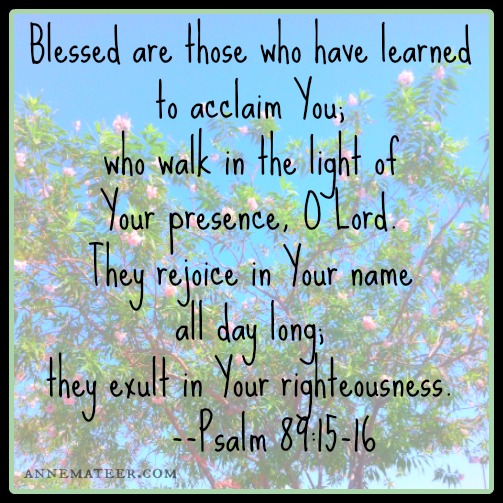
Ps.89.15.16


(“Blessed are those who have learned to acclaim you, who walk in the light of your presence, O Lord. They rejoice in your name all day long; they exult in your righteousness. For you are their glory and strength” (Psalm 89:15-17).)

Notice: We are blessed when we acclaim God. Disparaging ourselves or others, bemoaning our circumstances—even just in our thought life—is counter-productive.  It is worship that transforms our minds and spirits.

So let’s insert those earplugs and pop on those headphones! The difference will be remarkable.


(Photo and art credits:  www.cancerresearchuk.org; http://www.cozyhearthcandles.com; annemateer.com.)


Read Full Post »

« Newer Posts - Older Posts »

When the House is Quiet

Impressions Becoming Expressions

Mitch Teemley

The Power of Story

Still Traveling

Impressions Becoming Expressions

Living Our Days

Gaining a heart of wisdom

He Said What?!

I'm Patty, and my husband and I are living with our adult son who has autism and epilepsy. I love sharing lessons learned from life around me, especially life with Aaron.

Meditations of my Heart

Impressions Becoming Expressions

Linda Stoll

Impressions Becoming Expressions

Signora Sheila

Where Faith Meets La Dolce Vita

Heidi Viars

Finding the Image of God