Feeds:
Posts
Comments

Posts Tagged ‘Hope’

 picture-uh=715ce81d4af48c56d62e992073bfe9-ps=3da463e4536b201b56c385877e59a7

 (Photo from http://www.trulia.com.)

“There it is, Mom, “ Steve remarked, as he pointed to a little white house in the middle of a city block. “That’s where we lived when I was growing up.”

“Oh, yes,” she replied. But did Mom really remember?

We were on an excursion through Columbus, Ohio, taking Steve’s mother past the landmarks of her life. Alzheimer’s disease had already stolen away much of her vibrancy and warmth, and, of course, her memory.

 corner

Steve drove by West High School and continued his commentary. “That’s where we all went to school, you, Dad, Karen, and me. You were the very first homecoming queen.  How about that?  No wonder Dad asked you out.”

She murmured assent to Steve’s comments, but added nothing of her own.

 unnamed

We drove past the brick ranch they built out in the country in 1966. Horses used to reside beyond the back fence. Just a few houses had dotted the area back then. By this time, however, they had been swallowed up by dozens more. The saplings Mom and Dad had planted were now tall shade trees.  And the glorious flower beds and window boxes that Mom had tended were gone. She registered no recollection.

 unnamed

But when we approached her childhood home, a white Dutch Colonial on a quiet street, all of a sudden she perked up.  Pointing to a second-story window, Mom stated firmly, “That was my room, right up there.”

In the midst of the fog that is Alzheimer’s, one memory–one glimmer of light–shone through that morning. Steve and I almost gasped at the wonder of the moment. Mom remembered!

And the rarity of her memories pointed to the preciousness of this ability. Memory is a gift to be treasured. The older I grow, the more I appreciate the miraculous power of the brain to store millions of memories—with astounding detail–and yet access a particular one in a mille-second.

 1033249144001_2034162247001_900944612-159-1355440419795

Not only do sights trigger memories, but also smells. Researchers say this sense is the most powerful memory-inducer. For me, the aroma of fresh-baked bread always takes me back to my grandmother’s kitchen.

Sounds trigger memories as well—particularly music. Tastes and textures work the same phenomenon.

But surely God had more purpose in mind for giving us memory than the pleasant pastime of reminiscing.

Indeed.

Memories foster gratitude, as we contemplate God’s goodness to us in the past:

  • His countless blessings (even when we haven’t been a blessing to him).
  • Those times he led us through the shadow of death, so that we might experience more completely the glory of his light.
  • Moments when we almost gave up hope, and God surprised us with his creative, abundant provision.
  • Leaving behind what we once were and celebrating what we have become, solely because of his Son, Jesus.

Memories foster faith, as we remember how God has met our needs in the past. See if each phrase from Psalm 103 doesn’t trigger a memory in your mind, and a song of praise in your heart:

“Oh, my soul, bless God,

Don’t forget a single blessing!

He forgives your sins—every one.

He heals your diseases—every one.

He redeems you from hell—saves your life!

He crowns you with love and mercy—a paradise crown.

He wraps you in goodness—beauty eternal…

…God makes everything come out right.

He puts victims back on their feet…

…God is sheer mercy and grace;

Not easily angered, he’s rich in love.

He doesn’t treat us as our sins deserve,

Nor pay us back in full for our wrongs.

(Psalm 103:2-10, The Message)

Memories inform the present and provide hope for the future. As we meditate on all those times God has wrapped us in his goodness (v. 5), we are strengthened for what we face today. As we consider the many times he made everything come out right (v. 6), we can trust he will continue to make our paths straight.

Of course, there are some memories we would like to erase—those that generate sadness, hurt, or regret. How do we deal with those? Here are a few suggestions I’ve collected over the years:

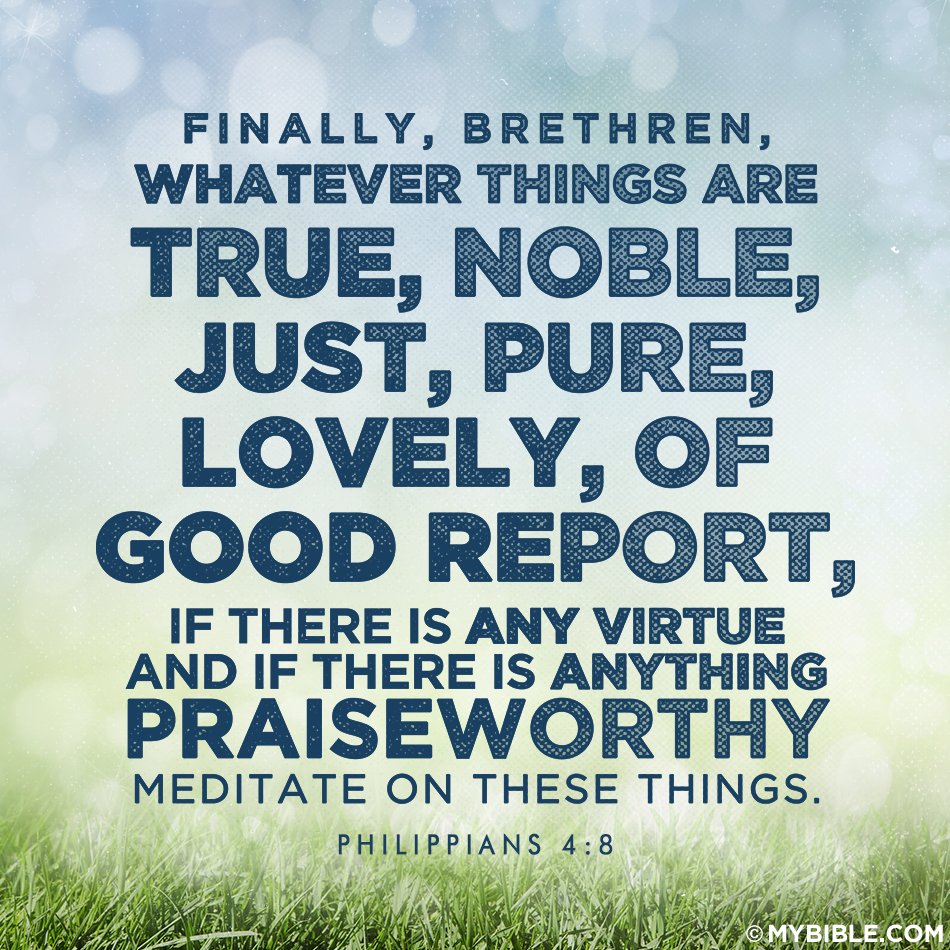
  1. We must resist self-pity—even in our thought life. Nowhere in scripture do we read that rehashing the negative is therapeutic. God’s way is to focus on the positive (Philippians 4:8).
Phil-4-8


  1. We can follow Paul’s example. He forgot what was in his past and pressed on to what lay ahead (Philippians 3:13). Not that amnesia had set in. Paul simply did not allow past failures to cripple his relationship with God and his service for God. God had forgiven and forgotten; Paul did too. No doubt he applied Philippians 4:8, not only to self-pity, but also to guilt. 
  1. We can leave the past in God’s hands. Oswald Chambers said it so well:

 c6d7d32bbdc18d2507a48f8aefa26359

(“Leave the irreparable Past in His hands, and step out into the Irresistible Future with Him”

–My Utmost for His Highest, Dec. 31.)


*     *     *     *     *     *     *     *    *     *    

Father, I do thank you for the gift of memories—the ability to remember with joy and appreciation the people, places, and experiences of the past. I even thank you for the not-so-good memories, knowing that you use every difficult situation for the development of my maturity (James 1:2-3). And may I take advantage of the wisdom gained in the past to guide me in the present, and lead me into the Irresistible Future with you.


Art & Photo credits:  www.trulia.com; http://www.westhighalumni.com; Steve’s photo collection; http://www.allrecipes.com; http://www.god.com; http://www.pinterest.com.


Read Full Post »

sepia-praying-woman

Abby has prayed for years that her estranged son would come home.

Stacie has faced the loss of one job and a stressful transition to another–with a broken leg.

Jack has worked hard to qualify for a prized promotion, but the boss’s unpleasant nephew was awarded the position instead.

Tricia can’t seem to shake a gray cloud of despondency, ever since her fiancé broke off their engagement.

Kate goes through the motions at church and even continues with her quiet time. But God seems to have distanced himself. She hasn’t sensed his presence for weeks.

These circumstances and more can cause a downward spiral in our spirits, as debilitating emotions take over–emotions like frustration, anger, hurt, worry, and depression. If we feed these emotions with negative thoughts, our faith in God begins to falter.

The devil’s lies begin to sound like truth:

  • So much time has passed; God is never going to answer your prayer.
  • Bad things keep happening; God has obviously abandoned you.
  • God doesn’t care about your life. Otherwise, why would he allow you to fail?
  • They say God offers love, hope, peace, and joy. Right. None of it is coming your way.
  • It looks like God has forsaken you and to make matters worse, you don’t even know why.

Is it possible to fight against such feelings and fortify our faith? Oh, yes!

Our fight begins with truth—straight from God’s Word. We have to choose fact over feelings—just like a pilot does, as he flies through miles of thick clouds. In order to stay on course, he can’t trust what he feels is proper speed, direction, and altitude; he has to rely on the facts presented by his instruments.

47056693.14

So what scriptural truths might help us maintain our spiritual equilibrium? There are dozens, perhaps hundreds of passages that address our various needs with pinpoint perfection.

Other scriptures provide broad-sweeping truth that covers almost any situation. One example:

“The Lord is faithful to all his promises and loving toward all he has made.  The Lord upholds all those who fall and lifts up all who are bowed down” (Psalm 145:13-14).

If we read the Bible with the intent of finding applicable truth for our circumstance, we will not be disappointed.

april13

(“Such things were written in the Scriptures long ago to teach us.  And the Scriptures give us hope and encouragement as we wait patiently for God’s promises to be fulfilled”–Romans 15:4, NLT.)

 Now the question is: Are we going to take God at his word and then act upon it?

Hebrews 11 gives us a line-up of faith-stars who did just that–based their actions on faith, not feelings.

By faith Noah built at ark (v. 7).   He did not allow feelings of inadequacy to stop him.

By faith Abraham left home with no notion of where he was going (v. 8). He did not allow fear of the unknown to deter him from following God’s direction.

By faith, the parents of Baby Moses hid him from Pharaoh. They did not allow fear of punishment to stop them. “They were not afraid of the king’s edict” (v. 23).

By faith the people of Israel marched around Jericho seven times, even though it didn’t make sense (v. 30).

Bottom line: Faith is the exercise of our minds, based on the stable truth of God’s Word, in spite of what we might feel. Emotions are just the unreliable, fluctuating condition of our minds (J. Clarke, http://www.writtentreasures.org).

On the other hand, God doesn’t ask us to ignore our feelings. Job, David, and the prophets honestly expressed frustration, fear, disappointment, and discouragement. But they didn’t allow their emotions to cripple them.

f7ea3e3945226580cc4cd80213db5133

Also worth noting:  None of these faithful people were perfect, yet God honored their faith.  He doesn’t need perfect people to accomplish his purpose, just willing and faithful ones.


*     *     *     *     *     *     *     *     *     *


Forgive me, Lord, for allowing feelings to impact my faith, to weaken my trust in you. Together with you, may I fit every thought and emotion and impulse into the structure of life shaped by Christ.  Thank you for listening and offering encouragement as I confess to you my feelings.  You even supply strength, peace, and hope.  And finally, I praise you that you preserve the faithful. I am secure in you.  In fact, you, my all-powerful God, are security itself.      

(2 Corinthians 10:5, MSG; Psalm 10:17; Psalm 29:11; Psalm 31:23.)

Art & Photo credits:  www.hem-of-his-garment-bible-study.org; www. pbase.com; http://www.scentoffaith.com; http://www.pinterest.com.

Read Full Post »

fall-foliage-2

Several weeks ago, in a post entitled, “Autumn Blaze,” I wrote about the glorious colors of fall foliage. The title was borrowed from a line of poetry by Helen Hunt Jackson (1830-1885): “The land is lit with autumn blaze.”

As most of you know, Steve and I lived in Florida for forty years. We retired in June to Ohio, so we could be near two of our three children and their families. In many ways our transition has been a homecoming because both of us grew up in the Midwest.

One of the things we missed most while living in the south was “autumn blaze.”  All through last summer I waited expectantly for October and the display of God’s rich tapestry among the trees.

But those of you who live in four-season states know only too well: the blaze is quickly snuffed out by northerly winds and chilly temperatures. By mid-November, many trees have already been stripped of every leaf.

And now those bare, bleak branches stand pitifully exposed, reaching uselessly toward the sun for warmth. The splendorous color is gone; dingy gray-brown bark is all we see. The trees stand lifeless. Hopeless.

If I’m not careful, such sad thoughts will lead me into the doldrums.

A better train of thought to follow? Reasons to appreciate this dormant stage of the trees. For example: When the leaves are gone, I can appreciate the delicate lace work of branches, hidden from view except in winter.   They too demonstrate the creative genius of our God.

OLYMPUS DIGITAL CAMERA

However, when numerous bare trees huddle together on a hillside, the individual branches are indistinguishable. Our younger son and daughter-in-law enjoy a hillside view from their kitchen window–in spring, summer, and early fall, that is. Indeed, just a few weeks ago, the trees were ablaze, dressed in autumn finery.

Now the scene is much different. Look out that window today and you’d be underwhelmed by the great swath of drab dullness. Time to close the curtains.

shen6913

But wait. What if we look at that sad scene and think HOPE. Because we know what’s in store.

“No winter lasts forever; no spring skips its turn” (Hal Borland).

Winter is a time of rest, recuperation, and preparation. When warmth and light return in the spring, new life will burst forth in all creation. Guaranteed.

Those lifeless branches can remind us of another HOPE. Because we know that the God who brings life to dead trees can redeem any situation. Guaranteed.

“Oh? What basis is there for such grand HOPE?” someone might ask.

  1. We base our HOPE on God’s love.

 Absolutely nothing can separate us from his love (Romans 8:39). And if he loves us, he will care for us. “With God on our side, how can we lose?” (v. 32, MSG).

HOPE in our loving God is not misguided.

  1. We base our HOPE on God’s character.

I love Psalm 145, the only one called “a psalm of praise,” in which David extols God’s character. Our Lord is great (v.3), gracious, good, and compassionate (vs. 8-9), glorious and mighty (v. 11), righteous and kind (v. 17).

These are not descriptors of a distant god who takes no interest in his creatures. Our God is a hands-on Heavenly Father who demonstrates all these glorious attributes–in our day-to-day lives. The Lord is always watching over us (v. 20).

HOPE in our powerful God is not just wishful thinking.

  1. We base our HOPE in God’s promises.

“The Lord is faithful to all his promises and loving toward all he has made” (Psalm 145:13).

HOPE in our reliable God is not blind optimism.

Christian HOPE is the trusting expectation that God will keep his Word.

This may sound strange, but let’s look to the bare trees for encouragement. See them as glorious HOPE on display! And let’s live in cheerful expectation of God’s plan, purpose, and blessing for the future.

(Photo credits:  www.staticweb.maine.edu; http://www.commons.wikimedia.org; http://www.terragalleria.com.)


Read Full Post »

Woman with piggy bank at rainy window


“Save for a rainy day,” financial experts advise.  And they’re right.  It is smart to have funds set aside in case of emergency.

But we would also be wise to save up for another kind of rainy day:

  • The day great disappointment shatters our joy
  • The day the doctor begins a consult by saying, “I’m terribly sorry, but…”
  • The day a loved one calls with disturbing news

What could we possibly save up that would help in such circumstances?

Consider: monetary deposits in a bank account insulate us against financial emergencies.

Similarly, we can make faith-statement deposits into our soul-accounts, to insulate us against life’s emergencies.  A healthy soul-account offers peace of mind, confidence, and a sense of well-being.

The most valuable faith statements are those straight from scripture, since the Bible is our source of truth.

Statements such as these are worthy starting points:

  • God is with me, even in the midst of trial.

“Those who know Your name will trust in You, for You, Lord, have never forsaken those who seek You” (Psalm 9:10).

  • God is my stronghold in time of trouble, offering help and deliverance.

“The salvation of the righteous comes from the Lord; he is their stronghold in time of trouble.  The Lord helps them and delivers them” (Psalm 37:39-40).

  • He will supply all my needs.

“My God will meet all your needs according to his glorious riches in Christ Jesus” (Philippians 4:19).


Sometimes God makes deposits in our soul-accounts through other reading.  Here are a few examples I’ve collected:

  • “God makes good things out of the hard times.” – Erica Hale
  • “Difficulties are sent to make us grow. Move from complaining to proclaiming what God is doing through the problem. Remind yourself, for every Calvary, there is an Easter.” – Barbara Johnson
  • “When we understand that life is not about us, we learn to overlook the trivial and fix our gaze on the eternal. What is an offense compared to His love? What is a rejection compared to His unconditional acceptance? What is a momentary trial compared to an eternity with Him?” – Emmanuelle Gomez


Faith statement deposits also come through experiences, such as:

  • The spontaneous hug of a good friend who knows of our struggles. That’s God’s way of assuring us…

…We are not alone.

  • An answered prayer—and the answer is far beyond what we asked for. That’s God’s way of showing us…

…His love and blessing never fail, even in the midst of difficulty.

  • A transformed spirit through worship.  Worry becomes faith. Fear becomes courage. Depression becomes gladness. That proves…

…The joy of the Lord is our strength (Nehemiah 4:8).


Faith-statements, deposited in our souls even before we have need of them, provide a deep, sweet sense of security.

When difficulties arise, and the time comes to make withdrawals, we can praise God for each truth. Praise will fill our hearts with song and drown out the voices of worry and fear.

*     *     *     *     *     *     *     *     *     *

Your faithfulness, O God, is unwavering and unfailing.   Oh, how I want to be faithful to you, especially during difficult circumstances.  You have provided the tools.  I praise you for the deposits your Spirit makes into my soul account, offering solace, perspective, strength, and wisdom.   Help me to avail myself of your gracious provision.  


(Photo credit:  www.dailyfinance.com.)


Read Full Post »

2008_003703


We sat on the runway, awaiting take-off clearance for our flight. Low, thick clouds hung above us, shrouding the area in gloom. Folks in the plane sat quietly in their seats. Really quiet. Not very many smiles either. The oppressive bleakness outside seemed to cause a depressive state inside.

Finally we felt the plane move, pick up speed, and lift off the ground. In seconds the view out our windows was obliterated by the gray-white clouds. We could see absolutely nothing, as if curtains had been drawn outside the windows. Was the plane even moving? There was no way to tell, except for the loud drone of the engines and the upward angle of the plane.

Suddenly we escaped the cloud bank and were almost blinded by the brilliant sun. Some people turned off the overhead lights, others closed their window blinds against the glare.

As a result of the bright light, the atmosphere changed inside the plane. The dark mood of moments before turned to cheer. Some passengers shifted in their seats, sitting up a bit straighter. Soft chatter, even a few chuckles, peppered the air.

What a difference sunlight makes.

The physiological connection between sunlight and mood has been studied by scientists. They’ve determined that sunlight increases the production of serotonin in the brain, which is tied to wakefulness and feeling happy.

Those of us who know God can experience another source of light – his light — even when the dark clouds of trouble roll in (Psalm 18:28).  The benefits are incredible.

1.  “In [his] light we see light” (Psalm 36:9b). As we practice God’s presence and live according to the directions of his Word, we see the wisdom of his ways. We also become more aware of God’s glorious attributes shining into our lives—his power, loving kindness, grace, and more.

2.  “Blessed are those who have learned to acclaim you, who walk in the light of your presence, O Lord. They rejoice in your name all day long; they exult in your righteousness. For you are their glory and strength” (Psalm 89:15-17a).

Take note. God is righteous. Everything he does is good and right, absolutely perfect.

Did you catch that amazing statement at the end?  Our God of Light is our glory. He is magnificent, full of splendor, and grandeur, yet he is our Heavenly Father!  Could any state of circumstances be more incredible?

God is the source of all strength. Think of it. The all-powerful, all-knowing, sovereign God of the universe is on our side—all the time. He is completely, forever committed to us, until that day we see him in all his glory, our King of kings!

3.  “The Lord is my light and my salvation—whom shall I fear” (Psalm 27:1)?

Consider what dark clouds might symbolize in our circumstances: stress, problems, fear, and sorrow.

Now consider what the Lord of Light brings to us: guidance, wisdom, joy, provision, comfort, grace, and peace.

He is light within us and around us.

Sometimes when a thick cloud bank of difficulty settles over our lives, we think God has abandoned us. But take note of these wise words:


“Measure not God’s love and favor by your own feeling.

The sun shines as clearly on the darkest day as it does in the brightest.

The difference is not in the sun,

but in some clouds which hinder the manifestation of the light thereof”

– Richard Sibbes (Anglican theologian, 1577-1635).


Praise God for his glorious constancy!


(Photo credit:  www.vision.cs.uiuc.edu.)

Read Full Post »

images


I am a person of roots and routine. Are you?

Do you grieve when it’s time to leave one community for another, because emotional attachments have grown deep?

Do you take comfort in familiar routine, because you can move forward with confidence?

Then you’ll understand this statement: I am a person who struggles with change.

So this post is for me, to review what I know about accepting–even celebrating–change. You’re welcome to read over my shoulder.

First and foremost: I need to be selective of vocabulary, even in my thoughts. Thoughts impact attitudes; attitudes impact soul and spirit. For example:

  • Instead of change, I need to speak of the circumstances as an adventure.
  • Instead of problem, I should say possibility.
  • Instead of challenge, I can call the situation an opportunity.

Such a small commitment, really. But retooling my word-choices could have a profound impact on my spirit.

First, the change I don’t want to embrace takes on a glowing, new aura when I rename it adventure—the adventure of participating with God to bring about his good purpose (Romans 8:28). Such thinking would surely foster excitement!

Second, the problem I see is nothing compared to the possibilities God is capable of. “God can do anything, you know—far more than you could ever imagine or guess or request in your wildest dreams” (Ephesians 3:20, The Message)! As I consider the possibilities, hope and anticipation will flourish.

Third, the challenge I find so uncomfortable will undoubtedly provide opportunity to see God’s power and provision at work. Perhaps I’ll witness a whole string of God-engineered events. Or, the power and provision may occur in me, as he molds my personality and spirit into a more Christ-like version. (That is even more miraculous!) And who would turn aside from seeing—even participating in—a miracle?

It begins with my words.

*     *     *     *     *     *     *     *     *     *

This might sound strange to some, but thank you, Father, for the uncomfortable changes, challenges, and disappointments you’ve brought into my life. Not one of them was without purpose. Forgive me for the times I have fretted about how circumstances would turn out. How easy it is for me to forget that you hold all things in your hands.

May I anticipate the adventure, the possibilities, and the opportunities of each day, NO MATTER WHAT, because you are by my side–my all-powerful, all-wise, all-loving God. Thank you for the promise that you WILL fill me completely with joy and peace as I trust in you.  Then I can overflow with hope (Romans 15:13).

(Photo credit:  www.desiremercy.wordpress.com.)

Read Full Post »


“I can’t remember the last time I felt truly happy.”

“Nobody understands what this situation is like.”

“I don’t know what I’m going to do.”

Chances are, at some point in your life, you’ve experienced one or more of the emotions behind those statements,  including:  discouragement, self-pity, hopelessness, and fear.

When circumstances seem out of control and problems defy solution, what can we do?

A good place to start:  praise God.

I know.  That seems an odd course of action and counter-intuitive.  But that’s what God instructs us to do (1 Thessalonians 5:18).

Now why would that be?

Reason #1:  Praise is a powerful weapon against those emotions listed above. It fosters peace and contentment by taking our minds off our problems and focusing our attention on God.

David shows us the way in Psalm 103.  In verse two he says,  “Forget not all [God’s] benefits.”  Then he lists  a number of them:  forgiveness of all sins, healing of all diseases*,  redemption from the pit, God’s love, compassion, righteousness, and justice (vs. 3-6).

What would your personal list include?  What specific ways has he provided for you, guided and protected you, fulfilled promises to you, and empowered you?

“Praise is the honey of life

which a devout heart extracts

from every bloom of providence and grace.”

–Charles H. Spurgeon

Reasons #2:  Praise invites his presence, and with his presence comes his strength and help.

“Praise be to the Lord, for he has heard my cry for mercy.  the Lord is my strength and my shield; my heart trusts in him, and I am helped.” (Psalm 28:6-7).

I have to be honest here.  There have been times when my praise to God had to be squeezed through gritted teeth.  And the first words of affirmation did not immediately lift me into golden clouds of euphoria.

What I can tell you is this:  Depression, discouragement, self-pity, and hopelessness were kept at bay.  And I felt the presence of God around me, giving me strength to press on.

How has praise brought God’s strength and help into your life?

Reason #3:  Praise lifts our spirits and gives us hope.  When words won’t come, we can turn to the psalms.  Chapter 145 offers one example of eloquent praise:

“God is magnificent; he can never be praised enough.  There are no boundaries to his greatness. ..

“God is all mercy and grace–not quick to anger, is rich in love.  God is good to one and all; everything he does is suffused with grace…

“Generous to a fault, you lavish your favor on all creatures.  Everything God does is right–the trademark on all his works is love…

“My mouth is filled with God’s praise” (vs. 3, 8-9, 16-17, 21,  The Message)!

Can you feel the hope, comfort, and strength stirring in the depths of your soul?

Keep praising!

*     *     *     *     *     *     *     *     *     *

Oh, yes, Lord, may my mouth be filled with your praise, whether I’m celebrating on a mountaintop or plodding through a valley.  Thank you for the delight of the former and your comfort and care through the latter.  I praise you that all things are under your control.  With a grateful heart,  I put my hope and trust in you. 

* All of our diseases are healed:  1) instantly and miraculously, often as the result of prayer, 2) slowly over time, often with extended prayer and medical intervention, or 3) eternally, when we reach heaven.

(photo credits:  www.pxhere.com; http://www.stockvault.com.)

Read Full Post »

The holiday season between Thanksgiving and New Year’s Day fills our senses with:

  • Sights of Christmas trees, candles, Santas, and angels.
  • Sounds of carols, from the light-hearted “Frosty the Snowman” to the heart-stirring “O Holy Night.”
  • Textures from prickly pine to plush velvet.
  • Aromas of cinnamon, spice, and gingerbread.
  • Tastes of iced sugar cookies and egg nog.

But the seasonal pleasures are over for another year.  And the uncertainties of our times—political, economical, as well as personal—that we set aside for a few weeks, are coming to the forefront again.  If we’re not careful, troublesome thoughts can raise our blood pressure and take away restful sleep!

What to do?  Take comfort in God’s Word.  “Great peace have they who love your law,” said the psalmist,” and nothing can make them stumble” (Psalm 119:165).  I suppose that would include uncertainties, don’t you?

Two verses have ministered to me lately, Romans 8:30-31:

“Those he [God] predestined, he also called; those he called, he also justified, those he justified, he also glorified.  What then, shall we say in response to this?  If God is for us, who can be against us?”

Of course, those key words in the first sentence beg to be examined more closely.

Predestination has been the subject of entire books and sometimes causes controversy.  I like the way the Living Application Bible explains the concept, in a footnote to Ephesians 1:5.  “Predestined” means marked out beforehand.

God knew each of us and loved us before we were even born.  He provided the way of salvation so we could be in relationship with him.  That does not negate our responsibility to believe in Jesus, in order to bring to pass God’s predetermined plan.

Called means we have been divinely summoned or invited.   Some Christians are divinely summoned for specific tasks.  Peter (John 21:15-17) and Paul (Acts 9:15) are perfect examples.

Most of us are called to love, obey, and serve God right where he’s placed us—in our homes, churches, business, schools, and neighborhoods.

Whatever our task, he cheers us on to work heartily because we’re doing it for him—to please him and bring him honor (Colossians 3:23-24).

And with his call comes hope, peace, joy, and blessing!

Justification is God’s way of making us right with him.  Out of his gracious love for us, he declares us “not guilty” for our sins. We deserve harsh punishment, but he treats us as righteous if we put our trust in Jesus.  Then the perfect sinlessness of God’s Son is credited to us  (Romans 3:22-25).

Imagine standing before a mighty king who’s dressed in elegant robes.  And there you are, wearing ragged, smelly clothes, staring at the floor, and wishing to be anywhere else but in this imposing throne room.

Suddenly the king’s words break through your embarrassment.  He’s calling for one of his son’s perfect robes to be brought for you.  He doesn’t just want to trade your rags for a  beautiful, pristine robe—he’s eager to do it!  And then, even more amazing, he welcomes you to his banquet table.

That’s justification—being treated as if we weren’t soiled by sin.  Being treated like  a royal son or daughter of the king, though it’s the last thing we deserve.

Full glorification  will occur when we arrive in heaven.  It refers to that moment when you and I will become like Christ (1 John 3:2.)  It is so certain, Paul uses past tense.  Our glorification is taken care of; it’s just a matter of when.

But the process has already begun.  Our glory—that is, anything that brings honor and praise to God—is developing day by day as we allow the Holy Spirit to have influence of our thoughts and choices.

*     *     *     *     *     *     *     *     *     *

Now consider the magnitude of these four processes which God lovingly, even anxiously, works within us.  I like the way Ken Taylor expresses verse twenty-nine in The Living Bible:

 “Having chosen us, he called us to come to him; and when we came he declared us ‘not guilty,’ filled us with Christ’s goodness, gave us right standing with himself, and promised us his glory.”

 And last, in light of whatever you may be facing in 2014, please take comfort in these joyous words:

“What can we ever say to such wonderful things as these?  If God is on our side, who can ever be against us?” (Romans 8:30, The Living Bible).


Read Full Post »

Last fall I read there were more than 150 million blogs on the internet, with approximately 175,000 new ones being launched daily.  At that rate, cyberspace now includes over 213 million blogs!

After much shopping, I have found twelve devotional blogs which I follow regularly.  I’ll introduce six today and six on Thursday–in no particular order.  After reading these sample bits, you might want to visit these blogs yourself, and discover fresh insight from…

IMG_1727…Jennifer Dukes Lee (www.jenniferdukeslee.com), wife of an Iowa farmer, mother of two daughters, professor of journalism, and author of a new book being released in early 2014.  Recently she wrote about “How to Talk Back to Fear:”

“I believe that bravery looks a lot like…believing.  And I believe that there’s really no such thing as failure, because there’s nothing unredeem-able in the hands of Christ.”

Smart woman, that Jennifer.

…Holley Gerth (www.holleygerth.com), life coach and author, tackled the topic, “When You’re Worried What People Think.”

First, Holley quoted 1 Corinthians 4:3 (MSG):  “It matters very little to me what you think of me, even less where I rank in popular opinion…Comparisons in these matters are pointless.”

Holley says.  “When I care very little what other people think of me then I’ve suddenly got room to care a lot about other people.”

Quite insightful, don’t you agree?

Unshakable Hope…Unshakable Hope (www.unshakablehope.wordpress.com), written by Bill, married more than twenty-five years, father of two daughters, diagnosed in 1996 with ALS, or Lou Gehrig’s Disease.  Bill has very little mobility, yet his spirit is more vibrant than ever.

On February 21, 2013, Bill wrote about Shadrach, Meshach, and Abednego (Daniel 3).  They were about to be thrown into King Nebucadnezzar’s furnace and boldly proclaimed, “The God we serve is able to save us…, and he will rescue us from your hand, O king.  But even if he does not…we will not serve your gods or worship the image of gold you have set up (vs. 17-18).

Bill says, “For me, this is more than a great example of strong faith.  I believe this is a pattern of faith that all Christians should emulate regardless of challenges we might be facing.  We can proclaim that, ‘Our God whom we serve is able to deliver us from [insert your trial here].  BUT EVEN IF HE DOES NOT…we are not going to serve…doubt, fear, worry, hopelessness or anything else that destroys faith, hope, joy and peace.’

Strong words from a man of deep strength.

…Morning Story & Dilbert (http://www.morningstoryanddilbert.wordpress.com).  Kenny gleans thought-provoking posts from many sources and serves them up with a Dilbert cartoon — something for the mind and heart; something for the funny bone!

Recently Kenny included an anecdote about Abraham Lincoln, highlighting the president’s humility.  Although Lincoln was wise, responsible, and persevering, surely humility was one of the supreme qualities that contributed to his strong leadership.

Here’s the story Kenny shared:

“After the Battle of Gettysburg, General Robert E. Lee and his Confederate forces were withdrawing to Virginia, and Lincoln felt that they were vulnerable. Eager to get the agony of the war over with, President Lincoln sent word to General Meade to attack.

“With his message, Lincoln also sent a personal note. ‘The order I enclose is not on record,’ said the note. ‘If you succeed, you need not publish it. Then, if you succeed, you will have all the credit of the movement. If not, I’ll take the responsibility.’”

Taking responsibility for failure, but giving others the credit for success.  Now that’s humility.

…Jean Wise of “Healthy Spirituality” (www.healthyspirituality.org), is a former nurse, but now focuses her time on writing My Photoand speaking.

On September 24, 2013, she shared the story of second-string quarterback, Kenny Guiton, of the Ohio State Buckeyes.  Opportunities to get in the game have been few for this senior, but Kenny is always prepared.  Then, on a recent Saturday, he not only had a chance to play, Kenny scored a record six touchdowns!

In contemplating Kenny’s story, Jean said, “My job is to be faithful. To enter each day relying on God’s love and guidance.  To show up every morning with an open mind and heart.  To say to our heavenly coach, ‘Here I am, Lord.  What position do you need me to play today?’  To be ready when He calls me off the bench.  To wait and let God form me as He wills till His time is right.’”

Jean’s prayer resonates with my heart, too.

Diana Trautwein…Diana Trautwein‘s musings at “Just Wondering” (www.dianatrautwein,com).  She’s the mother of three, grandmother of 8, and a graduate of seminary in mid-life.  Currently Diana serves as a spiritual director.  Her post on October 11, 2013 was titled, “Giving Permission to Say No.”  Her words of wisdom include:

“Saying ‘yes’ is central to a full, rich challenging life.  We need to say yes to lots of different things over the course of our [life] journey.”

But!  “Try as we might, we cannot do everything.  (Because God already has.)  We cannot save the world.  (There is only one Savior.)  And we must not work ourselves to death.  (We are meant to enjoy God, and glorify God, not assume responsibilities we were never designed to bear.)”

See what I mean?  Wise woman.

Please return on Thursday to meet six more outstanding bloggers!

Read Full Post »

“It is good to wait quietly,” Jeremiah said (Lamentations 3:26a).

At the risk of sounding impudent, “What’s good about it?”

Waiting can make us feel anxious and stressed.  If we’re waiting for a prayer to be answered or a scriptural promise to be fulfilled, we can become doubtful, discouraged, and despondent.  Not good.

Yet the act of waiting seems important to God.  Numerous times in the Bible we see people of faith who had to endure Wait Time:

  • Abraham and Sarah waited 25 years for the birth of Isaac.
  • Jacob waited 14 years to take Rachel as his bride.
  • Joseph waited 13 years, first as a slave, then as a prisoner, before being rescued and elevated by God to second-in-command over Egypt.
  • The Israelites waited through 400 years of slavery in Egypt before God’s miraculous intervention.

  • Caleb waited 45 years to inherit his portion of the Promised Land.
  • David waited at least 15 years to become king of Israel, after his anointing by Samuel.
  • Simeon, Anna, and many other Jews waited for their Messiah.

God’s delays must serve a purpose.  And a diligent search through scripture gives us answers to:  What good can come from waiting?

  • Times of waiting strengthen our trust in God and our resolve (Psalm 27:14).  If every day was problem-free and blissful, surely our faith would remain shallow.
  • We grow in our relationship with God while resting in his sovereignty and reliability (Psalm 62:5-8).  The Almighty of the universe becomes our closest confidant.  Intimacy with him deepens as we turn to him for comfort, encouragement, strength, and more.

  • Spiritual maturity develops (James 1:2-4).  Waiting is a challenge all by itself, but can also be accompanied by worry, pain, and sacrifice.  The test of waiting, however, develops our patience and perseverance and gives us opportunity to grow in character.  None of these benefits would blossom within us if God provided for every whim, and rescued from every trial.
  • We learn to take joy in the blessings we already have.  Paul wrote, “Be joyful always” (1 Thessalonians 5:16) to a church experiencing persecution.  They were undoubtedly praying and waiting for relief.  But Paul knew that focusing on what Christ had already done for the believers, and the benefits they already enjoyed, would help offset their anxiety and frustration.  The same is true for us.
  • Others see our patience and trust while we wait (Psalm 40:1-4).  Then, when God answers our cries, others take note of his provision, and their faith is encouraged.

It seems we’re always waiting for something; it’s only the intensity of emotion attached to the waiting that tends to vary.  When that intensity begins to grow, perhaps it would help to say, “I’m waiting with great anticipation!

There can be sweet delight in anticipation.  For example, as the Christmas holidays approach, I anticipate the glorious homecoming of family members.  I relish the imaginings of long conversations at the candle-lit dinner table, the hugs and laughter, and the gathering around the Christmas tree for family worship and gift-giving.

I need to apply that joy of anticipation to waiting on God.  I can relish the fact that his plan – including the Wait Time — always includes positive aspects.  I can reaffirm that God is always on time – never late, never early.  I can generate excitement in my spirit by musing on God’s promises and looking forward to the creative, miraculous ways he will fulfill those promises.  With an attitude of anticipation, waiting shouldn’t be nearly so uncomfortable.

(You have my permission to remind me of that, should impatience or frustration start to manifest themselves!)

*     *     *     *     *     *     *     *     *     *

Heavenly Father, I don’t think I’ve ever thanked you for the Wait Times in my life.  Thank you for holding me back, so trust, intimacy, gratitude, patience, and spiritual maturity have a chance to grow.  Help me to embrace the Wait Times as opportunities to discover more of who you are, more of the priceless treasures hidden in your Word, and more of who I can be when I am rooted and built up in you (Colossians 2:7)—especially through times of waiting.

(Art & photo credits:  www.bible-stories-library.com , http://www.moseseditor.blogspot.com . http://www.photosbyravi.com , http://www.pinterest.com.

Read Full Post »

« Newer Posts - Older Posts »

Still Traveling

Impressions Becoming Expressions

Living Our Days

Gaining a heart of wisdom

He Said What?!

I'm Patty, and my husband and I are living with our adult son who has autism and epilepsy. I love sharing lessons learned from life around me, especially life with Aaron.

Meditations of my Heart

Impressions Becoming Expressions

Linda Stoll

Impressions Becoming Expressions

Debby Thompson

Impressions Becoming Expressions

Signora Sheila

Notes on Life, Faith & Italy

Colleen Scheid

Writing, Acting, Living in God's Love

Mitch Teemley

The Power of Story

Heidi Viars

Finding the Image of God