Feeds:
Posts
Comments

Archive for the ‘Encouragement’ Category


“Are you all set for your move to Chicago?” I heard Jessica* ask. She’s one of the hair stylists at the salon I go to. Her station is just on the other side of a partition from where my stylist Anna* works.

As I settled into Anna’s chair last Wednesday morning, I readily heard the conversation between Jessica and her client.

“Yes, we found the perfect house,” the woman was saying. “There are just two bedrooms, but…”

I knew that voice.

In late December my hair appointment had overlapped with the same client. That day she had expressed concern because none of the properties shown on realtor websites were fitting her and her husband’s criteria. She feared there would be no suitable homes to tour during their house hunt set for mid-February.

“I don’t know what we’re going to do,” she confided. “I hate to think of moving into a rental and then moving again later.”

It seemed fitting to share our house-search experience.

“Excuse me,” I interrupted while peeking around the partition. “I couldn’t help overhearing your conversation and just wanted to tell you the same thing happened to us before we moved here three and a half years ago.  We discovered that if the perfect house becomes available too soon, it’s likely to be sold by the time you’re able to visit the area and view homes.

“Our perfect house came on the market just two weeks before we flew up here from Florida to house-hunt. The same will happen for you, I’m sure of it!”

She thanked me warmly, appreciative of the voice-of experience offering reassurance.

And now, at the end of March, I was quite certain that same woman (whom I had not seen since December) was in Jessica’s chair again, sharing the next chapter of her story.

I peeked around the partition just as I had before.  Instantly we recognized each other.

“You found the perfect house! Awesome!” I cried.

“Just like you said, “ she replied. “It came on the market a couple of weeks before our trip to Chicago.”

It wasn’t long before the two of us sported our coloring-chemicals and sat together so I could hear about her house. We chatted away like old friends.

A couple of times Diane* mentioned her husband’s illness but gave no specifics; I didn’t press for details. Later in the conversation it seemed appropriate to share Steve’s recent diagnosis of liver cancer. (You can read a short explanation at the end of last week’s post, “Haven of Peace.”)

“I don’t always talk about the details of my Ken’s* illness,” Diane confided, “but you need to know.” She paused. “Ken was diagnosed with brain cancer two years ago. The doctors only gave him twelve to fifteen months to live after the surgery, but it’s been two years and he’s still here!”

And together we praised God for his goodness.

I left the salon last Wednesday with my heart greatly uplifted. Ordinarily I would have sat at Anna’s station and read magazines or the book I always bring along.

But God is El Roi, the God Who Sees (Genesis 16:13). He saw my need for companionship that day.

He is Jehovah Jireh, the Lord Will Provide (Genesis 22:14). He provided Diane to be his voice of encouragement, hope, and joy.

He is El Shaddai, God Almighty (Psalm 91:1). He rules over all—every situation, every difficulty, every illness—even cancer.  Sometimes he ordains miracles.   Diane’s husband and countless others are living proof.


He is Yahweh Nissi, The Lord Our Banner (Exodus 17:15-16).  He goes into the battle before us, leading the way toward victory in all circumstances—a victory of faith in the face of trouble (1 John 5:4).

He is Yahweh Rapha, The Lord Who Heals (Psalm 103:2-3). And if the healing is not realized on earth, it is guaranteed in heaven (Revelation 21:4).


*     *    *     *     *     *     *     *     *     *


We praise you, O God,

for your knowledge that comforts,

your provision that reassures,

your power that enables,

your leadership that guides,

your healing that perfects.

You alone are the wellspring

of all that we need.

May we trust in you

with unwavering confidence

and rest in your transcendent peace.  


*Names changed.


(Photo credits:  http://www.minot.af.mil (Cassandra Jones, photographer); http://www.dailyverses.net.


Read Full Post »

Saturday afternoon provided the perfect circumstances for a cozy sit by the fire.   The calendar was clear for the day and we could burrow into the quiet. Snow showers added to the tranquility as they gently outlined backyard trees in white.


The serenity of our sitting area is enhanced by the beloved hand-me-down decor: the clock, oil lamp and child-size rocker from my grandmother, lanterns that belonged to Steve’s Dad and grandfather, books of our parents’ youth, and a painting that once hung in the home of Steve’s parents.


Altogether, the golden firelight, familiar furnishings, and cozy comfort engender peace and contentment.

But as delightful as these moments are, this kind of tranquility is fleeting. At any moment the phone might ring and the caller share distressing news. Then we’ll hardly notice our snug surroundings as concerns and questions begin to demand our attention.

When that phone call comes, circumstantial peace will not be enough. But that’s the only kind this world can offer. What we really need at such times is a stillness of spirit that originates outside this world from the Master of Peace.

My peace I give you,” Jesus told his disciples. “I do not give you as the world gives.”


Remember when he spoke those words? The night before he died.  He well knew what was to come (1). The next day would be a maelstrom of suffering, climaxed by tortuous pain on a cross.

How could he speak of peace on the eve of such horror?

Because his heart was always directed Godward, resulting in radiant peace. Jesus faced rejection, false accusations, hateful treatment (from religious leaders no less), and even attempted stoning. And yet he remained unruffled.

“Christ’s life outwardly was one of the most troubled lives that was ever lived…But the inner life was a sea of glass. The great calm was always there” (2).


And this is the peace he offers us—a peace that includes tranquility, security, and prosperity of spirit in spite of circumstances. It is “a rare treasure, dazzling in delicate beauty yet strong enough to withstand all onslaughts” (3).

How do we avail ourselves of this treasure?

By reviewing the attributes and promises of our Prince of Peace–all day long.

“Great thoughts of Christ will pilot you into the haven of peace,” said Charles Spurgeon.


Perhaps we could word our great thoughts of Christ as a prayer:

You, Lord Jesus, are our Good Shepherd, always leading in the way we should go. You tenderly watch over us, meeting every need and protecting us from evil—including wild, fearful thoughts and emotions (4).  

You are full of love for us. Out of your kindness and compassion you see us through every dark valley of life. Though we may not always be aware, you are ever-present, ready to offer strength and support (5).


You have said, “Everything is possible for those who believe” (6). And we know that’s true because we’ve seen your miracles. You’ve healed incurable diseases; you’ve protected and provided in hopeless situations. You’ve enabled others to transition to heaven with impossible grace and joy.

For these reasons and many others, we place ourselves in your attentive, all-wise, all-powerful care.

You are our Mighty One, our Rock, our Haven of Peace.


______________________________


P.S. I started rough drafting this post last Saturday afternoon, while sitting by that fire. Uncertainty had already moved into our hearts after Steve’s blood work last week turned up questionable results. The doctor immediately called for a cat scan that took place on Friday. Monday he shared the results with us: liver cancer.

Steve is now on an obstacle-ridden road toward a liver transplant, and the future holds much greater uncertainty than we faced last week.

Do you suppose it’s just coincidence that I’ve been reading, thinking, and writing about peace for the last six days?

I don’t think so either.


Notes:

(1) Luke 22:15-16

(2) Henry Drummond

(3) Sarah Young

(4) John 10:3-4; 2 Thessalonians 3:3; John 10:11

(5) Ephesians 5:1-2; Luke 6:35; Matthew 28:20

(6) Mark 9:23


Photo credits:  http://www.publicdomainpictures.net; Nancy Ruegg; http://www.canva.com; http://www.flickr.com; http://www.wikimedia.com; http://www.canva.com; http://www.wikimedia.org.


Read Full Post »


“Your life can overflow with radical blessings!” Jesus told the crowd.

Maybe he didn’t use those words (even in Aramaic), but that was the reason he shared eight glimpses of what happens when we embrace God’s way of thinking and living.  Those eight declarations of blessedness are called the Beatitudes (Matthew 5:1-12).

Declaration #1 reads as follows:


The subsequent seven statements follow the same pattern.

But read through the rest of scripture and you’ll find other beatitudes as well, especially in Proverbs. And now that I’ve accumulated some life experience over a number of decades, I see more clearly than ever:  we do receive radical blessings when we embrace God’s ways.

For example:

Rhonda was struggling financially, trying to work part-time as much as she could while putting herself through college. She came over for dinner one night and I felt compelled to give her a bunch of coupons from my file, for the things she purchased regularly.


Now you have to understand, that coupon collection was extensive, because I gathered from numerous sources, traded with others, and even sent away product labels to receive high-value coupons.

It hurt to hand over a fistful of my precious stash. But I knew it was the right thing to do.

The next week, I received–from two different women–two bags full of coupon inserts from Sunday newspapers.

And I learned:


Or, written Beatitude-style:

Blessed are those who give freely,

for they will gain even more.*


___________________________________


Everyone loved “Aunt Toss.” She never went anywhere without a smile on her lips, a twinkle in her eye, and a chuckle at the ready. Frequently Aunt Toss would pop into Steve’s office to share a joke he might be able to use in a sermon. She saw humor in everything, was quick with the witty quip, and could pun with the best of them.

Yet during the years we knew her, she suffered terribly from shingles. And she missed her husband dearly. No one would have blamed Aunt Toss if her cheerfulness slipped a little. But she didn’t let that happen.

Instead, Aunt Toss enjoyed a continual feast of happy thoughts, pleasurable moments, and the reflected cheer from others, as she caused everyone around her to smile and laugh with her.

And I learned:


Written Beatitude-style:


Blessed are the cheerful,

for they have a continual feast of delight.


(The lovely lady in the photograph is not Aunt Toss, but she exuded the same joy.)


___________________________________


One of my husband’s spiritual gifts is generosity (Romans 12:8). Even during those early years of our marriage when the budget was tight, he would graciously help others in need.

So how did we make ends meet? We lived quite frugally, owned one car, wore some very nice hand-me-down clothing from family and friends, shopped with coupons of course, and watched for bargains.

One store in particular became a regular stop on my errands—a hit-or-miss place that carried an ever-changing array of goods.

One day a jumble of Keds lay piled on a table near their door. Heather, our middle child, was just about ready for a new pair. But she had narrow feet; her shoes had to be purchased at places like Stride Rite. The chance I’d find her size on that table was slim to none. (‘Hope you like puns!)

But a good rummage through the mound turned up a pair of size 7 slim after all. The best part? The price. You are not going to believe this:

Fifty cents.


Now granted, this occurred in the late 1970s. Things were cheaper back then, but not THAT cheap! At Stride Rite, we were paying $14.00 for a pair of Keds.

During those years of financial challenge, God provided bargain after bargain and gift after gift, due at least in part to Steve’s God-honoring generosity. And as only our Heavenly Father can do, he made sure our needs were always met—and then some.


For our beatitude statement, we can add the result of kindness, from verse 31:

Blessed is he who is kind to the needy,

for he honors God.


___________________________________


Over and over God has proved:   His ways are always best.  In fact, they are perfect.


How has he proved his wise ways in your life?  Please share your story in the comment section below!


* Of course, financial gain is not the only way God blesses those who give freely. Gains can be received through enhanced relationships, an uplifted spirit, added wisdom, greater contentment—and that’s just for starters. Our God is highly creative; he brings gain into our lives in countless ways.


Art & photo credits — Sermon on the Mount: wikimedia.com, bird on branch: www,canva.com,  coupons: http://www.pexels.com, hands: http://www.flickr.com, smiling woman: http://www.pexels.com, heart: http://www.pexels.com,  tennis shoes: ww.pixabay.com, Proverbs 14:21: http://www.heartlight.org, 2 Samuel 22:31: http://www.dailyverses.net.

Read Full Post »

(A personal psalm in honor of our Lord Jesus)


We praise you, Author and Perfecter of our Faith.

BY your death on the cross we are saved from eternal separation from you and all that is good.  Your sacrifice made possible our adoption as children of the God of the universe. Your forgiveness covers every failure, and as your character permeates our own, your grace transforms us into works of art.


We praise you, Righteous One.

IN you there is no condemnation hanging over us like a black cloud. No longer must each of us wear the label sinner; we become saints when clothed in your righteousness.   Who dares point the finger and cry “Guilty?” Because of you, Lord Jesus, God has already forgiven us and granted right standing with himself.


We praise you, Emmanuel (God with us).

WITH you we may live a new life of confidence that Someone stronger and wiser is in charge, Someone available day or night for whatever we need, Someone perfectly capable to take on our troubles, Someone dedicated to increasing our joy, and Someone to infuse our lives with purpose and fulfillment.


We praise you, Ruler of Creation.

TO you all things are brought into existence. Everything in creation is for your glory—from the innumerable stars spilling across the sky to the diverse creatures inhabiting every corner of our planet.   As for humanity, we too are diverse—each endowed with unique gifts and talents to live for the praise of your glory.



We praise you, Great Shepherd.

FROM you we receive grace, mercy, and peace. Because of your grace, you listen to the broken heart, the guilt-ridden soul, the desperate plea. Lovingly you reply, “Come, and I will give you rest.” Out of your mercy you keep no record of wrongs. Your peace accompanies us through every storm of life.


We praise you, Lord of All.

THROUGH you we can do all things. Your perfect strength equips us for all life’s challenges, as we avail ourselves through continual, affirmative prayer. How reassuring to know “your power flows most freely into those who acknowledge their need for you” (Unknown).


We praise you, Christ Jesus our Hope.

LIKE you we will be raised from death to eternal life. That’s not just wishful thinking; it’s reliable truth. A whole body of proof corroborates the scripture record of your resurrection.* And because you came back to life, we can know beyond a shadow of doubt that eternity in heaven is guaranteed to us who put our trust in you.


Such astounding truths—too glorious for full comprehension.

But may I never cease to try.

_________________________


*The Case for Christ by Lee Strobel (Zondervan, updated 2016) offers proof after proof of the resurrection from scholars in the fields of science, history, and philosophy.  The book became the basis for a movie by the same title in 2017.


Scriptures used for this post:

Author and Protector–Hebrews 12:2; Acts 4:12; Romans 8:14-15; 1 John 1:9; Ephesians 2:10.

Righteous One–1 John 2:1; Romans 8:1 MSG; Hebrews 10:14-18; Romans 8:33-34.

Emmanuel–Matthew 1:23; Romans 6:4; Daniel 2:20; Psalm 46:1; Matthew 19:26; John 15:11; Philippians 2:13.

Ruler of Creation–Colossians 1:15; Romans 11:36; Colossians 1:16; Ephesians 1:12.

Great Shepherd–Hebrews 13:2; 2 John 3; Matthew 11:28-30; 1 Corinthians 13:5; John 4:27.

Lord of All–Acts 10:36; Philippians 4:13; 2 Corinthians:9.

Christ Jesus Our Hope–1 Peter 1:3; John 5:24; 1 John 5:12.


Art & photo credits: Ephesians 2:10–www.dailyverses.net; John 14:27–dailyverses.net; 2 Corinthians 12:9–www.heartlight.org.   


Read Full Post »

(In honor of Black History Month)

(Mary McLeod Bethune)

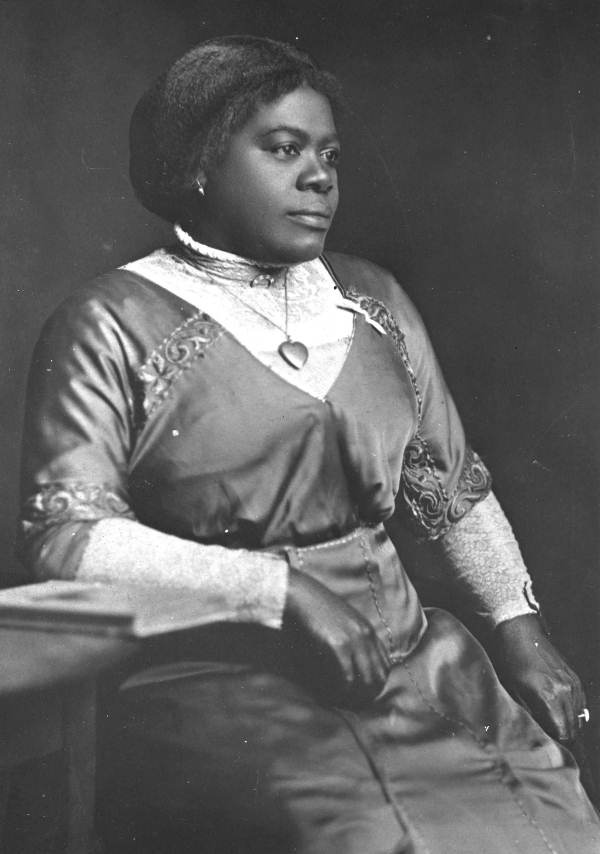
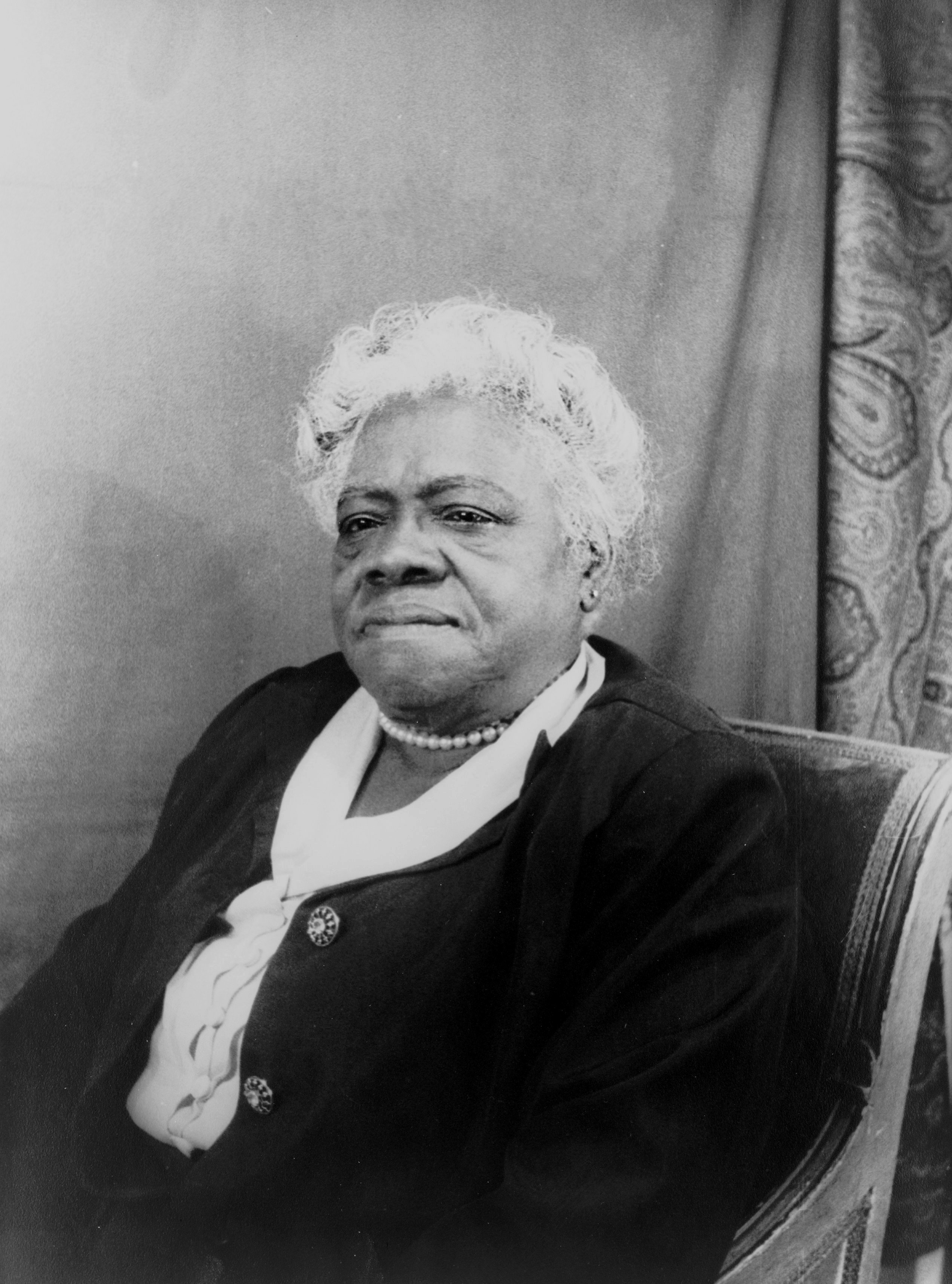
Mary turned over in her bed for the umpteenth time seeking a restful position, even though she knew discomfort was not the cause of her sleeplessness–excitement was. Tomorrow morning, October 4, 1904, she would stand in front of her first class of children in her own school: The Daytona Literary and Industrial School for Negro Girls.

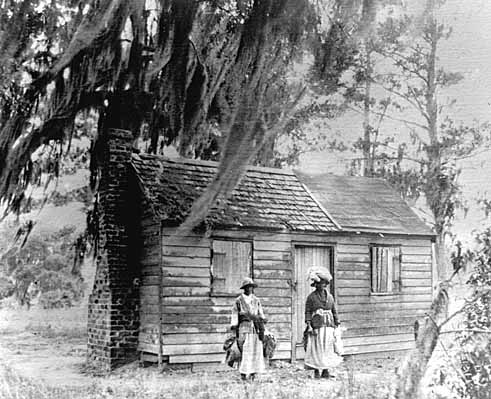
Mary smiled, remembering the miracle of learning to read for herself when she was a girl of ten—miraculous because: 1) the provision of education for African-American children was rare in 1885, and 2) out of the seventeen children in her family, she was the one chosen to attend.

(Cabin where Mary was born, the fifteenth child out of seventeen)

The school was five miles from home, and she had to endure harassment and assault from white children on her daily treks. But Mary knew: this opportunity meant God had purpose for her life.

In 1886 a Quaker missionary financed the continuation of her education at Scotia Seminary in North Carolina.

Seven years later she entered Moody Bible Institute in Chicago as the only African-American among hundreds of white students. Instead of harassment and assault, however, Mary encountered acceptance, proving that “blacks and whites could live and work together with equality” (1).

While at Moody, Mary sensed God leading her to Africa as a missionary. But when it came time to apply, her denomination’s mission board denied her request because she was black.

The disappointment was deeply painful, but Mary soon turned her attention to those of African descent in America, and became a teacher—first in Augusta, Georgia and then in Sumter, South Carolina. She worked tirelessly, not only for her students but also for the surrounding black communities.

Thank you, Lord, for those nine years of teaching experience, Mary prayed. You prepared me well to found this new school.

Granted, there would only be five little girls greeting her in the morning, but it was a beginning. And Mary was confident God would make her school grow.

She chuckled to herself. Of course, Lord, you left an awful lot of work for ME to do!

First she found a community in need of a school: Daytona Beach, Florida. Numerous African-American families were moving there, in order to be employed by the newly formed Florida East Coast Railroad.

(Workers on the East Coast Railway Extension, 1906)

Next Mary found a run-down cottage to rent for eleven dollars per month.  She convinced the owner to accept $1.50 as a down payment.

To supply her school with furniture and other necessities, Mary foraged at the city dump and behind hotels for anything useful. Old peach crates became student desks and chairs, an old barrel became her teacher’s desk.

She retrieved discarded linens, kitchen ware, and cracked dishes for the homemaking and skilled trades she would teach. Everything was scoured, mended and repurposed. Even charred wood had value as substitute pencils.

To cover expenses, Mary sold sweet potato pies and fried fish to wealthy tourists. She canvassed neighborhoods, spoke to church groups and clubs, and distributed leaflets.

Now, opening day was hours away.  And as she finally drifted off to sleep Mary wondered, What might the future hold?

If God had told her, even Mary’s strong faith would have been stretched.

That tiny handful of students in 1904 would grow to almost 250 by 1906, requiring more teachers, an advisory board, and a bigger facility. Among the influential men (black and white) on the board was James M. Gamble of the Proctor and Gamble Company.

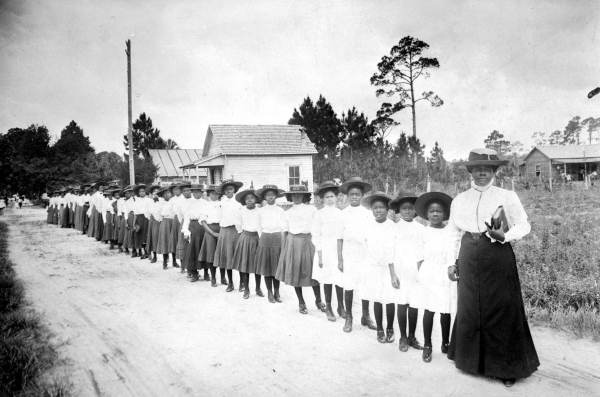
(Mary and her students, ca. 1905)

In 1923 her school would merge with the Cookman Institute, a co-educational school for African-American students in Jacksonville, Florida. Mary was chosen as the first president. Later the Bethune-Cookman Institute became a college and then a university. (Today, nearly 4,000 students attend the school.)

(Faith Hall, built in 1907 to accommodate Mary’s growing school;

now part of Bethune-Cookman University)

In 1935 Mary helped organize the National Council of Negro Women (NCNW) “to connect African-American women across the country and establish a national voice for them” (2).   Mary served as the first president.

A White House Conference of the NCNW met in Washington, DC in 1938. Then president, Franklin D. Roosevelt, offered her the position of Director of the Division of Negro Affairs of the National Youth Administration.

Mary met one-on-one with President Roosevelt several times a year and became good friends with Eleanor.

(Eleanor in the middle; Mary to her right)

Her participation on various government committees actually spanned the terms of four presidents, from Calvin Coolidge to Harry S. Truman.

(Mary’s home in Washington, DC)

Mary often said:

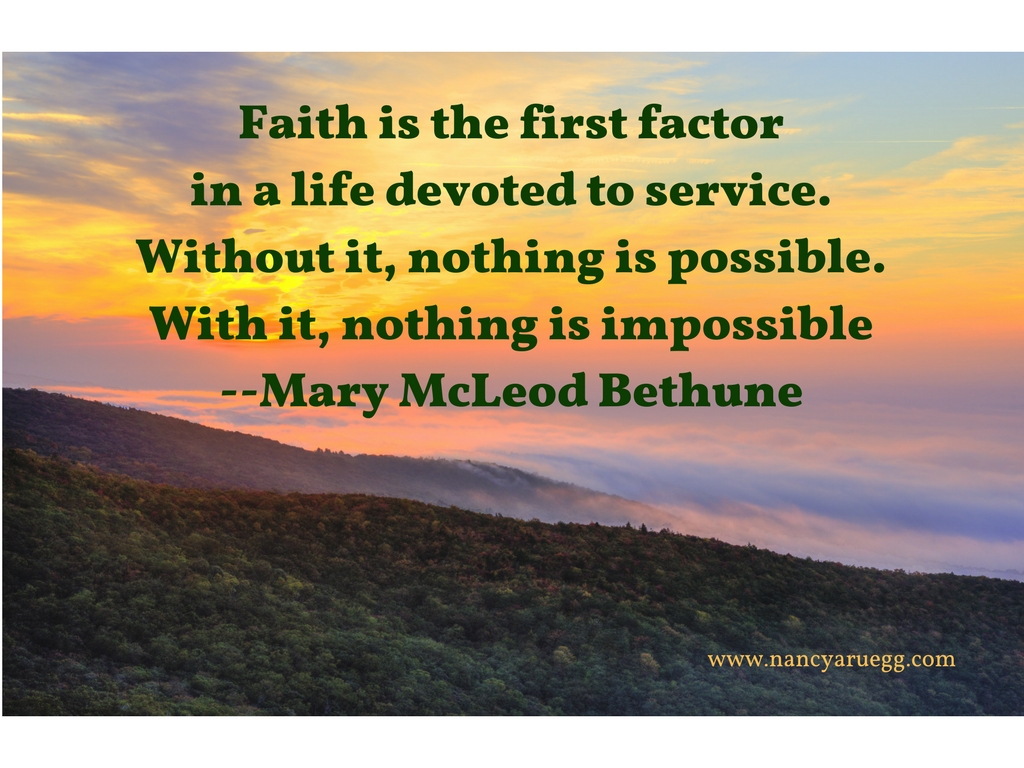
The impossible events of Mary’s life offer ample proof.

(Mary McLeod Bethune, 1875-1955)

Notes:

(1) http://www.talbot.edu/ce20/educators/protestant/mary_bethune

(2) https://savingplaces.org/stories/mary-mcleod-bethune-bethune-cookman-university-hbcu-history#.WnzP3pM-e8U

Sources:

http://www.talbot.edu/ce20/educators/protestant/mary_bethune

Click to access EJ969859.pdf

https://savingplaces.org/stories/mary-mcleod-bethune-bethune-cookman-university-hbcu-history#.WnzP3pM-e8U

http://www.wciujournal.org/journal/article/mary-mcleod-bethune-an-agent-of-change-and-leadership

Photo credits:  http://www.flickr.com; http://www.wikimedia.org (2); http://www.flickr.com; http://www.wikimedia.org (2); http://www.nationalparkservice.org; http://www.wikimedia.org, http://www.canva.com

Read Full Post »

‘Ever drive on a highway carved out of a mountainside or high hill where craggy cliffs border each side? Signs along the way warn drivers: Beware of falling rocks.

I wonder how much good those signs accomplish. Is it really possible to stop in time, should a rock come plummeting down the hillside right in front of your car?

When falling rocks do cause accidents, insurance companies usually categorizes the event as an “act of God.” It’s considered an unavoidable natural disaster that no amount of cautionary measures could have prevented.

Not that God would deliberately cause such an accident. Every good gift comes from him (James 1:17).  But he has set into motion certain natural consequences and laws that govern his creation. Erosion and gravity would be two examples at play in the case of falling rocks.

So what are we supposed to do when the road from Point A to Point B includes potential danger? (And doesn’t it always?)

For that matter, what are we supposed to do when the road of life includes potential danger? (Again, doesn’t it always?)

Many of us allow worry to niggle in our minds:

  • How many rocks do you suppose have fallen along this stretch already?
  • Does the Corps of Engineers check regularly for erosion?
  • Is that jutting rock up ahead breaking loose?
  • What’s up with that pile of rocks by the side of the road? That can’t be a good sign.

How do we steer clear of such thoughts? A good way to begin:

  1. Replace fearful thoughts with faith-filled thoughts.

“The only happy way to deal with [falling rocks and other such adversities] is the way of faith: faith in the purposes of God, in the presence of God, in the promises of God, and in the power of God” (Peter Marshall*).

  1. Affirm that God does indeed have loving purpose in it all. 

Even when rocks fall?

Yes, because God is sovereign (Psalm 103:19) and God is good (Psalm 145:9). Many saints through the ages have endured pain, suffering, and calamity, yet came to understand that God accomplished positive purpose(s) through it all.

Just one such saint out of many: Elisabeth Elliot.  Perhaps you already know the story. Her young husband, Jim, was one of five missionaries brutally murdered by Auca Indians in Ecuador, 1956. Their daughter was just ten months old. Yet Elisabeth was able to write this:

“I am not a theologian or a scholar, but I am very aware of the fact that pain is necessary to all of us. In my own life, I think I can honestly say that out of the deepest pain has come the strongest conviction of the presence of God and the love of God.”

And no doubt, those two realities in Elisabeth’s life, the presence of God and the love of God, were precious treasures indeed.

In addition, hundreds of young men and women vowed to become missionaries as a result of the example and inspiration of those five young martyrs.  Most amazing of all, numerous members of the Auca tribe eventually became Christians, including the killers of Jim Elliot and the other four missionaries with him.  (You can read more of the incredible story here.)

  1. Decide like the Apostle Paul: the only thing that really matters is exalting Jesus (Philippians 1:19-21).

And exalting Jesus can be achieved in any circumstance.

  1. Understand that tests and challenges are “sheer gifts” (James 1:3 MSG).

Why? The testing of faith develops perseverance. And perseverance leads to maturity and strength of character (vs. 3-4).

I like the sound of that: maturity and strength of character. So when I’m the victim of falling rocks and start to give in to self-pity, worry, or complaining, please remind me of these principles.

*     *     *     *     *     *     *     *     *     * 

Thank you, Father, for providing the way of faith on the treacherous road of life.  We can trust your purpose for all things, your presence in all situations, your scripture promises of hope and comfort, and your power to see us through.  Hallelujah!

 (Romans 8:28; Hebrews 13:5b; Psalm 145:13; Matthew 19:26b)

(1) Author, pastor, and chaplain of the United States Senate in the late 1940s.

(Art & photo credits:  http://www.wikimedia.com; http://www.pixabay.com (2); http://www.pexels.com;  http://www.inspirationalchristians.org; http://www.pixabay.com.)

Read Full Post »


On May 30, 1778, eighty-three year old Voltaire lay dying. His had been a writerly life, as he produced plays, poetry, essays, historical and scientific works, over 21,000 letters and over two thousand books and pamphlets.

Now he would never pick up his pen again.

Some of that writing criticized the Christian faith and the church. He had no use for them personally, asserting that a person could achieve moral character through reason. Wasn’t that what Christianity was all about anyway?

But Voltaire had also decided the way to dissolve the tight alliance between the self-serving state church and the totalitarian government of France was to discredit God and the Bible. Then the people would abandon Christianity and the church would become useless.

To that end he wrote in 1758:


Those twenty years passed. God was not in a pretty plight.

Voltaire made a new prediction around 1775: “Fifty years from now the world will hear no more of the Bible.”*

Of course, Voltaire was eighty years old by this time. He had no hope of being alive to see if his prediction came true.

Three years later on his deathbed, however, Voltaire was not concerned about his predictions. It would seem he was reconsidering if the Christians and their Bible may have been right after all about the importance of faith in Jesus.

Voltaire’s last words, as reported by his doctor, were these:


“I am abandoned by God and man! I shall go to hell!

O Christ, O Jesus Christ!”


Such a sad end for a brilliant man. We can only hope his last thoughts expressed the faith he fought against for so long.

But what about dying saints? Are they too tortured by doubt, fear, and aloneness?

Far from it.

“The very happiest persons I have ever met with have been departing believers,” said Charles Spurgeon. As a pastor to thousands over thirty-eight years of ministry, he must surely have visited many.


(Charles Spurgeon preaches to a crowd in 1858.)


In reality, the last remarks of saints most often offer hope, encouragement, and affirmation.

We can look forward to death, like Sir David Brewster (1781-1868)—a Scottish physicist, mathematician, astronomer, inventor of the kaleidoscope, and writer:


“I will see Jesus; I shall see Him as He is!

I have had the light for many years.

Oh how bright it is! I feel so safe and satisfied!”


Willielma Campbell (1741-1786), patroness of missionary work in Scotland and elsewhere, expressed complete contentment:


“If this is dying, it is the pleasantest thing imaginable.”


And John A. Lyth (1821-1886), a minister who served as a missionary in Ceylon (now Sri Lanka), died with his heart bursting with joy:


“Can this be death? Why it is better than living!

Tell them I die happy in Jesus!”


Another missionary, Adoniram Judson (1788-1850), created a delightful visual with his last words:


“I go with the gladness of a boy bounding away from school.

I feel so strong in Christ.”


And the famous evangelist, D. L. Moody, gave us a brief but bright glimpse of what awaits us beyond death.

Moody had been sleeping, although fitfully. When he awoke, Moody said, “Earth recedes. Heaven opens before me!” His son thought his father had been dreaming. “No, this is no dream, Will. It is beautiful. It is like a trance. If this is death, it is sweet. There is no valley here. God is calling me, I must go.”

 

*     *     *     *     *     *    *     *     *     *


O Father, thank you for this wonderful record of  joy-filled hope for the day when we, too, must go.

Even better, thank you for your great promises that you will be our refuge, even as we die. You will be our guide beyond death. And though we must walk through the valley of the shadow of death, we have no need to fear for you are with us. Hallelujah!

(Proverbs 14:32b; Psalm 48:14 (GW); Psalm 23:4)


*Fifty years after Voltaire’s prediction, the Geneva Bible Society was printing Bibles in the house where Voltaire had lived. They even used Voltaire’s printing presses.


(Art & photo credits:  http://www.wikimedia.com; Nancy Ruegg; http://www.wikimedia.com (2); http://www.wikipedia.com; http://www.wikimedia.com (2); http://www.flickr.com.)


Read Full Post »


“Well, that’s about as good as I can make it,” Steve announced.

We stood at the end of the hall in the parsonage where we lived, surveying his handiwork: a fort.

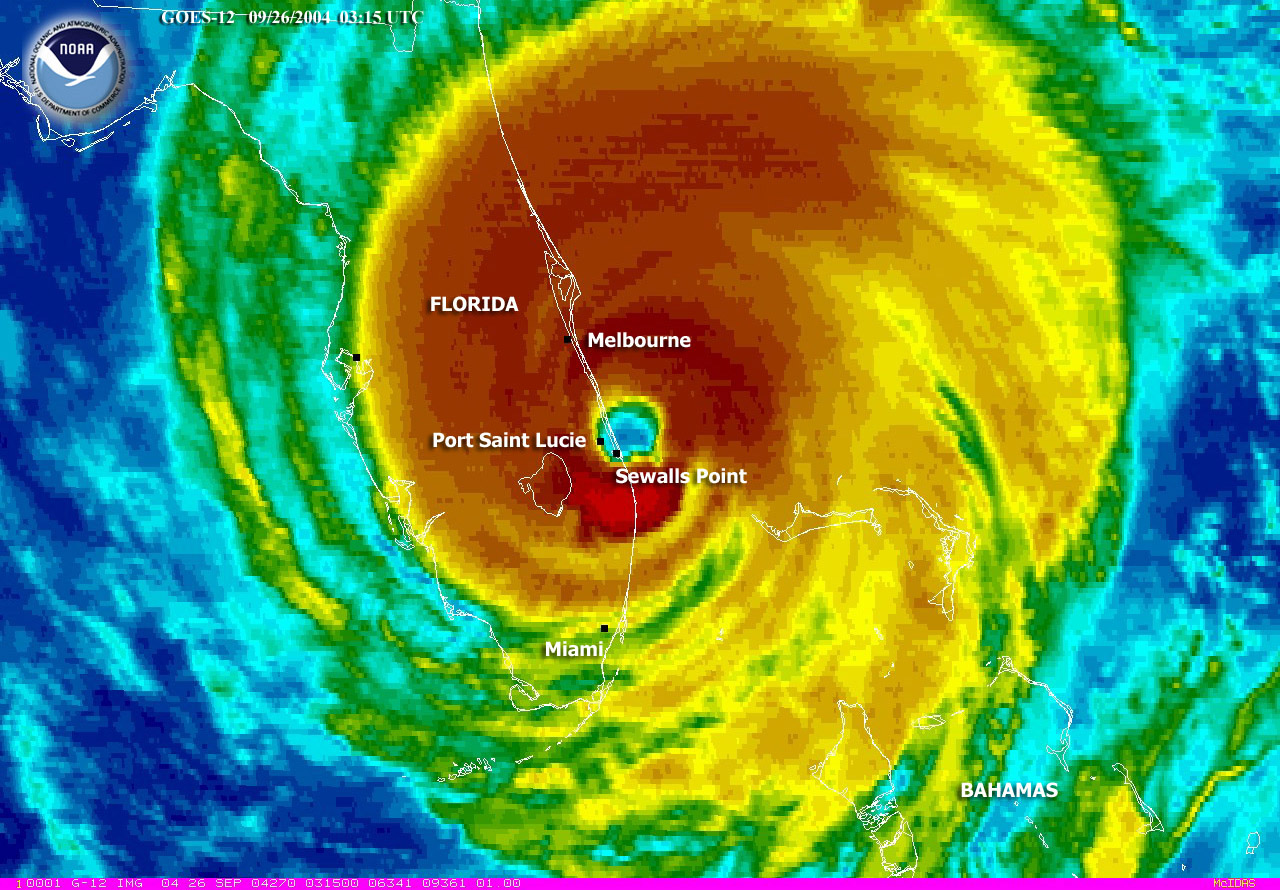
You see, a hurricane was roiling toward all of us who lived in South Florida, the second storm in two weeks.
The first one, named Frances, had torn branches from our trees, ripped numerous shingles off the roof, mangled the screened enclosure and thrown it in the pool.

It could have been so much worse.


(Jeanne at Landfall.  We lived south of the eye–in that bright red area.)


Now we were facing Hurricane Jeanne. We had no idea if Frances had compromised the roof structure, and of course we were among thousands waiting for an inspection to assess such damage.

Because of the uncertainty of our situation, Steve built that fort. He dragged two dressers into the wide area at the end of the hall where doors opened to three bedrooms, two storage closets and a bath. Over the dressers he put two mattresses, and on top of that, two long, folding tables.

He tightly looped rope around all the doorknobs (to help hold them shut) except the door to our bedroom and bath. Then he laced the rope across the dresser-mattress-table structure like a web, and tied it all together snugly.

Now I know why little boys build forts, I thought, so when they grow up they can keep their families safe during a hurricane.

In spite of Steve’s efforts, however, we could not be sure his structure would withstand the pressure of the wind, especially if the roof gave way. And even a well-built fort could not keep out water should flooding become an issue.

But thankfully our fate was not in Steve’s hands, reliant on his fort-building skills (stellar though they be).  Our lives were–as they always are–in the sure hands of God.


No, those verses are not meant to imply God’s perfect protection for his people at all times. The historical record and present day tragedies bear out: Many wonderful men, women, and even children have suffered and died through no fault of their own.

However, those of us who have “made the Most High our dwelling,” can be assured of these truths:

  1. Any number of catastrophes could have overtaken us already, but God has safeguarded us.

For example, if it were not for his providential care I may already have died from:

  • Any number of illnesses as a child. Thanks to penicillin and antibiotics I survived.
  • Car accidents.  At least several times I’ve come that close to a horrific crash.
  • Falls from high places. (You can read about one such escapade here.)

No doubt you have your own stories to tell of potentially disastrous circumstances.

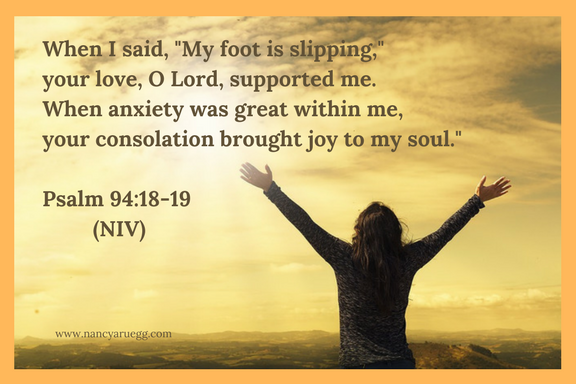
2. God always brings good out of distress—beginning with heightened awareness of his presence (Psalm 94:18-19).


Another positive outcome:  By the wind of his Spirit, he stirs up the ripple effect of his work in us to impact the lives others.


3.  In the context of eternity, our time on earth is no more than a blink.

One day we will be delivered out of this broken world into a place where no harm or disaster will ever occur, all troubles, frustrations, and pain will fade into insignificance.


Such truths gave me comfort that night as I hunkered down in our fort.  Wind and rain pounded against the house, sounding like hundreds of stomping feet on gymnasium risers.

Yet I slept.

*     *     *     *     *     *     *     *     *     *

Afterword: Obviously we survived that storm. The roof held firm and we experienced no flooding. Yes, the region was without power again for a number of days, and there was more debris to clean up. But God honored us with his loving protection–again.


(Photo credits:  http://www.wikimedia.org; http://www.maxpixel.com; http://www.pixabay.com.)


Read Full Post »

For one of his most stunning and delicate works of art, The Supreme Craftsman begins with the most innocuous of materials: dust and water.

His factory/workshop for these masterpieces is the upper atmosphere of Planet Earth where he sets into motion a miracle of formation and intricate design.

God endowed water vapor with the ability to cling, even to the tiniest of dust particles floating high into the atmosphere. And when the temperature drops below freezing, those wet, clinging molecules turn into ice crystals. Very quickly they form a hexagon shape, no more than .008 or .009 of an inch in diameter, and a snowflake is born.

Vapor continues to bond to the hexagons in different ways as temperature, wind velocity, and density of moisture vary—even within the same cloud.

Some snowflakes maintain a hexagon shape.


(Photo by Wilson Bentley)


Others develop arms, and from the arms grow lacy patterns or feathery extensions.


As the snowflake tumbles downward from the clouds, vapor continues to cling and ice crystals continue to form—up to 1,000 microscopic crystals, each impacted by differing conditions. One outcome is certain: the greater the humidity, the more complex the pattern.


 Another photo by Wilson Bentley, 1890)


Is it true what they say, that no two snowflakes are alike? Most meteorologists say yes, because the dust particles themselves come from countless different sources–from sand, soil, and volcanic ash to decayed plant and animal material.

Add to that the wide-ranging variations of weather conditions mentioned above, and it becomes apparent: an infinite combination of factors contributes to the infinite number of patterns.


But God isn’t finished yet.

The awe factor is increased as tiny snowflakes begin to gather:

  • in graceful drifts,


  • on every branch of the trees,


  • and in sparkling swaths across the landscape.


And a few lessons present themselves as well:


  1. If God cares about the formation of snowflakes, he surely cares about the formation of his children.

A practically minded person would take one look inside God’s snowflake-factory and shake his head. “Why bother with all these designs?” he might ask. “Such a waste when they’re just going to turn to slush and eventually evaporate!”

But our God is a true Artist at heart, paying attention to details and creating beauty where it isn’t even necessary.

How much more must he desire to create the beauty of his holiness within our spirits?


  1. By itself, one snowflake is a fragile entity. But think what an avalanche or glacier can do.


By himself, one person can accomplish little. But think what happens when human effort is multiplied.

We weren’t created for isolation; God intends for us to live in community with other believers. Together we can achieve great good. Groups of Christians have generously brought aid to those in need, built schools, hospitals, and orphanages, even accomplished the abolition of slavery—to name a few examples.

There is strength in numbers, whether it’s snowflakes or God’s people.


  1. The miracle of snow occurs in silence; the miraculous power of God works silently, too.


Hours before we catch snowflakes on our gloves, the Supreme Craftsman sets the conditions and engineers the circumstances for their creation. Silently the snow comes, and finally we hold in our hands a breath-taking miracle of dust and ice crystals.

Similarly, long before we take note of an answered prayer or unbidden blessing, The Supreme Craftsman sets the conditions and engineers the circumstances for their fulfillment.

Silently he comes. And suddenly we hold in our hands a breath-taking miracle of his power and love.


*     *     *     *     *     *     *     *     *     *


Maker of Miracles, just as your universe is full of wonder, so are our lives. We can’t begin to recount all the awesome works you have performed for our benefit. All we can do is sing for joy at the work of your hands!


(Psalm 40:5, 66:5, 92:4)


(Art & photo credits:  http://www.wikimedia.com; http://www.flickr (James P. Mann); http://www.wikimedia.com (2); http://www.pixabay.com (Natalia Kollegova); http://www.pixnio.com; http://www.flickr.com (AMagill); http://www.publicdomainpictures.net; http://www.wikimedia.com; http://www.nws.noaa.gov; http://www.paxpixel.freegreatpcitures.com; http://www.flickr.com & Nancy Ruegg.)


Read Full Post »

Hope.

Such a small word for such a big, important concept.

Multi-syllable synonyms seem to carry more clout:  expectation, assurance, confidence, and conviction offer a few.  (Thank you, Dr. Roget.)

Stir them together and we can create a definition for faith-filled hope:  the constant, confident, assured expectation that God will see us through every circumstance until we’re standing before him in heaven.  Those are words with heft that we can hang onto through dark and stormy nights.


You see, hope is much more than wishful thinking.

But sometimes it hides behind the overwhelming issues we face:  health concerns, financial problems, troubled relationships, difficult circumstances, foreboding futures.


How can we live with confident assurance that all will be well when uncertainty seems to rule the day, the week, the year?

As always, scripture offers us insight:

  • Understand that hope doesn’t come from a hidden reservoir within ourselves.  According to 1 Peter 1:3, our hope comes from God, provided for us out of his loving mercy.  It’s a living hope, breathing energy and strength into our souls.
  • Remember:  we can move forward with positive expectation because He is our all-powerful, grace-filled God—loving, kind, and wise, too.  He’s not just watching from afar; he’s an involved God, tending over us like an attentive Shepherd (Isaiah 40:11a).


  • Rest assured that our faithful God will see us through to a satisfying conclusion—either through events that unfold over time, or perhaps through an instantaneous miracle.  It may be the satisfying conclusion will not come until we cross the threshold into eternity (1 Peter 5:10).  But then, in the glorious ecstasy of that moment, our earthly trials will no longer matter (Philippians 1:21-23).
  • God’s plan is designed for our good (Jeremiah 29:11).
  • Hope involves waiting (Micah 7:7)—expectantly and patiently.

Sometime during second grade I noticed that being a teacher looked like fun.  And soon my favorite pastime became playing school with whomever I could cajole into being students.  When necessary, dolls were pressed into service.

That desire to become a teacher stayed with me all through high school and college.  Finally, after fourteen years, I was the one sitting at my own teacher’s desk, awaiting the arrival of my first students.  My hope, my confident expectation that I would one day be a teacher, had at long last become reality.  The import of the moment was not lost on me.  I had to fight back the tears.


Such euphoric joy does not happen often without waiting.  We appreciate more what we have to wait for.  And frequently, hard work is also involved.

God allows us to be part of the process, teaching us important lessons about patience and perseverance along the way.

Here’s what I need to remember:

Long-term waiting and steady hard work toward a dream makes the fulfillment all the sweeter when it finally comes.

For now, we can enjoy hopeful anticipation of a new reality that is coming, perhaps in this new year 2018—good health, financial security, improved relationships, or fulfilled dreams.  We can take comfort from the knowledge that our God, who is unlimited by the constraints of time, already resides there.  And…


Through the dark and stormy night

Faith beholds a feeble light

Up the blackness streaking;

Knowing God’s own time is best,

In patient hope I rest

For the full day-breaking!

– John Greenleaf Whittier


Let’s step out into each new day breaking with trust and obedience, because God is preparing us for that new reality.

And may these words ring in our ears:


“The Lord is good to those whose hope is in him,

to the one who seeks him.”

–Lamentations 3:25


*     *     *     *     *     *     *     *     *     *


What hope have you been clinging to?  Are there scriptures which contribute to your confidence and expectation?  What experiences of the past give you assurance for your hopes of the future?  Please share your insights below in the comments section!


(Revised and reblogged from January 31, 2013.  I do apologize for posting a reblog again.  Steve and I have been sick, catching a nasty bug on New Year’s Eve.  First I succumbed, and then he did.  A new post will be forthcoming next week!)


Art & photo credits:  http://www.flickr.com; http://www.pixabay.com; http://www.heartlight.org; http://www.pxhere.com; http://www.wikipedia.com; http://www.pixabay.com.

Read Full Post »

« Newer Posts - Older Posts »

When the House is Quiet

Impressions Becoming Expressions

Mitch Teemley

The Power of Story

Still Traveling

Impressions Becoming Expressions

Living Our Days

Gaining a heart of wisdom

He Said What?!

I'm Patty, and my husband and I are living with our adult son who has autism and epilepsy. I love sharing lessons learned from life around me, especially life with Aaron.

Meditations of my Heart

Impressions Becoming Expressions

Linda Stoll

Impressions Becoming Expressions

Signora Sheila

Where faith meets la dolce vita

Heidi Viars

Finding the Image of God