Feeds:
Posts
Comments

Archive for the ‘Excellence’ Category


6a00e54f0d380188340133f2ef50d4970b 

One of the delights of grand-parenting is recapturing the joys of childhood. In the name of entertaining the little ones, we get to return to such fun activities as drawing with crayons, molding Play-Doh, and building with blocks.

Little eyes watch in wonder as we sketch a flower, create a clay nest of eggs, or fashion a tall tower. It doesn’t take much to wow the little tykes.

Just the other day I demonstrated for our toddler granddaughter the first rule of constructing block skyscrapers: A solid, level foundation is a must. Without that strong base, the tower will lean and fall.

For centuries, the success of constructing real buildings depended on one foundation stone in particular: the chief cornerstone. Without the sophisticated tools of today, stone masons had to be certain that first stone was level and its corners squared accurately. The rest of construction conformed to that one stone. If the cornerstone was faulty in any way, the building would lean and fall.

The chief cornerstone also carried the weight of the structure. If laid properly, the weight of the building was evenly distributed and the structure remained sound.

Scripture tells us that Jesus is our cornerstone. God said,

“See, I lay a stone in Zion, a tested stone, a precious cornerstone for a sure foundation; the one who trusts will never be dismayed” (Isaiah 28:16).

Oh, my. So much good news in one short verse!

The “stone in Zion” is Jesus, our Rock (1 Corinthians 10:4), who has been tested for two thousand years. Billions of believers over the centuries have found him to be a trustworthy Savior, Shepherd, Friend, Prince of Peace, Teacher, and more.

Jesus is our precious cornerstone—highly valuable to us who believe in him. Think of the excellency of his character and his perfect, holy life. Think of his position. God exalted him to the highest place and gave him the name that is above every other name in the universe (Philippians 2:9). Think of the myriad ways he blesses, guides, comforts, and strengthens us, his followers.

He is also our sure foundation—strong and reliable. In his divine power he gives us everything we need for life. We can depend on his great and precious promises (1 Peter 1:5).

Those who trust in him will never be dismayed; their lives will not topple and fall into ruin. However, commitment to obedience is crucial. If I’m not following his blueprint for life, as provided in the Bible, I’m not demonstrating trust.  (Still working on that!)

Also important to understand: God’s architectural plan does not end with the placement of the chief cornerstone, his Son, in our individual lives. Each of us who believe in Jesus are like a stone or brick in the building of the Church universal.

The truth is, individual bricks by themselves are practically useless. They must be mortared together to realize their full potential. As Christians, we, too, must come together as the Church to realize our full destiny.

We become more significant, not less, as we gather to pray, encourage one another to lead godly lives, work together, and share with others the good news about Jesus.

We also become stronger, able to withstand storms and hardships because the stress from such forces is distributed over numerous bricks. We carry one another’s burdens.

Even better, we have a strong, sure foundation in Jesus. He is more than sufficient to carry the weight of our cares. On him rests the Spirit of power, which he dispenses on our behalf (Isaiah 11:2; Philippians 4:13).

*     *     *     *     *     *    *     *     *     *

Thank you, Father, for the wonderful, rock-solid saints you have brought into my life over the years, shining examples of living stones, spiritually well-hewn, and set apart for your service. I’m thinking of family members, pastors, Sunday School teachers, youth leaders, Bible study teachers, mentors, authors, friends. Countless saints have helped, encouraged, and challenged me to become a living stone for you also.

And oh, Lord Jesus, how I praise you for the sure foundation you provide in my life. When a storm of worry begins to stir, you offer reassurance of your power and strength. When I’m ready to topple from a multitude of cares, you uphold me. When fear wants to consume me, you soothe me with your Word. Over and over, with calm stability, you have steadied me. You are my foundational Rock.

(1 Peter 1:5; Isaiah 28:16; Matthew 6:25-26; 1 Peter 5:7; Isaiah 26:3; Psalm 18:31)

Photo credit:  www.amberdusik.com.

Read Full Post »


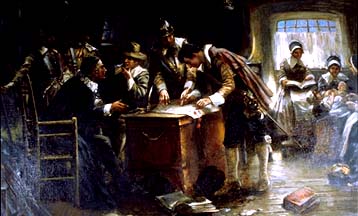
Mayflower_compact


They had been at sea for sixty-six days, enduring overcrowded conditions. Storms had caused damage to their ship and sea sickness plagued them all– passengers and crew alike. Meager provisions and no heat on chilly autumn days caused further discomfort.

So on November 9, 1620, when they finally saw the coastline of North America in the distance, the Pilgrims and others aboard the Mayflower must have cheered enthusiastically. Soon they could abandon the cramped, cold, and fetid ship and begin new lives in a new world.

But. All had not been peaceful and congenial among the passengers during the crossing. And when it became apparent the storms had blown them too far off course to land in the Virginia Colony as planned, relations deteriorated further.

Not all of the travelers were Pilgrims. Also aboard were merchants, craftsmen, skilled workers, and indentured servants. The Pilgrims called them “strangers.”

No sooner had the decision been made to anchor off Cape Cod, than an argument ensued. Several of the “strangers” pointed out that, since they were not going to be under the jurisdiction of the Virginia Company, they would “use their own libertie” and do as they pleased. “None had the power to command them, they said.” (Quoted words are from William Bradford’s records. He served as historian for the Pilgrims.)

To avoid anarchy, five men gathered in the cabin of the ship to create a basis for law and order. The result of their efforts: the Mayflower Compact.

The first words of the document give strong indication of the Pilgrims’ hearts.

In the name of God, Amen.

“Everything they did started with God” (The Founders’ Bible, p. 187).

Next, the Pilgrims stated their purpose for coming to America.

We, whose names are underwritten,…by the grace of God,…having undertaken for the glory of God, and advancement of the Christian faith, and honor of our King and country…

Several phrases indicate the Pilgrims’ desires for their new colony:

  • “For the glory of God” would be a guide for all manner of decisions.
  • “Advancement of the Christian faith” would encourage them to remain strong in Christian faith among themselves and to introduce others to Jesus.
  • “Honor of our King and country” indicates their loyalty to native England and its monarch, in spite of his untoward actions that caused their flight to America in the first place.

…[We] do solemnly and mutually in the presence God and of one another, covenant and combine ourselves together into a civil body politic…

The Mayflower Compact expressed their commitment to live together in a civil manner, in the sight of God.

[We] will enact…such just and equal laws, ordinances, acts, constitutions, and offices, from time to time, as shall be thought most meet and convenient for the general good of the colony, unto which we promise all due submission and obedience.” 

Note:  there is no mention of a leader who would oversee the colony. The Pilgrims created a democratic, representative form of government, in covenant with one another, rather than by a monarchy or dictatorship.

It was the first document of its kind in the history of the world.

But the Mayflower Compact would only be as good as the commitment of Pilgrims and Strangers alike to abide by its guidelines.

Would the mutinous Strangers sign?

John Carver, church deacon and one of the organizers of the voyage, was the first to affix his signature. Other Pilgrims followed.

One book says there was a long pause. Then Captain Myles Standish stepped forward to sign. Standish had been hired by the Pilgrims to be their military captain; he was with them, but not one of them.

Soon other Strangers followed Standish’s example.  In total, forty-one signatures appeared on the document. One freeman, two hired men and seven servants declined.

At long last, Pilgrims, Strangers, and crew were able to disembark. And what did they choose to do first?

Pray.

According to Bradford, they “blessed the God of heaven, who had brought them over the fast and furious ocean..and a sea of troubles before.” Then he quoted scripture:

“Let them therefore praise the Lord, because He is good and His mercies endure forever.” (Psalm 106:1).


*     *     *     *     *     *     *     *     *     *


We, too, praise you, Lord, for your goodness and mercy upon America all these years.  As we celebrate Thanksgiving on Thursday, may we remember the solemn history behind this occasion.  Thank you for the supreme example and sacrifice of our Pilgrim forefathers–strong in faith, commitment, and perseverance.  May we follow their example, not only because you are faithful to the faithful (2 Samuel 22:26), but out of appreciation for what you, our loving God, have already done.


(Sources:  By These Words by Paul M. Angle; The Founders’ Bible; The Intellectual Devotional:  American History by David S. Kidder & Noah D. Oppenheim; The Rebirth of America;  http://www.learningtogive.org; http://www.humanities360.com; http://www.crf-usa.org; http://www.americanhistory.about.com; http://www.tparents.org; http://www.mrkash.com; http://www.mayflowerhistory.com; http://www.plimoth.org.)


Art credit:  www.washingtonmayflower.org.  


Read Full Post »

DSC_7445-X3 (My mom & dad with their great-granddaughter, Sophie, 2011)


“What we leave behind

is not what is engraved in stone monuments,

but what is woven into the lives of others.”

— Pericles (495-429, B.C.  Greek statesman, orator, and general of Athens)

I love that word, woven. It speaks eloquently of the way my mother, Geraldine Claire  (November 5, 1928-October 9, 2014), influenced my life. Woven into the fabric of my being are memories of Mom’s words and example that still have impact to this day.

Many of those memories involve Mom and Dad because they were such an inseparable team. They even wallpapered together.

Now marriage experts will tell you that completing home improvement projects with your spouse can be detrimental to your relationship. But that was not the case for Mom and Dad. Amidst the measuring, pasting, and hanging, my brother, John, and I saw cooperation and patience in action.

Once the wallpaper was hung in the three homes of our growing-up years, Mom was ready to entertain. Hospitality was definitely one of her gifts. In fact, the last dining room table Mother and Dad purchased could seat fourteen people.

Mom became adept at organizing large gatherings by writing lists, doing everything she could ahead of time, even labeling the serving ware so each item on the menu would have an appropriate bowl or plate. Little did I know then how often I’d be following her routine and recipes, as Steve and I began to entertain.

Mom’s legacy included wise advice. One time I was heartsick over a low report card grade in math—my most challenging subject. She quickly gave me perspective for the tragedy, saying, “Just remember: this grade will not matter in ten years.”  And, of course, she was right.

Countless times over the years as disappointments and difficulties have occurred, I’ve heard Mother’s voice reminding me to consider events with a ten-year perspective.

But that doesn’t mean she accepted excuses. Instead, Mom fostered independence and personal responsibility .

I’m remembering the Sunday School Christmas program from second grade. My part was to recite six verses from Luke, chapter two, about the angel visitation to the shepherds. “This is too much to memorize,” I complained.

Mother replied calmly, “Well, just tell Mr. Faircloth that you can’t manage it, and he’ll ask someone else.”

Mom did not take control of the situation; she left it up to me to decide what course of action to take. Wise mother, indeed.

But perhaps the most astounding aspect of her legacy is the way she exhibited all features of the fruit of the Spirit, listed in Galatians 5:22-23.

For example:

LOVE — Mom lavished love on family, friends, and stranger alike. She could strike up a conversation with anyone, and was always ready with a warm hug.

JOY — Mother was a woman of gladness. She laughed easily and often.

PEACE — Mom and Dad created a peaceful, secure home for John and me.

PATIENCE — She exercised great patience, especially when dealing with my fluctuating moods of early adolescence.

KINDNESS — Mother demonstrated kindness in many ways.  I remember one house where the old wallpaper was in process of removal when Mom and Dad took in a missionary who needed a place to stay.  We have home movies of  that missionary, Miss Hunt, standing in front of  the glue-encrusted plaster.  Another time when a different missionary family stayed with us, Mom did all their laundry while they attended to other affairs.

GOODNESS — Mother’s goodness was also expressed in numerous ways.  In my mind’s eye, I can still see Mom at her desk at Scripture Press, where she was executive secretary to the Vice President of Editorial.  (The visualization is easy to conjure; I sat directly across from Mom, most of my seven summers as an editorial assistant.)  Frequently people stopped by her desk to share a need and ask for advice.  We used to tease her about being the psychologist of Scripture Press!   

FAITHFULNESS — Mother’s faithfulnesss to God never wavered for the seventy-five earthly years she knew Jesus as her Savior and Lord.

GENTLENESS — While John and I were growing up, Mom could be plenty firm with us.  Yet, when we were sick, hurt or experiencing trouble, she readily soothed us with comfort and hugs.

SELF-CONTROL — I have to admit:  I provided Mom and Dad with plenty of parenting challenges.  And though Mom did become angry sometimes, she never lost her temper with me.

For these reasons and so many more, John and I “arise and call her blessed” (Proverbs 31:28).  Mother did indeed weave godly integrity, wisdom, and faith into our lives.

Read Full Post »

‘Ever watch one of those television shows that provides a person with a complete makeover? By the end of the hour she (or sometimes he) has acquired a personalized, updated wardrobe, learned how to apply make-up, and received a new hair-do.  The physical transformation is always stunning.

However, there is a transformation even more amazing.  Paul explains it this way:

“If anyone is in Christ, he is a new creation; the old has gone, the new has come” (2 Corinthians 5:17).


new-creation


Those of us in Christ haven’t just been adjusted, primped, polished, or camouflaged.  We have become new people with clean slates, strong purpose, deep joy, and vibrant enthusiasm for life.

And that’s not all.  Each day we’re becoming better than the day before–a bit more perfected–if we remain in Christ.  Sarah Young (Jesus Calling) says we’re becoming more fully our true selves–the ones God designed us to be.  I like that.

Each day in Christ is an opportunity to grow more completely into his glorious image.  These changes have nothing to do with outward appearance.  They take place on the inside, impacting our personalities, emotions, minds, and spirits.

That expression, in Christ (also “in the Lord” and “in him”), occurs 164 times in Paul’s letters.  Such repetition would indicate the importance of the concept.

So how would we define the meaning of being “in Christ?”  Here are a few possibilities.

1.  In Christ means we live within his presence.  Now that’s a rather abstract concept. Perhaps an analogy would increase our understanding.

Picture yourself surrounded by trees in a forest.  The woods fill your senses—the sight of tall, stately trees, the sound of chirping birds, the aroma of pine and earth, the textures of rough bark and velvety moss, the taste of cold, clear water from a stream.


SunShiningThroughDustInWood

Similarly, the presence of Christ completely surrounds us as believers.  Christ fills the senses of our hearts, if we avail ourselves. We see more fully the glory of his creation, hear his truth, breathe in his love like a fine fragrance, feel his strength upholding us, and taste his goodness in the feast of blessings he provides.

Such sensations change who we are.  In Christ, we can become stable, contented, joy-filled people.

2.  In Christ means we are united with him, like a branch fused to the vine (John 15:1-8). He is the Source of everything we need, but we must stay in contact with him. How do we do that with Someone who’s invisible? Possibilities include prayer, praise, gratitude, and worship–throughout the day.

And when we’re united with him, his peace and strength are infused into us.

3.  In Christ means we’re in close relationship with him. Never should there “be day when we give ourselves a chance to forget him” (William Barclay).

And when we live in the presence of Christ, and in union with Christ, the inner transformation he has instituted will most definitely become visible. Jesus’ character will begin to flow through our attitudes and actions, just as sap flows through the vine into the branches. Attitudes like kindness, understanding, and forgiveness will give strong evidence that we’re living in Christ.


Woman praising with arms raised in the air


And what will the people around us see?  Folks who…

  • exude joy and optimism.
  • are gracious to others.
  • exhibit self-control.
  • make wise choices.
  • aim to express love–always.

Such delightful, purposeful living awaits those who center themselves  in Christ.

*     *     *     *     *     *     *     *     *     *

Thank you, Lord Jesus, for the supreme privilege of living in your presence.  You are the King of the universe, yet you want to be united with us in close relationship.  And as we avail ourselves, you infuse us with your attributes, your strength, your peace.  All praise to you, gracious Savior, the Author and Perfecter of our faith, as we abide in you.

(Photo credits:  www.brotherransome.com, http://www.wikipedia.org., and alishagratehouse.com.)


Read Full Post »

White_Oak-15_acorns


Elena, almost eighteen months old, loves to collect acorns. A grand oak tree on the church property across the street from her home provides perfect hunting grounds. She trundles along the edge of the sidewalk, her eyes on the grassy edge. Now and then she bends over, chooses a prime specimen, and clutches it tightly to her chest.

Yesterday was a banner day for acorns. Way too many shiny nuts with perfect caps. Her little hands couldn’t carry them all. I was given the honor of transporting a few of her treasures home. And this opportunity became the starting point for a train of thoughts.

You’ve no doubt noticed this yourself:  acorns do not appear capable of producing oak trees.  They’re too small and too hard.  How can the seeds inside even escape those tough shells?   Yet given the right soil, the right climate, and plenty of time, the miracle of growth occurs.  White oak trees can reach the height of 150 feet, growing twelve to fourteen inches per year.  Acorns do not appear until the twentieth year.  In the end, the majestic giant provides hundreds of benefits (www.arborday.org and http://www.ehow.com).


white_oak_5036-320


Now a few tall plants, like bamboo, grow very quickly. But not tall, strong trees.  I wonder why?

We humans are also slow-growing–in body and spirit. And I wonder about that, too.  Why didn’t God make us more like bamboo, able to reach maturity quickly? Instead, we progress through a protracted, sometimes painful learning process to become “mature, lacking in nothing” (James 1:4).

Perhaps God willed our development to happen slowly so we have many opportunities to follow his chosen path and fulfill the potential he’s especially prepared for each of us. A false step in the wrong direction can be corrected, just as a crooked tree can be straightened if attended to promptly.


 HardMaple1


Yes, there are those who choose not to mature, not to participate with God.

But we know that God is good, that what he does is good. I want him to train and teach me (Psalm 119:68). My guess is you feel the same.

Day by day, choice by choice, we can progress along the spectrum from self-centered to selfless, from impatient to patient, from lesser to greater.  But we have to realize: it happens slowly over time.

Here’s another possibility, even better than just accepting slow progress.  Let’s embrace it.

You see, our culture tends to look at time as a thief who steals away our youth, worth, mental acuity, and energy.

But what if we view time as a gift–a gift of countless opportunities provided day by day, choice by choice–to grow into the mature and gracious people God ordained? Instead of regretting the passage of time we can celebrate:

  • Our progress to become rooted and built up in Jesus, strengthened in our faith (Colossians 2:6).
  • The growing ability to bear fruit (the fruit of the Spirit, exemplary living, glorifying God to others)–even into old age (Psalm 92:14).
  • Becoming “oaks of righteousness, a planting of the Lord, for the display of his splendor” (Isaiah 61:3).

Oh, I like that last verse especially, don’t you?

And it can happen through  slow and steady perseverance, with God as our guide.


(Photo credits:  www.bio.brandeis.edu; http://www.treetopics.com; http://www.awesometools.com.)


Read Full Post »


Unknown

(“Beautiful young people are accidents of nature, but beautiful old people are works of art.” – Eleanor Roosevelt)


Can I get an “Amen?”

For those of us who’ve reached the fifth decade and beyond, Eleanor’s words give us a worthy goal: to become lovely masterpieces as we age.

Obviously she’s not talking about the artistry of a plastic surgeon’s facelifts and tummy tucks. I don’t think such procedures were even being performed in her generation.   Besides, the most successful procedures provide only temporary changes. I’ve never seen a ninety-year old who looks twenty-one, have you?

But if you Google the phrase, “aging gracefully,” you’ll find a long list of articles about stalling the aging process—on the outside.  Eat right, exercise, get seven to eight hours of sleep each night, etc.  Where are the essays about becoming more lovely in heart and spirit as the decades pass?

No doubt Eleanor was referring to those who have achieved this kind of beauty–those gracious elders who listen, encourage, and speak positively.  And I dare say, such folks are most often Christians who have grown in faith and spiritual maturity over the years.

Their eyes twinkle from the Light within. And those radiant lines that fan out from the corners? Son-beams.

In fact, His name is often on their lips, because their thoughts turn to him so consistently. Jesus is an intimate Friend.

In addition, the joy of the Lord is their strength—perhaps not in body, but in soul. It shows in a delightful sense of humor and frequent smiles. Joy is also expressed in continual gratitude and praise.

These dear ones learned self-discipline along the way. Those ugly traits of bitterness, complaining and negativity are nowhere in sight. And never do you have to endure a long soliloquy that begins, “Back when I was young…”, that goes on about how much better or tougher life was decades ago.

Wise elders realize the value of influence, and the power of positive memories for the younger generations. They know that integrity and faith are best taught through example—examples that live on long after the elders graduated to heaven.

And as such saints delight in God and minister to others, they discover contentment—even as aches, pains, and deficiencies overtake their bodies.

They are true masterpieces, according to the definition: outstanding, superlative, ingenious works of art.

Masterpieces don’t just happen; they are the result of: 1) informed skill, 2) extended time, and 3) concentrated effort.

Similarly, beautiful seniors are the result of: 1) living by Biblical principles, 2) trusting in God day after day, and 3) practicing his presence moment by moment.


*     *     *     *     *     *     *     *     *     *


Father, thank you for taking up your paintbrushes and paints to create a pure and beautiful spirit within me (Psalm 51:10). But it’s also true I must be a willing and active participant. May I not lose heart and invite your Spirit to refresh me every day. May I be mindful that “what is seen [like outward beauty] is temporary, but what is unseen [a pure heart] is eternal (2 Corinthians 5:16-18). May I be focused on the latter.

(Photo credit:  www.groups.yahoo.com.)


Read Full Post »

Remember the old song, Kids Under Construction, by Bill and Gloria Gaither?

The chorus went like this:

“Kids under construction –

Maybe the paint is still wet.

Kids under construction –

The Lord may not be finished yet.”

underconstruction2

  Well, it’s not just the little folks that require refurbishing. Most of us still need our:

  • Patience polished from time to time
  • Kindness cultivated every now and then
  • Joy rejuvenated on a regular basis
  • Self-centeredness scoured away occasionally
  • Faith uplifted once in a while

faith

If we’re not careful, such realities can push us toward discouragement. Thoughts like these begin to peck away at our spirits:

“I’ll never measure up. Why even try? What’s the point?”

Might it be we’re even harder on ourselves than God? Might he actually take pleasure in our imperfectly right efforts toward spiritual growth?

Think of Charlie Brown’s small and scraggly Christmas tree. Imperfect? Definitely. Heart-warming and charming nonetheless? Oh, yes.

Think of the pleasure listening to a young child sing—off-key, with unsteady rhythm and incorrect words. But everybody loves the performance anyway.

speech1

Think of dust—how it shrouds our belongings and irritates our allergies. But sprinkle a bit in a sunbeam and instantly we’re mesmerized by the magical display of glitter and shine.

Think of the wrong word written or spoken at the right time and how the result can produce uproarious laughter.

When my husband Steve began his ministry, he was assigned to a congregation of mostly older folks. One Sunday the bulletin listed the first hymn as, “’Tis So Sweet to RUST in Jesus!”

And that brings me to Mrs. Bisso’s muffins. Mrs. Bisso was a member of that same church, and lived down the street. She loved to bake. It wasn’t long after our arrival before Mrs. Bisso began to regularly supply us with muffins. Sometimes she’d call at 6:30 or so in the morning to let us know she’d be over in a few minutes with fresh muffins for our breakfast. Hold the oatmeal!

Problem is, Mrs. Bisso’s muffins were always over-baked—rather thoroughly. That meant, even if we cut off the black bottoms, the sharp, charred flavor still permeated all the way through to the tops.

aug13-nutella-muffins-2-burnt

But dear Mrs. Bisso took such pleasure in baking for us, we continued to enthuse over her burnt offerings—batch after batch after batch.

All these thirty-some years since that time, we’ve occasionally remembered and smiled nostalgically about Mrs. Bisso’s muffins.  After all, her heart was in the right place, and she gave so lovingly and generously of her time and effort.

You see? There is much for us to celebrate in the imperfectly right.   And I think God does too.

(Photo credits:  www.drexelchurch.org; http://www.highlandschristianfellowship.org; http://www.christchurchlikely.org.uk;  www.salmonavocado.com.)

Read Full Post »

(As most of you know, Steve is retiring from the pastorate, after serving forty years in Florida. Very shortly we move to the Midwest, to be close to our sons and their families. If our daughter and her family would just move east from Washington State, life would be near-perfect!

No doubt you’re also aware that packing and unpacking are time-consuming tasks, so I’m putting the blog on hold for a few weeks. But please continue to visit! I’ll re-blog some previous posts, and hopefully you’ll find them meaningful again, or perhaps for the first time.

The following post was first published 5-16-13.)
220px-E-W-Wilcox

“With every deed you are sowing a seed, though the harvest you may not see”

(Ella Wheeler Wilcox, author and poet, 1850-1919).

Observation #1:

We never know when a small deed may plant a seed of faith or encouragement. We never know when that seed will reap a bountiful harvest in the life of someone else.

Live attentively to the fact that every deed is a seed. The people around us are watching and listening. Perhaps you’re familiar with the story of a church elder who once led a worship service for two. It happened over 150 years ago in England. A blizzard on Saturday night made it impossible for villagers to get to the church—including the pastor.


Oakwood_Park,_London_N14_-_snow_storm_-_geograph.org.uk_-_1146589


The elder almost sent home the two individuals who had come, an older man and a young boy. But something (Someone?) compelled him to speak. Later he confessed his words came out rather jumbled and brusque.

But. The elder planted a seed that immediately took root. The young boy accepted Jesus as his Savior that day. His name? Charles Spurgeon—preacher and author extraordinaire, whom God used mightily. People are still impacted by his writings to this day. (For an example of Dr. Spurgeon’s God-given genius, see the post, “Not Length But Strength,” from May 9, 1913).


Observation #2:

Our responsibility is the planting of “deed seeds”; the harvest is up to God.

The same principle that works in the physical realm works in the spiritual realm: A farmer may plant, fertilize, and water, but the germination of each seed is a miracle only God can bring about. Don’t become tightly focused on results.

The elder who led Charles to the Lord that snowy, wintry day, had no idea the boy would grow up to have such a profound effect on the world. The gentleman may not have lived long enough to see the results of his deed that morning. But we know, and we marvel.


Observation #3:

The true harvest is not measurable in physical terms, and it’s hidden from view in the spiritual realm.

Only now and then does God give us a glimpse of what our small deeds are accomplishing. Perhaps God planned it that way so pride and self-gratification do not taint the glory of the harvest.

Imagine the joy that elder continues to experience every time a saint comes through the gates of heaven–fourth and fifth generation Christians, who have been influenced by Charles Spurgeon, whose ancestors accepted Jesus because of him. In addition, thousands  have been influenced and encouraged by the preacher’s writings.

And it all began with that faithful elder.

You see, the positive influence of a man or woman of God never dies.


4 T


Such a possibility should translate into enthusiastic motivation for planting seeds wherever we go.


(Art and photo credits:  www.wikimedia.org and http://www.wikipedia.org.)

Read Full Post »

“I even wash aluminum foil so I can use it again–if it’s not too messy,” joked a friend.  “My son makes fun of me, but that’s what my mother did, and I just picked up the habit.  Seems so wasteful to throw away a perfectly good piece of foil, just because it has a bit of goop on it.”

We were discussing the frugal habits passed down to us from our parents. They were children during the Great Depression, and learned to conserve, reuse, and make do.  Now, eighty years later, the effects of that difficult time are still impacting many of us today.

Might the same effect occur in the spiritual realm?  Might our spiritual habits not only impact those around us, but even generations to come?

Legacy-Postcard

An anonymous psalmist alluded to our long-reaching influence:  “Blessed is the man who fears the Lord, who finds great delight in his commands.  His children will be mighty in the land; the generation of the upright will be blessed…his righteousness endures forever” (Psalm 112:1-3).

James Moffatt (1870-1944), theologian and professor, also spoke poetically of our ongoing influence:  “Death is never the last word in the life of a…man. When a man leaves this world, be he righteous or unrighteous, he leaves something in the world. He may leave something that will grow and spread like a cancer or a poison, or he may leave something like the fragrance of perfume or a blossom of beauty that permeates the atmosphere with blessing.”

42-21217958

Who has left “something like the fragrance of perfume or a blossom of beauty” in your life?  I am surrounded by the examples of:

  • my grandparents’ perseverance
  • my father’s wisdom
  • my mother’s resiliency
  • a favorite teacher’s sense of humor
  • a choir director’s positive attitude

To name a few.

When I was a small child, our family’s pastor called each of us girls “Little Miss Sunshine.”  I found myself trying to live up to the name.  Now, decades later, I still feel the influence of his affirmation.

As a teenager I benefited greatly from the examples of various youth sponsors.  One married couple in particular took me under their wings and mentored me.  Their example of integrity, service, and caring, lived out in a loving home, remain with me to this day.

And so many more!  We really are composites of the countless influences we’ve absorbed.

Now, it’s our turn to pass on a worthwhile legacy.  We mustn’t give in to the notion that Generations X and Y will always find us irrelevant.  One day they’ll realize older persons have the benefit of experience, and experience gives rise to wisdom.  And whether we are present on that day or not, our example will be.

Most of what they absorb will not be the words we have spoken.  They will remember our actions.  Kids watch and learn–sometimes intentionally, but most of the time not.

learning-by-observing

We are the ones who need to be intentional, living out a legacy of character and faith, to be a perfume of blessing.  If we do, the fragrance of our Christian maturity will permeate the atmosphere for years to come.

We can also be encouragers.  Others will remember positive affirmations.  At least one Little Miss Sunshine can attest to that.

*     *     *     *     *     *     *     *     *     *

Please leave a comment below.  I’d love to hear from you!

(Photo credits:  www.jeaninemurk.com ; http://www.telegraph.co.uk ; http://www.inspiredwednesdays.blogspot.)


Read Full Post »

Portrait_of_George_Washington

Many of our founding fathers were men of Christian faith.  The record of their background, correspondence, and character attests to that fact.  Consider:

  • Twenty-four of the fifty-six men who signed the Declaration of Independence attended seminary or Bible school.
  • Hundreds of letters of these men speak of God and their faith in Him.
  • Honor and integrity were important attributes which characterized their lives.  Most of them sacrificed much for the cause of American liberty.  “With firm reliance on the protection of the divine Providence*, we mutually pledge to each other our Lives, our Fortunes, and our Sacred Honor,” they declared.

George Washington was no exception. With great integrity,  courage, faith, wisdom, and humility, he was instrumental in bringing America through perilous times.  We should know his legacy well, and follow his example.  Can you imagine an America where men and women would display…

 …The Integrity of George Washington

Washington was the only president unanimously chosen by the electoral college, an indication of the trust the American people invested in the general.  Frequently throughout his life, he demonstrated strong reliance on God.  Remember the portrait of him, kneeling in prayer at Valley Forge?    And decades after his death, pastors were still preaching sermons that honored his exemplary life.

…The Courage of George Washington

Washington’s accomplishments can be rivaled by few.  At age 23 he was commissioned colonel at the outset of the French and Indian War (1754).  His courage was legendary.  In one battle he directed the troops while riding up and down the front lines on his horse, seemingly not to care he was an easy target.  After that battle (which the British and American forces won), George wrote home that his safety was the result of “the miraculous care of Providence*.”

…The Faith of George Washington

Washington recognized that God had been strongly involved in the colonies’ battle for liberty.

“The hand of Providence* has been so conspicuous in all this that he must be worse than an infidel that lacks faith and more than wicked, that has not gratitude enough to acknowledge his obligations.”

His first act upon being sworn in as President?  He prayed, reminding his listeners at the inauguration that it is Almighty God who presides over the universe.  Washington also closed his inaugural address with prayer.

As he signed official government documents, he often concluded with the closing, “In the year of our Lord Christ.”

…The Wisdom of George Washington

In an address given in 1796, George wisely stated:  “Of all the dispositions and habits which lead to political prosperity, religion and morality are indispensable supports.”

(Might the economic and political decline now happening in America be the result of those supports–religion and morality–being slowly but surely removed?)

…The Humility of George Washington

In spite of a long list of outstanding accomplishments over a lifetime of sacrificial service to his country, Washington said:  “I have only been an instrument in the hands of Providence*.”

What chance did the weak, floundering colonies have to become a strong, prosperous nation?  Small, indeed.  But God used men of Christian character such as Washington to achieve the impossible.

What chance does our nation have today, to recapture our strength and prosperity?  Small, indeed.  But, God can use men and women of Christian character, just as he did George Washington–those willing to follow God’s lead and live sacrificially, to achieve the impossible. Because “nothing is impossible with God (Luke 1:37) .”

*     *     *     *     *     *     *     *     *     *

*Providence was a word used frequently in early America, to indicate God’s active care and protection.  Noah Webster, in his first dictionary (1828), noted that Divine providence is often understood as God Himself.  The word appeared over 100 times in the Geneva Bible, the translation of choice among many early Americans.  Now the word is translated with synonyms for care, such as “tender mercies,” “loving kindness,” and “protection.”

Because the word, providence, no longer appears in our Bibles, some have concluded that those forefathers who used the term were Deists who believed in an impersonal God.  But many outspoken Christians of the day used the term, including Rev. Dr. John Witherspoon (minister and signer of the Declaration), John Quincy Adams (officer of the American Bible Society, active patriot, and sixth president of the United States), John Jay (president of the American Bible Society and first chief justice of the Supreme Court), and Dr. Benjamin Rush (founder of the Sunday School in America and signer of the Declaration).  All of these men and others, whose allegiance to Christ is verifiable in their writings, also  included many references to Providence in their works.

(Sources:  The Founders’ Bible, http://www.wallbuilders.com, http://www.ochristian.com)

(Art Credit:  www.en.widipedia.org)

Read Full Post »

« Newer Posts - Older Posts »

When the House is Quiet

Impressions Becoming Expressions

Mitch Teemley

The Power of Story

Still Traveling

Impressions Becoming Expressions

Living Our Days

Gaining a heart of wisdom

He Said What?!

I'm Patty, and my husband and I are living with our adult son who has autism and epilepsy. I love sharing lessons learned from life around me, especially life with Aaron.

Meditations of my Heart

Impressions Becoming Expressions

Linda Stoll

Impressions Becoming Expressions

Signora Sheila

Where faith meets la dolce vita

Heidi Viars

Finding the Image of God