Feeds:
Posts
Comments

Archive for the ‘God-Given Abilities’ Category

Yes, the title is a bit of word play, generated by the discovery of this quote:

0725d644e0e4eb43f7a1c2e9904a02e5

M-m-m. Spiritual lessons in the woods are relatively easy to extrapolate.  The Bible offers several inspiring metaphors/similes from trees (1).

But stones—lifeless, drab stones? What can we learn from them?

stones-02

So began my query into stones, and a bit of research turned up the following:

There are at least 120 different sub-categories of rocks, within the igneous, sedimentary, and metamorphic groupings. Another thirty-one types make up a group of their own, not fitting those three common categories.  One website stated there are over 700 varieties of igneous rocks alone.

Geologists and rock collectors will tell you:

There is delight in diversity.

Beach stones washed in the surf

That goes for people, too, doesn’t it. A planet inhabited by identical beings would be painfully boring.

But even similar, ordinary stones can generate interest. For example, take this little pebble:

med_ap025s5408

Rather dull and ordinary, right?

But what if you put it with numerous, similar stones? What then?

water_landscapes_rocks_pebbles_ocean_beaches_cool

We discover that:

Many ordinary stones together can provide breathtaking beauty.

Within the church that truth applies to people. Regular folks become remarkable as we join together and serve under the power of God. Someone put it this way:

When a river sings, it is thanks to the stones.

Now some stones appear dull and plain on the outside. The casual observer passes them by. But the trained eye detects a hint of the splendor within.   And when such a rock is split open, a colorful, gleaming wonder is revealed.

LagunaAgate1
an agate

You have to open up some stones to discover their treasures.

Agates of a different nature are all around us—in our neighbors, coworkers, church acquaintances, etc. What if we reached out with a friendly question or two and gave them opportunity to open up? Perhaps gleaming treasure awaits.

Beauty in stone can occur in other ways, too.  For example:

A stone in the hand of a master sculptor becomes a new creation.

 The genius of Michelangelo gives us a glimpse of such transformation. Out of nondescript marble he chiseled exquisite, life-like statues.

Madonna from the Pieta

Praise God that even dull, ordinary people of stone can become works of art when we give ourselves over to him.

God, our Rock, is Lord of stones. 

*     *     *     *     *     *     *     *     *     * 

I praise you, oh God, for being a Rock of constancy, stability, and protection. You graciously build us into a spiritual house—individually and corporately– where the Holy Spirit can reside.  As “living stones,” we too become everlasting and durable, united together with the One Living Stone, your Son, Jesus (1 Peter 2:5).

(1) For metaphors/similes of trees, see Psalm 1:3, 52:8, and 92:12; Jeremiah 17:8; Micah 4:4.

Photo Credits:  www.pinterest.com; http://www.free-pictures-photos.com; http://www.pxhere.com; http://www.freephotosbank.com; http://www.hdwallpapers.com; http://www.bhmpics.com; http://www.d.umn.edu; http://www.flickr.com.

Read Full Post »

(a personal psalm)

2623c0fd18c33f4b8cf93ca72614c796

(I will praise you;

for I am fearfully and wonderfully made:

marvelous are your works;

and that my soul knows right well.

–Psalm 139:14, King James Bible 2000

I do praise you, oh God, for the breathtaking wonder of the human body.

You put together trillions of cells that perform a multitude of functions in one harmonious whole.

maxresdefault

As each of us was formed in our mothers’ wombs, you carefully engineered the transformation of cells into:

  • blood vessels—an estimated 60,000 miles of them.
  • more than 600 individual skeletal muscles. Two hundred of them are required for just one step—an indication of the complexity of the muscular system.
  • organs, including the liver. Scientists have discovered five hundred functions for this highly important body part that we rarely think about.
  • The heart–strong and reliable enough to beat more than 2.5 billion times over an average lifespan.

Within each cell nucleus is the DNA double helix, just 80 billionths of an inch long, yet “comprised of chemical bases arranged in approximately 3 billion precise sequences. Even the DNA molecule for a single-celled bacterium,  E. coli, contains enough information to fill all the books in any of the world’s largest libraries.”*

DNA_orbit_animated_static_thumb

(Model of the DNA double-helix)

Once this amazing organism called “human” begins functioning, you, oh God, orchestrate more wonder:

  • Nerve impulses travel to and from the brain at 170 miles per hour.
  • Noses (in conjunction with the brain) begin cataloging up to 50,000 scents.
  • The heart pumps the equivalent of 2,000 gallons of blood through the vessels every day.
  • The blood circulates through the body three times every minute.
  • Cell replacement must occur frequently.  Approximately 25 million new cells are being produced every second.

cells-dividing

Yet the wonder continues. You’ve given us the power to think and reason.

  • All the grooves or wrinkles in the brain provide more surface area, which equates to more processing power within the small confines of the skull.
  • The brain is surrounded in fluid that acts like a cushion in case of impact, and as a barrier in case of disease.
  • More than 100,000 chemical reactions occur in the brain every second.
  • The brain contains billions of neurons that send electrical and chemical messages to the body. If all the neurons were lined up end to end, they’d stretch 600 miles.
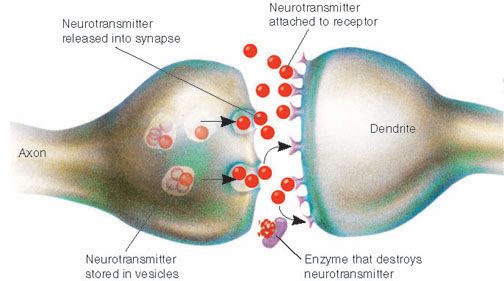
  • And for each neuron there are 1000 to 10, 000 synapses.

7a4efdec4c1a76004113fc4dcacf8fa3

But you, oh God, weren’t finished yet! You created within each of us wonderful and unique abilities. Just among our family you’ve designed a (n):

  • imaginative artist,
  • caring school psychologist,
  • attention-holding preacher,
  • passionate psychiatrist,
  • self-taught tech wizard, and
  • talented graphics designer

IMG_0596

(2010 — Shame on us for not having

a more recent photo of the whole family!)

How glorious to contemplate, O Lord, the breathtaking wonder of how we’re made. Hearts keep pumping, lungs keep breathing, nerve impulses keep sending messages–without a single voluntary thought. Our brains are capable of learning and storing an enormous amount of information. And everything works together in perfect unity.

I cannot begin to fathom your creativity, expert engineering, and attention to detail. Even if we were identical robots, we would have to stand in awe of your holy genius.

But you have made each person unique, designed to fulfill a specific purpose.

May I live close to you in order to be transformed day by day into the one you designed me to be.

*www.allaboutscience.org

Other sources: www.facts.randomhistory.com; www.health.howstuffowrks.com; www.icantseeyou.typepad.com, www.medindia.net; www.nursingassistantcentral.com; http://www.sciencekids.co.nz

Art & photo credits:  www.pinterest.com; http://www.youtube.com; http://www.tr.wikipedia.org; http://www.superteachertools.us; http://www.pinterest.com; Nancy Ruegg

Read Full Post »

(Steve and I are enjoying time with family this week.  I’ll return soon with  new posts.  Meanwhile, I’ll reblog previous ones.  Hopefully you’ll find them meaningful again, or perhaps for the first time.  The following post was first published June 13, 2013.)

From stage left, she crosses the platform in confident strides.  One hand waves in sweeping arcs to the large audience. The crowd claps and cheers.

In the other hand, with confident ease, she holds the microphone.  And the smile—big and broad, bright white teeth visible even from the balcony.

Able to sing like a nightingale and articulate truth with conviction. Impacting thousands.

Now there is someone God is using in a powerful way, whispers an accusing voice.  Look at her significant contribution in the Kingdom of God. No doubt she’s highly valuable to him.  So what are you doing that’s important?  Your spot in the scheme of things is nothing compared to that shining star on the stage.  You might as well face the truth:  You are unimportant.  The ship of Significance has passed you by.

Sound the least bit familiar? You’re not alone. Demons use those same lies on a lot of us. Evil spirits aren’t very creative, are they?

But here’s the truth of the matter:

Each of us is the workmanship of God (Ephesians 2:10). The Greek word, workmanship, sometimes has the connotation of “work of art.” You are a work of art—carefully designed and meticulously executed.

The verse goes on to explain we’ve been created to do good works. It does not say the same work. Diversity of personality, talent, and interest are necessary among the children of God in order that all his plans are accomplished.

He made each of us unique, to fulfill a personalized plan. Every now and then we see such a plan unfold so clearly, we know God engineered the circumstances. Sometimes it’s a unique set of talents or gifts that work together sublimely to meet a need.

Take, for example, the naturally talented writer, who happened to grow up in a bilingual home, and studied Christian Education in college. She was especially prepared by God to write Spanish curriculum for a Christian publishing company.

Other times the plan is much less obvious, and we must trust that the task before us–caring for our families, teaching that Sunday School class, working at the homeless shelter–is indeed accomplishing divine purpose.

What we can know for certain:  each of us is valuable to God (Matthew  10:29-31).

Believe that he has prepared in advance good works for you to do (Ephesians 2:10).  Take joy and satisfaction from completing those good works.

It may not be walking across a stage with a microphone. It might mean walking across the kitchen with a rolling pin—to bake cookies for the neighbors.

That’s just a small, insignificant thing, you say?

Think about this: What if God takes particular pleasure in small things?

Personally, I’m fascinated by small things. Miniatures, doll houses, petit-point, babies!

Scripture gives us indication that God does indeed love small things as well:

Sparrows (Matthew 10:29-31).

Two little mites given by a widow (Mark 12:41-44).

Five small barley loaves and two small fish (John 6:1-13).

Bethlehem (Micah 5:2).

Let’s never again allow those little demons of abasement to put us down. God has promised: “I will bless those who fear the Lord—small and great alike” (Psalm 115:13, emphasis added).

You see, in God’s sight, we’re of equal worth.

Read Full Post »

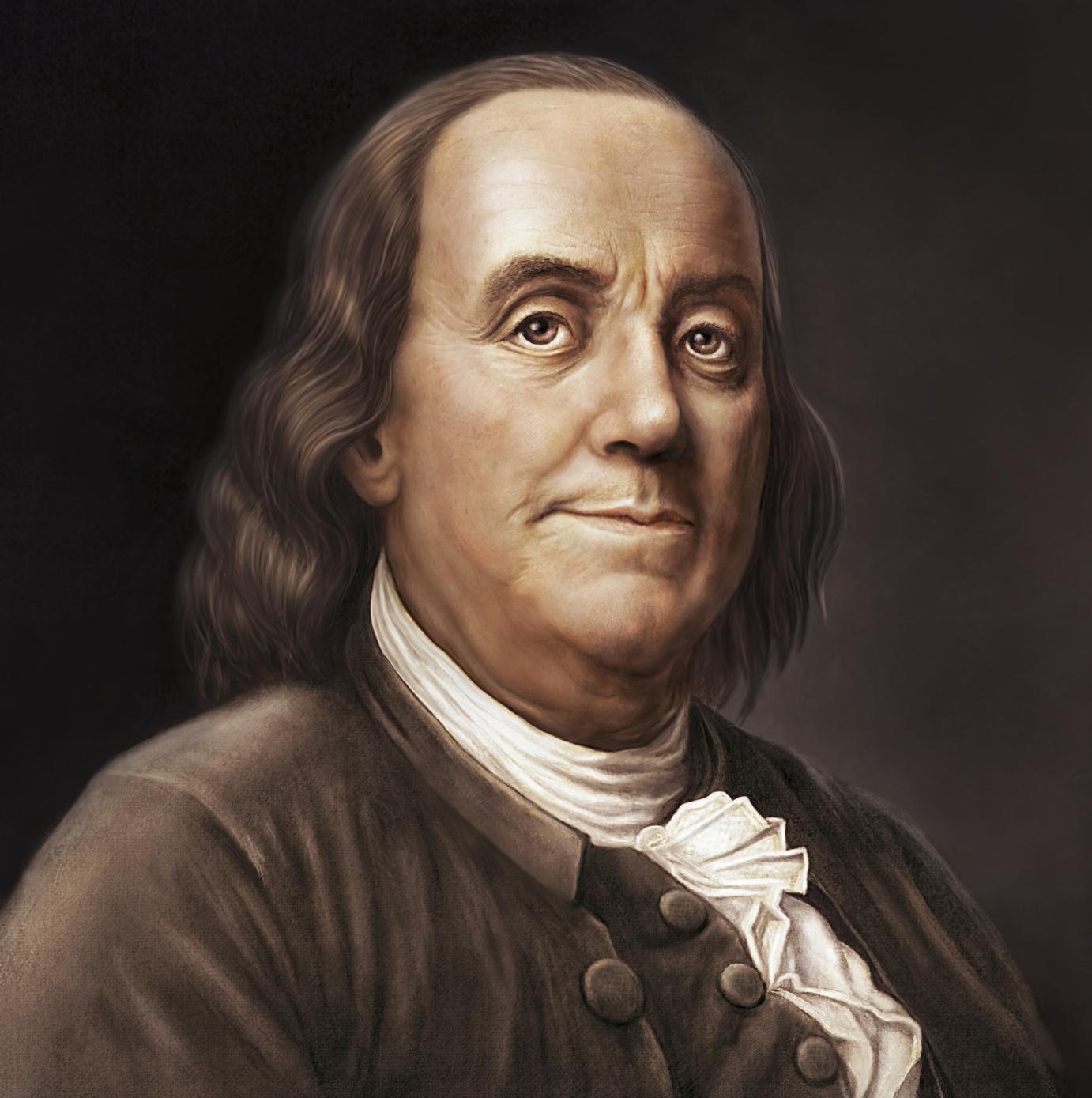
portrait_bf

Benjamin Franklin was the thirteenth child of a humble soap-and-candle maker. Obviously, no family fortune provided him easy success in life. Neither did a stellar performance in school that would lead to scholarships. His formal education lasted all of two years, from ages eight to ten. Yet Ben became:

  • a respected publisher
  • the country’s first millionaire
  • a world-famous scientist
  • an influential voice as the thirteen colonies fought for independence and established a nation
  • a distinguished diplomat in Europe

No wonder Franklin was proclaimed a self-made man. But there are other factors, outside his control, that contributed to his success, including:

INTELLIGENCE

His varied accomplishments as writer, statesman, and diplomat prove his sharp intellect.

CHARACTER

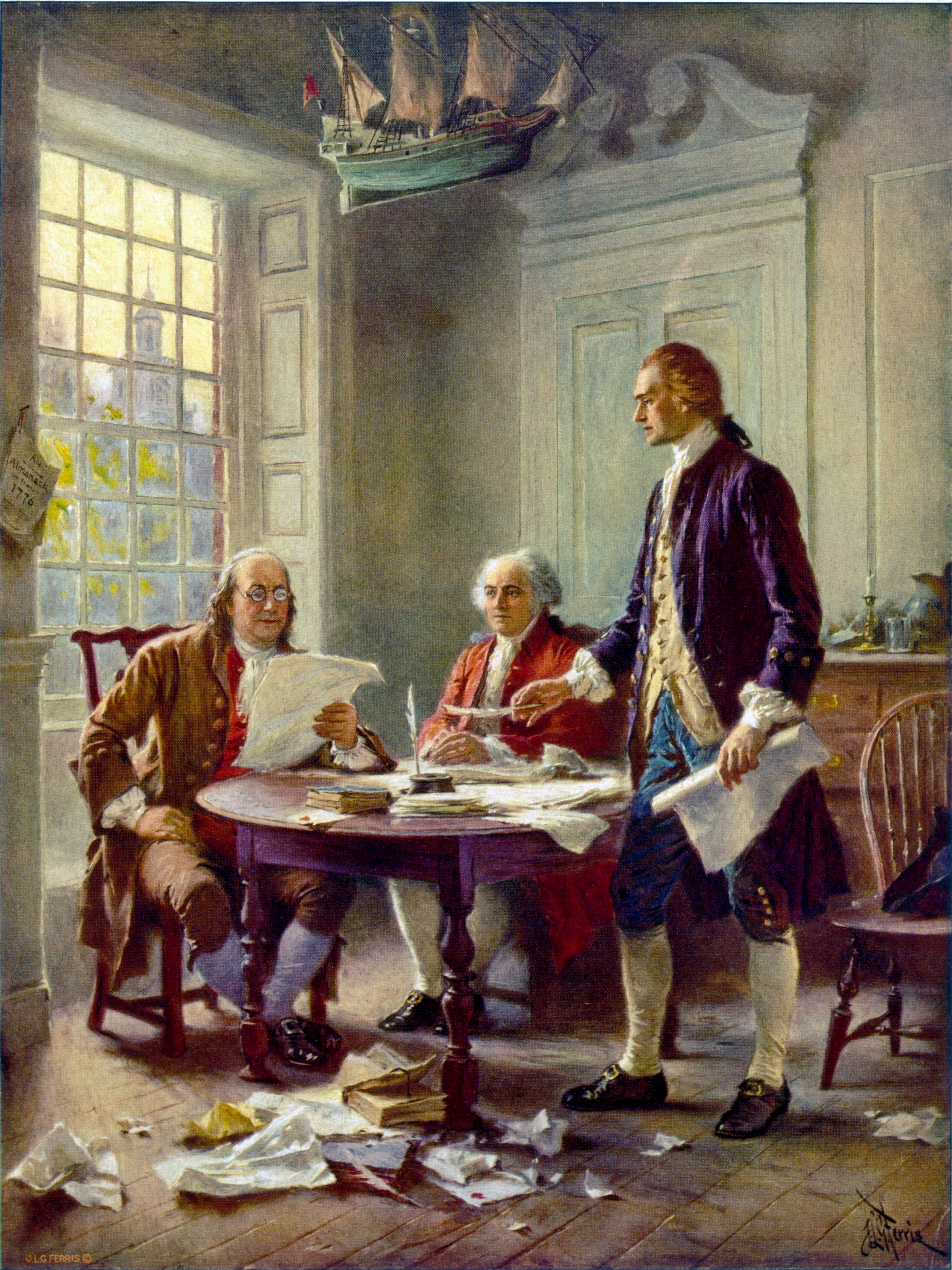
Ben was  curious and skeptical–useful attributes for a scientist. His astuteness, sense of humor, and ability to communicate served him well as publisher of Poor Richard’s Almanac. And all of these traits came into play when Franklin participated in the forming of our nation.

Writing_the_Declaration_of_Independence_1776_cph.3g09904

TEMPERAMENT

Surely Ben was an energetic and passionate individual. He was always in pursuit of something—things like:

  • Solving problems. Numerous inventions credited to Franklin grew out of need. For example, his desire to create more heat in his home led to his invention of the wood stove.
  • Acquiring new knowledge. Ben attempted his well-known key-and-kite experiment because of his curiosity about lightning.
  • Improving the lives of his fellow colonists. Franklin wrote, met with other delegates, sought the help of France, and more, in America’s struggle to gain independence from England. In 1789, at age 84, he was still writing and working. His cause? The abolition of slavery in America.

OPPORTUNITY

Franklin was often in the right place at the right time. One example: through his connections in the publishing industry of Philadelphia, Ben secured a contract to print the colony’s paper money.

Seems that Ben’s success had much to do with factors outside his control. These elements just mentioned–intelligence, character, temperament, and opportunity–came from God. In fact, for all of us, “Our sufficiency is from God” (2 Corinthians 3:5).

28847

In reality, the idea of a self-made man/woman is myth. No one is truly self-sufficient.

On the other hand, God has ordained work and effort. From beginning to end, scripture proclaims the value of industry. In Genesis 2:15 we see God placing Adam in the Garden of Eden to tend and keep it. In 2 Thessalonians 3:10, Paul says, “If a man will not work, he shall not eat.”

So how do we balance working with our God-given abilities and depending on God?

  1. Pray.  Thank God for the gifts he has given us.  Then prayerfully seek to determine what God is doing and cooperate with him. If we are earnest in this desire, he’ll make each step clear. As seminary professor, Howard Hendricks, used to say: God does not play hide-and-seek in the trees with his will.
  1. Nourish.  The effectiveness of our giftedness requires preparation and inspiration. Preparation includes study and practical experience. (Even a talented pianist must take lessons and practice.) Preparation includes nourishing the spirit, too, with study of scripture and practical experience of worship and service. Inspiration comes from the Holy Spirit as he works within us.
  1. Embrace.   Embrace the teaching of wise, godly leaders. Embrace the help of others. Keep in mind that self-sufficiency is not a praiseworthy quality; it’s a form of pride. The person who thinks he knows everything and needs no input, or who is too proud to ask for help, is someone to be pitied, not celebrated.

As dependents upon God, we are meant to work. As workers, we are meant to be dependent upon God.

And…

13498c445c1e1c4e8f0c84056a33f287

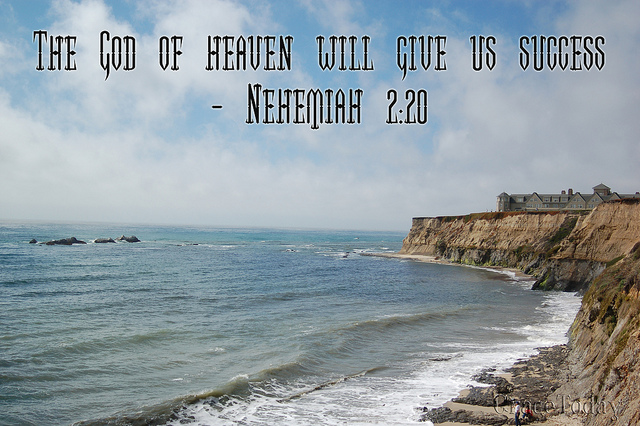
(“The God of heaven will give us success”–Nehemiah 2:20)

*     *     *     *     *     *     *     *     *     *

I praise you, Father, for being my all-sufficient God, Someone I can trust completely for guidance, direction, and training. Help me find that balance between working for you and depending on you. May I not neglect preparation, but also look to you for inspiration.  And may I be a humble, grateful recipient of help.  Amen.  

Read Full Post »

“You have given me the shield of your salvation,

and your right hand supported me,

and your __________ made me great.”

–Psalm 18:35 (EST)


What word would you put in that blank?

  • Power?
  • Grace?
  • Mercy?


The word chosen most often by translators* may surprise you. It certainly surprised me.

“Your GENTLENESS made me great.”

In addition to being surprised, I was puzzled. How can God’s attribute of gentleness make a person great?

A good place to begin our search for understanding is the background of this psalm.  It was written by King David, perhaps during his later years. He may have been pondering the incredible progression of his life from lowly shepherd boy to exalted king.


89446669


Surely young David never even daydreamed of becoming the most powerful man in Israel, as he sat on the hillsides of Bethlehem watching over his father’s sheep.

Neither could he have known at least fifteen years would pass between his anointing as king (a ceremony indicating a setting apart) and his actual coronation.

And contrary to human logic, those intervening years would not be spent as a student in preparation, but as a fugitive and outlaw, running for his life.  Seems like such a waste of time, doesn’t it? As David hid from King Saul in the Cave of Adullam, did he wonder, Lord God, what ARE you doing?

In hindsight we can see that God was gently teaching and preparing David his way, with practical, hands-on lessons such as:


d61f0ae266f6e653dd1702ccdb3a4b40


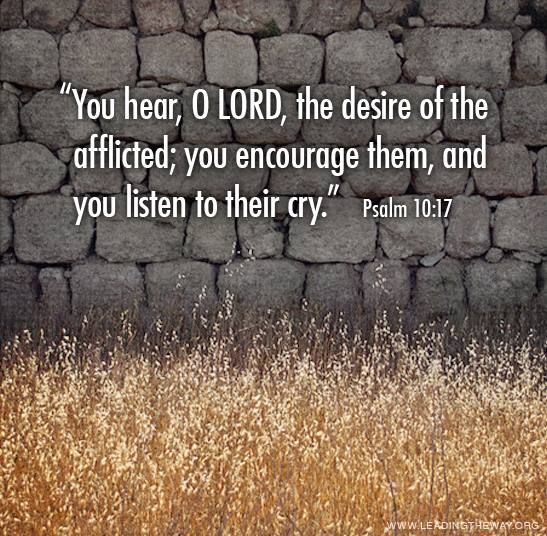
  • The Lord hears the prayers of the afflicted and encourages them (Psalm 10:17).
  • The Lord’s unfailing love can be trusted (Psalm 13:5).
  • The Lord gives wise counsel (Psalm 16:7).
  • The Lord is like a rock. His people can take refuge in him (Psalm 18:2).
  • There is no need to fear evil, because the Lord is always present with his own (Psalm 23:4).

One definition of gentle is “considerate or kindly.” God certainly demonstrated gentleness of this nature by endowing David with certain character traits–traits that would serve him well as monarch over Israel:


david-goliath-carousel


  • Courage—most obvious, perhaps, when teenaged David took on nine-foot-plus Goliath (1 Samuel 17)
  • Perseverance—when he spent those years waiting for God’s plan to be fulfilled, all the while fleeing from Saul’s vengeful rage (1 Samuel 19-2 Samuel 1)
  • Cleverness—on display when David pretended madness in order to avoid death at the hands of the Philistines (21:10-15)
  • Restraint—when he twice resisted the opportunity to kill Saul before the king killed him (chapters 24 and 26)
  • Respectability—During his years as a fugitive, six hundred men gathered in support of David and fought with him (27:3-4).


Another definition of gentle is “tender hearted.” No doubt it was with a tender heart that God:

DAVIDHARP


  • Bestowed upon David  the gifts of poetry and music (1 Samuel 16:18)
  • Demonstrated his wonderful love (Psalm 31:21)
  • Forgave David (32:1-2)
  • Remained faithful to him (57:3)
  • Protected David in the shadow of his wings (61:4)


But here’s even better news about God’s gentleness: It wasn’t reserved just for David or other Bible heroes. God displays his gentle nature to all of his children, every day.

In hindsight, we, too, can often see God’s gentle teaching and preparation for what he has called us to do. (If you’re in the middle of that process, rest assured those tough life-lessons you’re enduring now will not be for nothing!)

Second, with kind and gentle consideration, God has bestowed upon each of us specific character traits that qualify us to accomplish his plans. (And that plan isn’t complete until we hear the angels sing!)

Third, God has surely demonstrated his gentle, tender-hearted love for us, beginning with the death of his Son on a cross and ending with…

…well, there is no end to his faithfulness, grace, mercy, attentive care, peace, joy, and more.  How glorious is that?

And though it’s very doubtful you or I will ever be great monarchs like David, we can aspire to greatness in God’s eternal kingdom.

How? By serving him wherever we are with the specific gifts and traits he has given us.

Jesus spoke that truth very clearly:


deb571b6619a70af4ad01348af4191b3

(“The greatest among you will be your servant.” –Matthew 23:11)


*     *     *     *     *     *     *     *     *     *

I praise you, God, for your gentleness that tenderly prepares us for our purpose, kindly endows us with attributes for that calling, and graciously showers us with the benefits of your character, all throughout life.

Help me, I pray, to be compliant under your tender hand, ready and willing to follow your gentle lead, and generous to bestow upon others the graces of your character which I have enjoyed.  Amen.


(Photo and art credits:  www.panoramio.com; http://www.pinterest.com; http://www.donnarios.com; http://www.plusii.blogspot.co.uk; http://www.pinterest.com.)


* www.biblehub.com provides easy access to twenty translations of the Bible. Fifteen out of twenty include the word “gentleness” at the end of Psalm 18:35, or a synonym: humility, lowliness, or meekness.

Read Full Post »

“You have made man a little lower than the heavenly beings…

You made him ruler over the works of your hands…

All the beasts of the field, the birds of the air, and…

All that swim the paths of the seas” (Psalm 8:5-8, italics added).


4553514-More-Underwater-Fish-1


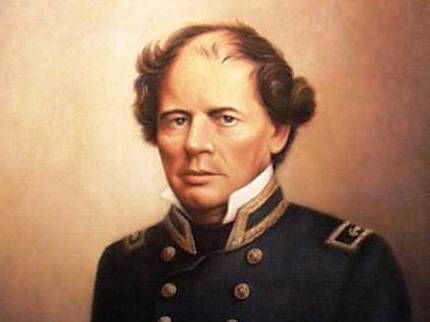
“Paths of the seas.” What might that refer to?  That question crisscrossed Matthew Maury’s mind frequently.

Maury had always loved the sea, prompting him to join the U.S. Navy at age 19, in 1825.

Life at Sea

The second ship on which he served, the Vincennes, included a library. Matthew was eager to learn and spent his spare time studying navigation. Sometimes he chalked out problems in spherical geometry on cannon balls. When the Vincennes circumnavigated the world, Matthew received practical experience in the subject.

Upon returning to the States, Matthew took an examination in navigation and passed. He was then appointed acting sailing master on the Falmouth. Along with the ship’s commander, he was responsible for navigating the course, steerage, and sail trim.

Next Matthew determined to learn about winds and currents. He discovered that no one had charted such information for the treacherous Cape Horn off the southern tip of South America. He kept meticulous records during the voyage and wrote about his findings in a paper, published by the American Journal of Sciences and the Arts.

In 1834, Matthew married Ann Herdon, and they settled in Fredericksberg, Virginia.

Maury’s life was certainly following a positive trajectory. And no doubt, as a strong Christian believer since boyhood, he saw each new opportunity as a blessing from God.

Plan B

But in 1839, Matthew was injured in a stagecoach accident.  The final result:   permanent lameness.  Never again would Maury be able to work aboard a naval vessel.  His career came to an abrupt end, and Maury fell into despair.

Surely he must have wondered, What am I to do, Lord? The sea is all I know.

But Maury did not allow his despair to debilitate him. He used his convalescence to continue studying navigation, meteorology, winds, and currents.

Was God behind that compulsion? Perhaps so. In 1841, Maury was offered a position as manager of the U.S. Naval Observatory and the depot for charts and instruments. This position was perfect for him, requiring the exact knowledge and abilities he had acquired.


4 arthur


In 1852-1853, Maury brought together ten major maritime powers of the world. In unanimous agreement, they began to compile unified records benefiting all mankind. For the next thirty-five years, more than a million ships’ logs were sent annually to the observatory. From those records were developed wind and current charts for the globe.

Pathfinder of the Seas

Meanwhile, Maury sought for the meaning of that mysterious phrase in Psalm 8:8, “the paths of the seas.”

As he studied those ships’ logs being sent to the observatory, he compiled charts of ocean-wind and sea currents. He set adrift weighted bottles that would float slightly below the surface of the water, where they would not be impacted by wind.

Instructions inside each bottle informed the person who found it to return the bottle, with the location and date of its discovery. From his charts and experiments, Maury was able to determine the “paths of the seas,” including the Gulf Stream.

Pathfinder of the Wind

Maury also proved the truth of Ecclesiastes 1:6:

“Blowing toward the south, then turning toward the north, the wind continues swirling along; and on its circular courses the wind returns.”

Further study and experiments indicated that the wind did indeed move in circular patterns. Today we call them jet streams. Maury’s investigations led to a better understanding of weather, and predictions became more reliable.

Plan C

But despair entered Maury’s life again when the United States declared civil war. As a citizen of Virginia, he felt obligated to side with the South, giving up the position in Washington at his beloved observatory. Jefferson Davis, President of the South, sent Maury to England as an ambassador for the Confederate States.

After the war Matthew spent three years exiled in England. Many honors were conferred on him during that time, but his heart was still in the U.S.

Did he wonder once again what God might be planning? Perhaps he prayed, “Lord, if it be your will, arrange circumstances so that we may return to America.”

In 1868, the U.S. offered general amnesty to ex-patriots and Matthew sailed back to the States. He accepted a position at Virginia Military Institute as professor of meteorology, a position he held from September 1868 to the day he died, February 1, 1873.


maury2187


Matthew Fontaine Maury, a self-taught navigator of the seas, astronomer, meteorologist, author, and educator, always sought to prove:

“The Bible is true and science is true,

and therefore each, if truly read,

but proves the truth of the other.”

–Matthew Maury


And though he may not have set out to do so, Maury also proved:

“I know the plans I have for you, plans to prosper you and not to harm you, plans to give you hope and a future” (Jeremiah 29:11).

With the advantage of hindsight, we can readily see this promise grandly fulfilled in Maury’s life. Yes, he suffered pain and hardship. All saints of God do (Romans 8:17).

But! God brought Maury through every challenge and used him in mighty ways—ways that impact our world to this day.

*     *     *     *     *     *     *     *     *     *

Lord, I am deeply grateful you are the one who plans each of our lives. What comfort to know that an all-seeing, all-wise God is orchestrating not only the main events of life, but every single day. I pray for your grace, in order to be accepting of disappointments, knowing that you will bring good out of every situation. In fact, you may very well be preparing something important. I want to trust you without hesitation.

(Psalm 139:16; Romans 8:28; Ephesians 2:10)


Sources:  The Founders’ Bible, https://answersingenesis.org; http://www.cbn.com; http://www.creation.com.)

Photo and art credits:  www.travelblog.org; http://www.firstladies.org.)

Read Full Post »

(In honor of Black History Month)


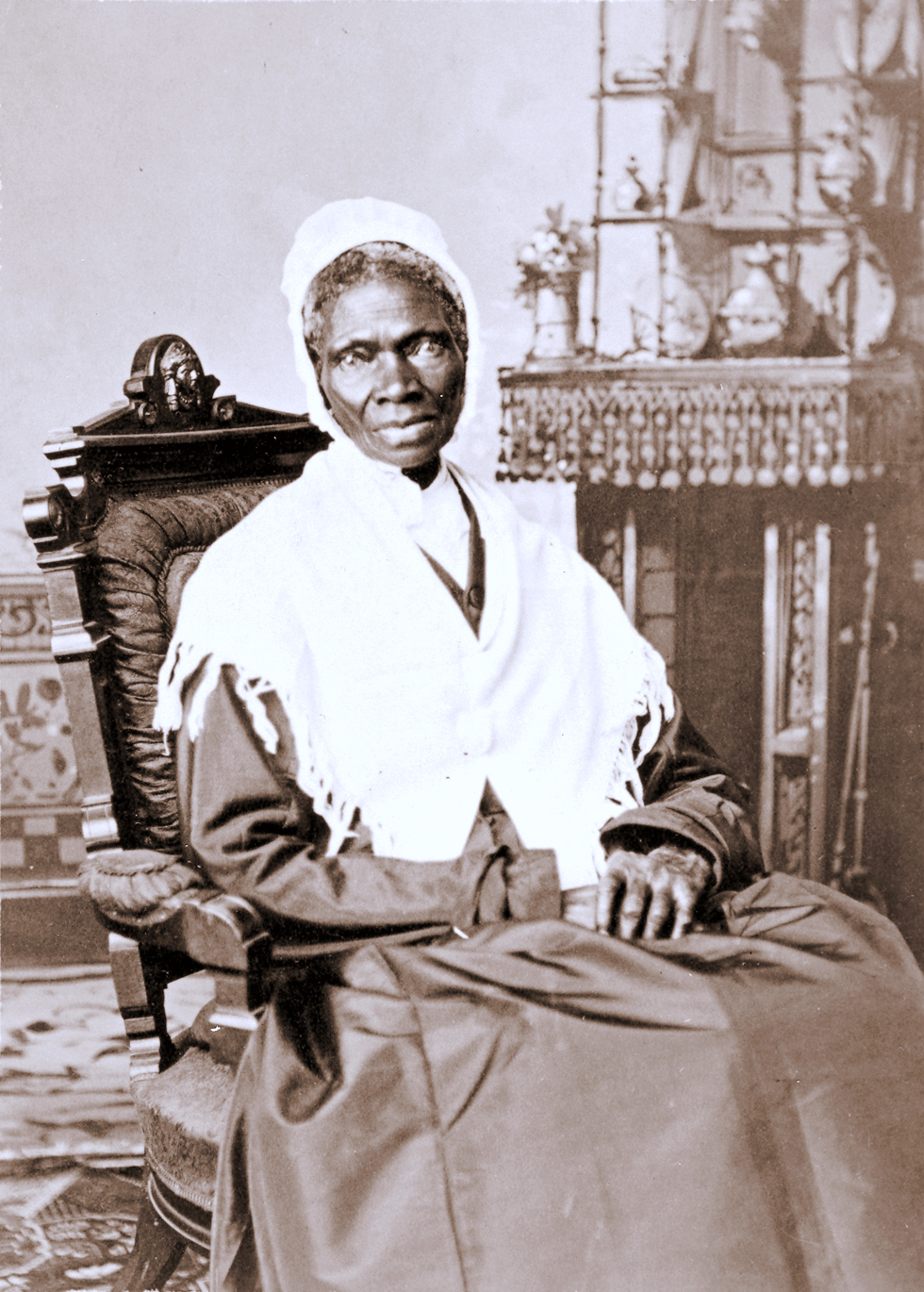
Isabella, the daughter of James and Elizabeth Baumfree, was born a slave in New York state about 1797. No one knows the exact date, because birth records weren’t kept for “property.”

Did her parents know the name means, “consecrated to God?” Even if they chose the name for its meaning, those parents could not have dreamed of the future awaiting their Baby Belle.

Her early years were difficult.  Belle was sold five times, several times to cruel masters.

At age eighteen or so, Belle fell in love with Robert, a young slave from a nearby farm. The couple had a daughter. But Belle’s master, John Dumont, forbade her to see Robert again. According to the law, all children of the union would belong to Robert’s master, not Dumont.

Two years later, Dumont forced Belle to marry an older slave. They had three children: Peter, Elizabeth, and Sophia.

In 1826, Belle escaped the Dumont farm with Baby Sophia. In a vision, God showed her a particular home to go to. That home belonged to a Quaker family, the Wageners, who took in the young woman and her baby. They even paid Belle’s price to Dumont and made her a free woman. Belle became a housekeeper, then a maid.

Shortly after her escape from slavery, Belle learned that her five-year old son, Peter, had been illegally sold in Alabama. She took the matter to court and won her case. Peter was returned to New York. That was the first time a black woman challenged a white man in a U.S. court. It was also the first time of many that Belle’s resolve and courage were put on display.

Several years later Belle was falsely accused of poisoning her former employer. In 1835 she took that case to court and won again.

Someone must have encouraged Belle to tell her story of being a slave and becoming a free woman. But she had never learned to read or write, so a friend wrote as Belle dictated. A Northern Slave was published in 1850.

In her book, Belle explained that several years after she was freed, God revealed himself to her, “with all the suddenness of a flash of lightning, showing her, in the twinkling of an eye, that he was all over, that he pervaded the universe, and that there was no place where God was not.”

The book sold many copies and Belle became well-known. She was asked to speak at a women’s rights convention in Massachusetts. Before long, Belle was traveling with abolitionist, George Thompson, speaking against slavery and for human rights.

In 1851, Belle gave a speech at another women’s conference, this time in Ohio. She spoke convincingly (and extemporaneously) about women being every bit as capable as a man:

“I have plowed and reaped and husked and chopped and mowed, and can any man do more than that?”

And, no doubt with a twinkle in her eye, she added:

“As for intellect, all I can say is, if a woman have a pint, and a man a quart — why can’t she have her little pint full? You need not be afraid to give us our rights for fear we will take too much, for we can’t take more than our pint’ll hold. The poor men seems to be all in confusion, and don’t know what to do. Why children, if you have woman’s rights, give it to her and you will feel better. You will have your own rights, and they won’t be so much trouble.”

She concluded by asking: “And how came Jesus into the world? Through God who created him and the woman who bore him. Man, where was your part?”

It’s not surprising that some were displeased with Belle’s speeches. One time she was told that the building where she was to preach would be burned down if she dared to speak. “Then I will speak to the ashes,” she replied.

Belle was also physically assaulted. One brutal attack caused permanent injury, and she had to walk with a cane for the rest of her life.

In 1863, Harriet Beecher Stowe wrote an article about Belle for the Atlantic Monthly:

“I do not recollect ever to have been conversant with anyone who had more of that silent and subtle power which we call personal presence…She seemed perfectly self-possessed and at her ease. An audience was what she wanted—it mattered not whether high or low, learned or ignorant. She had things to say, and was ready to say them at all times, and to anyone.”

Imagine. A slave woman who never had the opportunity to go to school, never learned to read or write. Yet the power of her spoken word helped bring the end of slavery and pave the way for women to be granted the right to vote.

Belle proved:

“There is no difficulty that cannot be defeated.

There is no victory that cannot be achieved,

if you believe in the power of God!”

— Anonymous

Of course, by the time she achieved notoriety, Belle was known by another name.

You see, Belle had asked God for a new name several decades before the Civil War. Again, it was the result of a vision. She said God chose her new first name based on the fact she would travel. Then Belle asked God for a second name, “’cause everybody has two names.” And the Lord granted her request. Her second name proclaimed what Belle always declared from her podium.

Perhaps you remember Sojourner Truth.


Sojourner_truth_c1870

(Photo from http://www.wikipedia.org.)


Sources:  www.biography.com; http://www.sojournertruth.org; http://www.; http://www.blackpast.org; http://www.americanswhotellthetruth.org; http://www.christianitytoday.com.)

Read Full Post »

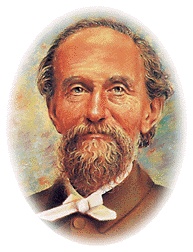
His name keeps popping up in books and blog posts: Andrew Murray.

His words are thought-provoking:

  • “Never try to arouse faith from within. You cannot stir up faith from the depths of your heart. Leave your heart, and look into the face of Christ.”
  • “Abiding fully means praying much.”
  • “Just as water ever seeks and fills the lowest place, so the moment God finds you abased and empty, His glory and power flow in.”

So who was this deeply thoughtful man, Andrew Murray(1828-1917)? Did his conversion experience turn him around 180 degrees like Paul’s? Did he face great danger like David or Daniel? Did he impact throngs of people with his preaching like Jonah or John the Baptist?


andrew_murray-gif


No. According to the Christian Classics Ethereal Library (www.ccel.org), Andrew grew up in a Christian home. No spectacular transformation from unbeliever to saint.

His father was a Scottish Presbyterian minister who served in the Dutch Reformed Church of South Africa. Andrew became a pastor himself and served several pastorates, also in South Africa.

Andrew helped found two schools, made several evangelistic tours of South Africa, and received an honorary doctorate for his contributions to world missions. Today he is best known for his devotional writings, found in the 240 publications to his credit.

Not a shabby list of accomplishments, but Andrew faced no giants or lions. There are no cliff-hanger stories to tell about him. He simply served God faithfully where he was.

No doubt there are some who would skim-read such a biography, yawn, and seek more exciting stories–Adoniram Judson’s or David Livingstone’s.

Andrew Murray may have written some thoughtful books and essays, but let’s face it. His life-story borders on ho-hum ordinary.

But wait. The Bible and annals of history are overflowing with the stories of ordinary people such as:

  • Jethro, a shepherd. Yet his wisdom greatly assisted his son-in-law–Moses (Exodus 18:1-27).
  • Mordecai, a captive. However, he was in the right place at the right time to hear of a plot against the Jews (the book of Esther).
  • Lydia, a dealer in fine purple cloth and dye. She just happened to provide housing for Paul and Silas, and became the first convert—in all of Europe (Acts 16).

No doubt these people considered themselves just ordinary folk. But God used them in astonishing ways.

The truth is, there is no such thing as an ordinary person in God’s kingdom.

So, guess who’s talking when that voice in your head whispers, “You are a nobody. You aren’t accomplishing anything worthwhile in your life.”

It’s not God!

He placed within each of us wondrous, unique gifts. Would God do that if we were worthless?

Second, he placed us within a circle of influence that includes family, neighbors, friends, church acquaintances, business contacts, and more. (And let’s not forget the ripple effect.)

Third, God provides opportunities within that circle for us to use our gifts, be a blessing to others, and  bring him praise.

So whether God ordains you or me to be a leader or follower, a platform personality or a behind-the-scenes helper, a larger-than-life Paul, or a lesser-known Andrew Murray, we each have a unique niche to fill—especially designed by God himself.


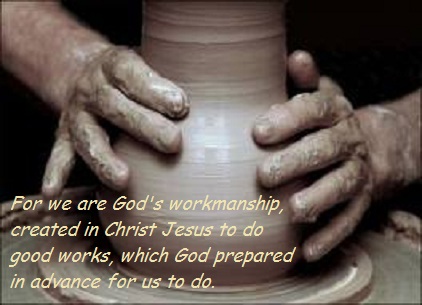
potter


For we are God’s workmanship, 

(Think of it—we are the handiwork of the Master Designer!)

Created in Christ Jesus to do good works, 

(Works that will bring glory to God and supreme satisfaction to our hearts.)

which God prepared in advance for us to do (Ephesians 2:10).”

(Availing ourselves to what he’s prepared results in supremely worthwhile accomplishment.)

*     *     *     *     *     *     *     *     *     *


Thank you, Father, for gifting each of us with unique abilities to fulfill your specially designed plans. Thank you that in your kingdom there is no such thing as ho-hum ordinary, because you, the Master of the universe only create masterpieces! May our joy be centered in faithfully completing the works you have prepared for each of us.


Art and photo credits:  www.newparadigmthinkers.wordpress.com; http://www.dayofgrace.me.)       


Read Full Post »

Washington_Constitutional_Convention_1787


On September 17, 1787, George Washington took up a quill and signed the Constitution of the United States of America. He was the first of thirty-three convention delegates to endorse the document that day.


Most Americans probably don’t realize that this Wednesday is the anniversary of that important event.  Chances are they do not realize how close we came, the summer of 1787, to dissolving into small factions and losing our identity as the United States of America.

I certainly wouldn’t have been aware, except I read Catherine Drinker Bowen’s book, Miracle of Philadelphia over the summer.  Our constitution does indeed qualify as a miracle of creativity, wisdom, compromise, and forward thinking–all wrapped up into one.

The young delegates (average age, 43) had begun their deliberations at the end of May. As the summer heated up (many days were oppressively hot), so did the discussions. Their task seemed impossible: create a strong national government that could support and stabilize the states, yet limit that government in order to honor states’ rights.

For almost four exhausting, uncomfortable months the men debated issue after issue, including: 1) slavery, 2) representation in the legislature, 3) whether the executive branch should be a committee or one man, and 4) whether a bill of rights should be included.

It was the dispute over representation that really caused tempers to flare. Some delegates were concerned that large states would lord it over small states in a legislature of equal representation.   Other delegates thought proportional representation based on population was the fairest method.

The two opposing sides hurled arguments back and forth with no compromise in sight. According to Georgia delegate, William Few, “It was an awful and critical moment. If the Convention had then adjourned, the dissolution of the union of the states seemed inevitable.”

What kept them from adjourning? Perhaps it was the strong appeal of an elder statesman in attendance, encouraging the delegates to press on–with God’s help.  Following is an excerpt. (Note the twelve phrases and references borrowed from Scripture):

In this situation of this assembly, groping, as it were, in the dark to find political truth, and scarce able to distinguish it when presented, how has it happened that we have not once thought of humbly applying to the Father of Lights to illuminate our understandings?

In the beginning of the contest with Britain when we were sensible of danger, we had daily prayers for the Divine Protection. Our prayers were heard and were graciously answered. All of us who were engaged in the struggle must have observed frequent instances of a superintending Providence in our favor…

…And have we now forgotten that powerful Friend? Or do we imagine we no longer need His assistance? I have lived a long time; and the longer I live the more convincing proofs I see that God governs the affairs of men.

And if a sparrow cannot fall to the ground without His notice, is it probable that an empire can rise without His aid?

We have been assured in the Sacred Writings that except the Lord build the House, they labor in vain that build it. I firmly believe this; and I also believe that without His concurring aid, we shall succeed in this political building no better than the builders of Babel…and we ourselves shall become a reproach and a byword down to future ages (from The Papers of James Madison, 1840).

Those words came from a delegate known for his wisdom and political savvy, one of the most highly respected men in America: Benjamin Franklin.

Another delegate, Mr. Randolph of Virginia, proposed that “thenceforward prayers be used in ye convention every morning” (according to James Madison’s notes).

The Great Debate continued, arguments still broke out, Alexander Hamilton wrote that the crisis was alarming and he “almost despaired.” But the delegates did indeed press on. On July 16, the final compromise was voted upon and passed. The Senate would have two members from each state; the House of Representatives would be based on population, one member for every 40,000 residents.

Slowly but surely, over four months of grueling deliberation, these young visionaries hammered out a new form of government comprised of three branches: executive, legislative, and judicial. They strove for careful balance of power between those three branches, as well as between the federal government and the states.

The Constitution of the United States of America is the oldest written constitution in the world. It has stood the test of time, as a result of the collective genius of the delegates. They persevered to create a flexible document that could adapt to change as the decades passed.

And undoubtedly Benjamin Franklin has been proven right:

Without [God’s] concurring aid, we shall succeed in this political building no better than the builders of Babel…and we ourselves shall become a reproach and a byword down to future ages.

On the contrary, with God’s aid providing that collective genius, those resolute patriots created the foundation for the greatest nation on earth.


(For those interested in the scriptures Mr. Franklin alluded to in his speech, they include:  Job 12:25; James 1:17; James 1:5; Luke 12:6; Psalm 75:7; Daniel 4:17; Psalm 127:1; Genesis 11:1-9; Deuteronomy 28:37; 1 Kings 9:7; 2 Chronicles 7:20; Psalm 44:14).


Art credit:  wwwlwikipedia.com.   Sources:  The Founders’ Bible, Shiloh Road Publishers, 2012; Miracle at Philadelphia by Catherine Drinker Bowen, Little, Brown and Company, 1986; The Story of America, Reader’s Digest Association, 1975).


Read Full Post »

Does your to-do list for tomorrow include such items as:

  • Send birthday, get-well, or encouragement cards?
  • Attend a meeting or rehearsal at church?
  • Prepare for teaching a Bible study or Sunday School lesson?
  • Pick up your husband’s prescription?
  • Prepare for dinner guests?

Young woman cooking in her kitchen

Our days are often filled with small deeds. We tend to think they’re insignificant and therefore, so are we.

But that negative evaluation is not from God!

“Who despises the day of small things?” he spoke to Zechariah (4:10).

In fact, evidence indicates that God loves to take small, seemingly insignificant actions, and use them in creative, powerful ways:

  • A piece of wood thrown into bitter water turned it sweet (Exodus 15:25).
  • A cord hung from a window saved a family from destruction (Joshua 2:17-21).
  • An army of 300 defeated a powerful enemy, just by blowing trumpets and breaking clay jars to expose torchlight (Judges 7).
  • A dab of mud applied to a man’s blind eyes restored his sight (John 9).
  • Paul’s handkerchiefs and aprons became healing agents as they were laid upon the sick ((Acts 19:12).

mud

It doesn’t matter that we’re not famous, wealthy, intellectual, or strong, because it is “‘Not by might nor by power, but by my Spirit,'” says the Lord Almighty” (Zechariah 4:6).

Might = strength, resources, and ability.  If that describes you, wonderful!  But those blessings alone will not guarantee significance.

Power = persistence, resolve, and consistency.  Again, if you are able to power through with effort and efficiency to accomplish much, terrific!  But what’s truly important is if the effort is achieving God’s purpose.

Granted, God has given us talents and gifts, opportunities and choices.  We must be prayerful and wise in the ways we use them.

John Wesley advised:

025-All-You-Can-John-Wesley

(“Do all the good you can, by all the means you can, in all the ways you can, in all the places you can, at all the times you can, to all the people you can, as long as ever  you can.”)

Just remember:  apart from the Lord Almighty, we accomplish nothing worthwhile (John 15:5).

On the other hand, little is much–IF God is in it.

He rejoices in what is right, you see, not necessarily in what is big.

So, when you feel like a nobody who’s accomplishing nothing, be mindful of this:

Does the place you’re called to labor

Seem small and little known?

It is great if God is in it

And He’ll not forget His own.

–Kitty Suffield

(Art & photo credits:  www.whattoexpect.com; http://www.auyouth.com; http://www.kokabella.com.)

Read Full Post »

« Newer Posts - Older Posts »

When the House is Quiet

Impressions Becoming Expressions

Mitch Teemley

The Power of Story

Still Traveling

Impressions Becoming Expressions

Living Our Days

Gaining a heart of wisdom

He Said What?!

I'm Patty, and my husband and I are living with our adult son who has autism and epilepsy. I love sharing lessons learned from life around me, especially life with Aaron.

Meditations of my Heart

Impressions Becoming Expressions

Linda Stoll

Impressions Becoming Expressions

Signora Sheila

Where faith meets la dolce vita

Heidi Viars

Finding the Image of God