Feeds:
Posts
Comments

Archive for the ‘Praise’ Category

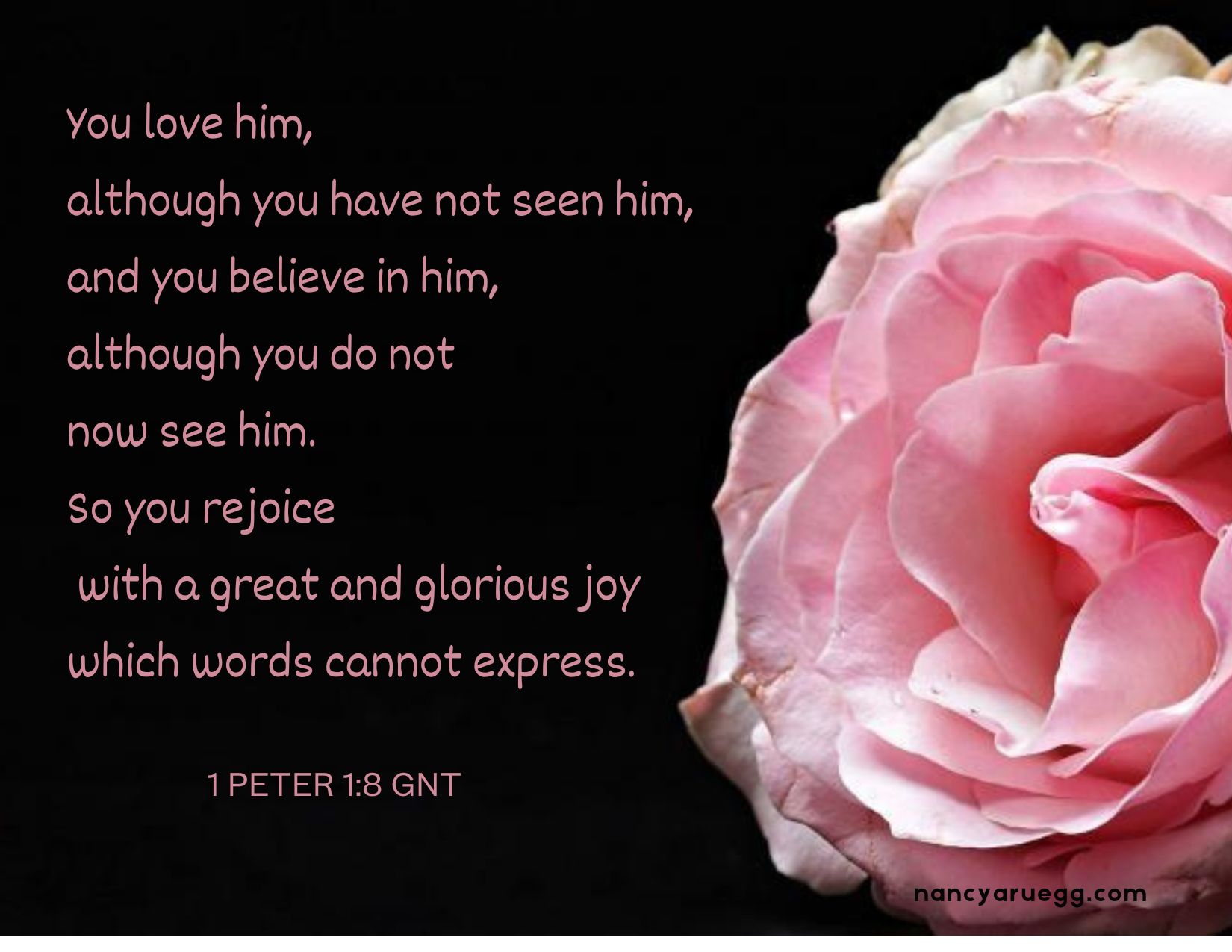
I praise you, Lord Jesus, for surrendering all the glorious perfections of heaven, to live among us with all our un-glorious imperfections [1].

Also astounding is your arrival as an infant, born to peasants, in a stable-cave. How ignoble for the King of kings, the Alpha and Omega who always was and always will be.

As Mary and Joseph tried to rest on scratchy straw, did they wonder, “How could this be part of your plan, Lord Jehovah? How could the Messiah fulfill his grand destiny from such lowly beginnings?”

Little did the couple know:

  • their helpless baby who could not stand “would one day walk on water” [2]
  • his little hands that could not grasp would one day break five rolls and two fish into pieces and feed five thousand people
  • their Child who could not speak would one day make the hearts of men burn within them as he spoke words of supernatural wisdom and insight
  • his flailing arms would one day spread wide on a cross, to save his people from their sins [3]

The depth of your humility and the magnitude of your sacrifice, Lord Jesus, overwhelm me.

I praise you for all the ways you demonstrated God’s character to us during your earthly ministry—his love, compassion, goodness, and more.

I praise you, Lord Jesus, for your power on display in the miracles you performed and those you continue to perform to this day, confirming who you are—not just a wise teacher or mystic but the Son of God.

I praise you for the glimpses of heaven we experience from time to time of what it will be like when all creation is “brought into the freedom and glory of the children of God,”–because of what you accomplished [4].

Such glimpses include:

  • The exquisite beauty of nature, causing us to gasp in wonder
  • The profound heart-to-heart connections we experience with other believers
  • The songs that move our spirits and cause tears of blissful joy
  • The sense of your presence—your encompassing and perfect shalom [5]

–C. S. Lewis (The Problem of Pain, 150-151)

I praise you, Lord God, that before time began, you’d already established the plan for your Son’s birth, ministry, death, and resurrection [6].

I praise you, Lord Jesus, for withstanding horrific suffering in our place, paying the penalty for our sins [7].

I praise you Heavenly Father, for your power over death, proven by the resurrection of your Son. He received a grand welcome back to heaven and now sits on his throne, receiving the honor, glory, and power he deserves [8].

I praise you for the promise—repeated many times through scripture—that upon our physical deaths, those of us who believe in Christ will live forever with you, surrounded by the wonders of heaven [9].

I praise you, Lord Jesus, we’ll even sit with you on your throne [10]!

Such an honor seems downright absurd, and yet there it is—promised and guaranteed in your infallible Word—promises we can trust, a guarantee we can believe in.

I pray that many will see:

And may many embrace you, O Christ, as their Prince of Peace and King of kings, to experience your shalom and joy. May they accept your gift of gifts: eternal life!


[1] Philippians 2:5-7

[2] From Mark Lowry’s carol, “Mary Did You Know”; see also Matthew 14:22-33 for one example

[3] Matthew 14:13-33; Luke 24:13-24; Luke 23:33; Matthew 1:21

[4] Romans 8:21

[5] Shalom includes not only peace, but complete well-being and wholeness

[6] Titus 1:2

[7] Romans 5:8

[8] Revelation 3:21

[9] John 3:16

[10] Revelation 3:21

[11] From a sermon, “The Great Birthday of Our Coming Age,” December 21, 1884.

Photo credits: http://www.freebibleimages.com; http://www.canva.com; http://www.heartlight.org; http://www.dailyverses.net; canva.com.

Processing…
Success! You're on the list.

Read Full Post »

As his father prayed, little Isaac peeked through his fingers to see what was causing a rustling sound. His eyes spied a mouse crawling up a bell-rope, and Isaac giggled.

After family prayers, Father wanted to know what had possessed his son to be so disrespectful.

“I saw a mouse running up the bell-rope, and it came to my mind:

There was a mouse for want of stairs,

‘Ran up a rope to say his prayers.”

Father was not amused and reached for the rod. Isaac fell to his knees and begged:

“Father, Father, pity take,

And I will no more verses make [1]!”

Neither the little poet Isaac Watts (1674-1748) nor his father could have known where the boy’s penchant for rhymes would take him.

As a late teen, Isaac complained often to his father about the tiresome, chanted hymns of the church. How was a person supposed to sing them with joy as the Bible-psalms often urged, when the music droned in a minor key?

From a 1600’s hymnal

Mr. Watts finally suggested he turn complaining into composing and create better melodies and lyrics. Isaac did, and over the next fifty-plus years more than six hundred of his hymns were published.

Some people found fault with Isaac’s contemporary worship songs. But at least several prominent leaders supported him, including Samuel Johnson, Cotton Mather, and John Wesley [2].

Isaac Watts

Probably the best known of Watts’ hymns is “Joy to the World,” although Watts never set it to music. Decades later Lowell Mason felt inspired to do so and upon publication in 1848, the song soon became a beloved Christmas carol.

Some insist this hymn has no place in the carol-category, because Watts included no elements of the Christmas story in the lyrics.

But as Alyssa Poblete points out: This song celebrates what Christ came to do. And along with looking back at the grace accomplished in the past, we also look forward to the grace accomplished for our future, to the ultimate joy to be revealed [3].

That enlightenment helps explain that puzzling first line, “Joy to the world, the Lord is come” (emphasis added). I’ve often wondered why Watts didn’t choose “has come.”

Ms. Poblete gives us indication. God’s grace (explained in part by the acronym, God’s Riches at Christ’s Expense) is active in all of time—past, present, and future.

Our Messiah’s birth was long-promised for centuries. His coming ushered in a new kingdom of Light. Those who believe in Jesus gain release from the kingdom of darkness, and one day that evil kingdom will be utterly destroyed [4].

In addition:

Christ’s coming is an ever-present and ongoing engagement in the world.

–Darrow L. Miller [5]

The Lord didn’t just come. He is here! And we can sing with dazzling Christmas joy because:

  • One day the whole earth will receive her King. Therefore, let heaven and nature sing (v. 1) [6]
  • The Savior reigns forever and ever (v. 2) [7]
  • Sins and sorrows will be no more, when Christ returns (v. 3) [8]
  • He comes to make his blessings flow (v. 3) [9]
  • He rules the world with truth and grace (v. 4) [10]
  • The glories of his righteousness and the wonders of his love are on display everywhere (v. 4) [11]

These musicians capture well the dazzling joy of knowing our Savior reigns!

For the reasons listed above and more, Watts invites: “Let every heart prepare him room” (v. 1), and “Let men [all humanity] their songs employ” (v. 1)!

May we be just such people who sing with intention, from a place of authenticity [12].

In fact, take a moment right now if you can, and worship, celebrate, and sing with dazzling Christmas joy!


[1] Betty Dunn, https://www.powerofchange.org/blog/2011/12/16/isaac-watts-joy-to-the-world.html

[2] Erin Tabor, https://www.zmiinternational.org/daily-dose-of-encouragement/joy-to-the-world-the-lord-is-come  

[3] https://www.thegospelcoalition.org/article/joy-to-the-world-a classic-christmas-hymn-reconsidered/

[4] Isaiah 7:14 and 9:6; Colossians 1:14; Revelation 20:7-20.

[5] https://disciplenations.org/wp-content/uploads/202004/Music-that-Writes-Culture-Reflections-on-Joy-to-the-World.pdf

[6] Romans 8:19-23; Revelation 22:20; Psalm 96:1-4

[7] Revelation 11:15

[8] Revelation 21:4

[9] Psalm 5:12; 34:10b; 2 Peter 1:3

[10] John 1:14; Colossians 1:16-17

[11] Psalm 33:4; 145:17 31:21

[12]  https://passioncitychurch.com/article/joy-to-the-world/

Art & photo credits: http://www.justanotherclaypotblogspot.com 9/10/2008; http://www.boudewijnhuijgens.getarchive.net; http://www.jenikirbyhistory.getarchive.net; http://www.canva.com (2); youtube.com; http://www.pxhere.com and canva.com.

Processing…
Success! You're on the list.

Read Full Post »

The heading promised: “Expert Tips for Creating a Gratitude List.”

But nowhere did the writer suggest who we’re supposed to thank. And that omission raises an important question: Can gratitude provide any value if there’s no one to receive it?

On the other hand, giving thanks and praise to God lifts our spirits as we review his unfailing love for us, expressed in countless ways.

Imagine King David’s euphoria as he wrote:

In Psalm 31, David included these five inspiring truths: our God is faithful (5), loving (7, 16, 21), good (19), merciful (22) and protective (23).

And as I considered theses scriptures, my thoughts turned to examples in our family’s lives when we’ve seen these attributes in action. For example:

God is faithful (Psalm 31:5) and shows us the wonders of his love (21).

Our son Eric needed slides of his paintings for a college application. However, several days of overcast skies made it impossible to sufficiently light his work and show it to best advantage. 

The deadline was fast approaching, and four paintings still hadn’t been photographed.

Eric decided he’d have do his best with the light available. But as he finished setting up and adjusting the painting on his easel, the sun came out! Three more times, just as he finished positioning, the clouds parted and the sun shone!

God stores up abundant good things for those who honor and trust him (Psalm 31:19).

Our family has experienced an abundance of good things—sometimes in miraculous ways (like provision for employment through an astonishing string of God-incidences [1]), and sometimes in smaller-but-no-less-startling events, like the one described above.

I’ve recorded hundreds of such moments in a notebook-journal kept since 1983 (as many of you regular readers know). Entry after entry proves our God is abundantly good and ever faithful [2].

God hears my cries for mercy when I call to him for help, and he protects the faithful (Psalm 31:22, 23).

Years ago before GPS, I became hopelessly lost on a lonely, tree-lined road. To make matters worse, the gas tank was approaching empty, and I was going to be late for an appointment.

In near-panic mode I prayed, LORD HELP ME!, and tried to calm my racing heart by affirming that God would not fail me nor abandon me (Hebrews 13:5b NLT).

Suddenly a three-way stop appeared. I looked left to see a gas station about fifty yards down the road, almost hidden by the trees.

I turned the corner—into the 1950s. The style of the building and peeling paint indicated the age of the station; the pumps were just as old.

More alarm ensued as I studied one of the ancient pumps. What do I do with THIS?

And then an older gentleman approached (an angel, perhaps?) and kindly offered, “I’ll pump that for you.” He also directed me where I needed to be, and I arrived at my appointment just a few minutes late.

I could share SO many more examples. But it’s not just our family that’s experienced God’s goodness, faithfulness and love. All of us have stories to tell of God working wonders in our lives.

May we be quick to give him the thanks he deserves, and with King David, experience the euphoria of gratitude and praise that makes us leap for joy!

Now it’s your turn. In the comment section below, please share one of your stories that makes you leap for joy in what God accomplished!


[1] See https://nancyaruegg.com/2020/08/27/after-the-fact-2

[2] See https://nancyaruegg.com/2012/11/12/proving-gods-presence for how this journal came to be.

[3] Quoted by Herbert Lockyer, Seasons of the Lord, 199.

Art & photo credits: http://www.flicr.com (Evelyn Lim); http://www.biblepics.co; http://www.pickpik.com; http://www.freerangestock.com (Paul Morris); http://www.pickpik.com; http://www.flickr.com (Bill Badzo); http://www.canva.com.

Processing…
Success! You're on the list.

Read Full Post »

Some time ago I mentioned my quiet time notebook in response to one of Linda Stoll’s thoughtful essays on Substack.

(DO visit her at https://lindastoll.substack.com!)

This notebook provides a place to keep Bible study notes, scripture memory work, prayer-starters, and more. Then when I sit down each morning to spend time with God, I have what I need in one place.

Linda replied to my comment, “One of these days you’ll have to tell us more about that notebook!”

Well, today is the day! Here’s a brief explanation of its contents.

First, I’ve chosen looseleaf over spiral, allowing me the freedom to move things around, even remove pages and file them to make room for newer material.

The set-up of various sections allows me to organize by category, making it easier to find what I need.

Below you’ll find more details for each section, plus suggestions for others.

THE COVER

Here’s a chance to be creative! It might be as simple as a scripture coloring page (Many free ones are available online.), a favorite Bible verse or quote written with colorful markers, or an inspiring photograph. Make your notebook a pleasure to pull off the shelf.

PROMPTS FOR PRAISE

Many of us follow the pattern-for-prayer based on the acronym, A.C.T.S. A = Adoration, C = Confession, T = Thanksgiving, and S = Supplication.

To add freshness to my praise, I decided to focus on just one of God’s attributes each day, to avoid a repetitious list-prayer.

For each trait I’ve collected scriptures and quotes that help me express adoration for who our God is. That collection is the first section in my notebook.

CURRENT BIBLE STUDY

If I’m not using a workbook—a study by the likes of Jen Wilkin or Priscilla Shirer—I keep my notes together in this section.

When I finish journaling or verse-mapping through a book of the Bible (for example), I file these pages so, if needed, I can find them again.

However! Purging has been necessary now and then. Had I kept every study throughout the decades of my life, I’d probably need two or three file cabinets!

Also in this section: ideas for scripture meditation, to add variety to the ways I study. These too are available online. (One example: https://biblicalspirituality.org/wp-content/uploads/2015/03/Meditation-Methods-Summary-17.pdf).

MEMORY WORK

I keep a typed copy of each chapter I’ve memorized, the many shorter passages, and individual verses. Reviewing a page or two each day helps to keep the passages fresh in my mind.

PRAYERS

Some people keep a prayer list in this section. But years ago I transitioned to a prayer box of 3 x 5s. The cards provide more room to write, as some requests go through stages toward fulfillment. It’s encouraging to see God at work through the process, as well as in the final outcome.

So this section of my notebook isn’t for requests, it’s for model prayers that have especially touched my heart. I can turn to these when the words won’t come.

An index helps me find an appropriate one. For example, when I need discernment I turn to a prayer of Thomas Merton, for hope, John D. Rayner, and for peace, Teresa of Avila.

FROM THE INTERNET

Occasionally I come across articles and blog posts worth keeping close at hand: how to’s, poetry, inspiration, information, and more. (I need to create an index for this section too!)

WORD OF THE YEAR

Sometimes I participate in this practice of prayerfully choosing a word to focus on for a year. That focus can include searching out related scriptures, writing them out, journaling meditative thoughts, and then praying through them.

The goal is to allow such focus to form our character and enhance our relationship with God.

OTHER POSSIBILITIES

There are those who include a reflection journal, gratitude journal, written out prayers, and/or other personalized pursuits. I prefer actual journals or separate notebooks for certain endeavors.

One example: my God Is Faithful journal, mentioned here now and then.

The first pages are starting to show their age!

Dozens of pages offer a record of God’s faithfulness to our family since 1983. At first this journal did reside in my quiet time notebook. But it soon grew and required a notebook of its own.

And now, gracious readers, I’d love to hear how you organize your quiet time materials. Please share in the comment section below!

All photos: Nancy Ruegg

Processing…
Success! You're on the list.

Read Full Post »

(An imaginary conversation between God and me, but I invite you to put your name in the blanks):

ME: You’ve heard me say, Lord, “I can’t imagine life without You,” because You’ve been an invaluable, all-wise influence through the years.

You’ve provided protection, guidance, care, and more. Just knowing You are with me gives me comfort, strength, and peace.

GOD: Ministering to you in these ways has been My delight, __________. I do love to see you practicing My presence—asking for My help and connecting with Me through praise and prayer.

As you draw near to Me, you experience wonder, quiet, calm, and warmth.  

ME: Thank you Father for these blessings! But I’m still on the learning curve of sustained awareness. Distractions frequently interfere. It seems I’ll never attain moment-by-moment communion with You.

GOD: I understand, __________. Remember, I’m the One who made you and am well aware you cannot achieve perfection [1].

What I value is progress, and rest assured, that is occurring.

Think back to the days when you experienced great difficulty practicing My presence. Your thoughts rarely turned toward Me once your morning quiet time was over—unless you ran into trouble.

Now you come to Me much more frequently, giving Me the opportunity to strengthen and encourage you. Keep coming back to Me, __________.

The day will come when we enjoy almost-unbroken communion and it will be all the sweeter for the wait. Meanwhile, there are habits-of-thought to embrace that will advance your progress toward that day:

BE ATTENTIVE TO MY ATTRIBUTES

Stay alert to discover reminders of Me everywhere. And let each discovery bring to mind one or more of My attributes.

As attentiveness leads to praise and praise to joy, you’ll find yourself nestled more closely to My side. That’s where I long for you to be!

BE GRATEFUL FOR MY BLESSINGS

Ask yourself throughout the day, “What can I thank God for right now?”

For example, your answer in this moment might include the colorful fall flowers in the deck planter—a delight for your eyes—enjoyed in the surroundings of My living room [2].

And as we enjoy such blessings together, you’ll find your heart drawing close to Me.

AFFIRM MY PROMISES

Come worship at My footstool, __________ (Psalm 132:7).

Look up into My face and see in My eyes the love I have for you. See in My smile the delight you bring Me. Imagine My hand upon your back and feel My compassion.

Now, breathe out your cares and breathe in the truth of My promises. Listen closely as I affirm:

  • I love you __________ with an everlasting love (Jeremiah 31:3).
  • I will always help you (Isaiah 41:13).
  • My lovingkindness prevails over you (Psalm 117:2 AMP).
  • I am in control of all things (Ephesians 4:6).
  • I will work all things together for the good of those who love Me, who seek to live out My purpose for them (Romans 8:28).

It delights Me that you want to be more aware of My presence. Know that I take deep pleasure in every occasion you turn your attention toward Me.

Know too that beautiful transformation is taking place within you each time you do, because you can’t spend time in My presence and not grow more into My likeness [3].

 *      *      *     *     *     *     *     *     *     *

ME: Thank You, Father, for encouraging me toward greater intimacy with You, to enjoy You more fervently. Help me pause and sense Your presence, even in the ordinary moments of life.

May I create space for You through attentiveness to Your attributes on display, gratitude for Your countless blessings, and review of Your uplifting promises.

May I remember:

 I don’t want to miss that pleasure, even for a moment.


[1] Psalm 103:13-14

[2] Those of you who visit here often will probably remember that Michael Hyatt, former CEO of Thomas Publishing, is the one who calls the outdoors God’s living room. I love that imagery!

[3] 2 Corinthians 3:18

Photo credits: http://www.canva.com; http://www.heartlight.org; http://www.picryl.com; http://www.dailyverses.net; http://www.freerangestock.com; http://www.canva.com.

Read Full Post »

Come with me on a journey through time and space and watch God spin a miracle, crossing more than ten countries and spanning more than seventy years.

First, Sweden, 1885: Pastor and poet Carl Boberg watches a storm roll across the countryside—loud and blustery with pelting rain. For all its fury however, the maelstrom soon moves on and leaves behind a sparkling landscape, arched by a glowing rainbow.

Boberg is inspired to write and composes a nine-verse poem, “O Great God,” celebrating the beauty of God’s creation.

In 1891 he hears his poem being sung, set to a traditional Swedish melody. He publishes his poem and the tune together. However, the popularity of “O Great God” quickly subsides.

Second, Estonia, 1907: Manfred von Glehn becomes acquainted with Boberg’s hymn and translates the lyrics into German. . .

. . . and third, in 1925, E. Gustav Johnson brings the hymn to America and translates it to English, titling it “O Mighty God.”

In Russia, 1927, Ivan Prokhanoff hears the hymn while imprisoned for his faith. He translates the lyrics into Russian and his rendition is published in Moscow.

Fifth, the Carpathian Mountains in Eastern Europe, 1934: British missionary Stuart L. Hine bicycles from village to village, sharing his faith in Jesus and distributing Bibles to peasants who’ve never even seen one.

No doubt there were few paved roads through the Carpathian Mts. in the 1930s

Like Boberg, Hine also witnesses a fearsome storm and is reminded of a hymn he’s heard, the Russian form of “O Great God.” However, new lyrics begin to develop in his mind, and he writes an original stanza in English.

In Romania Hine marvels at the beauty and serenity of the woods, the warbles, trills, and whistling of the birds. He adds a second verse.

High up in the mountains he comes upon the village of Dmitri and Lyudmila who do own a Bible, left behind by a Russian soldier in 1915.

Just that year Lyudmila had learned to read, and as Hine arrives at their home, she’s just completed a read-aloud to other villagers. They’re discussing the wonder of God’s love, and Hine is prompted to write verse three.

By 1939, war threatens Europe again. Hine and his wife Mercy are forced to return home to England.

Nazi troops marching through Warsaw, Poland, September, 1939

Six years later they immerse themselves in ministering among the thousands of refugees. “Their stories of loss and hope inspire the fourth verse of the hymn, filled with the promise of eternal reunion” [1].

In 1949, Hine publishes his lyrics in a gospel magazine that’s sent to missionaries in fifteen countries across Europe and Asia.

India, 1954: British-American missionary J. Edwin Orr hears a choir singing Hine’s hymn. He experiences the power of the lyrics and tune.

Back in America, 1954, Orr begins sharing the song at conferences he leads on college campuses.

Children of actor/singer/song-writer Tim Spencer attend one of those colleges. Tim had been a well-known singing cowboy in the 1930s and ‘40s, appearing in numerous films.

(One cowboy trio, but no Tim!)

But in 1949 Tim had become a Christian. When his kids share with him this new, inspiring song, he also becomes an enthusiast.

In 1955 Spencer founds Manna Music Publishing and purchases the rights to Hine’s song. This same year, a friend of George Beverly Shea and Cliff Barrows introduces them to the newly-published hymn.

(Some of you will recognize those names. Shea was a featured soloist and Barrows was the music and program director for the Billy Graham Crusades.)

Toronto, Canada, 1955: Shea sings the hymn at one of the crusades and it rapidly gains popularity.

New York City, 1957: Shea and the crusade choir sing the song ninety-nine times during the sixteen weeks of meetings [2].

1959: It became the theme song for Billy Graham’s weekly radio program and continued to grow in popularity.

1978: The American Society of Composers, Authors, and Publishers named the song “The All-Time Outstanding Gospel Song” in America [3].

It has been translated into more than fifty languages and recorded by dozens of artists.

To this day the hymn “How Great Thou Art” remains a beloved favorite of many, as the lyrics lift our hearts in worship:


[1] https://worshipleader.com/worship-culture/how-great-thou-art-75-years-later/

[2] https://billygraham.org.uk/p/summer-soul-refresher-how-great-thou-art/

[3] https://www.umcdiscipleship.org/resources/fiftieth-anniversary-of-how-great-thou-art-in-the-united-states

Other Sources:

https://www2.cbn.com/article/not-selected/story-behind-how-great-thou-art

https://www.crosswalk.com/faith/spiritual-life/the-story-you-don-t-know-behind-how-great-thou-art.html

https://www.ibelieve.com/slideshows/10-incredible-facts-about-how-great-thou-art.html

https://www.premierchristianity.com/worship/the-ukrainian-roots-of-britains-favourite-hymn-how-great-thou-art/12908.article

http://www.wycliffe.ca

Photo credits: http://www.garystockbridge617.getarchive.net; http://www.commons.wikimedia.org; http://www.picryl.com; http://www.rawpixel.com; http://www.boudewijnhuijgens.getarchive.net; http://www.rawpixel.com.

Read Full Post »

For ten years of my twenty-six year teaching career, I commuted almost fifty miles each day. Those of you who endure the same or worse understand that it is: 1) boring, 2) a waste of time, and 3) FRUSTRATING!

The roadways are filled with thoughtless, rude drivers who can raise your blood pressure to dangerous levels if you’re not careful.

One day, after yet another encounter with a dreadful driver, I started to sing, “To God Be the Glory”—an old hymn that is still a favorite of many.

But somehow my mind took a wild turn and I veered into new lyrics that fit my situation–and my mood:

“To God be the glory in spite of the jerks who travel the turnpike and drive me berserk!”

It made me chuckle. The tension in my shoulders began to relax.

M-m-m, I thought. I may be on to something.

For the next several weeks I spent my commuting time working thoughts into rhymes and rhymes into the rhythm of the old hymn.

Here are the results:

The South Florida Commuter Song

Verse 1

To God be the glory in spite of the jerks
Who travel the Turnpike and drive me berserk!
I’ll focus on Jesus and all of His works,
Improving my attitude and calming my nerves.

Praise the Lord for the trees, and the birds on the wing!
Praise the Lord for the clouds, and this song I can sing!
I’ll thank Him for His promises and victories won,
And for taking frustration and making it fun!

Verse 2

I’ll pray for the poor bloke who speeds out of sight.
He’s clueless I’ll see him at an upcoming light.
I’ll pray for his safety, since he’s unconcerned,
And hope in the process some patience I learn!

Praise the Lord for the sun as it spangles the sky.
Praise the Lord for the ponds, and the mist on the rise.
I’ll thank Him for creation, its beauty sublime.
Renouncing frustration, His peace I shall find.

Verse 3

And when drivers speed by then squeeze in ahead,
Replace my frustration with your grace instead.
Remind me they don’t know you, they’re striving alone.
I pray they may seek You, and make You their own.

Praise you, Lord! I am Yours, and You’re always with me.
Help me lean, and be serene, even when folks are mean.
I pray for Your Spirit to take full control
As over the highways and byways I roll.

Verse 4

There’s one more group of drivers that I must address.
They pull out in front of me, then drive like Aunt Bess!
They poke along slowly, yet still make the light,
But then the light turns red—I’M stuck! What a fright . . .

. . . How upset I can get when others drive thoughtlessly!
But I have heard from Your Word how You want me to be:
As loving and forgiving as You are to me.
So when others drive like Aunt Bess, I’ll say, “God bless!”

© Nancy Ruegg 2008

Are you smiling? I hope so! And perhaps you’ll be inspired to turn a frustration in your life into an attitude-changing song. If you do (or already have), please share it with us in the Comment section below!

(Revised and reblogged from 1/7/2013 while we prepare for houseguests.)

Photo credits: http://www.commons.wikimedia.org (Ildar Sagdejev); http://www.flickr.com; http://www.pxhere.com; http://www.flickr.com (Pam Link).

Read Full Post »

Sunday evening at our son’s house we reveled in a rare musical experience—a private mini-concert by a gifted violinist, Jenny Armor. She happens to be the daughter of friends, and they’d joined us for dinner.

Not only is Jenny able to play ultra-challenging music with superb technique, she plays from her heart. This week Jenny graduates from a music conservatory in Canada; in the fall she’ll begin a two-year master’s program in Europe.

Here’s a link to a video of Jenny playing a Schoenfeld trio for clarinet, violin, and piano, recorded two years ago.

You can imagine what two more years of training and practice have achieved. But one thing has been apparent since Jenny was very young: making beautiful music brings her blessed happiness.

Of course, Jenny’s violin experience didn’t begin with the works of Schoenfeld, Brahms, or Tchaikovsky. Most likely it was “Twinkle, Twinkle, Little Star.” But as she’s grown in knowledge and then put that knowledge into practice (lots of practice!), the pleasure Jenny derives from playing has only expanded.

The same could be said for many endeavors. The journey to become an expert in any field is to increase the pleasure of that activity along the way.

Even in the spiritual realm, a close parallel can be drawn:

Someone might ask, “How can just knowing the stories of Jesus increase my happiness?”

First, familiarity with the biblical accounts can provide pleasure. Who doesn’t enjoy a good story?  But the delight expands as we identify Christ’s attributes-in-action and then realize they also impact us

Those attributes would include:

  • Compassion—upon those who came to hear him teach and those who approached him for healing (Matthew 14:14; Mark1:40-41, et al.)
  • Mercy and grace to forgive sins (Matthew 9:2; Mark 2:5, et al.)
  • Respect and kindness for all people, including hated Samaritans (John 4), Roman occupiers (Luke 7:1-10), and disregarded pagans (Matthew 15:21-24)
  • Selflessness, ultimately expressed as he endured crucifixion (Matthew 20:26-28)

And as we develop awareness, we see more and more evidence of such attributes at work in and around us. Think of it: The King of the universe is participating in our lives (Revelation 17:14; Philippians 2:13)! And growing appreciation leads to greater joy.

The next question becomes, how might we see more evidence of his presence, in order to experience fresh delights? One way is meditation.

Meditation on Christ is what turns knowledge about him into an intimate relationship with him. It begins with slow, prayerful reading of New Testament verses or passages. Questions such as these can guide our thinking:

  • What does this text reveal about my relationship with Christ?
  • What am I learning about God the Son in this passage, about his character and/or activity?
  • What encouragement or instruction would he have me internalize and apply to my life?
  • What insights might I make a matter of prayer?

And if we record responses in a notebook or journal, we’ll deepen our reflection and receive even greater benefit, because oftentimes to write is to discover.

We can conclude our meditations with praise, for who our Savior is, what he has done, and the understandings brought to light by the Spirit. This prayer might also be written, to augment its imprint on our hearts.

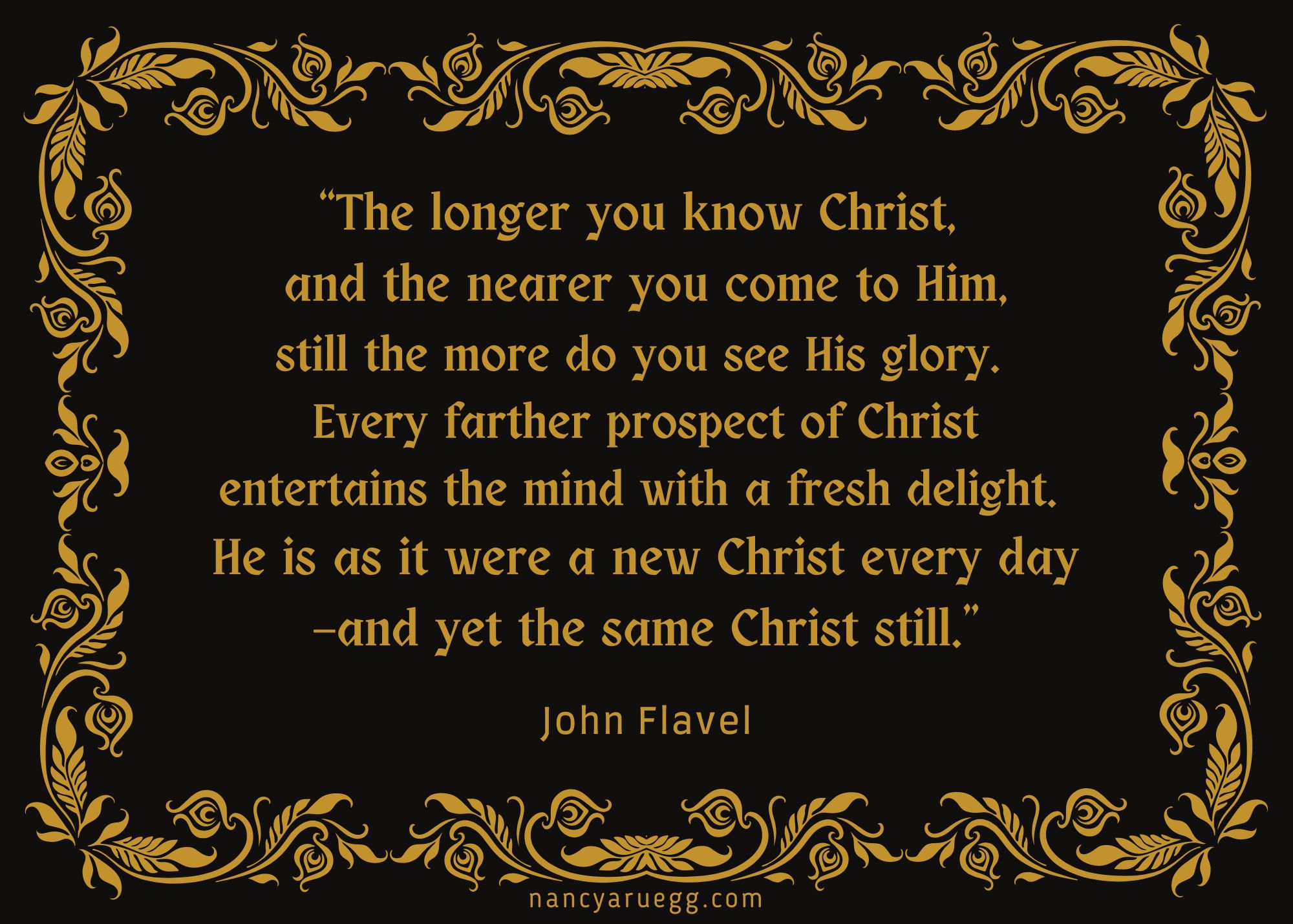
And then, with Puritan minister and author John Flavel, we’ll be able to affirm:

Just as our young friend Jenny surely experiences happy blessedness as she pursues her violin studies, how much more will we experience fresh delight and happy blessedness in Jesus as we study him.

Art & photo credits: http://www.flickr.com; http://www.freerangestock.com; http://www.canva.com

Read Full Post »

How would you finish this statement?

Nothing we do is more powerful or life-changing than _____________.

Some would suggest taking better care of ourselves, or setting goals that include a plan for completion, or training our minds to focus on the positive. And the argument could be made that all of these actions create beneficial influence in our lives.

But according to author Stormie Omartian, “nothing we do is more powerful or life-changing than praise[1]. Others would likely agree with her, having cited numerous benefits themselves:

  • Prayers of adoration calm any fear, lift the spirit, and fill us with indescribable joy [2].
  • Praising God reduces our cares, levels our anxieties, and multiplies our blessings [3].
  • Continual praise is what changes the emotions, lifts the darkness, offers hope, frees the mood, and blesses God so that evil is driven out. It changes everything [4].
  • When we choose to practice adoration anyway in the midst of whatever we are feeling, our words lift us over that barrier and into a deeper connectedness with God [5].

But how could simple words produce such life-changing results? Psalm 69:30 offers a clue:

To magnify God is to make larger our view of him and his attributes, which lessens our view of the problems we face. The more often we focus on God, the more our faith thrives, and that in turn leads to less worry and fretting.

For example, see if these statements don’t boost your confidence in God for what you’re facing right now:

  • Praise God he is all-sufficient, all-knowing, and all-powerful. He has everything under control (Isaiah 55:11; Romans 11:33-36; 1 John 3:20b).
  • Praise God he is forever faithful, always working out his overall plan, always fulfilling his purpose (Lamentations 3:22-23; Job 42:2). 
  • Praise God he is continually gracious and good, full of love and compassion (Psalm 145:8-9).

The longer we gaze at him, arrayed in such glorious attributes, the less insurmountable our problems become.

And with an unknown Puritan of old we too can affirm:

“When I think upon and converse with Thee, ten thousand delightful thoughts spring up, ten thousand sources of pleasure are unsealed, and ten thousand refreshing joys spread over my heart, crowding every moment with happiness” [6].

That is the power of praise.

But the enemy of our souls is well aware of this power. He’ll do everything he can to keep us from developing the habit of praise. What might help?

Habit-stacking. Have you heard of it? The practice involves adding a new habit to some action that’s already a fixed routine.

For example, we might add more praise to our days while making the bed in the morning, completing some household chores, commuting to and from work, walking from place to place, waiting for the microwave, chopping fruit or veggies.

What routines are established in your life? Which ones lend themselves to spending a few minutes praising God for who he is and what he’s done?

Another possibility for adding praise to our lives comes from C. S. Lewis: “Make every pleasure into a channel of adoration.” He suggested several ideas to get us started: a beautiful mountain valley, delicious food, a great book, or a piece of music [7].

And you know what happens as we praise God for these blessings?

One’s mind runs back up the sunbeam to the sun [8].

Isn’t that lovely imagery?  

And is there any better place for our mind to be?


[1] Values for Life, 160.

[2] Kristine Brown (https://www.ibelieve.com/christian-living/prayers-of-adoration-to-fill-your-heart-wonder.html).

[3] Suzanne Dale Ezell, Values for Life, 160.

[4] Arnold Prater, Bonding with God, 78.

[5] Sara Hagerty, Unseen, 151.

[6] From The Valley of Vision, Puritan prayers and devotions compiled by Arthur Bennett, 1975.

[7] Quoted by Timothy Keller in Prayer: Experiencing Awe and Intimacy with God, 197.

[8] C. S. Lewis, Letters to Malcolm: Chiefly on Prayer, 89-90.

Art & photo credits: http://www.pickpik.com (2); http://www.canva.com; http://www.freeimageslive.co.uk; www,pxhere.com; http://www.canva.com.

Read Full Post »

‘Tis Poetry Month once again, a time to celebrate this art form that can stretch, inspire, and amaze us in ways unique from prose. Award-winning poet Pattiann Rogers identified at least one element of that uniqueness: the music of poetic language.

But is the composing of such music reserved only for experts? That question brings to mind another quote:

Such encouragement for us amateur-poets to give it a try and be stretched, inspired, and amazed when we create our own music of poetic language—unsophisticated as it may be.

This year I’ve experimented with three forms: Shadorma, diamante, and quadrille.

The Shadorma is of Spanish origin. It contains six lines, each with a specific syllable count that follows this pattern: 3/5/3/3/7/5.

Early morning on our deck offered inspiration for this Shadorma:

Dawn Rising

Sunbeams climb

Dusky shadows fade

Breezes kiss

Robins trill

Nasturtiums spangle with dew

Morning masterpiece

The diamante (diamond) form derives its name from its shape. It was created by American poet Iris McClellan Tiedt in 1969.

The pattern for diamante is more complex than Shadorma. The first half of the poem relates to the one word of the first line; the second half to the one word of the last line. These two lines often present opposites. The middle line provides a bridge between the two. 

Each of the seven lines requires a certain number of words of a certain part of speech:

  • Line 1: 1 word (subject/noun)
  • Line 2: 2 adjectives that describe line 1
  • Line 3: 3 -ing words that relate to line 1
  • Line 4: 4 nouns (first 2 relate to line 1, last 2 relate to line 7–if you’re writing about opposite topics)
  • Line 5: 3 -ing words that relate to line 7
  • Line 6: 2 adjectives that describe line 7
  • Line 7: 1 word (subject/noun)

This diamante began to take shape as I considered the transformation Christ can make in a person’s life. A list of R-words began to grow—repentance, redeemed, restored, so I pursued the pattern.

A Transformed Life

Ruin

Repugnant, reprehensible

Rebelling, ravaging, retaliating

Rashness, recalcitrance, remorse, repentance

Returning, Releasing, Receiving

Redeemed, restored

Renewal

The Quadrille form first appeared at www.dversepoets.com in 2016. The only requirement is to include 44 words (excluding the title). They believe that “limitation can happily breed extreme creativity.” Each Monday they provide a word-prompt, and participants must use that word in their poems.*

I chose my own word from John 15:1, 5—vine. And while I played with possibilities, my poem began to fit a pattern. Every line contains seven words except the last, which contains nine.

First, the scripture, as a point of reference:

And now, the poem.

Bonded to the Vine

Praise to the Gardener of our souls!

Once we’re grafted to his Vine, he

Prunes away withered branches of worthless folly,

Waters us with his life-giving, spirit-strengthening Word,

And produces pleasing fruit with boundless sufficiency.

Such beauty results when we’re bonded to the Vine!

Remember the quote of Christopher Fry at the beginning of this post–“Poetry is the language in which man explores his own amazement?”

I wonder if he knew that the pleasure in exploring our amazement—whether as poets or not—is greatly enhanced when we include the Genius behind all things amazing.


* https://dversepoets.com/2017/09/11/quadrille-40/

Photo credits: http://www.canva.com; http://www.pxhere.com; http://www.pickpik.com; http://www.pexels.com (3); http://www.commons.wikimedia.org.

Read Full Post »

« Newer Posts - Older Posts »

Still Traveling

Impressions Becoming Expressions

Living Our Days

Gaining a heart of wisdom

He Said What?!

I'm Patty, and my husband and I are living with our adult son who has autism and epilepsy. I love sharing lessons learned from life around me, especially life with Aaron.

Meditations of my Heart

Impressions Becoming Expressions

Linda Stoll

Impressions Becoming Expressions

Debby Thompson

Impressions Becoming Expressions

Signora Sheila

Notes on Life, Faith & Italy

Colleen Scheid

Writing, Acting, Living in God's Love

Mitch Teemley

The Power of Story

Heidi Viars

Finding the Image of God