Feeds:
Posts
Comments

Archive for the ‘Suffering’ Category

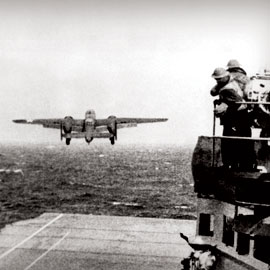
Staff Sgt. Jacob DeShazer, a member of the famed Doolittle Raiders, was the bombardier of Crew No.16, the last of the 16 B-25 Mitchell bombers to launch from the USS Hornet April 18, 1942, on the famous bombing run over Tokyo. Sergeant DeShazer, 95, died March 15. (U.S. Air Force photo)

Jake DeShazer sat on a narrow bench facing the back wall of his cell, a position he was forced to keep hour after hour, day after day, as his imprisonment dragged on.

The year was 1945. DeShazer had been a prisoner of war in Japan for forty long months, enduring suffocating heat in summer, bitter cold in winter, solitary confinement, near-starvation, cruel treatment, and torture.

As he sat, perhaps Jake thought of his comrades among the eighty flyers of Dolittle’s Raiders, the bombing run over Japan that helped turn the tide of the war in favor of the Allies in 1942.

DeShazerTakeOffFinal_md

But DeShazer’s plane was among those shot down, its crew members captured. How many of the original eighty had survived? Jake had no way of knowing, except for the few in his own cell block.

During those long, solitary hours, perhaps Jake reviewed the encouragements from scripture he had learned and the verses he’d memorized when–for three short weeks–he was allowed to have a Bible. What a change had taken place in his heart.

Prior to his captivity, Jake had no interest in Christianity. But the cruel treatment from his captors month after month nearly drove him crazy. Hatred consumed him. He remembered that Christianity supposedly changed hatred into brotherly love. Was that really possible?

He had begged for that Bible, but it was a long time coming. When the emperor of Japan told prison guards to treat their captives better, DeShazer’s request was finally honored. And as a result of studying the scriptures, he put his faith in Jesus. Bitter hatred for the Japanese transformed into loving pity.

As Jake’s thoughts focused on his captors, he may have prayed again the words from scripture that first melted his heart: “Father, forgive them, for they know not what they do” (Luke 23:34). Perhaps DeShazer reaffirmed what God’s Spirit had revealed to him earlier: His captors knew nothing of a Savior.  Without Jesus it was only natural for them to be cruel.

And so, as he lifted up loved ones and fellow soldiers, as he expressed his longing for the war to end, Jake also prayed for his captors to know Christ.

Finally, on August 10, 1945  the emperor of Japan surrendered to the Allied forces, following the atomic bombings of Hiroshima and Nagasaki.

The horror was finally over; DeShazer and thousands of other soldiers returned home to pick up the pieces of their lives.

Jake chose to pursue a degree at Seattle Pacific University, which he accomplished in three years. By December of 1948, he and his wife, Florence, along with their first baby, were headed for the mission field, to—of all places—Japan.

Every time DeShazer met someone in his new home country and told his story, almost always the person would ask, “Why did you come back here?” And he would introduce them to Jesus.

DeShazer-with-kids-1952

(DeShazer with Japanese children, 1952)

It is estimated that some 30,000 people accepted Christ into their lives—just in the first year of Jake’s ministry in Japan. Among them, a number of former prison guards who had held Jake and his comrades captive.

Another surprising convert: Mitsuo Fuchida, the pilot who led the attack on Pearl Harbor. He “happened” to read a pamphlet Jake had written, “I Was A Prisoner of Japan.” Fuchida began to study the Bible, became a Christian, and served as a missionary himself in Asia. He and Jake eventually met and became friends.

fuchida

(DeShazer and Fuchida)

For nearly thirty years the DeShazers served God in Japan, helping to found sixteen churches throughout the country.

Someone has said:

e29eb6e78638f02633d911339071451d

(“Forgiveness does not change the past,

but it does change the future.”)

DeShazer’s story proves just how mind-boggling and miraculous that future can be.

*     *     *     *     *     *     *     *     *     *

Thank you, Father, for DeShazer’s story, proving it is possible to love our enemies, bless those who curse us, do good to those who hate us, and pray for those who persecute us (Matthew 5:44). By comparison to DeShazer’s horrific experiences, my hurts and resentments are embarrassingly puny. Yet I still need your Spirit to transform them into compassion and love. As a starting point, may I never lose sight of the totally underserved forgiveness you have lavished upon me.

You can access more of Jacob DeShazer’s story at:

(Art & photo credits:  www.verterantributes.org; http://www.worldevangelism.net; http://www.spu.edu; http://www.jacobdeshazer.com; http://www.pinterest.com.)

Read Full Post »


Digital StillCamera


My knowledge of boat parts is limited, but this much I know: throw an outboard motor in the water; it will sink. Throw a propeller in the water; it, too, will plunge to the bottom. So will seats, cleats, and other parts. But when they are assembled together on a strong hull, the boat floats.

Similarly, our lives are comprised of a variety of experiences: some heavy and hurtful, others light and joyful. When properly assembled as a whole, they create a life that floats, and one that’s headed on a course toward worthwhile purpose.

Proper assembly of negative as well as positive events requires the trait of resiliency—the ability to press on through setbacks again and again.

Do those words, press on, sound familiar? The great missionary-adventurer, Paul, said he pressed on toward the goal of becoming what God intended for him (Philippians 4:12-14).  Paul is a worthy case-study for resiliency.

Saint_Paul,_Rembrandt_van_Rijn_(and_Workshop?),_c._1657

(The apostle Paul by Rembrandt)


He suffered plenty of hurt, disappointment, and failure. For example, Paul was:

  • stoned (Acts 14:19),
  • flogged and imprisoned (Acts 16:23),
  • unjustly charged with treason (Acts 18:13),
  • nearly killed on at least several occasions (Acts 21:30-31), and
  • rejected by many, even after brilliantly preaching about God and his Son, Jesus (Acts 17:16-34).


How do you bounce back from such defeats? Researchers have identified the following ways to cultivate resiliency:


  1. Get real.

No one sails through life problem-free. Accept the reality that troubles will come, then apply those strategies that provide relief, strategies such as: exercise and proper nutrition, sufficient sleep, laughter, and meaningful activity, including acts of kindness each day.


b8a886a4d226b7c342d7be36add4f9e6


  1. Get hope.

Be watchful for God’s blessings in spite of the circumstances, and thank him for his loving attention. Gratitude does indeed transform attitudes.

Find fresh strength in God’s Word, especially in his promises and assurance of his faithfulness to keep those promises (Romans 15:4; Psalm 145:13; 1 Corinthians 1:9).

We can ask God to help us set new, worthwhile goals, then look forward to the day when those goals will be met.

Researchers have noted that resilient people do not strive for riches, fame, power, or recognition. Instead they are focused on their legacies—what contributions their lives will make to those around them.  Hope in God—in all circumstances—is in itself an invaluable legacy.


dc018940ab0edea3d3f776dc4336173f


  1. Get in community with other Christians—not just by being present, but by actively participating.

Years ago while I was dealing with an ongoing disappointment, Sunday morning worship on the praise team and mid-week rehearsals did much to recharge my spirit. (Not that all was smooth sailing in between! I still struggled to stay on an even keel; but with God’s help I didn’t stop trying.)

In addition, when we contribute hope to others through listening and encouragement, we find our own outlook much improved.


d64f6b0348399c6ab1a2db4d6da0e560


*           *          *

A boat that floats is not built by just lining up the various parts in the boatyard. It requires the hands and expertise of a master boat builder, to craft a skiff of beauty, function, and purpose.


017c661391a97e6ad96158e0211995fb


A satisfying, meaningful life cannot be achieved by mere acceptance of the various events in our lives. It requires the hands and expertise of the Master. He takes all of it—the delightful and the demoralizing—to craft a life of beauty, function, and purpose.


(The boat metaphor idea came from Ralph W. Sockman, author of The Higher Happiness (1950).


Art & photo credits:  www.inland-boats.com; http://www.slideplayer.com; http://www.wikipedia.org; http://www.pinterest.com (3).


Read Full Post »

Say the word, “blessing,” and what immediately comes to mind?

For me, it’s happy events and lovely gifts, engineered or bestowed by God out of his loving kindness.

But James, the brother of Jesus, saw a different side of blessing: “Consider it a sheer gift, friends, when tests and challenges come at you from all sides” (James 1:2, MSG, italics added).

Tests and challenges as gifts?! Sounds a bit daft—until we consider:

What-Seems-To-Us-As-Bitter-Trials-Are-Often-Blessings-In-Disguise

Take, for example…

THE CRAZY BLESSING OF WANT

Do you wish you had a bigger house? A newer car? Better furniture? Consider yourself blessed, that you’re not like King Solomon–the wealthiest person who ever lived. For all his striving to achieve and accumulate, Solomon discovered that when every desire is gratified, the end result was nothing but meaningless smoke (Ecclesiastes 1:2, MSG).

The blessing of want protects us from the pit of depression caused by self-indulgence.

The blessing of want fosters contentment, as we learn to enjoy and be grateful for what we already have.

THE CRAZY BLESSING OF DIFFICULTY

Difficulties provide a surprising number of positive opportunities. Here are ten:

  • To press in closer to God and trust him more completely.
  • To experience the adventure of God’s sufficiency (Philippians 4:13) as he enables us to endure—in ways we never thought possible.

Philippians4_13

  • To see how God will bring beauty out of ashes (Isaiah 61:3).
  • To discover more of who God is.
  • To witness the fulfillment of his never-failing promises.
  • To present a sacrifice of praise to God, beginning with the affirmation that he has our best interests at heart—in spite of what we see.
  • To be prepared for greater usefulness for God (John 15:2), which fosters greater fulfillment and satisfaction in our spirits.

46dd131cacc19b855d589b3358b83851

  • To have a compelling story to share, as encouragement for others. Years ago I heard a speaker say, “With no test there is no testimony.” In the final analysis, I’d rather have the latter. You, too?
  • To become mature, complete, not lacking anything (James 1:4). That doesn’t happen without trials.  As Thomas Carlyle wrote:

quote-no-pressure-no-diamonds-thomas-carlyle-31833

  • To love our Savior more passionately. Josif Trif, a pastor from Romania during the days of Communism, said, “If it weren’t for Communism, I would not have loved our Lord as much. I kissed the cross the Communists gave me” (1).

THE CRAZY BLESSING OF FAILURE

If failure served no purpose in our lives, God would not allow it to happen. But since he does, we can know that failure is either for our benefit or for God’s glory—often both.

Failure is the soil from which great success can grow, beginning with a crop of positive character traits, such as perseverance, humility, and greater reliance upon God.

Green-Bean-Sprouts1

Out of failure comes experience; from experience comes greater wisdom; and wisdom leads to a godly life.

“How blessed are those who are hungry and thirsty for righteousness, because it is they who will be satisfied (Matthew 5:6, ISV)!

*    *     *     *     *     *     *     *     *     *

Crazy as it sounds, I want to praise you, Father, for the blessings of challenges and tough times. Thank you for your loving attention that carries me through, transforming me and makes me a better version of myself.  I also praise you for the glorious promise that through trouble, hardship, disappointment, or pain–“overwhelming victory is ours through Christ” (Romans 8:37, NLT)!

What crazy blessing have you experienced in the crucible of trouble, hardship, disappointment, or pain?  Please join the conversation below!

(1) His Imprint, My Expression, Kay Arthur, Harvest House, 1993, p. 135.

(Art & photo credits:  www.imagesbuddy,com; http://www.wallpaper4god.com; http://www.pinterest.com; http://www.izquotes.com; http://www.pinterest.com; http://www.harvesttotable.com.)

Read Full Post »

what-can-separate-us

“I am convinced that neither death nor life,

neither angels nor demons,

neither the present nor the future,

nor any powers,

neither height nor depth,

nor anything else in all creation,

will be able to separate us from the love of God

that is in Christ Jesus our Lord.”

–Romans 8:38-39

Consider the author of these lofty, poetic words: Paul—a man who endured beatings, stonings, shipwrecks, danger, sleepless nights, extreme hunger and thirst, and exposure to the elements (1).

Yet in spite of all these hardships, Paul never thought, Maybe God doesn’t love me anymore.  No, he was convinced otherwise.  And he wanted to assure his readers, including us today, that nothing can come between the believer and his/her God:

            “Neither death nor life…”

Every moment of our lives God is watching over us, working out his plans that will achieve the highest good. Sometimes that includes suffering, for reasons we don’t always understand.

But consider: the greatest tragedy of history, the cruel torture and death of God’s perfect Son on a cross, brought about the most glorious consequence–the eternal salvation of all who believe (2).

image.axd

And when we die? God will still be watching over us (3). Visit a dying Christian and you will be the one encouraged by their God-given peace, joy, and expectation.

“Neither angels nor demons…” 

Long ago, the rabbis believed some angels were grudgingly hostile to men, not wanting to share God with earthly creatures. Perhaps Paul was saying, “Even jealous angels can do nothing to separate us from God’s love” (William Barclay).

As for demons, they were defeated when Jesus died on the cross (4). Granted, they may prowl around and cause mischief, but they are powerless to sever us from God’s love. Their teeth were removed at Calvary!

colossians2_15

“Neither the present nor the future…”

 Sometimes we worry about the future. Will we be able to handle potential calamities down the road? Or, perhaps it’s the present that’s unbearable, and we wonder if better days will ever dawn.

But our omniscient God has never been surprised by any turn of events. What he says here (through Paul) is a guaranteed promise: nothing present or future—no circumstance–can separate us from his loving presence.

“Nor any powers…” 

All powers of the universe—whether physical or spiritual—are subject to God, because he alone is the Omnipotent One. No one supersedes him.

“Neither height nor depth…”

 Many in Paul’s day believed that the star a person was born under controlled that person’s destiny. Height referred to a star’s zenith; depth to the star’s lowest point in the sky. Paul may have been assuring his readers that the stars have no power over our lives.

By contrast, our Star of David, Jesus, is like the North Star. He never waxes and wanes; he never changes. And his love is present everywhere (5).

22b369c3e20ff6b9ced0597f35085cfb

            “Nor anything else in all creation…”  

No circumstance, no place, no person can remove us from God’s love. “God never loses his loving grip on his children” (Keith Krell, www.bible.org).

And so Paul covered every eventuality that might separate us from the love of God and assured us: It. Can’t. Happen. Surely, if Paul was convinced, after all he suffered, shouldn’t we be convinced as well?

*     *     *     *     *     *     *     *    *     *

Day after day, Father, you express your love to us: forgiving our sins, transforming our spirits, defending us from spiritual enemies, showering us with blessings. We praise you for the warm embrace of your love—a love that spans all time and space, overcomes all pain and suffering, and defeats every foe! “Because your love is better than life, [our] lips will glorify you” (6).

(1) 2 Corinthians 11:25-27

(2) John 3:16

(3) Psalm 23:4

(4) Colossians 2:15

(5) Psalm 139:7-10

(6) Psalm 63:3

Photo credit:  www.doughusen.com; http://www.klove.com; http://www.verseoftheday.com; http://www.pinterest.com.

Read Full Post »

tumblr_n6al7hhRSw1rzadffo1_500


For long stretches of time, life can roll along quite satisfactorily. The kids are healthy and doing well in school. Bills are paid on time. The house and cars are holding together with no major repairs required.


Stone_mold


And then suddenly, we hit a stone wall. The promotion goes to someone else.   The company requires a move across the country. An addiction is disclosed. A life-threatening prognosis is delivered.

Pow.   We’re broadsided by disappointment, fear, and pain.

For a few moments we’re frozen in disbelief.

We grieve.

And that’s to be expected.   These are normal reactions.

What we want to avoid is parking at the stone wall, allowing it to consume our thoughts and prohibit forward movement.

That’s much easier said than done, right? That wall of trouble looms over us–thick, tall, and menacing. It’s not like we want to meditate on it; the ugly thing demands attention.

But, oh, praise God, he can tear down walls! (Remember Jericho?)


80a8523580822ed8e5556777b2c3a552


We can also defy the enemy who built the wall. Satan, the father of all strife (1 John 5:19), is the one with whom we must battle.

How? There are a number of worthy tactics, but let’s focus on three:

Let the Lord Jesus Christ be as near to you as the clothes you wear and be strengthened (Romans 13:14 CEV).  We can praise him for such affirmations as the following to lift our spirits and nourish hope.

He is our:


6b7162242c49e27d145b54f99f524f14


Sing or recite scripture and be revived (Psalm 119:25b).

Start writing down every verse that applies to your situation, and read through them frequently.  Fellow blogger, Bev Rihtarchik (over at Walking Well with God) chooses one meaningful verse, and copies it on a slip of paper to carry in her pocket. When worry comes to call, out comes the verse—truth, in black and white.  Now there’s a surefire way to boost our faith!

Count your blessings and be encouraged.

Yes, it’s an old cliché, but naming God’s benefits is soothing balm to the soul.

Several years ago, I struggled through a particularly challenging year, giving me the opportunity to practice the disciplines of forgiveness, perseverance, renewing the mind, and more.

I continued to keep my blessings journal, more eager than ever to notice the evidence of God at work around me.


photolibrary_rf_photo_of_woman_writng_in_journal


On December 31, I tallied the entries. Imagine my astonishment to count twenty more than any other year to that point, and I’d been keeping that journal over twenty-five years.

God had indeed been at work.  but if I not been recording the evidence, I surely would have missed the generous extent of his blessing.

*     *     *     *     *     *     *     *     *     *

Oh, how I praise you, Heavenly Father, that you are in control. I can move on from that stone wall–strengthened by you, led by you, and encouraged by you. Help me to see the unseen steps ahead as an adventure with you, and fill my heart with your hope. You are my Rock whose works are perfect; all your ways are just. You are a faithful God who does no wrong (Deuteronomy 32:4). I cannot praise you enough!


(Photo credits:  www.vesselforchrist.tumblr.com; http://www.survivingtoxicmold.com; http://www.pinterest.com (2), http://www.web.md.com.)


How do you fight the battle against discouragement, fear, and hurt?  Please share with us in the comment section below!

Read Full Post »

seagrape03

“Oh, what a beautiful tree!” my mother-in-law exclaimed with enthusiasm. Her comment referred to a tall bush, planted near the house and visible outside our kitchen window. “What’s the name of it?” she asked.  Being from Ohio, Mom wasn’t familiar with some of the unique foliage of our area in south Florida.

“That’s a sea grape,” I told her. “It’s actually a shrub, but they can grow quite tall.”

“Well, it’s lovely. Such big leaves!”

Now clearly there’s nothing remarkable about this conversation, until you know that Mom had asked the very same question with the very same enthusiasm every morning of her visit. And each morning I supplied the same answer.  Mom was in her late 80s, and her dementia was becoming more and more noticeable.

Mom’s fresh outlook each morning reminded me of Lamentations 3:22-23: 

The faithful love of the LORD never ends!

His mercies never cease.

Great is his faithfulness;

his mercies begin afresh each morning (NLT).

his-mercies-are-new-wallpaper_1366x768

Just as Mom brought new enthusiasm to each morning, so God brings new mercies for each day. Yes, the challenges we faced yesterday required wisdom, strength, and perseverance. But today we’ll need a fresh supply.   Praise God he never runs out of such gifts; he is always able to provide.

In the same way, God’s new mercies for today are not meant to be sufficient for tomorrow. In other words, we shouldn’t expect to feel confident and in charge this morning for the potential challenges of the future—much as we’d like to. (Who hasn’t wished to know now exactly how the next day or week will unfold, and how best to respond?)

Instead, our wise and loving Heavenly Father has chosen to lead us one day at a time. And just what is so wise and loving about keeping us in the dark?  So as to protect us from being overwhelmed, easy prey to depression, and paralyzed by fear.

No, our best course of action is to avail ourselves of God’s mercies for this one day. As for tomorrow, we can trust God to supply new mercies, more than sufficient for whatever we might face when the time comes (Matthew 6:34).

I’m remembering Corrie ten Boom. (Maybe this post brought her to your mind, too.)

g25143_u22597_corrie_ten_boom

Corrie and her family suffered cruel hardships in the concentration camps of Nazi Germany, as a result of helping Jews escape the Holocaust.

After the war, people would often say to Corrie, “I wish I had such great faith as yours. I could never live through the experiences you survived.”

Corrie would tell a story to explain.

When she was a child, Corrie happened to see a dead baby. A terrible fear gripped her that one of her family might also die. When Papa ten Boom came to tuck her in that night, she burst into tears.

“I need you!” she sobbed. “You can’t die!”

Her sister, Betsy, explained why Corrie was so afraid.

Papa asked, “When you and I go to Amsterdam, when do I give you your ticket?”

“Just before we get on the train,” she responded.

“Exactly,” Papa replied. “And God knows when you’re going to need things, too. Don’t run out ahead of him, Corrie. When the time comes that some of us have to die, you will look into your heart and find the strength you need—just in time.”

Papa ten Boom was proven right. When Corrie needed supernatural strength, God did provide. We can rest assured that his mercies will be new and fresh each morning for each of us, as needed.

*     *     *     *     *     *     *     *     *     *

I praise you, Lord God, that we can face each day with fresh enthusiasm, because for each trial, you have prepared for us great mercies like endurance, strength, and wisdom. I thank you that in the midst of trouble, you also provide blessings: a more acute awareness of your presence, peace that defies explanation, family and friends to come alongside, miraculous provision, and delightful surprises to make us smile. You are not just a sufficient God; you are an abundantly gracious God!

(Photo credits:  www.mgonline.com; http://www.coffee4thesoul.com; http://www.myhero.com.)

Read Full Post »

Chocolate Chip Cookies

Chocolate Chip Cookies

There’s nothing quite like a fresh batch of chocolate chip cookies. The best recipes (and a decent oven!) create a buttery crunch on the outside and a chewy, chocolate-and-walnut infused center.

Of course, every ingredient of the recipe is necessary—not just the chips and nuts. You have to include the flour, butter, eggs, and more. Leave one out, and the results will be hugely disappointing.

Take vanilla extract, for example. A batch of chocolate chip cookies is quite bland without that one teaspoon of flavoring. But have you ever tasted vanilla extract all by itself?  Whew!  It is shockingly strong and bitter.

Now try this idea on for size: Our lives are a bit like chocolate chips cookies!

(Stay with me–the simile will be clear in a moment!)

Just as it takes a variety of ingredients to make delectable cookies, it takes a variety of people and circumstances to make our lives into “the aroma of Christ” (2 Corinthians 2:15).

Some ingredients, like chips and walnuts, can be enjoyed all on their own. Similarly, God’s recipe for each of us also includes blessings, provided solely for our pleasure—all on their own.

But then there’s that vanilla. So awful by itself; so transforming when combined with the rest of the ingredients.

I see that vanilla as representative of the distasteful and bitter experiences God allows in our lives. Without them, we’d end up as bland and good-for-nothing as vanilla-less chocolate chip cookies.

Every person, every situation God allows into our lives has the potential to make us like Jesus. Even the bitter ones. No, especially the bitter ones. It’s those uncomfortable, challenging relationships and situations that transform us the most. For example:

  • Would Joseph have been as prepared to be second-in-command under Pharaoh—without being sold into slavery or thrown into prison? Probably not. He learned invaluable lessons about organization and leadership while overseeing Potiphar’s household. Those skills only increased while Joseph was incarcerated and given responsibility for all that was done in the prison.
  • Would David the shepherd boy have become the greatest king of Israel? Undoubtedly, his perseverance and faith grew strong as he struggled through fifteen years of waiting—and hiding in caves from Saul.
  • Would Paul’s ministry have been as effective to the persecuted Christians of the first century, if he himself had not been exposed to great suffering?

It’s true. Just a teaspoon of trouble can create great benefit. Trials offer us opportunities for:

  • Growing spiritually and emotionally
  • Ministering to others with understanding and empathy
  • Developing a closer relationship with God
  • Preparing for a God-ordained change-of-direction in life
  • Praising, as God engineers circumstances beyond our dreams

However.

We must be willing participants.

Perhaps our prayer could be based on Ephesians 3:20, a verse often quoted to give us hope for blessing. But this scripture also offers great hope for the good accomplished through difficulty:

“All glory to God,

who is able,

through his mighty power

at work within us,

to accomplish infinitely more

than we might ask or think.”

Just as a bit of acrid vanilla works wonders in the cookie dough,…

God uses the bitter moments to work wonders in our lives.

*     *     *     *     *     *     *     *     *     *

Heavenly Father, I praise you for your infinite wisdom. You know exactly what to allow into my life to achieve your ultimate purpose. I thank you for the blessings but also for the trials. May I be a willing participant, like Joseph, David, and Paul. And may I become strong and resilient as they were—for your honor and glory. Amen.

(Photo credit:  www.thehealthyfoodblog.wordpress.com.)

Read Full Post »

l-12422

“Be careful what you think,

because your thoughts run your life.”

–Proverbs 4:23, NCV


That would explain why worrisome thoughts can turn into paralyzing fear, pessimism into debilitating discouragement, and sadness into utter hopelessness.

No one wants to dwell in such misery.

But if a person is facing difficult circumstances, and she allows her thoughts to run amok on auto-pilot, she’s likely to slide downward into hyper negativity.  Climbing out is difficult.

“Snap out of it!” someone will say. Not very helpful.

“Look for the silver lining,” advises another. Easier said than done when tragedy strikes–and lingers.

“Spend some time in reflection.” That’s what one web site recommends, offering sixteen questions for a person to consider. Most of us don’t have time for that much introspection, nor the inclination, when we’re hurting.

So, how can we climb out of a miserable pit of despair?

By replacing negative thoughts with positive thoughts, especially scripture.

You see, our brains cannot focus on two things at once. Prove it to yourself by counting to ten and reciting John 3:16 at the same time. You’ll find you’re either counting or reciting, not both simultaneously.

We can apply the same strategy to negative thinking. At the first moment we realize our thoughts are headed in the wrong direction, we can confess it and ask God to help us renew our minds:

“Lord, I don’t want to think about this anymore.  I know it’s counter productive and does absolutely no good. Help me to refocus on what is noble and right, pure and lovely (Philippians 4:8).”                            

Then we start singing a favorite praise song, listing all the reasons we can trust God in this situation, or reciting an uplifting scripture.

For a start, the bulleted quotes below highlight some common threads of negative thinking.  Following each is a positive scripture as rebuttal:

  • “There is no way this situation is going to work out.”

 Oh? “In all things God works for the good of those who love him, who have been called according to his purpose” (Romans 8:28, italics added).

  • “I can’t stand another day of this.”

Oh, yes, I can stand. I can put on the full armor of God, so that in this day of trouble, I may be able to stand my ground” (Ephesians 6:13).

 Restoration will come. “Though you, [God], have made me see troubles…you will restore my life again…you will again bring me up” (Psalm 71:20).

  • “I am never going to succeed.”  

Not true.  God says [He] will accomplish all [his] purposes (Isaiah 46:10b, italics added).  What greater success could there be than to accomplish the purpose of Almighty God?

  • “I have no idea how to proceed. Maybe I should just quit. This is just too hard.”

 I can pray as the author of Hebrews did: “May the God of peace…equip me with everything good for doing his will, and may he work in me what is pleasing to him” (Hebrews 13:20-21).

  • “Sometimes I can’t seem to do anything right. How can God use me?” 

I am God’s workmanship, created in Christ Jesus to do good works, which he prepared in advance for me to do (Ephesians 2:10).

If the bulleted comments in bold print are our focus, our lives will surely head in a downward direction toward discouragement and hopelessness.

If, on the other hand, we focus on the promises and positive affirmations of scripture, we head in an upward direction toward wholeness, productivity, and joy.

habakkuk_3_19_scripture_memory_card_post_card-r720e7f7e571e4323b9c59aed790eee1b_vgbaq_8byvr_512

“He enables [us] to go on the heights” (Habakkuk 3:19)–above the doubts and uncertainties.

Focus determines direction.

*     *     *     *     *     *      *     *     *     *

What scripture promise or affirmation lifts you up when circumstances try to pull you down?  Add your favorites in the Comments below!

(Photo credits:  www.facebook.com/wonwithoutaword; http://www.zazzle.com.)


Read Full Post »

 Zwald-62


One of the “Letters to the Editor” in the most recent issue of Country Magazine caught my attention. The writer, James, related an event from his boyhood days on a farm in the 1940s.

Seems he had injured his hand quite severely one day while tightening a chain. But work on a farm doesn’t wait, especially during hay-baling season when the hay is ripe for harvesting. So in spite of his injury, James had to wear rough work gloves as he operated the wire baler. Every day for a week when he removed the gloves, the scab on his hand would come off and the wound would bleed profusely again.

On Sunday afternoon he plopped down on the living carpet to take a nap. His dog, Shadow, came to lie down beside him. But instead of settling in for a snooze himself, Shadow began to lick James’ wound. It actually felt good, James explains, so he let the dog continue.

The next morning James was astonished to see that his wound was completely healed. “It was as if the injury had never happened.”

Not until much later did James find out that a dog’s saliva contains healing properties. That’s why, when injured, they will lick their own wounds over and over.

I found James’ story particularly interesting because of a question that had been niggling in my mind this Easter season: Why did Jesus bear the scars of the crucifixion—in his hands, feet, and side–after the resurrection? It was certainly within God’s power to return Christ’s physical body to perfect wholeness, “as if the injuries had never happened.”

Come to find out, I’m not the first one to consider this question. As far back as the seventh century, Saint Bede of England (672-735, A.D.) wrote about the possibilities. Many others throughout the ages of the church have contemplated the reasons, including the following:

  1. The scars were proof to the disciples that he was the same person after resurrection as before. Had Jesus been completely restored, his followers may have assumed that their first inclination was correct: that what they saw was an apparition of Christ. After all, he appeared to them out of nowhere—an impossibility for a physical body.

But they not only saw him, Jesus invited them to touch him, so there could be no doubt (Luke 24:36-42).

  1. The scars were part of the proof of the prophecy that Jesus spoke of himself, that he would suffer, be killed, and rise again on the third day (Matthew 16:21). “This is what I told you,” Jesus reminded them (Luke 24:44).
  1. The scars provided evidence of Jesus’ physical body. Early in church history there were those who taught that Jesus didn’t really suffer on the cross. He was not truly human, therefore he only appeared to suffer.

They could not fathom the sinless Son of God submitting himself to such humiliation and horrific pain.   But dismissing the agony of Christ on the cross as well as the scars is incomprehensible.

Those three answers do quiet our curiosity, but what relevance might Jesus’ scars provide for us today?

  1. The scars prove that Jesus knows what it means to suffer. Crucifixion is the most cruel of death penalties, the worst that man can deliver. No one can say, “Jesus doesn’t know what I’m going through.” No, he is well-acquainted with grief. He knows what it’s like to bear scars of suffering.
  1. The scars prove God’s love and compassion. As the Son of God, he didn’t have to suffer on our behalf. Surely he could have devised a less abhorrent way. Instead, he identified himself with humanity by becoming human himself. He took our physical, emotional, and spiritual pain upon himself.   And he will wear the scars of suffering for eternity (Revelation 5:6).
  1. The scars remind us of what is to come. On Good Friday, Jesus body was beaten, bruised, and pierced. On Easter Sunday, those wounds became scars. A miraculous healing of gruesome wounds had occurred in a matter of hours.

One day a miraculous healing of our gruesome wounds will take place. Pain, suffering, loss, illness, and physical challenges will cease. Every negative aspect of life will melt away.

*     *     *     *     *     *     *     *     *     *

Oh, Lord Jesus, thank you, THANK YOU for carrying our pains, our disfigurements, all the things wrong with us.  Thank you for taking the punishment we deserve and making us whole.  You are the one and only source of eternal salvation.  And only through your eternal bruises are we healed.  Out of overwhelming gratitude, we give ourselves to you.  We want to follow your example and please you.  Make us into what gives you pleasure.  

All glory to you, Jesus, forever and always!”  

 (Isaiah 53:4-6; Hebrews 5:9, 13:21, MSG)

Photo credits:  www.motherearthnews.com

Read Full Post »

Jesus-Praying-Last-Supper-570x377


Whether I heard it or read it, I don’t remember. But the words caught me by surprise, and I jotted them down:

“What was uppermost in Jesus’ mind as Good Friday approached?

“Joy.”

Do you find that surprising, too?

Yet at least three times on the eve of his crucifixion Jesus spoke about joy (John 15:11; 16:22, 24; 17:13)–a most unusual topic and completely unnatural.  Who thinks about joy when they know that catastrophe is about to strike?

Jesus, that’s who.

Within the next twenty-four hours he would face excruciating pain, total abandonment by his Father, and the most horrific death ever devised.

But his concern was for his disciples, not himself.  Jesus wanted them to remember the important principles of love, obedience, and joy–an empowering joy that no one could take away from them.

Perhaps you remember the scene. Jesus and his disciples had just finished their last Passover supper together. After the meal, he taught his final lesson.

The first mention of joy came near the end of his teaching about the vine and the branches:

“I have told you this

so that my joy may be in you

and that your joy may be complete”

(John 15:11).

The word, “this,” refers to the ways Jesus had just mentioned that will contribute to joy:

1.  Live close to him and produce much good in and through your life (vs.4-8).

2.  Live in obedience to Jesus and experience the warmth, peace, and care of His love (vs. 9-10).

 Note that Jesus wanted his joy to be in the hearts of his disciples. What characterized his joy, compared to that of others?

  1. Strong awareness of the Father’s love for him, and his own love for the Father (vs. 9-10).
  1. Absolute surrender and self-sacrifice of himself to his Father, and the joy of doing what his father had sent him to do. Even during his great travail in the Garden of Gethsemane, his one desire was to do his Father’s will (Luke 22:42).

Jesus’ joy coexisted with the profound sorrow of his impending suffering, because he was already well-acquainted with the satisfaction and fulfillment of obedience.

  1. The understanding that joy deferred to the future is anticipatory joy in the present. “For the joy set before him he endured the cross” (Hebrews 12:2).

And finally, Jesus told his disciples that he desired complete joy for them. What does complete joy look like? It is:

  • Not so much an emotion as it is a conviction (Keith Krell, “Moment by Moment,” http://www.bible.org).
  • Inner contentment, resulting from continually cultivating an intimate relationship with Jesus.
  • Constant, not dependent on circumstances.
  • Enduring, day after day. Indestructible.
  • Perfect—the perfect, joy-filled fulfillment of the destiny for which God created you, even when a portion of that destiny is suffering.

I’m thinking of the martyrs–Stephen, Polycarp, Ignatius of Antioch, William Tyndale, John Wycliffe and countless others who demonstrated complete joy even as they died in anguish.

Polycarp, disciple of the Apostle John and Bishop of Smyrna for many years, refused to revile Jesus. For that he was burned at the stake.

But before the flames rose up, Polycarp prayed:

“O Lord God Almighty, Father of thy blessed and beloved Son, Jesus Christ, through whom we have been given knowledge of thyself…I bless thee for granting me this day and hour, that I may be numbered amongst the martyrs, to share the cup of thine Anointed and to rise again unto life everlasting…”

Such devotion, courage, and supernatural strength are impossible to fathom apart from the enablement of the Holy Spirit.

Can you hear the grace in Polycarp’s voice as he blessed God for the privilege of dying a martyr?

That is complete joy, only experienced by those who trust in Jesus implicitly.

Complete joy that Jesus purchased for us at Calvary.

*     *     *     *     *     *     *     *     *

We marvel, Heavenly Father, in the extreme paradox that is the cross. Out of the evil unleashed upon your Son comes your holy, righteous goodness–upon us. Out of the horror of the crucifixion that Jesus endured comes inexpressible and glorious joy, to those who put their faith in him–not a temporary feeling of elation, but deep, abiding, abundant joy. 

All praise to you, our loving, gracious God!       

(Acts 3:13-16, 1 Peter 1:8, John 6:47, John 10:10)


(Photo credit:  www.rejesus.co.uk.)


Read Full Post »

« Newer Posts - Older Posts »

Still Traveling

Impressions Becoming Expressions

Living Our Days

Gaining a heart of wisdom

He Said What?!

I'm Patty, and my husband and I are living with our adult son who has autism and epilepsy. I love sharing lessons learned from life around me, especially life with Aaron.

Meditations of my Heart

Impressions Becoming Expressions

Linda Stoll

Impressions Becoming Expressions

Debby Thompson

Impressions Becoming Expressions

Signora Sheila

Notes on Life, Faith & Italy

Colleen Scheid

Writing, Acting, Living in God's Love

Mitch Teemley

The Power of Story

Heidi Viars

Finding the Image of God