Feeds:
Posts
Comments

Posts Tagged ‘Faith’

“God preserved me so I might tell the story of my life and of God’s goodness to me,” wrote Jeanette Li in her autobiography. And readers might expect her to share stories indicating a life of continual blessing.

They would be wrong.

Jeanette Li (known first as Li Mao Ya, or “Jasmine Bud”), was born in 1899 and grew up in Southeast China with a large extended family of forty-plus people. They lived in hardship and poverty along with most everyone else in the village.

At age six, Jeanette suffered her first trauma—her beloved father died.

Many more ordeals followed, including:

At age 9: Jeanette contracted malaria and received treatment at a mission hospital. One blessing: while there, she and her mother, Taai-So, became Christians.

Perhaps a mission such as this one in central China

When Jeanette was released, they returned home, only to be turned away by their Buddhist family because they’d become Christians.  Taai-So and Jeanette returned to the mission and lived there.

Age 10: The mission was closed due to political strife; all their missionary-friends had to leave.

Age 16: Against Jeanette’s will, Taai-So arranged a marriage for Jeanette, in order to provide for her daughter’s future. Jeanette went to live with her husband’s family under the thumb of a domineering mother-in-law.

Age 20: Jeanette bore a son. But her husband was rarely home, first because he was in school, and then because he was hired as a teacher some distance away. Eventually he married someone else.

Age 32: Jeanette left all she knew to live and serve in bitter-cold Manchuria, requiring her to learn a new language and culture. For thirteen years she traveled by cart on unpaved roads, telling people about Jesus.

Age 38: War broke out between China and Japan in 1937, lasting eight years. Millions died in combat or the result of starvation or disease.

Age 47: The Communists warred against the Nationalists in a three-year civil war, resulting in more suffering and the death of another million-plus people.

Jeanette returned to South China, to the mission where she and her mother had lived. Jeanette was questioned many times by Communist Army officials.

Age 50: All foreign missionaries were constrained to leave China as the Communist Party took power. Jeanette assumed responsibility for the mission-orphanage.

Age 51: She suffered imprisonment for seventeen months, accused of being a counter-revolutionary. Jeanette had to sleep on the floor “in a damp cell infested by mosquitoes, with hardly any food”[1].

They forced her to perform hard labor, and interrogated her day and night. she became ill with fever and developed hemorrhaging dysentery. Her captors offered no medical treatment [2].

Some would ask, “Where was God in all this? The poor woman endured such hardship, pain, and unfair treatment!”

Jeanette would have us know that God graciously involved himself throughout her life, blessing her, and bringing her joy:

He was there during the siege of malaria that took Jeanette and her mother to the regional mission. God spared Jeanette’s life and introduced them to Jesus.

When they returned home, God used the family upheaval to lead the two back to the mission. Taai-So obtained employment and they grew in their Christian faith.

God brought good out of the abandonment of Jeanette’s husband, providing the opportunity for her to obtain a teaching certificate. She was able to support her son as a teacher and then as school administrator.

God fulfilled Jeanette’s desire to tell others about Jesus and made it possible for her to serve in Manchuria, teaching in village after village.

God led her to return to South China where he used her to assume leadership of the mission-orphanage, putting to use her skills as educator and administrator.

God sustained Jeanette during her imprisonment as she suffered acute misery with grace, courage, and stamina—a witness to all in the prison of God’s power at work in her life.

God also spared her life as illness and weakness nearly overcame her.

After her release, God provided for her recovery and subsequent missionary-work in Canton.

God bestowed a miraculous escape from Communist China, first to Hong Kong where she ministered to children and refugees, and finally, in 1962, to Los Angeles, California where her son already lived.

Throughout her life, Jeanette was one of those “true saints who [could] wear the mismatched pairing of suffering and joy” [3]. And as a result,  she drew attention to Christ.

May we do the same.

Addendum: For six years prior to a fatal stroke, Jeanette ministered in the Chinese community of Los Angeles, told her story at every opportunity, and wrote her autobiography.


[1] https://www.placefortruth.org/blog/jeanette-li-and-her-faith-in-gods-promises

[2] Ibid.

[3] https://jenniferdukeslee.com/on-suffering-and-joy-a-lesson-from-the-garden-tomato/ 

Other Sources:

https://www.bdcconline.net

https://rpwitness.org

Image credits: http://www.commons.wikimedia.org; http://www.getarchive.net (2); http://www.canva.com (2); http://www.freebibleimages.org; http://www.getarchives.net.

Processing…
Success! You're on the list.

Read Full Post »

“It isn’t necessary that we stay in church in order to remain in God’s presence,” wrote Brother Lawrence. “We can make our hearts personal chapels where we can enter anytime to talk to God privately” [1].

Isn’t that a glorious realization?

After all, “God could have . . . made his sanctuary in the farthest galaxies, in the majestic mountains, in the deep oceans, or in the vast Grand Canyon. But he chose to live in you and me” [2].

Being a visual learner causes me to wonder, What might an imaginary, personal chapel look like?

I see intricately-carved marble bathed in golden light, stained glass windows creating rainbows on the walls, and a soaring ceiling that fosters awe and wonder.

I also see a long, winding staircase within the castle of my heart. It leads upward to this turret-chapel, far away from the concerns and distractions of the day.

Along that staircase, images line the walls—reminders of God’s attentive care through the years. By the time I reach the chapel-door, my spirit is filled with gratitude and praise.

But the door is closed.

And the only action that will open it is repentance.

Sin is no small matter; it is cosmic treason—it is overthrowing the rule of the One to whom I owe everything [3].

But what do I say? King David’s prayer of repentance (Psalm 51) gives me words:

Lord God, I feel dirty with self-centeredness and pride as I approach your presence. I ask you to wash me, cleanse me, and purge me. Blot out my iniquities, I pray.

I praise you for your mercy and steadfast love that prompt you to abound with forgiveness. “Create in me a clean heart, O God, and renew a right spirit within me. Amen.” [4].

And the door swings open.

There my Heavenly Father sits in an ornate chair, befitting the Almighty King. He beckons me to join him and perch on his footstool [5].

“I’m so glad you’ve come . Just sit and rest awhile. Allow my calming presence to envelop you.” And his arm gently rests on my shoulders.

“Now, what brings you here today?” he asks, while leaning back comfortably in his chair.

“Feelings of frustration,” I blurt. “Circumstances are not unfolding as I expected.”

“I know Child. Remember, I am over all and through all and in all [6]—even in these circumstances. Refresh your spirit with such affirmations of trust as:

“I also feel overwhelmed, Lord. The to-do list is long and time is short.” I turn my body to face him more squarely.  “Please help me prioritize and use my time wisely.”

“Of course!” he responds, with a pat on my back. “When you need wisdom, just ask. I am always ready to oblige” [7].

“Thank you, Father, for your reassurance to see me through [8]!

“And then, one more thing. I ask that you help me honor you in the tasks and encounters of this day.”

He smiles. “Now that is the kind of prayer I love to answer. Never forget that I am always with you; I am your reliable and perfect helper” [9].

I bask in his presence as God provides encouragement from his Word. The golden light that emanates from his presence, permeates my being [10].

I receive the inflowing of the Holy Spirit; he strengthens my will, thinking, and perceptions [11]. He grants me shalom—wholeness, contentment, and peace.

Now I’m ready to face the day, but very glad that anytime I can swoop up that staircase to my personal chapel and be ministered to by the Lord himself.

Praise God for his open invitation to come and his gracious benefits when we do!


[1] The Practice of the Presence of God, “Fourth Letter,” edited by Whitaker House, 1982.

[2] Beth Moore, A Woman’s Heart: God’s Dwelling Place, 215.

[3] Timothy Keller with Kathy Keller, The Songs of Jesus, 108.

[4] Based on Psalm 51:1-3, 7, 9-10, and a devotional by Dane C. Ortlund, In the Lord I Take Refuge, 144.

[5] Psalm 99:5

[6] Ephesians 4:6

[7] Based on James 1:5 NLT

[8] Proverbs 3:5-6

[9] Psalm 118:7a

[10] 2 Corinthians 4:6

[11] Based on The Spiritual Life by Andrew Murray, Whitaker House, 1996, pp. 148, 155.

Image credits: http://www.picryl.com; http://www.flickr.com (Chris Smith); http://www.canva.com; http://www.dailyverses.net; http://www.pickpik.com; http://www.canva.com.

Processing…
Success! You're on the list.

Read Full Post »

Although the family gathered ’round him wept openly, Pastor Martin Rinkhart held back his own tears as men lowered another townswoman into her grave. It was his forty-second burial that day; and a few more would require his administration before sundown.

The next day promised more of the same as the plague ravaged the city of Eilenburg, Germany, Rinkhart’s hometown. But this wasn’t their only tragic circumstance. Long before in 1618 the Thirty Years’ War had begun, devastating much of Europe—especially Germany.

Now it was the mid-1630s, and numerous refugees had crowded into the walled city of Eilenburg to escape death and destruction at the hands of the Swedish army. The plague had soon followed.

Eight thousand people died, including many children, two clergymen from nearby neighborhoods, and Rinkhart’s wife. He would bury nearly 4,500—forty to fifty per day– before mass graves were instituted.

Martin Rinkhart could never have imagined such heartbreak when he earned his degree in theology in 1602.  He no doubt looked forward to shepherding a little flock of believers, leading them to grow in faith and ministering to their needs.

And for fifteen years or so, Rinkhart did serve as music minister or pastor in several locations. Then in 1617, at age thirty-one, he was invited back to his native Eilenburg.

Eilenberg, Germany today

Shortly after his relocation, the Thirty Years’ War began—one of the longest, most destructive conflicts in European history, taking eight million lives [1].

The Swedish army caused much suffering. Soldiers plundered livestock, food stores, and household goods.  They demanded to be billeted in citizens’ homes. Even as Rinkhart endured these same hardships, he continued to faithfully care for his hurting parishioners.

No sooner did the plague subside than famine gripped the land. Rinkhart did his best to help others, reducing rations for his own household until he found himself mortgaging his future income in order to purchase food and other necessities for them.

During this time, the Swedish army returned, besieging Eilenberg for several months. They finally demanded an exorbitant ransom to leave the city. Rinkhart met with the general to plead the city’s case, but he wouldn’t back down.

One account explains that Rinkhart called together his parishioners and others to pray. “Come my children,” he invited. “We can find no hearing, no mercy with men; let us take refuge with God” [2].

Evidently the general was present as Rinkhart prayed fervently for God’s deliverance. The Swede acquiesced, and lowered the ransom considerably.

During these decades of suffering, in 1636, Rinkhart wrote a mealtime prayer-song for his two children. They sang it at bedtime too.  

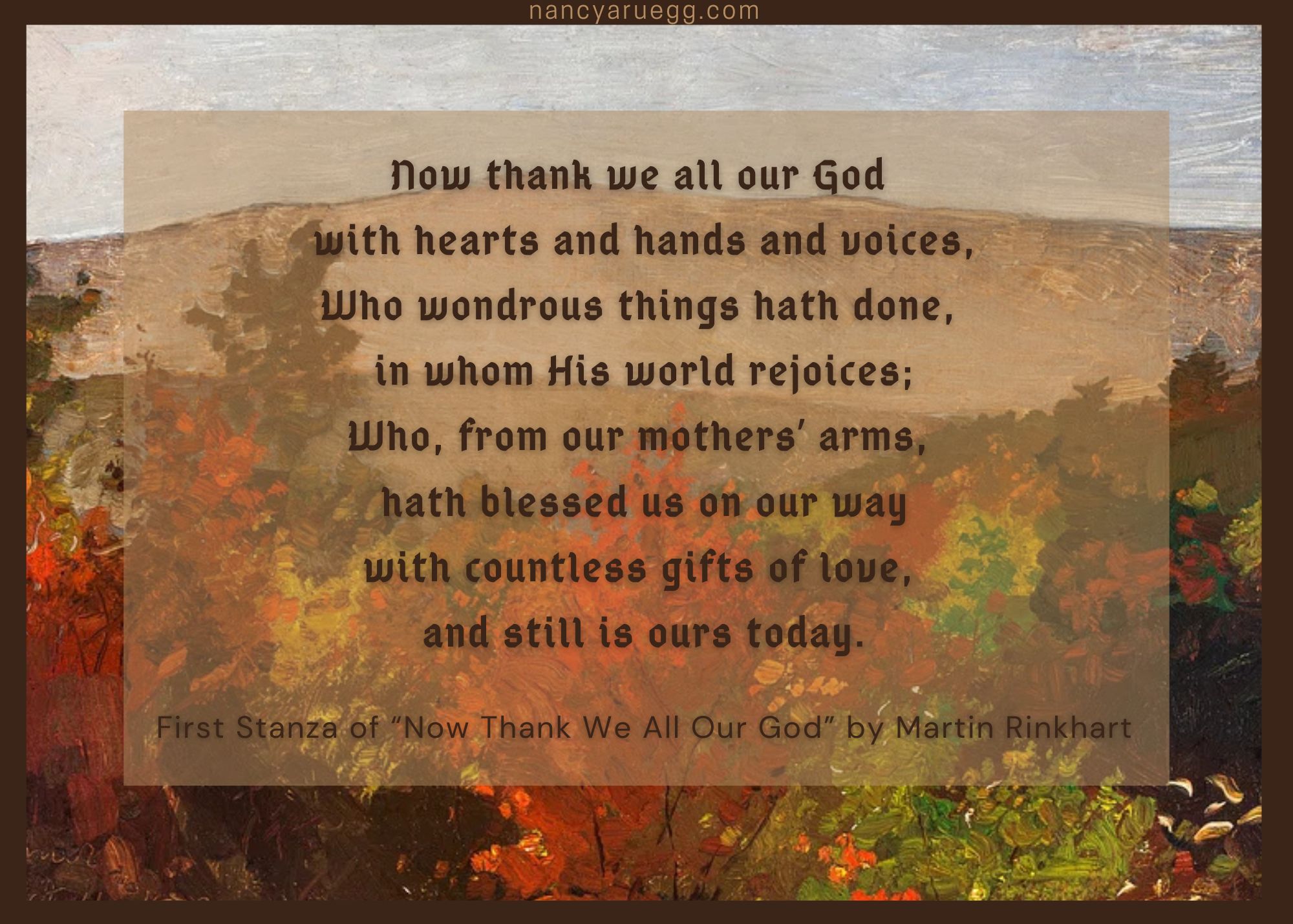
Most of us would expect a prayer pleading for relief and rescue by God’s power and mercy. Instead, Rinkhart focused on gratitude:

His prayer became the basis for a beloved hymn, chosen to be sung at the national thanksgiving service when the Thirty Years’ War ended. It’s still sung today:

https://youtu.be/ItfKjxkXhMk?si=TXR0eN0Tj9rP0Of4

I marvel how someone could write such lyrics—about the wondrous things God has done, his blessings along the way, and countless gifts of love—all while suffering terrible hardship and grief.

But I’m thankful for Martin Rinkhart’s example, demonstrating what it means to trust in the Lord with all your heart, in all circumstances [3].

Still, the question remains: WHY. Why Lord?” we plead toward heaven. “Why must good people suffer?”

Herbert Lockyer would have us understand:

No doubt Rinkhart embraced those truths. He also understood: Gratitude to God nurtures hope in him, the One who brings good out of all circumstances [5].


[1] https://enjoyingthejourney.org/hymn-history-now-thank-we-all-our-god/

[2] https://www.thedestinlog.com/story/lifestyle/faith/2018/11/20/story-behind-song-pastor-gives-praise-thanks-during-darkest-of-times/8320618007/

[3] Proverbs 3:5; 1 Thessalonians 5:18

[4] Seasons of the Lord, 371.

[5] Romans 8:28

Additional Source: http://www.baptistnews.com/article/now-thank-we-all-our-god/

Art & photo credits: http://www.picryl.com (Artist: Jozef Szermentowski); http://www.wikimedia.org; http://www.rawpixels.com.

Processing…
Success! You're on the list.

Read Full Post »

Surely you’ve met them—those glowing saints whose eyes always twinkle, smiles always dazzle, and whose faith and attitude always inspire.  We’re left wondering, how did they grow that glow?

No doubt it begins with strong trust in Christ, cultivated by scripture-study and prayer. They apply what they’ve learned about:

  • Giving all their concerns to God, knowing he truly cares
  • Focusing on the positive, the joyful, the beautiful
  • The pleasure of giving such gifts as time, encouragement, and a listening ear
  • Practicing God’s presence to experience his peace, strength, and more [1]

But researcher Michael Zigarelli discovered another reason why godly saints radiate joy: gratitude. He found that expressing continual gratitude to God actually energizes the practice of other spiritual disciplines, and altogether they contribute to growing that saintly glow [2].

Insightful author, Ann Voskamp concurs:

“The brave who focus on all things good and all things beautiful and all things true, even in the small, who give thanks for it and discover joy even in the here and now, they are the change agents who bring fullest Light to all the world” [3].

In addition, author and theologian Warren Wiersbe would have us know:

“That’s all fine and good,” someone might say. “But right now I see very little to be thankful for. We’ve had one financial setback after another, my job is more stressful than ever, our son is having a hard time in school, and my brother and sister-in-law just announced they’re separating. ‘See what I mean?”

Yes, we do. Some seasons of life include multiple troubles all at once.

But take note of this good news: simply expressing thankfulness (even if we don’t feel grateful) has been proven to create positive change in our brain chemistry [4].

And we find: continual gratitude contributes to a sense of WELL-BEING.

Another surprise?

Continual gratitude provides HEALING for the wounds of distress [5] —especially appreciation for who our Savior God is and what he has done.

Think of it: He created all things! He sustains all things! He has supremacy over all things! He is our Emmanuel (God with us), our Good Shepherd, our Wonderful Counselor, and so much more [6]!

God hears us as we pray, loves us with an everlasting love, empowers us through the Holy Spirit, fills us with hope, and anchors us through the storms of life [7]

And as we cultivate continual gratitude for such realities, we find PEACE.

The truly thankful person

is a truly peaceful person.

—Lysa TerKeurst [8].

It makes sense. The more we thank God for all the benefits he bestows, the firmer our faith-stance in his competence to sustain us.

Third, continual gratitude cultivates JOY.

Turn [your] eyes toward Jesus and everything shines—

even the tough spots morph into excitement. . .

How is he going to solve my problem this time? . . .

When I am consciously aware of him,

life fills with wonder and wonder brings joy [9].

What better way to remain aware of God and expand joy-inducing wonder than with gratitude?

Last, continual gratitude “lays out planks of TRUST” [10].

Think of all the moments he’s been faithful, when:

  • an impossible situation worked out amazingly well
  • a potentially difficult conversation turned out to be restorative and beneficial
  • an inspired idea came to mind that cleverly solved a problem
  • a surprising bargain materialized, supplying a current need
  • a string of just-so-happened circumstances provided the answer to a prayer

Yes, some will call these coincidences. Around here we call them God-incidences, because “whatever is good and perfect is a gift coming down to us from God our Father” [11].

And every time we acknowledge such gifts of provision, protection, and guidance, we lay another plank of trust, constructing a strong bridge of faith from yesterday into tomorrow [12].

Now we know. Each of us can grow a glow as we embrace the power of gratitude.

And isn’t November—with Thanksgiving just a few weeks away—the perfect month to grow that glow a little bit brighter?


[1] 1 Peter 5:7; Philippians 4:8; Acts 20:35; Isaiah 26:3 NLT

[2] https://godsmissionarychurch.org/2018/10/26/growing-through-thankfulness/

[3] One Thousand Gifts, 58.

[4] https://www.focustsoul.com/blog/signs-of-maturity-in-christ-part-1-gratitude-and-joy

[5] https://cct.biola.edu/spirituality-suffering-gratitude/, emphasis added

[6] Colossians 1:15-20; Matthew 1:23; John 10:14; Isaiah 9:6

[7]  1 Peter 3:12; Jeremiah 31:3; 2 Timothy 1:7; Romans 15:13; Hebrews 6:19

[8] Embraced, 256.

[9] Deanna Chadwell, Soul Bare, 82-84.

[10] Ann Voskamp, One Thousand Gifts, 151.

[11] James 1:17 NLT

[12] Voskamp, 152.

Art & photo credits: http://www.commons.wikimedia.org; http://www.heartlight.org; http://www.pexels.com; http://www.pickpik.com; http://www.flickr.com; http://www.shutterstock.com.

Processing…
Success! You're on the list.

Read Full Post »

A Date Night, 1976

One of the delights of a long-term relationship are the shared memories. My husband Steve and I find ourselves saying quite often, “Oh that reminds of . . .” and we’re each transported to a time and place of our mutual past:

  • Any songs from the Carpenters’ album, Close to You, take us back to a vacation house shared one week with two other couples—before kids. All we had for music was a tape of that one album!
  • Certain dishes remind us of favorite restaurants from our forty years in Florida: Bananas Foster–the Don Cesar Hotel on St. Pete Beach; blackened fish–Fast Eddie’s on Anna Maria Island; the shrimp pot–Captain Charlie’s on Juno Beach; and garlic knots–Mama Mia’s in Lake Worth.
  • Trigger-words immediately conjure up experiences: camper—four adults and four children in a pop-up—nice and cozy; muffins—Mrs. Bisso’s burnt offerings, humorously memorable [1]; and reggae music—a mini-vacation of snorkeling in the Keys with our three children.

No doubt you’ve experienced the same phenomenon. Sights, sounds, aromas—even a single word can elicit a memory.

And have you also noticed . . .

–C. S. Lewis, Out of the Silent Planet

God would have us know the same is true in the spiritual realm. The pleasure of our relationship with him grows more fully as we remember all the great things he’s done:

We also find that recalling God’s goodness in the past restores our faith for what he can do in the present and the future.

For example:

Has God miraculously supplied a need?

I’m remembering a time when Steve gave money to a struggling family, even though we were hardly making ends meet ourselves. Not long after, a speaking engagement (for which Steve didn’t expect to be paid) and a surprise monetary gift from a family member provided double what Steve had given.

Has God blessed beyond what you’d asked for, or perhaps with something you didn’t ask for at all?

One spring we were surprised by the gift of a new car, provided for us by a member of the church Steve was pastoring at the time.

Has God answered your prayers in marvelous ways?

In my God Is Faithful journal I came upon this entry:

“We’ve seen so many miracles at church recently—Barbara’s and Shirley’s healings, John’s clean bill of health from his doctor, special care of Joyce’s niece, and more! Thank you, Father, for blessing our fellowship in so many ways.”

Has God worked out impossible circumstances with astonishing ease?

During those years of ministry, children-raising, and teaching (for me), the Christmas season always meant extra-tight time-constraints. One morning I prayed God would somehow get me through the long, hectic day ahead.

And sure enough: 1) a teacher-colleague and I polished off essays that needed grading—I didn’t have to take any of them home, and 2) after school, a list of errands was expedited by little traffic (six days before Christmas no less!), a quick hunt for the items on my list, and short lines in the stores [2]!

When we’re feeling anxious or overwhelmed, taking time to remember God’s faithfulness, lovingkindness, and help in the past, does indeed help us trust him in the present.

Finally, remembering results in rejuvenating praise:

“Many, LORD my God, are the wonders you have done, the things you planned for us. None can compare with you; were I to speak and tell of your deeds, they would be too many to declare. . .

. . . You make me glad by your deeds, LORD; I sing for joy at what your hands have done.”

Psalm 40:5; 92:4 NIV


[1] https://nancyaruegg.com/2014/07/07/imperfectly-right/

[2] I’m so thankful for my “blessings” notebook-journal, kept since November 1983, so hundreds of examples such as these have not been lost over time.

Charles Spurgeon quote from Morning by Morning, 27.

Art & photo credits: Nancy Ruegg; http://www.stockvault.net; http://www.canva.com (2); http://www.commons.wikimedia.com.

Read Full Post »

How would you finish this statement?

Nothing we do is more powerful or life-changing than _____________.

Some would suggest taking better care of ourselves, or setting goals that include a plan for completion, or training our minds to focus on the positive. And the argument could be made that all of these actions create beneficial influence in our lives.

But according to author Stormie Omartian, “nothing we do is more powerful or life-changing than praise[1]. Others would likely agree with her, having cited numerous benefits themselves:

  • Prayers of adoration calm any fear, lift the spirit, and fill us with indescribable joy [2].
  • Praising God reduces our cares, levels our anxieties, and multiplies our blessings [3].
  • Continual praise is what changes the emotions, lifts the darkness, offers hope, frees the mood, and blesses God so that evil is driven out. It changes everything [4].
  • When we choose to practice adoration anyway in the midst of whatever we are feeling, our words lift us over that barrier and into a deeper connectedness with God [5].

But how could simple words produce such life-changing results? Psalm 69:30 offers a clue:

To magnify God is to make larger our view of him and his attributes, which lessens our view of the problems we face. The more often we focus on God, the more our faith thrives, and that in turn leads to less worry and fretting.

For example, see if these statements don’t boost your confidence in God for what you’re facing right now:

  • Praise God he is all-sufficient, all-knowing, and all-powerful. He has everything under control (Isaiah 55:11; Romans 11:33-36; 1 John 3:20b).
  • Praise God he is forever faithful, always working out his overall plan, always fulfilling his purpose (Lamentations 3:22-23; Job 42:2). 
  • Praise God he is continually gracious and good, full of love and compassion (Psalm 145:8-9).

The longer we gaze at him, arrayed in such glorious attributes, the less insurmountable our problems become.

And with an unknown Puritan of old we too can affirm:

“When I think upon and converse with Thee, ten thousand delightful thoughts spring up, ten thousand sources of pleasure are unsealed, and ten thousand refreshing joys spread over my heart, crowding every moment with happiness” [6].

That is the power of praise.

But the enemy of our souls is well aware of this power. He’ll do everything he can to keep us from developing the habit of praise. What might help?

Habit-stacking. Have you heard of it? The practice involves adding a new habit to some action that’s already a fixed routine.

For example, we might add more praise to our days while making the bed in the morning, completing some household chores, commuting to and from work, walking from place to place, waiting for the microwave, chopping fruit or veggies.

What routines are established in your life? Which ones lend themselves to spending a few minutes praising God for who he is and what he’s done?

Another possibility for adding praise to our lives comes from C. S. Lewis: “Make every pleasure into a channel of adoration.” He suggested several ideas to get us started: a beautiful mountain valley, delicious food, a great book, or a piece of music [7].

And you know what happens as we praise God for these blessings?

One’s mind runs back up the sunbeam to the sun [8].

Isn’t that lovely imagery?  

And is there any better place for our mind to be?


[1] Values for Life, 160.

[2] Kristine Brown (https://www.ibelieve.com/christian-living/prayers-of-adoration-to-fill-your-heart-wonder.html).

[3] Suzanne Dale Ezell, Values for Life, 160.

[4] Arnold Prater, Bonding with God, 78.

[5] Sara Hagerty, Unseen, 151.

[6] From The Valley of Vision, Puritan prayers and devotions compiled by Arthur Bennett, 1975.

[7] Quoted by Timothy Keller in Prayer: Experiencing Awe and Intimacy with God, 197.

[8] C. S. Lewis, Letters to Malcolm: Chiefly on Prayer, 89-90.

Art & photo credits: http://www.pickpik.com (2); http://www.canva.com; http://www.freeimageslive.co.uk; www,pxhere.com; http://www.canva.com.

Read Full Post »

Have you seen those grace-filled fingerprints? Perhaps at home in the joy of good-natured laughter around the family table, or one child helping another with his homework—unprompted, or unified celebration of all—for the success of one.

Perhaps you’ve seen God’s fingerprints outdoors in a landscape of incredible beauty and grandeur, or an up-close encounter with one of God’s creatures, or the expanse of a sunrise, sunset, or brilliant rainbow.

And especially at church, we see God’s fingerprints when an impassioned congregation sings their praise to him, a saint of God offers a heart-touching prayer, someone shares a personal story of divine, miraculous provision, or a scripture-reading fits perfectly our current circumstances.

No doubt, God’s grace is on display everywhere and always. It never wanes; it’s new every morning. And, as illustrated above, when we intentionally look, we see his fingerprints in the GRACE of place.

But God’s grace is not only evident around us. God has provided a place of GRACE within us as well.

  • Our God of grace hears—even before we speak (Isaiah 55:24).
  • Our God of grace leads—along the best and straightest path to himself (Psalm 16:11a) [1].
  • Our God of grace drives (propels)—gently but persistently—so we’re resilient, not fragile; strong, not weak; useful, not ineffectual (Ephesians 3:20).
  • Our God of grace lovingly and relentlessly draws us unto himself (Jeremiah 31:3).
  • Our God of grace changes us, progressively transforming us into his likeness with ever-increasing glory (2 Corinthians 3:18).
  • Our God of grace works in us so he can work through us—all to his and our mutual delight (Philippians 2:13).

He is a passionately dedicated, perfectly-intentioned, and supremely benevolent Heavenly Father!

Yet there is more. 

Our God enriches, enlightens, enables, and enraptures by:

  • blessing us—not with everything that pleases us—but with everything good for us [2]
  • bestowing the privilege of his presence—“so wonderful, quieting, soothing, calming, and warming” [3]
  • guiding us with supernatural wisdom as we avail ourselves with childlike trust
  • shaping our lives into what is useful and beautiful [4]
  • providing a haven within of comfort (Psalm 34:18) and strength (Psalm 59:16), refreshment (Acts 3:19) and joy (Psalm 4:7)

All good things are a result of God’s grace (Psalm 84:11)—in the GRACE of place all around us and in the place of GRACE within.

Where are you seeing God’s grace-filled fingerprints this day? Tell us about it in the comment section below!


[1] Dietrich Bonhoeffer

[2] King David mentions at least ten gifts in Psalm 103 alone.

[3] J. Danson Smith, quoted in Streams in the Desert, Jim Reimann, ed., 340.

[4] Eugene Peterson, Run with the Horses, 79.

Art & photo credits: http://www.openclipart.org & canva.com; http://www.pickpik.com; http://www.canva.com (2); http://www.creazilla.com (painting by Pieter Claesz).

Read Full Post »

Several years ago I read these words written by a pastor: “When hard times come, say to yourself, ‘Now is the time to use my faith in a new way.’”

I had to wonder, What might that new way include? He didn’t say.

But while considering my own hard times I remembered a few new-to-me strategies God brought to my attention that did indeed strengthen my faith. 

First, he led me to a new way to read scripture, recording any thoughts, insights, or prayers in a notebook. Writing helps slow my thinking so I can absorb more of what God would have me understand.

A few questions, prayerfully considered, might help our pens begin to write. For example:

  • God, what do you want me to understand and embrace from this passage/verse?
  • How would you desire this insight to impact my attitudes, beliefs, and/or actions going forward?
  • What does this passage teach me about you, as God the Father, Son, and/or Holy Spirit? How might this knowledge impact my current frame of mind?

During one time of upheaval I wrote the following, based on Psalm 62:5.

You are my hope, O God. Your plan is to prosper me, to help me grow in faith and Christian maturity. My eternal hope in you can help keep this present difficulty in perspective. After all, when compared to eternity, any hardship here on earth is brief. Someday I’ll live forever with you and the problems I’ve faced will seem insignificant in the light of heaven!

God also introduced me to a new way to pray: spend less time rehashing the problem, and more time rejoicing with gratitude. It’s the kind of praying Paul encouraged (Philippians 4:6-7):

We can thank God for each of his attributes at work on our behalf: his wisdom, power, goodness and more. We can also thank him for graciously upholding us, surrounding us with encouraging family and friends, and allowing us to sense his presence more palpably.

Consider also the positive impact on mind and spirit if we pray with anticipation, affirming God will act to fulfill his highest purpose. If we thank God that it will be so before it is so—that’s faith!*

Such a prayer might be:

I praise you, O God, for your power that can fulfill grand purpose even through (name the situation.) I praise you for being a creative God who solves problems in amazing, miraculous ways.

I thank you for being an involved God who takes an active, loving role in the lives of his children. I thank you that you are faithful and trustworthy, that when we commit our way to you and trust in you, you will act (Psalm 37:5)!

God also led me to a new way to embrace the promises, by acquiescing to his plan for fulfilling them.

For example, when a beloved fellow believer is diagnosed with cancer, our prayer is for a complete restoration, of course. We might site the promise of Psalm 41:3:

And sometimes God’s answer is yes. Even the doctors are surprised how quickly the patient recovers. Sometimes God’s answer is wait, as the patient endures radiation, surgery, and chemotherapy. And sometimes the answer is no.

But isn’t that complete healing as well as the patient is taken home to heaven where no sickness exists?

Life-experience and a growing relationship with God teach us:

It is then we turn to promises like these—promises we can count on no matter what:

  • He will guide us along the right paths (Proverbs 3:5-6)
  • He will provide peace of heart (John 16:33)
  • He will bring good out of every situation (Romans 8:28)
  • His grace will see us through (2 Corinthians 12:9)
  • He will provide everything we need (Philippians 4:19) 

These are among the promises to hold especially close.

And as we exercise such ways of faith presented above, they lead us to know God more, trust God more, and experience more of the spiritual blessings he longs to bestow.

And now, what new way of faith have you discovered that strengthens you during hard times? Please share in the Comments section below!

*Arnold Prater, Bonding with God, 81.

Art & photo credits: http://www.picryl.com; http://www.rawpixel.com; http://www.dailyverses.net; http://www.commons.wikimedia.org; http://www.canva.com; http://www.picryl.com; http://www.canva.com; http://www.pexels.com.

Read Full Post »

Many of those who haven’t asked Christ into their lives yet will still admit: historical evidence proves Jesus once lived on earth. They’ll agree he was a good man who taught wise principles to live by.

But even they might wonder: Why would God allow his Son to suffer such a cruel death at the hands of hateful men?

Welsh pastor and author Selwyn Hughes provided this insightful answer: what seemed to be the worst thing that could happen to Jesus—crucifixion—turned out to be the best thing for him [1].

That sounds ludicrous at first reading until we consider what Christ has enjoyed since returning to heaven, and what he’s looking forward to in the future–all because he fulfilled his mission at the cross.

As he suffered for us, Jesus kept in mind the joys set before him (Hebrews 12:2):

  • Sitting in the ultimate place of honor in the universe, at the right hand of the Majesty on high (Hebrews 1:3b).
  • Angels acclaiming him, saying, “Worthy is the Lamb who was slain, to receive power and wealth, wisdom and strength, honor, glory and praise” (Revelation 5:12).
  • God appointing him to be head over everything for the good of the church (Ephesians 1:22 GNT).
  • Being given authority and sovereign power that will last into eternity (Daniel 7:14).
  • All kings bowing before him one day, and all nations serving him (Psalm 72:11 NLT).
  • All nations and people of every language worshiping him (Daniel 7:14).
  • Being given the name above every name (Philippians 2:9).

And why is that last fact significant?  Jesus is the One and only Son of God, the only Redeemer and Savior, the only Christ and Anointed One of God. “His rank, his titles, his dignity, are above all others” [2].

Perhaps no one has explained the significance of Jesus’ name(s) more eloquently than theologian Charles Spurgeon:

Jesus’ name is “the sum total of all delights. It is the music with which the bells of heaven ring; a song in a word; an ocean for comprehension; although a drop for brevity, a matchless oratorio in two syllables; a gathering up of the hallelujahs of eternity in five letters” [3].

Charles Spurgeon

But Jesus doesn’t want to enjoy these accolades and privileges alone. Max Lucado wrote:

Jesus desires for us to be one with him, continually availing ourselves of all he has to offer.

Even more astonishing? Because of what Christ accomplished on the cross, we who’ve accepted Jesus into our lives get to share in his power and wealth, wisdom and strength, honor and glory!

For example:

  • The immeasurable and surpassing greatness of God’s spiritual POWER is in us who believe (Ephesians 1:19 AMP).
  • He supplies spiritual RICHES and blessings that cannot be fully understood or measured (Ephesians 3:8-9).
  • Christ’s word with all its WISDOM lives within us so we can experience his joy (Colossians 3:16; John 15:10-11).
  • We’re equipped for anything and equal to anything, through Christ who infuses us with inner STRENGTH (Philippians 4:13 AMP).
  • As beloved children adopted into God’s family through Christ, we are precious in his sight (Isaiah 43:4). He’s crowned us with HONOR and GLORY (Psalm 8:5; Romans 2:10), including the honor of representing Jesus in this world, and the glory of his character at work within us [4].

On this eve of Good Friday, we’d do well to remember:

We can pick up our own cross, inspired by Jesus’ example, empowered by God’s Spirit within us, and encouraged by the glorious outcome yet to be [5].

The worst circumstances we might face will become God’s best in our lives too.


[1] Every Day Light, 285.

[2] Barnes’ Notes on the Bible at www.biblehub.org

[3] Morning by Morning, 41.

[4] See also 2 Corinthians 5:17, 20

[5] To “pick up our cross” means trusting in God even when suffering comes our way, putting aside our self-will and embracing God’s will instead.

Photo credits: http://www.freebibleimages.com; http://www.canva.com (2); http://www.quotefancy.com; http://www.canva.com; http://www.pexels.com.

Read Full Post »

Years ago I served as a short-term missionary in Ecuador. One of my first meals there included a fruit I’d eaten many times back home in Illinois, although more often from a can than the produce section.

But that day the golden wedges provided an uber-delightful surprise: more flavor, more sweetness, and less acidity than any I’d enjoyed in the States. It was as if I was eating a different fruit.

That’s because Ecuador grows some of the world’s best pineapple. Their location on the equator and the volcanic soil of the Andes Mountains provides perfect growing conditions. I gained new appreciation for what pineapple could be.

There’s another kind of fruit that many of us are familiar with, but it’s not the kind we eat. It’s the fruit of the Spirit, listed in Galatians 5:22-23. Many of you can probably recite its nine aspects:

What follows are brief thoughts on each. I pray we gain new appreciation for what this fruit can be—perhaps even uncover a surprise or two.

LOVE

If you were asked, what’s a powerful, practical way to express love for others, what would you say? Theologian John Calvin suggested intercession [1]. To pray for a person is to love that person.

Who might you love with a prayer today?

JOY

Scripture tells us to “rejoice always” [2], but that’s hard to do when problems and pain come our way.

Selwyn Hughes offers this perspective: Even though our difficulties may have begun with the devil, by the time they get to us and through us, they will have a divine purpose running through them [3].

Now that we can joyfully celebrate.

PEACE

“The truly thankful person is a truly peaceful person,” asserts Lysa TerKuerst [4]. And Isaiah 26:3 suggests why:

What better way to fix our thoughts than with thanksgiving? And as we affirm God’s blessings, peace will warm our hearts.

PATIENCE

Patience blossoms best in the soil of God’s promises, as we wait for him to intervene. His promises cover every circumstance; our part is to know them and believe, then patiently anticipate their fulfillment.

Are you clinging to a scripture-promise today? Turn it into a prayer of faith, hope, and patience [5].

KINDNESS

We can grow this attribute with one action: meditate on God’s kindness to us [6]. Meditation fosters appreciation; appreciation fosters emulation, and soon we find God’s kindness becoming more a part of who we are.

GOODNESS

This trait often seems out of reach. But instead of trying harder to be good, author Philip Yancey recommends: simply love God. “A person who truly loves God will be inclined to please God” [7].

Also worth remembering, the inclination to always please self results in dissatisfaction and restlessness [8].

FAITHFULNESS

Every year thousands gather to see Old Faithful, even though it’s not the tallest geyser in the world. Why is it so popular? Dependability. You can count on Old Faithful.

What might dependability look like for you today?

GENTLENESS

A list of traits of successful people rarely includes gentleness. Yet this attribute contributes much to prosperity in life. That’s because: “[Gentleness] creates in us a capacity for the closest possible intimacy with God” [9].

It’s the gentle-spirited souls who lean in toward God with yielding hearts to rest in his sovereignty. And then, think of it: God, with all his glorious attributes, comes close (James 4:8).

SELF-CONTROL

“A person without self-control is like a city with broken-down walls”[10]–vulnerable to all sorts of problems.

Better to take the wise course, prayerfully availing ourselves of the Holy Spirit’s help, to develop those habits we know will bring benefit and usefulness.

*     *     *     *     *     *     *     *     *     *

And now, our fruit bowl is full! Did you find any surprises?

I pray this week, you enjoy one or more aspects of this familiar fruit–with fresh appreciation!


[1] https://gracequotes.org/topic/love-others_for/

[2] 1 Thessalonians 5:16

[3] Every Day Light, 124.

[4] Embraced, 256.

[5] A few favorite scripture-promises include: Psalm 32:8; Isaiah 41:10, 31; Romans 8:28; James 1:5.  

[6] From a sermon our pastor preached last spring.

[7] Grace Notes, 325.

[8] Ecclesiastes 2:10-26

[9] Albert M. Wells, Jr., Inspiring Quotations Contemporary & Classical, 91.

[10] Proverbs 25:28 NLT

Art & photo credits: http://www.needpix.com; http://www.heartlight.org; http://www.pickpic.com; http://www.flickr.com; http://www.negativespace.com; http://www.deviantart.com (vulcanknight).

Read Full Post »

« Newer Posts - Older Posts »

When the House is Quiet

Impressions Becoming Expressions

Mitch Teemley

The Power of Story

Still Traveling

Impressions Becoming Expressions

Living Our Days

Gaining a heart of wisdom

He Said What?!

I'm Patty, and my husband and I are living with our adult son who has autism and epilepsy. I love sharing lessons learned from life around me, especially life with Aaron.

Meditations of my Heart

Impressions Becoming Expressions

Linda Stoll

Impressions Becoming Expressions

Signora Sheila

Where Faith Meets La Dolce Vita

Heidi Viars

Finding the Image of God