
According to research, guess what percentage of our happiness is based on circumstances.
A. 10%?
B. 25%?
C. 50%?
D. 80%?
The answer? Just 10%.
Now why would that be? My guess is, our perspective matters more than our circumstances.

(“Contentment is not the fulfillment of what you want,
but the realization of how much you already have.”)
Ah, yes. Gratitude. Definitely an important attitude, contributing to the sweet, even-keel life of contentment. But it doesn’t come naturally to most of us.
Our thoughts, if left untended, can easily fall into a dark hole of:
- Self-centeredness. “Yeah, the budget’s tight, but I really need a new car. It’s downright embarrassing to drive around in our old clunker.”
- Self-pity. “It’s not fair that I’m not paid what I’m worth. I work so hard.
- Self-justification. “I deserve that new car.”
Note the focus on self. And half the time (or more) we don’t even realize how much of our thought life spins around in that dark hole.
How can we possibly climb out? Time and attention are required to develop a mind that frequently contemplates thanks-giving and praise instead of complaint-making and dissatisfaction.
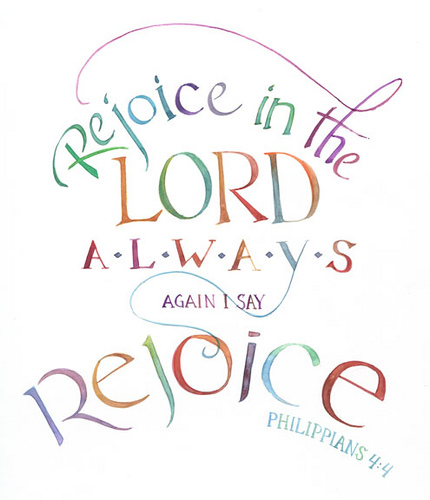
Even the apostle Paul said he had to learn how to be content whatever the circumstances (Philippians 4:12). And like any new skill, developing contentment requires a bit of knowledge and a lot of practice.

The best place for knowledge on such a topic is scripture. Several passages can inform our understanding of contentment.
- King Solomon said, “The fear of the Lord leads to life; then one rests content, untouched by trouble” (Proverbs 19:23).
Not that reverencing God protects us from trouble and every day is glorious. Bad things still happen to good people. But those who reverence God and worship him see life from a different perspective. They can be content even when catastrophe strikes, knowing that God will see them through.
Think about Daniel in the lions’ den, or Peter and Paul in prison.
- Paul said he didn’t really care if he was living in plenty or in want (Philippians 4:12). How is that possible? He answers in the next verse, and it’s a familiar one: “I can do everything through him who gives me strength.”
Living in plenty–with God–taught Paul how to keep his priorities straight. Living in want–with God–taught Paul to detach himself from “things.”
- Paul told Timothy, “Godliness with contentment is great gain” (1 Timothy 6:6).
When we think of a man with “great gain,” we imagine a person with a large, beautifully decorated home, designer suits, two or three cars (for his own use—family members have their own cars), and the capability to go on expensive vacations.
But what about the young Christian father who thanks God every day for his loving wife and two precious kids? Who enjoys a circle of fun, supportive friends at church that also help him keep his priorities straight? This guy lives in a two-bedroom ranch, drives a ten-year old car, and spends vacations taking day trips from home.
Yet he’s rich, too–maybe even more so. It’s just that his riches fall into a different category. He’s rich in relationships, especially with God. “True godliness with contentment is itself great wealth” (I Timothy 6:6, NLT).

Now that we’ve absorbed a bit of scriptural understanding, it’s time to practice what we’ve learned. How can we foster contentment in our spirits?
- Cultivate a positive, faith-filled perspective by turning “I wish” statements into “I praise” statements.
Paul was under house arrest in Rome when he wrote to the Christians at Philippi. His days as an adventuring missionary were most likely over; the future looked bleak. Once his trial took place before Nero, Paul knew he could be facing execution.
He might well have said, “I wish I could be back on the road again preaching the gospel. It makes no sense why God has let this happen. I wish he’d get me out of here!“
But Paul’s response was far removed from wishful thinking. He actually praised God that his circumstances were advancing the gospel (Philippians 1:12-18).
- Feed our confidence in God, not our comparisons to others. Contentment wells up in our spirits when our thoughts are grounded in scripture, praise, worship, and gratitude.
- Focus on the present—look for the blessings of right now. “We will become content as we enjoy each day for what it is rather than moan about what we imagine it could have been” – Bruce Goettsche.

An airline pilot was flying over a lake when he turned to his copilot and remarked, “See that little lake? I used to fish there a lot when I was a kid. Every time a plane would fly overhead I’d think, “Boy, I sure wish I was flying that plane. It must be so wonderful to soar through the sky and see for miles and miles. Now do you know what I’m thinking? How I wish I was down on that lake fishing!”
I don’t want to be like that pilot. I want to be like Paul.
(Art credits: www.covgrace.org; www,janellenichol.com; http://www.quoteimage.com; http://www.ponderingtheheartofjesus.com; www.i.mobypicture.com.)













The Mind of Christ
Posted in Bible Study, Blessings, Encouragement, Godly Character, Maturity, Meditation, Uncategorized, tagged 1 Corinthians 2:16, 1 Corinthians 2:16 commentary, Bible Study, Galatians 2:20, Galatians 5:22-23, God's Creative Genius, Philippians 1:6, Romans 8:6, The mind of Christ on November 3, 2014| 10 Comments »
“Who has known the mind of the Lord?” Paul asked (1 Corinthians 2:16).
That’s an easy question to answer: Nobody! His intellect and wisdom are far beyond our human ability to comprehend.
After all…
God has worked out the complexities of every living cell–with perfect precision.
(X-ray microscopy combine to picture interior of living cell)
He has engineered a staggering number of specialized plants and creatures, carefully interrelated in a web of reliance upon one another.
He has created the unfathomable reaches of the universe filled with countless heavenly bodies of immeasurable proportions.
(Spiral Galaxy M74)
Such intellect and wisdom to accomplish these feats is incredible.
Yet, at the end of that same verse above, Paul makes a statement even more astounding. In fact, at first glance it seems ludicrous.
“We have the mind of Christ.”
What? How is that possible? His knowledge and wisdom are infinite; ours is markedly limited.
But Paul makes clear: we have the mind of Christ because he lives within us (Galatians 2:20).
Not that we can know everything and respond with pure wisdom in all situations. Our perfection is a process that won’t be completed until Jesus returns (Philippians 1:6).
But my heart beats a little bit faster to realize that, each day and for all my tomorrows, I might think more like Jesus, understand more like Jesus, and react more like Jesus.
One particular action will encourage progress: spending time with him, especially in his Word.
Here’s an analogy, though far from perfect. Steve and I have been married a very long time—forty-four years. At this point, we can finish each other’s sentences, supply missing information or words in a conversation, and sometimes even know what the other is thinking.
It’s as if we’ve acquired a bit of the other person’s mind. And it’s happened bit by bit, over time.
So I repeat: We will have the mind of Christ as we spend time with him day by day– especially in his Word.
And how will we know that his way of thinking is becoming our way of thinking? After all, there’s no measuring stick for spiritual growth.
Oswald Chambers, in My Utmost for His Highest, posed an excellent question that can help us determine our progress:
“Are other people beginning to see God in my life more and more (p. 78)?” Because a person with the mind of Christ will demonstrate Christ-like behavior.
Perhaps we could take an occasional inventory, based on the fruit of the Spirit (Galatians 5:22-23). The attributes listed in these two verses characterize a person with the mind of Christ–someone who is loving, joyful, peace-filled, patient, kind, good, and so on. We could ask ourselves, how have I demonstrated these attributes this week?
And what will be the result of cultivating the mind of Christ? “The mind controlled by the Spirit is life and peace” (Romans 8:6).
Life that is characterized by vitality and purpose.
Peace that includes inner-contentment, freedom from guilt, and security for eternity.
That sounds awfully good to me.
* * * * * * * * * *
Heavenly Father, we praise you for taking us into the high places of blessing in Jesus. That includes this gift: the mind of Christ. And day by day you are transforming us into his likeness, with ever-increasing glory. May I seize this day and its opportunities to think like you, understand like you, and react like you.
(Ephesians 1:3; 2 Corinthians 3:18)
Art and photo credits: www.lbl.gov; http://www.chesapeakebay.net; http://www.hubblesite.org; http://www.crosspointenwa.com; http://www.pinterest.com; http://www.changingthefaceof christianity.com; http://www.footsoldier4christ.com; http://www.motivationalquotes.com.
Read Full Post »