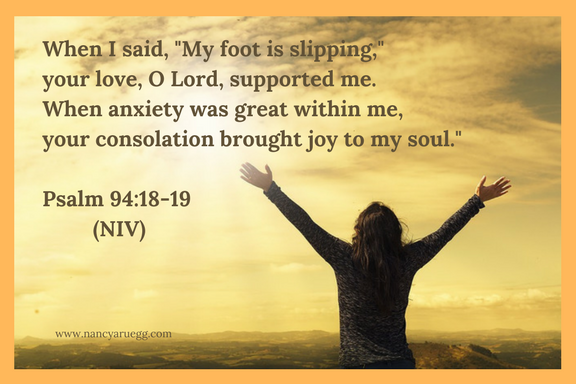
Feeds:
Posts
Comments

Archive for the ‘Faith’ Category

Hope.

Such a small word for such a big, important concept.

Multi-syllable synonyms seem to carry more clout:  expectation, assurance, confidence, and conviction offer a few.  (Thank you, Dr. Roget.)

Stir them together and we can create a definition for faith-filled hope:  the constant, confident, assured expectation that God will see us through every circumstance until we’re standing before him in heaven.  Those are words with heft that we can hang onto through dark and stormy nights.


You see, hope is much more than wishful thinking.

But sometimes it hides behind the overwhelming issues we face:  health concerns, financial problems, troubled relationships, difficult circumstances, foreboding futures.


How can we live with confident assurance that all will be well when uncertainty seems to rule the day, the week, the year?

As always, scripture offers us insight:

  • Understand that hope doesn’t come from a hidden reservoir within ourselves.  According to 1 Peter 1:3, our hope comes from God, provided for us out of his loving mercy.  It’s a living hope, breathing energy and strength into our souls.
  • Remember:  we can move forward with positive expectation because He is our all-powerful, grace-filled God—loving, kind, and wise, too.  He’s not just watching from afar; he’s an involved God, tending over us like an attentive Shepherd (Isaiah 40:11a).


  • Rest assured that our faithful God will see us through to a satisfying conclusion—either through events that unfold over time, or perhaps through an instantaneous miracle.  It may be the satisfying conclusion will not come until we cross the threshold into eternity (1 Peter 5:10).  But then, in the glorious ecstasy of that moment, our earthly trials will no longer matter (Philippians 1:21-23).
  • God’s plan is designed for our good (Jeremiah 29:11).
  • Hope involves waiting (Micah 7:7)—expectantly and patiently.

Sometime during second grade I noticed that being a teacher looked like fun.  And soon my favorite pastime became playing school with whomever I could cajole into being students.  When necessary, dolls were pressed into service.

That desire to become a teacher stayed with me all through high school and college.  Finally, after fourteen years, I was the one sitting at my own teacher’s desk, awaiting the arrival of my first students.  My hope, my confident expectation that I would one day be a teacher, had at long last become reality.  The import of the moment was not lost on me.  I had to fight back the tears.


Such euphoric joy does not happen often without waiting.  We appreciate more what we have to wait for.  And frequently, hard work is also involved.

God allows us to be part of the process, teaching us important lessons about patience and perseverance along the way.

Here’s what I need to remember:

Long-term waiting and steady hard work toward a dream makes the fulfillment all the sweeter when it finally comes.

For now, we can enjoy hopeful anticipation of a new reality that is coming, perhaps in this new year 2018—good health, financial security, improved relationships, or fulfilled dreams.  We can take comfort from the knowledge that our God, who is unlimited by the constraints of time, already resides there.  And…


Through the dark and stormy night

Faith beholds a feeble light

Up the blackness streaking;

Knowing God’s own time is best,

In patient hope I rest

For the full day-breaking!

– John Greenleaf Whittier


Let’s step out into each new day breaking with trust and obedience, because God is preparing us for that new reality.

And may these words ring in our ears:


“The Lord is good to those whose hope is in him,

to the one who seeks him.”

–Lamentations 3:25


*     *     *     *     *     *     *     *     *     *


What hope have you been clinging to?  Are there scriptures which contribute to your confidence and expectation?  What experiences of the past give you assurance for your hopes of the future?  Please share your insights below in the comments section!


(Revised and reblogged from January 31, 2013.  I do apologize for posting a reblog again.  Steve and I have been sick, catching a nasty bug on New Year’s Eve.  First I succumbed, and then he did.  A new post will be forthcoming next week!)


Art & photo credits:  http://www.flickr.com; http://www.pixabay.com; http://www.heartlight.org; http://www.pxhere.com; http://www.wikipedia.com; http://www.pixabay.com.

Read Full Post »



In three short days 2017 will melt into memories, and we’ll greet a new year with all its potential for grand possibilities.

These last few days of December offer a time of optimism and expectancy within our spirits. We wonder if 2018 will be the year for:

  • The fulfillment of a long-held dream,
  • The answer to a frequent, heart-felt prayer, or
  • The accomplishment of a hard-won goal.

It’s also a time when our hearts become reflective:


  • What might God have in store for me in 2018?
  • What would he desire me to do over the next twelve months?
  • How would he have me grow in character and maturity?

And so I pray.  (Perhaps you’d like to join me?)

Thank you, Father, for the demarcation between one year and the next, giving us pause to evaluate and encouraging us to:

  • Refocus our attention on priorities,
  • Recalibrate those attitudes that hold us back, and
  • Renew our resolve to live your way for your purpose (and experience your effervescent joy in the process).


To that end:

  • I pray for strength to accomplish what you have ordained for me.

Make clear your plan, Lord, and then help me tackle that plan boldly, mindful that you rarely give strength beforehand; most often you grant strength as we journey.

Remind me also: “When I am weak, then I am strong” (2 Corinthians 12:10). That sense of inadequacy in my spirit is actually a positive force. It compels me to rely on you more consistently.


  • I pray for wisdom to choose those areas where you want me to spend my time, energy, and resources.

Remind me my days on Planet Earth are growing short (Psalm 90:12). I need to remain focused.


Thank you, O God, for the delightful promise that the pursuit of wisdom results in joyful satisfaction in life. “Blessed is the man who finds wisdom and the man who gains understanding (Proverbs 3:13). May I be diligent to seek wisdom from your Word and then make choices based on that wisdom.

  • I pray for courage to speak of you everywhere, anytime.

As I pick up the phone or head out the door, may I affirm you are with me (Joshua 1:9). You will spread the knowledge of Christ through me, like a sweet perfume (2 Corinthians 2:14)—if I am a willing participant.


With Pastor Jack Hyles (1926-2001), I do not pray for my fears of rejection or conflict to be removed; I ask for courage equal to my fears.

  • I pray for faith to relish the adventure of a God-honoring life.

Keep me mindful of your promises, Father, that create a rock-solid foundation for my faith, including: 1) You are always working to accomplish your plan (John 5:17). 2) You are always working in me to mold my character into Christ-likeness (Philippians 1:6). 3) Your incomparably great power is always available for us who believe (Ephesians 1:19).


And if I proceed into each day with a simple reliance upon your power, with a single eye to your glory, it is certain you will be with me…And if you are with me, then I must succeed (Charles Spurgeon). Thank you for such emboldening words!

  • Last, I pray for passion to experience even more of your abundant life.

I want to participate with you in what you are doing around me, Lord—in my family, church, neighborhood, community, even in the lives of those I meet in the blogosphere.

I want to live with spiritual intensity, acutely aware of your presence around me and your power within me.

I want to experience the abundant life you offer in John 10:10 until even simple moments sing with significance because they reveal your glory.


O God, as you fulfill these desires and increase these qualities in me–strength, wisdom, courage, faith, and passion–what a year 2018 promises to be!


(Art & photo credits:  http://www.maxpixel.freegreatpicture.com; http://www.pixabay.com (2); http://www.dailyverses.net (2); http://www.wallpaper4god.com; http://www.slideshare.net; http://www.wallpaper4god.com.)


Read Full Post »


“Joseph went up from the town of Nazareth to Bethlehem,

because he belonged to the house and line of David.

He went there to register with Mary,

who was pledged to be married to him and was expecting a child.”

–Luke 2:4-5 excerpts, NIV


The distance from Nazareth to Bethlehem is about eighty-five miles. Can you imagine walking that far, nine months pregnant? I can’t. Even if Mary rode on a donkey, she’d have been jostled and swayed from side to side. How comfortable would that have been? I think I’d rather walk.

And yet, in spite of Mary’s unremitting discomfort and Joseph’s growing concern, the couple surely traveled the road to Bethlehem with great hope in their hearts. Her firstborn would soon enter the world—a Child like no other. The angel, Gabriel, had made it clear to both of them: Mary would bear a son, the promised Messiah, and he would save his people from their sins (Matthew 1:21).

Sure enough, Mary delivered the child while they were in Bethlehem, the exact birthplace identified by the prophet Micah (5:2), centuries before the event.


That same night shepherds cowered in the grass as blinding light pierced the darkness and a startling figure appeared—an angel. Fear quickly gave way to wonder, however, as the shepherds heard the astounding announcement. The Messiah had finally been born, not in the Holy City of Jerusalem as one might expect, but just a stone’s throw away in their own little village.

Soon the shepherds were also traveling a road to Bethlehem. But this was undoubtedly no midnight stroll; they may have even tried to outrun each other. And the exuberant joy that propelled them was accompanied by confident faith in their hearts. They knew the angel’s message had come from the Lord (Luke 2:15).


Many miles to the east wise men took note of a special star and shortly thereafter set out upon their own long road to Bethlehem. It’s possible they followed the star westward for two years, in order to worship the Messiah and present him with precious treasure: gold, frankincense, and myrrh.   Theirs was a road of generosity.

And now it’s our turn to travel the road to Bethlehem—a figurative one. With Thanksgiving behind us, we journey toward December 25, the final destination after a month-long celebration of our Savior’s birth.

Like Mary and Joseph we can travel with hope because our Heavenly Father is a God of his Word, who loves, encourages, strengthens, and more (2 Thessalonians 2:16-17).


Like the shepherds, we can embrace the truth of our Savior’s birth and all its implications for an abundant, God-enhanced life now and unending euphoria in heaven yet to come (John 10:10, 1 John 5:11-13).

Last, like the wise men, we can follow the road of generosity, not only with presents for family and friends or contributions to ministries and charities, but also with such gifts as:

  • A smile for the harried store clerk,
  • Focused attention on the toddler who wants to sing “Rudolph,”
  • A listening ear for the elderly lady at the grocery store,
  • Cheerful patience while waiting in line at the post office, and
  • The benefit of the doubt—for everyone.

Best of all, our road to Bethlehem extends beyond December 25—into eternity—where hope will be culminated, faith will become sight, and generosity will be rewarded (1 Peter 1:3-4; Hebrews 11:1; Ephesians 6:8).


The road may seem long at times.   But the destination will be rapturously worth it.

______________________________

Your turn:

Of course these three–hope, faith, and generosity–aren’t the only roads to Bethlehem.  There are many, including the familiar roads of love, joy and peace.  What road (s) will you travel this Advent season?  Please share your thoughts in the comment section below!


(Art & photo credits:  http://www.flickr.com; http://www.wikimedia.com; http://www.flickr.com; http://www.slideplayer.com; http://www.pexels.com.)


Read Full Post »

The place:  Spindletop, Texas.

A group of five investors formed the Gladys City Oil Company.  Sulphur springs in the area gave them great hope that black gold lay beneath the surface, especially since gas seepages in the area would ignite if lit.

Soon the area was dotted with holes–holes that produced nothing.  Two investors pulled out.

A geologist was brought in.  More investors were convinced to take the risk.

Nine long, unproductive years went by, and  still no oil. That’s 3,285 days of discouragement, disappointment, and exhausting labor.  Yet those men would not give up.

Finally, on January 10, 1901, their long-held dreams were realized.  At the depth of 1,139 feet, the company struck oil.  And it wasn’t just a gurgling flow.  The discovery at Spindletop gave new meaning to the term, “gusher.”  The oil shot over one hundred feet into the air, spewing enough to fill 100,000 barrels a day.  It took nine days to get the well under control.  No oil field in the world, up to that time, had been so productive.

Lucas_gusher

I wonder what those men said to each other each morning, over those 3,000-plus days of working, learning, waiting, and wondering?  Surely their conversations included some positive uplift, or they would have quit.  Perhaps they made such comments as:

  • “If we don’t find oil, at least we can say we gave the effort everything we’ve got.  If we quit before all possibilities are tried?   That‘s failure.”
  • “All the signs indicate there is oil.  We cant quit!
  • “Today might be the day!”

Just as oil is sometimes discovered by accident, so God’s blessings fall into our laps as glorious surprises. Other times,  God chooses to postpone a blessing while we dig our way through learning, working, waiting, and wondering–like the oil men of Spindletop, Texas.

How do we press on when circumstances look bleak, when common sense tells us to quit?

1.  Pray!  The key to knowing when to persevere and when to change direction is to spend time with God. Ask him to make clear what the next step is.  Most likely he will not reveal the whole plan at once.  He rarely works that way, because it eliminates the faith factor.  Our moment-by-moment trust in him is too crucial to the abundant living he desires for us.

2.  Believe!  Dozens of promises in scripture probably apply to your situation and mine. We can recite those promises–not as demands (“God, you said this, so I’m expecting you to do it.”) but as faith-builders. (“God, you said this, and I know with you all things are possible.”)

3.  Fight!  Fight against discouragement with plenty of encouragement.  God is very creative in the ways he brings hope to our spirits.  We must keep watching and listening!

A friend or even a stranger can speak uplifting words that resonate in our hearts.  Sometimes it’s as if God is speaking directly. One sign for me, that someone is speaking for God?  Goosebumps!  I can almost feel his light touch on my arm and his voice saying, “Pay attention to this, Nancy.”

Our God is a well of unending supply.  Whatever we need in this life, including wisdom, direction, and perseverance toward a goal, he will provide.  In fact, he will do whatever it takes for his praying, believing, fighting children to discover the oil of gladness, instead of mourning (over failure), a garment of praise instead of a spirit of despair.

That’s one way our loving, supportive Heavenly Father displays his splendor (Isaiah 61:3).

Steven Curtis Chapman Quote: “Out of these ashes beauty will rise.”

[https://quotefancy.com/quote/1129946/Steven-Curtis-Chapman-Out-of-these-ashes-beauty-will-rise]

(Revised and reblogged from February 13, 2014.)

Photo credits:  www.en.wikipedia.org; http://www.heartlight.org; http://www.quotefancy.com.

Read Full Post »
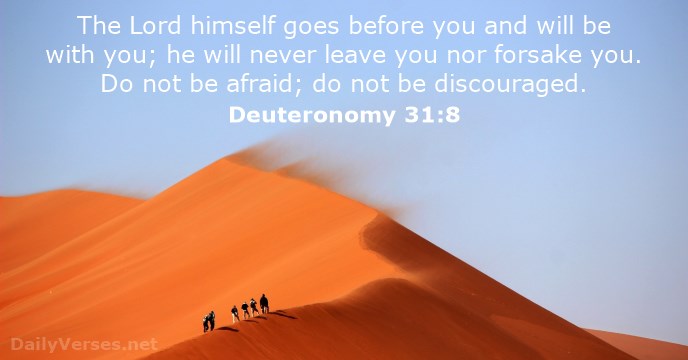
Ever had a sleepless night due to a relentless whirl of what-ifs, a churning jumble of distress and anxiety, a racing heart?

Worry will do that. No wonder we’ve been told worry is bad for us.  In fact, according to Charles Mayo (co-founder of the Mayo Clinic), worry causes adverse affects on the circulatory system, heart, glands, and nervous system.*

But what about concern? Is that different from worry? Is it OK to be concerned?

The answer is yes. Scripture gives much evidence that even our perfect Heavenly Father exhibits concern. He demonstrates:

  • Compassion on all he has made (Psalm 145:9).
  • Care for each of us (1 Peter 5:7).
  • Mindful attention (Hebrews 2:6).
  • Watchful protection (Jeremiah 31:10).
  • Careful planning for us (Psalm 40:5).

As God exemplifies, concern prompts beneficial action; worry, on the other hand, accomplishes nothing but harm.

Worry creates a thick fog of fear; concern invites God into our experience with all his wisdom, power, and comforting presence. He is, after all, the only One who can dispel fog, whether it’s water vapor in nature or worry on our minds.

Just the reminder our loving Father is right in the midst of the mess with us will do much to sweep away worry.  And “there is heaven in the depth of that word—Father!” (Charles Spurgeon, emphasis added).

Indeed. If we dig into the heavenly depths of our Father’s love we’ll see:

  • The support of his powerful right hand (Psalm 65:8).
  • The protection of his everlasting arms (Deuteronomy 33:27).
  • The comfort of being carried close to his heart (Isaiah 40:10).

And that’s just for starters.

If we dig into what we know about him, we can affirm:

  • “Nothing happens in any particular unless God’s will is behind it; therefore [we] can rest in perfect confidence in him” (Oswald Chambers).
  • The God who made us will equip us for whatever lies ahead—even if it’s unpleasant (Habakkuk 3:19).
  • Difficulties most often set the scene for his glory to be displayed (Romans 11:36).

Sometimes, though, the fog of worry shrouds even the strongest mental images and the most affirming truths. We’re forced to admit: trustful concern is not easy.

For most of us, it is a learned discipline that grows over time. Slowly we’re able to embrace the truth that all will be well because all is in God’s perfect and capable hands. Slowly we develop the habit of affirming God’s character and power, to develop a nearly worry-less state of contentment.

And we learn the value of gratitude amidst turmoil—as illogical as that may sound. The very act of thanking God releases our minds from negative focus. When we turn our attention to him, problems fade in significance and the fog is dispersed. That’s why Paul recommended, “Pray with thanksgiving” (Philippians 4:6).

And that’s how we turn worthless worry into productive concern.

*     *     *     *     *     *     *     *     *     *

I thank you, Father, that NO situation is hopeless because you are the God of eternal hope. I can count on you because you are the God of universal sovereignty, complete sufficiency, and abundant goodness.

I thank you for your comforting presence, for your power at work (even though I can’t see it right now), and for your glorious promise that you always bring good from every situation. I praise you that, while we may sow in tears, there will come the day we reap with songs of joy. Hallelujah!

2 Thessalonians 2:16-17; Romans 11:36; 2 Corinthians 3:5; Psalm 145:7;

Matthew 28:20; John 5:17; Romans 8:28; Psalm 126:5

*www.todayinsci.com.

(Art & photo credits:  http://www.flicker.com; http://www.wallpaper4god.com; http://www.youtube.com; http://www.dailyverses.net; http://www.heartlight.org.)

Read Full Post »

Conventional wisdom teaches that success comes to those who work hard to achieve their goals.  And to a point that’s true.

But.  Success can quickly crumble when tragedy strikes.

Ask Job; he’ll tell you.  He was an extremely wealthy man and the greatest among all the people of the East.

He enjoyed a large, loving family.  His children liked each other so much they partied together.

Job was blameless and upright—totally undeserving of what happened to him (Job 1:1-4).

Stripped of everything.  All his wealth.  All his wonderful children.

Some of the recent hurricane victims know the magnitude of such horror. Home and all contents, gone.  Family members, gone.  I can’t even imagine their emotional pain and heartache.

And what was Job’s reaction to his tragedy?

If you had asked me that question a couple of years ago, I would have answered:  Job was incredibly accepting; he didn’t even blame God (1:22).

But there’s more:

“He fell to the ground in worship” (v. 20b).

WHAT?!

How can a person possibly worship at a time like that, when his whole world has collapsed around him?

All Job had left was his foundation—a foundation of faith in God.

And worship was his expression of that faith, declaring God’s worth to him—in spite of horrific calamity.  For Job, God was enough.

From Job we learn that true worship is not reliant upon circumstances.  In fact, a sacrifice of praise (Hebrews 13:15) is surely very precious in God’s view.

Second, true worship is not reliant upon emotions.  We don’t have to be filled with joy in order to worship.  We can worship God with our tears, expressing our trust in spite of the pain.

Job couldn’t rely on answers that would give meaning for his suffering.  God gave him none.  What Job did rely upon was God’s character:

  • “His wisdom is profound, his power is vast” (9:4a).
  • “He performs wonders that cannot be fathomed, miracles that cannot be counted” (9:10).
  • “If it is a matter of strength, he is mighty!  And if it is a matter of justice who will summon him?”  (9:19).
  • “You gave me life and showed me kindness, and in your providence watched over my spirit” (10:12).
  • “To God belong wisdom and power; counsel and understanding are his (12:13).
  • “Can anyone teach knowledge to God, since he judges even the highest” (21:22)?

In the end, knowing God was more important to Job than knowing answers.

*     *     *     *     *     *     *     *     *     *

Heavenly Father, I shake my head in wonder as people of faith such as Job neither blame you nor give up on you in the face of calamity.  Instead, they rely upon you all the more tenaciously.  They worship, affirming that you are still their sovereign, loving God; they testify of your strength and peace. 

Thank you for being a God who comes alongside us with your wisdom and grace, especially when we’re hurting.  Thank you for powerful examples to follow such as Job.

(Art & photo credits:  http://www.flickr.com; http://www.wikimedia.org; http://www.pinterest.com (2); http://www.flickr.com.)

Revised and reblogged from June 17, 2013.

Read Full Post »

In spite of sunny, spring weather that day, I sat in misery on the bedroom floor. Around me lay bubble wrap, packing-tape, and a bunch of stuff to be cocooned, before stashing it all into Moving Box #78,493. (Does extreme exaggeration make clear my frustration and exhaustion with the whole process?)

Some weeks before, the district superintendent of our church denomination had informed us my pastor-husband was being assigned elsewhere. After five years of living and working with the current loving congregation, our time together would soon end.

I wasn’t ready to move.  We’d become as close as family to many in that church, as we met in small groups, sang in the choir, served one another and the community, and got together just for the fun of it.

I felt homesick before I’d even left.

While wrapping and packing, I listened to song writer/vocalist/pianist, Ken Medema, on our tape player. His song about Moses talking with God at the burning bush was a favorite, and as it began, I listened more closely.  (Click below to enjoy this distinctive song.)

What’s that in your hand, Moses?” 

“It’s just a rod.” 

“Throw it down, Moses.”

 “Lord, don’t take my rod away from me. 

Don’t you know it’s my only security?”


Suddenly God was speaking those words to me, with slight variation:

What’s that in your hand, Nancy?” 

“It’s just a church.” 

“Throw it down, Nancy.”

“Lord, don’t take my church away from me. 

Don’t you know it’s my only security?”

Tears filled my eyes as I realized, our church home had become my dwelling place of security. I was certain we’d never again find such a caring, supportive faith-family.

Now, decades removed from that morning I know: places—not even wonderful churches (and we served in four more)–can provide perfect security forever.

There is only One who can offer eternal refuge. God alone.

Home is a Person.

He is our dwelling place (Psalm 90:1). And just as a home requires a foundation, roof, and walls, so God provides these elements for us in the spiritual realm.

As our foundation, God offers:

  • STRENGTH–Nothing I face will stymie or overpower him (Psalm 147:5).
  • RELIABILITY–I’ve lived a long time. So far God’s track record for getting me through tough times has been 100%*. That’s reliable.
  • PROMISES–I can trust him to keep his word based on the perfection of his character (Psalm 145:13).
  • POWER–All the universe is under God’s control, yet he tends the small matters too (Psalm 8:3-4)–like mending the broken heart of a young pastor’s wife.

As our roof, God offers shelter and protection (Psalm 5:11).

Not that we’re immune to danger, difficulty, or pain, but by God’s strength we’re able to bear it (Philippians 4:13).

As the walls around us, God provides a barrier of love (Psalm 32:10) and a guard of grace**.

“All shall be well,” wrote Julian of Norwich. “There is a force of love moving through the universe that holds us fast and will never let us go.”

Praise God for such expansive love (Psalm 103:11).

That morning long ago, amidst the bubble wrap and boxes, I surrendered as best I could my tight hold on that church. Instead of trying to fight my fears alone, I asked God to strengthen my trust in him.

And that’s the kind of prayer God always answers “YES.”

*     *     *     *     *     *     *     *     *     *

I praise you, Heavenly Father,

for watching over me all the days of my life.

Thank you for your loving guidance,

training me to live by faith in your wise sovereignty

and rely on your strength to endure.

Help me hold fast to the truth

that you have my best interest at heart—

now and forever.

(Psalm 23:6; Psalm 25:5; Psalm 103:19; Psalm 46:1-2; Romans 8:28)

* A similar sentiment found on Pinterest, no author name provided.

** “Guard of grace,” a Charles Spurgeon phrase.

(Art & photo credits:  http://www.flickr.com (Jason Toney), http://www.youtube.com; http://www.heartlight.org (2); http://www.canva.com; http://www.dailyverse.net.)

Read Full Post »

Each time before you intercede,

be quiet first and worship God in his glory.

Think of what he can do

And how he delights to hear the prayers

of his redeemed people.

Think of your place and privilege in Christ

and expect great things!

Andrew Murray

We can EXPECT great things?  That news gets my heart beating a little faster. How about you?

I also find Reverend Murray’s affirmations raising important questions–questions like:

How do I quiet myself?

My thoughts can jump from one thing to another until they’re on another continent from the subject of my prayer. What’s a scatterbrain like me to do?

I researched solutions for that problem a couple of years ago, and six suggestions became a blog post, “The Drift into Distractions.”

Since then I’ve encountered two more ways to still my mind:

1. One, shut the door.

Sounds a bit silly, I know. But that simple action can alter my mindset, reminding me that unimportant concerns and the ever-present to-do list can wait until later—outside the door.

2.  Two, breathe a breath prayer.

With a slow, deep inhale I might whisper, “My hope is in You, God.” On the exhale I can conclude with, “I am trusting you.”

A few repetitions help focus my mind on the Almighty One to whom I pray and the anticipation of serious, life-changing intercession.

How do I “worship God in his glory?”

First I need to understand that God’s glory includes all his splendorous attributes: his creativity and power, goodness and mercy, wisdom and love and more.   Taking a moment to remember who my God is, prepares my heart to pray with confidence.

One such prayer might be:

O Lord, the magnificence of your Personhood renders me speechless with wonder. You are all-knowing, all-wise, and all-powerful.

You perfectly attend to the immense totality of your creation, and with compassionate love you care for your children.

“Your splendor is above the earth and heavens” (Psalm 148:13b)!

Why is it beneficial to think about what God can do?

Reviewing God’s miracles and wonderful works of the past is like a warm-up before working out. It prepares our faith muscles to pray with conviction and endurance.

Does God really delight to hear our prayers?

Oh, yes!

“The Lord…delights in the prayers of his people” (Proverbs 15:8b NLT). Can’t get much clearer than that.

Why should I consider “my place and privilege in Christ” before praying?

First, I am in Christ because I accepted his offer to pay for all my wrong thoughts, attitudes and actions—a supreme, sacrificial payment he made on the cross. God the Father made that exchange possible so I might have the gift of eternal life with him in heaven.

Second, Jesus’ painful sacrifice also provided a place and privilege in God’s family, with access to his presence anytime, anywhere. (Ephesians 3:12).

Prayer is a precious privilege; I’d be foolish to ignore it.

*     *     *     *     *     *     *     *     *     *

Thank you, Lord Jesus my Advocate. Because of you I can approach our Father, the King of the universe, and receive his mercy and grace to help in my time of need and that of others.

I praise you for all your scripture promises assuring us that high expectations in you are not misplaced.

Help me to wait in patient confidence upon you, the only One who can accomplish great things—even above our expectations.  

 (Hebrews 4:16; I John 5:14-15; Ephesians 3:20)

(Art & photo credits: http://www.rawpixel.com; http://www.pxhere.com; http://www.heartlight.org; http://www.scripture-images.com; http://www.dailyverses.net.)

What helps you expect great things as you pray?  Please share your thoughts in the comment section below!

Read Full Post »

I had no idea; maybe you didn’t either.

One of the reasons birds can fly has to do with the tiny barbs on each feather—hundreds, even thousands of them per feather, depending on the size. The barbs zipper-lock together, providing an airtight seal on the bird’s wings. Without that seal, birds would not be able to achieve lift (1).


The Almighty Engineer of the universe was mindful of every detail necessary so his avian creations could fly. And that’s just one small example out of millions in nature, proving:


God pays attention to detail.


But creation is not the only theater where his attentiveness is on display.

Our detail-oriented God has been active throughout recorded history. Out of countless illustrations, consider these three from the American Revolution:


Bunker Hill, Boston, Massachusetts, June 17, 1775.  “Don’t shoot till you see the whites of their eyes” was the pre-battle cry that day and quickly became famous.


  • The British brought the wrong-size cannonballs to the Battle of Bunker Hill. Though officially the Americans lost this conflict (they ran out of ammunition), the British casualties more than doubled those of the patriots (2).
  • Perfect weather in March, 1776 assisted the Americans in their move to free the citizens of Boston from British occupation. Frozen ground made it relatively easy to move 350 ox carts of heavy wooden obstacles (in one night!) so they could fortify their position above Boston at Dorchester Heights. In addition, ground fog in the valley hid the patriots from view and a strong wind in the heights helped carry away the sound of their movements (3).
  • On Christmas Eve of 1776, Hessian Colonel, Johann von Rall was playing cards in Trenton, New Jersey when he received a dispatch: Washington’s army was nearing the city. But Rall stuffed the message in his pocket, unread, and by evening’s end, forgot it was even there. Washington’s attack on the 26th was a complete surprise and a victory for the patriots (4).


(Washington inspecting the captured colors

after the Battle of Trenton,

by Edward Percy Moran, 1914.)


General Washington wrote to William Gordon in March, 1781: “We have…abundant reasons to thank Providence for its many favorable interpositions on our behalf. It has at times been my only dependence, for all other resources seemed to have failed us” (5).

Our own lives give similar proof of God’s attention to details, when we’ve received just what we needed at the precise time we needed it.

Years ago we needed a new refrigerator. The budget was tight, and such a large expense would normally have required a withdrawal from our paltry savings account.

But! We “happened” to receive an unexpected state income tax return—from a couple of years previous. It was sufficient to purchase the refrigerator with a few dollars to spare.

Yes, there are those who would see such events as coincidences. But when circumstances of protection, provision, and guidance occur again and again, the explanation of simple happenstance proves insufficient.


George Washington was right: we have abundant reasons to thank God for his many favorable interventions.

Think of all the scriptures that assure us of his wise administration of all things and his loving care of all creatures. I find great comfort in the knowledge that:

  • I am always sheltered under his wings (Psalm 61:4).
  • “[He] works out everything in conformity with the purpose of his will” (Ephesians 1:11).
  • “From him and through him and to him are all things” (Romans 11:36).


Do I always rest peacefully in these truths? No. When troubles assault, it can take some time for my emotional state to catch up to my statements of faith.

However! Even though I may quake at the uncertainties in front of me, I can still choose to trust my attentive Father who will see me through—down to the last detail.

*     *     *     *     *     *     *     *     *     *

I praise you, Jehovah-sabaoth, the Lord of hosts. All power and authority belong to you, all things are under your control—even the seemingly insignificant details of my life. How thankful I am to be one of your sheep, under your care, my great, attentive Shepherd.

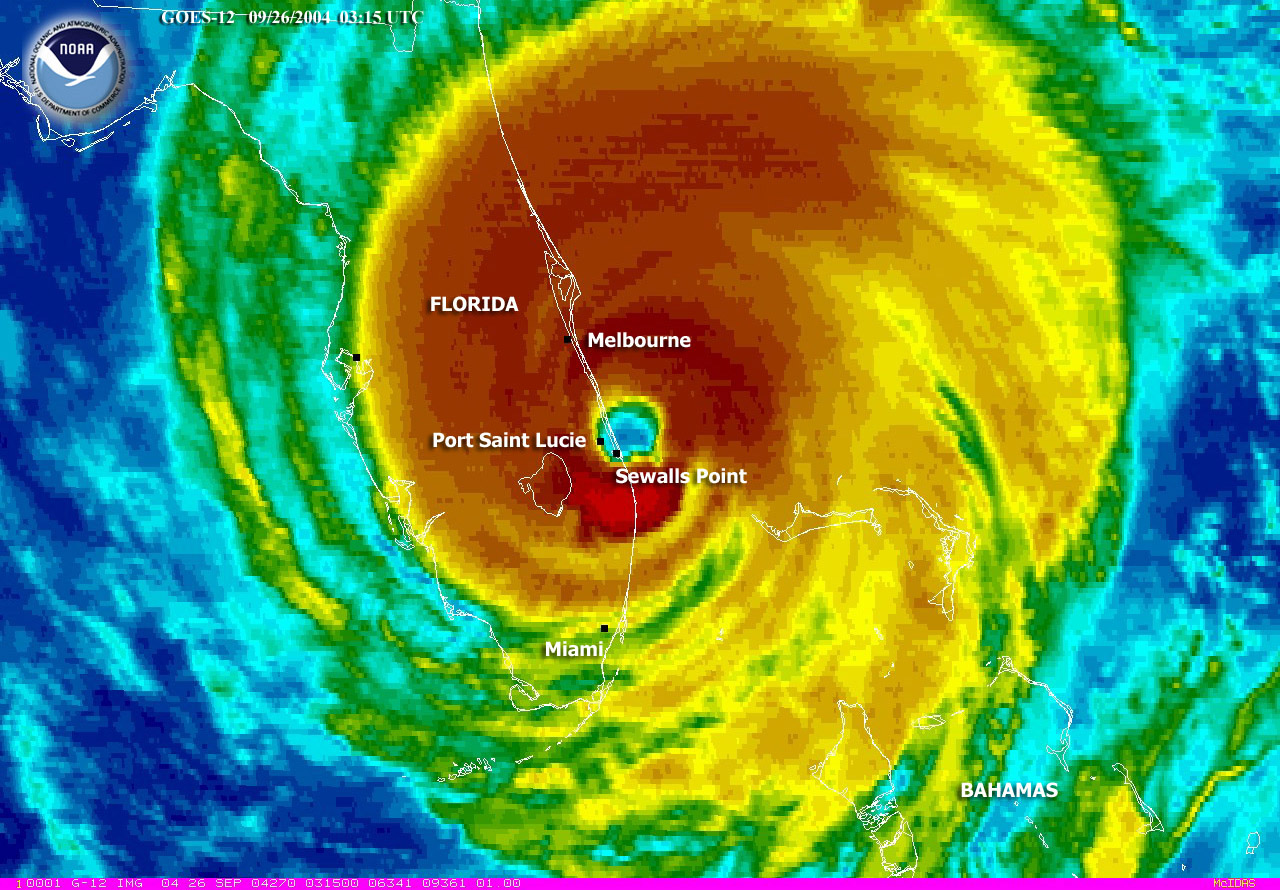
I pray that you, Jehovah-sabaoth, bring all power and authority to bear upon Hurricane Irma, tearing toward Florida as I type.  Yet even in the face of uncertainty, your people are grateful.  You are in control and every person is in your attentive care, O Great Shepherd. Thank you for watching over them as only you can.


Notes:

  1. Anne Graham Lotz, Refresh My Heart, Word Publishing, 1998, p. 77.
  2. www.wnd.com, “Generals Marvel at God’s Intervention in American History,” Bill Federer.
  3. https://fsu.digital.fivc.org
  4. www.warfarehistorynetwork.com
  5. www.wnd.com, “Generals Marvel at God’s Intervention in American History”, Bill Federer.


(Art & photo credits:  www.wikipedia.com; http://www.flickr.com; http://www.wikipedia.com (2); http://www.wikimedia.com; http://www.dailyverses.net.)


Read Full Post »


It was a grand summer evening to be at the park. Not too hot, not too crowded. Mom, Dad, my grandparents, baby brother and I were just finishing a picnic supper. Through the trees a nearby vacant swing beckoned.

Come ride with me! We’ll fly up to the sky!

I had just learned how to pump and was anxious to try my new powers on the ten-story park swings. (OK, they weren’t that tall. But compared to most playground swings, these were colossal.)

No sooner were the last bites of hot dog and potato salad consumed, than Mom and Dad said it was time to pack up; we needed to leave.

“But I want to go on the swings,” I protested.

“We’ve got something better planned,” Mom replied.

What could be better than flying up to the sky?

Reluctantly I climbed into the back seat of the car. Dad stowed the picnic paraphernalia in the trunk, and drove us through city streets to the countryside where fields of corn stretched to the horizon.


And then, miracle of miracles, Dad turned into the parking lot of…

…Kiddie Land!

Some clever farmer had carved out a corner of his field and installed a number of carnival rides: a merry-go-round, Ferris wheel, kid-sized motorized tractors, small boats that rotated in a large tub, and more.


(Another visit the following year,

when my brother, John, was old enough to join in the fun.)


We had passed this Kiddie Land at least several times on our way to visit my great-aunt and her large family. And though I would beg to stop, we never had time.

“Not today, Honey,” they’d say. “We have to get to Aunt Hester’s.

That summer evening, however, turned out to be the occasion of my first visit, and in a cloud of euphoria I flew up to the sky on the Ferris wheel instead of an old playground swing.


My plans for the evening didn’t begin to compare to what Mom, Dad, and my grandparents had in store for me.

Someone else also designs delightful plans that far exceed my child-sized ideas. My Heavenly Father.

One experience on top of another begins to construct a good foundation of things already seen, so I can trust him for what is not seen. (A number of previous posts have highlighted some foundational experiences. See: “After the Fact,” “Progress,” and “The Greater Plan.”)

The psalmist, Asaph, knew about this foundation for faith and built one of his own. “I will meditate on all your works,” he declared, “and consider all your mighty deeds” (Psalm 77:12). He affirmed there is no god as great, who performs miracles and displays his power among us all (vs. 13-14).


Ah, but what about the potential for trouble or pain in the not seen of the future? Even then, God will produce good effect (Romans 8:28). And a bedrock foundation of trust will provide the necessary fortitude to endure, even thrive.

With Job we’ll be able to say, “Those who suffer he delivers in their suffering; he speaks to them in their affliction” (36:15).

I have no idea what God is planning for tomorrow, next week, or next year. But just as my parents set a reliable example of parental care and blessing, so has my Heavenly Father–only infinitely more so. Every good gift comes from him (James 1:17), and they are plentiful.

I have seen enough evidence to know I can trust his all-knowing, all-wise, all-sufficient ways. Especially because all he does is motivated by perfect love.


*     *     *     *     *     *     *     *     *   *


Thank you, Lord of Joy, for every good and perfect gift you bestow, many of which exceed our expectations. We delight to see your creativity and marvel at your generosity. Day after day you pour forth your blessings, building a strong foundation of experiential evidence. And each blessing demonstrates your compassion, grace, patience and love.

“Your righteousness reaches up to the skies, you who have done great things. Who, O God, is like you?”

 (Psalm 103:2-5, 8; 71:19)


What great things has God performed in your life that have built your foundation of faith?  Please share an experience or two in the comment section below!


(Photo credits:  www.nps.gov; http://www.publicdomainpictures.net; Nancy Ruegg; http://www.pinterest.com (3).


Read Full Post »

« Newer Posts - Older Posts »