Feeds:
Posts
Comments

Archive for the ‘God’s Faithfulness’ Category

“You have given me the shield of your salvation,

and your right hand supported me,

and your __________ made me great.”

–Psalm 18:35 (EST)


What word would you put in that blank?

  • Power?
  • Grace?
  • Mercy?


The word chosen most often by translators* may surprise you. It certainly surprised me.

“Your GENTLENESS made me great.”

In addition to being surprised, I was puzzled. How can God’s attribute of gentleness make a person great?

A good place to begin our search for understanding is the background of this psalm.  It was written by King David, perhaps during his later years. He may have been pondering the incredible progression of his life from lowly shepherd boy to exalted king.


89446669


Surely young David never even daydreamed of becoming the most powerful man in Israel, as he sat on the hillsides of Bethlehem watching over his father’s sheep.

Neither could he have known at least fifteen years would pass between his anointing as king (a ceremony indicating a setting apart) and his actual coronation.

And contrary to human logic, those intervening years would not be spent as a student in preparation, but as a fugitive and outlaw, running for his life.  Seems like such a waste of time, doesn’t it? As David hid from King Saul in the Cave of Adullam, did he wonder, Lord God, what ARE you doing?

In hindsight we can see that God was gently teaching and preparing David his way, with practical, hands-on lessons such as:
 

d61f0ae266f6e653dd1702ccdb3a4b40


  • The Lord hears the prayers of the afflicted and encourages them (Psalm 10:17).
  • The Lord’s unfailing love can be trusted (Psalm 13:5).
  • The Lord gives wise counsel (Psalm 16:7).
  • The Lord is like a rock. His people can take refuge in him (Psalm 18:2).
  • There is no need to fear evil, because the Lord is always present with his own (Psalm 23:4).

One definition of gentle is “considerate or kindly.” God certainly demonstrated gentleness of this nature by endowing David with certain character traits–traits that would serve him well as monarch over Israel:


david-goliath-carousel


  • Courage—most obvious, perhaps, when teenaged David took on nine-foot-plus Goliath (1 Samuel 17)
  • Perseverance—when he spent those years waiting for God’s plan to be fulfilled, all the while fleeing from Saul’s vengeful rage (1 Samuel 19-2 Samuel 1)
  • Cleverness—on display when David pretended madness in order to avoid death at the hands of the Philistines (21:10-15)
  • Restraint—when he twice resisted the opportunity to kill Saul before the king killed him (chapters 24 and 26)
  • Respectability—During his years as a fugitive, six hundred men gathered in support of David and fought with him (27:3-4).


Another definition of gentle is “tender hearted.” No doubt it was with a tender heart that God:

DAVIDHARP


  • Bestowed upon David  the gifts of poetry and music (1 Samuel 16:18)
  • Demonstrated his wonderful love (Psalm 31:21)
  • Forgave David (32:1-2)
  • Remained faithful to him (57:3)
  • Protected David in the shadow of his wings (61:4)


But here’s even better news about God’s gentleness: It wasn’t reserved just for David or other Bible heroes. God displays his gentle nature to all of his children, every day.

In hindsight, we, too, can often see God’s gentle teaching and preparation for what he has called us to do. (If you’re in the middle of that process, rest assured those tough life-lessons you’re enduring now will not be for nothing!)

Second, with kind and gentle consideration, God has bestowed upon each of us specific character traits that qualify us to accomplish his plans. (And that plan isn’t complete until we hear the angels sing!)

Third, God has surely demonstrated his gentle, tender-hearted love for us, beginning with the death of his Son on a cross and ending with…

…well, there is no end to his faithfulness, grace, mercy, attentive care, peace, joy, and more.  How glorious is that?

And though it’s very doubtful you or I will ever be great monarchs like David, we can aspire to greatness in God’s eternal kingdom.

How? By serving him wherever we are with the specific gifts and traits he has given us.

Jesus spoke that truth very clearly:


deb571b6619a70af4ad01348af4191b3

(“The greatest among you will be your servant.” –Matthew 23:11)


*     *     *     *     *     *     *     *     *     *

I praise you, God, for your gentleness that tenderly prepares us for our purpose, kindly endows us with attributes for that calling, and graciously showers us with the benefits of your character, all throughout life.

Help me, I pray, to be compliant under your tender hand, ready and willing to follow your gentle lead, and generous to bestow upon others the graces of your character which I have enjoyed.  Amen.


(Photo and art credits:  www.panoramio.com; http://www.pinterest.com; http://www.donnarios.com; http://www.plusii.blogspot.co.uk; http://www.pinterest.com.)


* www.biblehub.com provides easy access to twenty translations of the Bible. Fifteen out of twenty include the word “gentleness” at the end of Psalm 18:35, or a synonym: humility, lowliness, or meekness.
Read Full Post »

Munttar17

In a desert land he found him,

in a barren and howling waste.

He shielded him and cared for him;

he guarded him as the apple of his eye

(Deuteronomy 32:10, italics added).

Notice the verbs: found, shielded, cared for, and guarded. Just as God watched over the Hebrew nation in the wilderness, God is surely watchful over each of us. See if these stories trigger memories of your own–when God found, shielded, cared for, and guarded you.

FOUND:

Growing up in a Christian home, I learned about Jesus before taking my first steps. At age four, after hearing the crucifixion story, I asked Jesus to be my Savior and constant Companion. Even as a preschooler, I understood my need for Someone to take the punishment I deserved for my naughtiness, so I could receive God’s gift of eternal life. If Jesus was willing to suffer and die in my place, how could I say, “no?”

81dcb5dcf618c976c041e845ebb0dd25

Praise God he seeks after lost sheep—even the little ones (Luke 15:4)!

Where did God find you?

 SHIELDED:

Numerous times over the years I have felt shielded from harm, including serious car accidents.

One time while approaching a stoplight, I hit a rain-slicked patch of city street, with cars in front of me and a bus to the right. My car began to slide and swerve; I started pumping the brakes. But there was no way to stop soon enough and avoid collision with the slowing line of vehicles ahead.

I took a chance and turned a bit to the right, hoping beyond hope there would be enough room for me to squeeze ahead of the bus, where the lane was open. Surely God intervened and created the needed space. (I think he also alerted the bus driver to apply his brakes and leave room for me!) My car did come to a safe stop, with room to spare.

God has shielded me in other important ways, too. He’s protected me from life-choices that would have led me down treacherous paths. He’s saved me from unhealthy relationships.

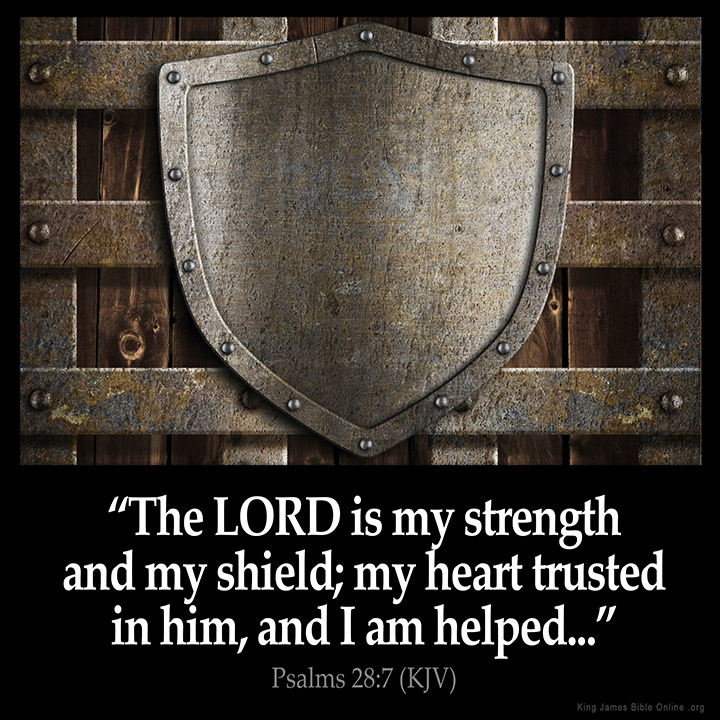
Psalms_28-7

Praise God he is our shield! We can trust in him, and receive the help we need (Psalm 28:7).

How has God shielded you?

CARED FOR:

I couldn’t find the dental insurance form I needed to drop off at Dr. H.’s office. Jeremy (our younger son and a middle schooler at the time) assisted me in a thorough search.  No form. While out on my walk, it suddenly occurred to me the form may have been gathered up with the newspaper. Sure enough, that’s where it was. Being Wednesday, those papers—and the dental form—should have been long gone in the recycling truck, but Jeremy was saving newsprint for his art teacher. God not only revealed to me the location of that form, but kept it safe, saving me the hassle of getting a new one and filling it all out again.

a6b7d3947c75be26393ae18a51f35ccc

Praise God for his loving attention, even in small matters like dental forms (1 Peter 5:7)!

How has God cared for you?

GUARDED:

One spring day in 1985, an elderly gentleman hit the gas pedal instead of the brake, at the stop sign on our corner. He drove his station wagon right through the garage wall. Several feet more to the right and he would have plowed into our daughter’s room, and she was playing there at the time. The driver was protected, too, sustaining only minor injuries.

god-of-the-bible-gcsrw-25-638

Praise God he guards us like an eagle, hovering over its young (Deuteronomy 32:11).

How has God guarded you?

THE APPLE OF HIS EYE:

The last phrase of Deuteronomy 32:10 explains why God is so attentive to his people. We are the apple of his eye. Some translations replace apple with pupil. God protects us as the pupil of his eye.

Just as our eyesight is precious to us, so we are precious to God.

As we’re careful to provide protective care for our eyes, shielding them from danger, for example, so God provides loving, protective care of us.

May we continually praise our God for all he is to us. First, he found us, and then became our attentive Shield, Provider, and Guard.

bbd550f7373b204033320b16c5638e3c

(“You make me glad by your deeds, O Lord; I sing for joy at the works of your hands” — Psalm 92:4.)

 In the Comments below, please share your personal stories of how God found you, or how he has proved himself as your Shield, Provider, and Guard. Let’s celebrate together God’s powerful deeds on our behalf!

(Art and photo credits:  www.biblewalks.com; http://www.pinterest.com; http://www.kingjamesbibleonline.com; http://www.imagefriend.com; http://www.slideshare.net; http://www.pinterest.com.)


Read Full Post »

seagrape03

“Oh, what a beautiful tree!” my mother-in-law exclaimed with enthusiasm. Her comment referred to a tall bush, planted near the house and visible outside our kitchen window. “What’s the name of it?” she asked.  Being from Ohio, Mom wasn’t familiar with some of the unique foliage of our area in south Florida.

“That’s a sea grape,” I told her. “It’s actually a shrub, but they can grow quite tall.”

“Well, it’s lovely. Such big leaves!”

Now clearly there’s nothing remarkable about this conversation, until you know that Mom had asked the very same question with the very same enthusiasm every morning of her visit. And each morning I supplied the same answer.  Mom was in her late 80s, and her dementia was becoming more and more noticeable.

Mom’s fresh outlook each morning reminded me of Lamentations 3:22-23: 

The faithful love of the LORD never ends!

His mercies never cease.

Great is his faithfulness;

his mercies begin afresh each morning (NLT).

his-mercies-are-new-wallpaper_1366x768

Just as Mom brought new enthusiasm to each morning, so God brings new mercies for each day. Yes, the challenges we faced yesterday required wisdom, strength, and perseverance. But today we’ll need a fresh supply.   Praise God he never runs out of such gifts; he is always able to provide.

In the same way, God’s new mercies for today are not meant to be sufficient for tomorrow. In other words, we shouldn’t expect to feel confident and in charge this morning for the potential challenges of the future—much as we’d like to. (Who hasn’t wished to know now exactly how the next day or week will unfold, and how best to respond?)

Instead, our wise and loving Heavenly Father has chosen to lead us one day at a time. And just what is so wise and loving about keeping us in the dark?  So as to protect us from being overwhelmed, easy prey to depression, and paralyzed by fear.

No, our best course of action is to avail ourselves of God’s mercies for this one day. As for tomorrow, we can trust God to supply new mercies, more than sufficient for whatever we might face when the time comes (Matthew 6:34).

I’m remembering Corrie ten Boom. (Maybe this post brought her to your mind, too.)

g25143_u22597_corrie_ten_boom

Corrie and her family suffered cruel hardships in the concentration camps of Nazi Germany, as a result of helping Jews escape the Holocaust.

After the war, people would often say to Corrie, “I wish I had such great faith as yours. I could never live through the experiences you survived.”

Corrie would tell a story to explain.

When she was a child, Corrie happened to see a dead baby. A terrible fear gripped her that one of her family might also die. When Papa ten Boom came to tuck her in that night, she burst into tears.

“I need you!” she sobbed. “You can’t die!”

Her sister, Betsy, explained why Corrie was so afraid.

Papa asked, “When you and I go to Amsterdam, when do I give you your ticket?”

“Just before we get on the train,” she responded.

“Exactly,” Papa replied. “And God knows when you’re going to need things, too. Don’t run out ahead of him, Corrie. When the time comes that some of us have to die, you will look into your heart and find the strength you need—just in time.”

Papa ten Boom was proven right. When Corrie needed supernatural strength, God did provide. We can rest assured that his mercies will be new and fresh each morning for each of us, as needed.

*     *     *     *     *     *     *     *     *     *

I praise you, Lord God, that we can face each day with fresh enthusiasm, because for each trial, you have prepared for us great mercies like endurance, strength, and wisdom. I thank you that in the midst of trouble, you also provide blessings: a more acute awareness of your presence, peace that defies explanation, family and friends to come alongside, miraculous provision, and delightful surprises to make us smile. You are not just a sufficient God; you are an abundantly gracious God!

(Photo credits:  www.mgonline.com; http://www.coffee4thesoul.com; http://www.myhero.com.)

Read Full Post »

No, that’s not a typo in the title; I intentionally chose rust. However, that parody on an old hymn actually did result from a typo years ago.

Steve was just a few months into his first pastorate in St. Petersburg, FL. The mean age of the congregation was somewhere in the 70s. When the church secretary typed the opening hymn title for one Sunday’s bulletin, ‘Tis So Sweet to Trust in Jesus, she accidentally omitted the “T” in trust.

But there was a whole lot of truth in that typo-title. Many saints of that congregation could testify, even into old age: “Blessed is the man who makes the Lord his trust” (Psalm 40:4).

bd703f478e8eed5bd6013b55b582b8d3

And just what might those blessings be? A few possibilities quickly come to mind. When we put our trust in God, we enjoy:

  • Peace of mind (Isaiah 26:3-4)
  • Guidance (Proverbs 3:5-6)
  • Help (Isaiah 41:10)
  • Strength (Isaiah 12:2)

But there are many more blessings that come to those who trust in God—some of which are quite surprising. The following is undoubtedly just a partial list:

Intimacy with God–not just acquaintance. The more we exercise trust, the more we recognize his involvement in our lives. With David, we can affirm: “All those who know your mercy, Lord, will count on you for help. For you have never yet forsaken those who trust in you” (Psalm 9:10).

Hope. Praise God for his hope that fills us with all joy and peace as we trust in him (Romans 15:13)! I can’t imagine going to bed at night without hope for tomorrow—much less for eternity.

Joyful Expectation and Quiet Confidence. Our lives are in the hands of an absolutely perfect, all-powerful, loving God. We can count on him to see us through every situation. So with great delight we can say, “I don’t know what God’s up to, but I know it has to be good!”

imagesca5icqwx1

Life above the Fray. Like Paul, we can learn to be content in every situation (Philippians 4:12), knowing that God will give us the strength to endure (v. 13). A heart full of trust has no room for worry or stress. (Remind me of that when the challenges pile up, will you?)

Adventure. Think of the adrenalin rush these Bible heroes must have experienced, as they placed their trust in God:

  • Joshua fighting the battle of Jericho—with trumpets and loud shouts!
  • Elijah praying for fire to consume a drenched offering to God, in front of 450 prophets of Baal
  • Nehemiah watching the walls of Jerusalem reconstructed, after the Israelites had been held in Babylonian captivity for seventy years

Are we going to sit on the sidelines of life and miss the miracles, because we’re afraid to trust? Perish the thought!

Influence. The Light of Jesus shines most brightly through those who demonstrate trust in the midst of dark circumstances. People remember those saints who maintain a positive, faith-focused outlook in spite of trials.

6100-07639474er

For all these reasons and more, it is indeed sweet to (t)rust in Jesus–to rest secure in the loving, everlasting arms of our Heavenly Father.


*     *     *     *     *     *   *     *     *   *

I praise you, Lord, with all my heart,

for being a trustworthy God who never fails his children.

How glorious to know

I can trust in your unfailing love!

(Psalm 9:1; 13:5; 52:8)

Photo credits:  www.pinterest.com; http://www.pixgood.com; http://www.masterfile.com.)

Read Full Post »

prd_007161


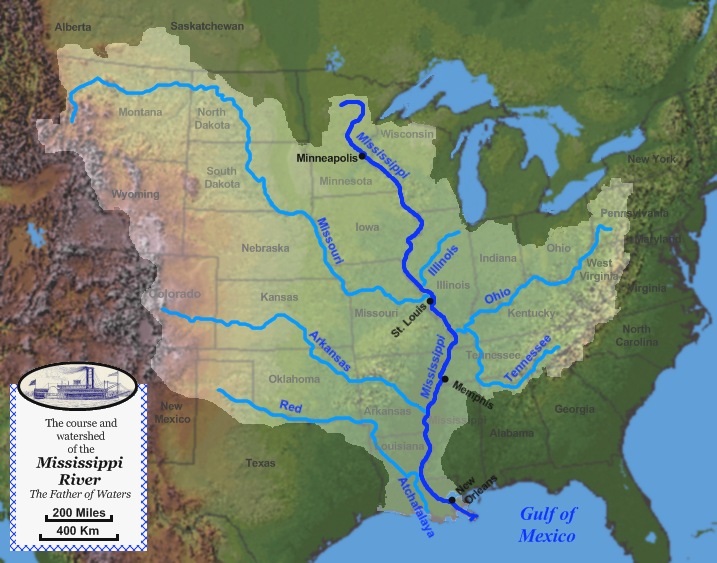
His kayak paddle provided more steering than propulsion, as the tourist enjoyed a quiet excursion past tall conifers and wide-armed hardwoods. Slowly he meandered southward, confident that returning to his launching point would not be a challenge.  The man at the kayak-rental shack had assured him: surface water flowed at just over one mile per hour. And should he fall out of his craft, no real danger would threaten. The water was only three feet deep, and the shore not more than ten feet to either side.

It’s hard to imagine, the kayaker thought,  that this narrow, shallow stream actually becomes a mammoth river. He’d been told the stream was fed by underground springs, and flowed another 2,300 miles from where he paddled. Along the way, more rivers would flow into it. And when the fresh water finally met salt, the river would be over a mile wide.

Mississippi-River

Have you guessed the name of this waterway? It’s the grand and powerful Mississippi. Yet its headwaters is a tame little stream, fed by a few underground springs or fountains.

Such a river offers an illuminating picture of our relationship with God. We are the rivers, and…

…“[God] is the fountain of life,” (Psalm 36:9).

Anglican bishop John James Stewart Perowne (1823-1904) said: “These are some of the most wonderful words in the Old Testament. Their fullness of meaning no commentary can ever exhaust.”

But if we don’t at least try to grasp the wealth of truth in these six words, we stand to lose much profit.

So let’s consider that, as our fountain of life:

  • God the Son is the source of all life, and all life is sustained by him (Hebrews 1:3). Without him, all life would cease.
  • In him we live, and move, and have our being (Acts 17:28).
  • He is like a spring of water welling up to eternal life in our spirits (John 4:14).

Those are wonderful concepts, which Dr. Perowne surely had in mind as he contemplated Psalm 36:9. Yet our triune God is like a fountain of spring water in more ways.

First, a bit of digression. No doubt you’re aware that bottled spring water is a big business these days, supposedly offering water that is much superior to what comes out of the tap. Critics have their doubts.

But our God is 100% perfect! No doubt about it.

 psalm8-how-excellent-your-name0

“He is the Rock, his works are perfect, and all his ways are just. A faithful God who does no wrong, upright and just is he” (Deuteronomy 32:4).

Consider as well the following scriptures, which itemize his excellent perfections. And keep in mind they come to us in unending supply:

  • Presence.  “I am with you always” (Matt. 28:20).
  • Reliability.  “The plans of the Lord stand firm forever; the purposes of his heart through all generations” (Psalm 33:11).
  • Right-Doing. “His righteousness endures forever” (Psalm 111:3).
  • Faithfulness.  “The faithfulness of the Lord endures forever” (Psalm 117:2).
  • Sovereignty.  “He rules forever by his power, is eyes watch the nations” (Psalm 6:7).
  • Love.  “His love endures forever” (Psalm 100:5).
  • Compassion.  “[The Lord’s] compassions never fail” (Lam. 3:22).
  • Protection.  “Save your people and bless your inheritance; be their shepherd and carry them forever” (Psalm 28:9).
  • Stability.  “The Lord is the Rock eternal” (Isaiah 26:4).
  • Joy.  “With joy you will draw water from the wells of salvation” (Isaiah 12:3).
  • Blessing.  “Surely you have granted him eternal blessings and made him glad with the joy of your presence” (Psalm 21:6).
  • Grace.  “God is able to make all grace abound to you, so that in all things at all times, having all that you need, you will abound in every good work” (2 Cor. 9:8).

That’s an even dozen attributes. But since our God is infinite, his attributes are also infinite. We’ve barely begun to explore his perfections. In addition, he will forever expend those attributes for our good (Romans 8:28)—not only outwardly, as he engineers circumstances, but inwardly as we allow his attributes to flow in us.

In addition, God is flowing through us, so we can provide life-giving grace to those around us—grace that expresses itself in love, compassion, and blessing.

And that brings me to another metaphor–for those tributaries that pour into the Mississippi. They remind us of the influence of others in our lives–faithful and mature family members, friends, pastors, and teachers, who come alongside us by example and with wisdom, providing strength and growth.

Mississippi_watershed_map_1

Chances are, those tributaries of the Mississippi are also fed by springs. For every believer, our triune God is the pure, ever-flowing, life-giving source of all that is excellent, and everything we need for a fulfilling life.

Is your heart overflowing with praise?

*     *     *     *     *     *     *     *     *     *

We do give you praise, oh God! You are the fountain of our abundant and excellent spiritual life. You are the only spring that quenches our thirst for fulfillment, joy, peace, and satisfaction.  Thank you for flowing in us, so these desires and more are fully met. And thank you for flowing through us, so we might have the privilege of sharing your living water with others.


(Information about the headwaters of the Mississippi from the Mississippi Headwater Board and wikipedia.org.  Photo & art credits:  www.nature.org; http://www.1mississippi.org; http://www.fbcphil.org; http://www.agodman.com; http://www.wikipedia.org.)


Read Full Post »

 picture-uh=715ce81d4af48c56d62e992073bfe9-ps=3da463e4536b201b56c385877e59a7

 (Photo from http://www.trulia.com.)

“There it is, Mom, “ Steve remarked, as he pointed to a little white house in the middle of a city block. “That’s where we lived when I was growing up.”

“Oh, yes,” she replied. But did Mom really remember?

We were on an excursion through Columbus, Ohio, taking Steve’s mother past the landmarks of her life. Alzheimer’s disease had already stolen away much of her vibrancy and warmth, and, of course, her memory.

 corner

Steve drove by West High School and continued his commentary. “That’s where we all went to school, you, Dad, Karen, and me. You were the very first homecoming queen.  How about that?  No wonder Dad asked you out.”

She murmured assent to Steve’s comments, but added nothing of her own.

 unnamed

We drove past the brick ranch they built out in the country in 1966. Horses used to reside beyond the back fence. Just a few houses had dotted the area back then. By this time, however, they had been swallowed up by dozens more. The saplings Mom and Dad had planted were now tall shade trees.  And the glorious flower beds and window boxes that Mom had tended were gone. She registered no recollection.

 unnamed

But when we approached her childhood home, a white Dutch Colonial on a quiet street, all of a sudden she perked up.  Pointing to a second-story window, Mom stated firmly, “That was my room, right up there.”

In the midst of the fog that is Alzheimer’s, one memory–one glimmer of light–shone through that morning. Steve and I almost gasped at the wonder of the moment. Mom remembered!

And the rarity of her memories pointed to the preciousness of this ability. Memory is a gift to be treasured. The older I grow, the more I appreciate the miraculous power of the brain to store millions of memories—with astounding detail–and yet access a particular one in a mille-second.

 1033249144001_2034162247001_900944612-159-1355440419795

Not only do sights trigger memories, but also smells. Researchers say this sense is the most powerful memory-inducer. For me, the aroma of fresh-baked bread always takes me back to my grandmother’s kitchen.

Sounds trigger memories as well—particularly music. Tastes and textures work the same phenomenon.

But surely God had more purpose in mind for giving us memory than the pleasant pastime of reminiscing.

Indeed.

Memories foster gratitude, as we contemplate God’s goodness to us in the past:

  • His countless blessings (even when we haven’t been a blessing to him).
  • Those times he led us through the shadow of death, so that we might experience more completely the glory of his light.
  • Moments when we almost gave up hope, and God surprised us with his creative, abundant provision.
  • Leaving behind what we once were and celebrating what we have become, solely because of his Son, Jesus.

Memories foster faith, as we remember how God has met our needs in the past. See if each phrase from Psalm 103 doesn’t trigger a memory in your mind, and a song of praise in your heart:

“Oh, my soul, bless God,

Don’t forget a single blessing!

He forgives your sins—every one.

He heals your diseases—every one.

He redeems you from hell—saves your life!

He crowns you with love and mercy—a paradise crown.

He wraps you in goodness—beauty eternal…

…God makes everything come out right.

He puts victims back on their feet…

…God is sheer mercy and grace;

Not easily angered, he’s rich in love.

He doesn’t treat us as our sins deserve,

Nor pay us back in full for our wrongs.

(Psalm 103:2-10, The Message)

Memories inform the present and provide hope for the future. As we meditate on all those times God has wrapped us in his goodness (v. 5), we are strengthened for what we face today. As we consider the many times he made everything come out right (v. 6), we can trust he will continue to make our paths straight.

Of course, there are some memories we would like to erase—those that generate sadness, hurt, or regret. How do we deal with those? Here are a few suggestions I’ve collected over the years:

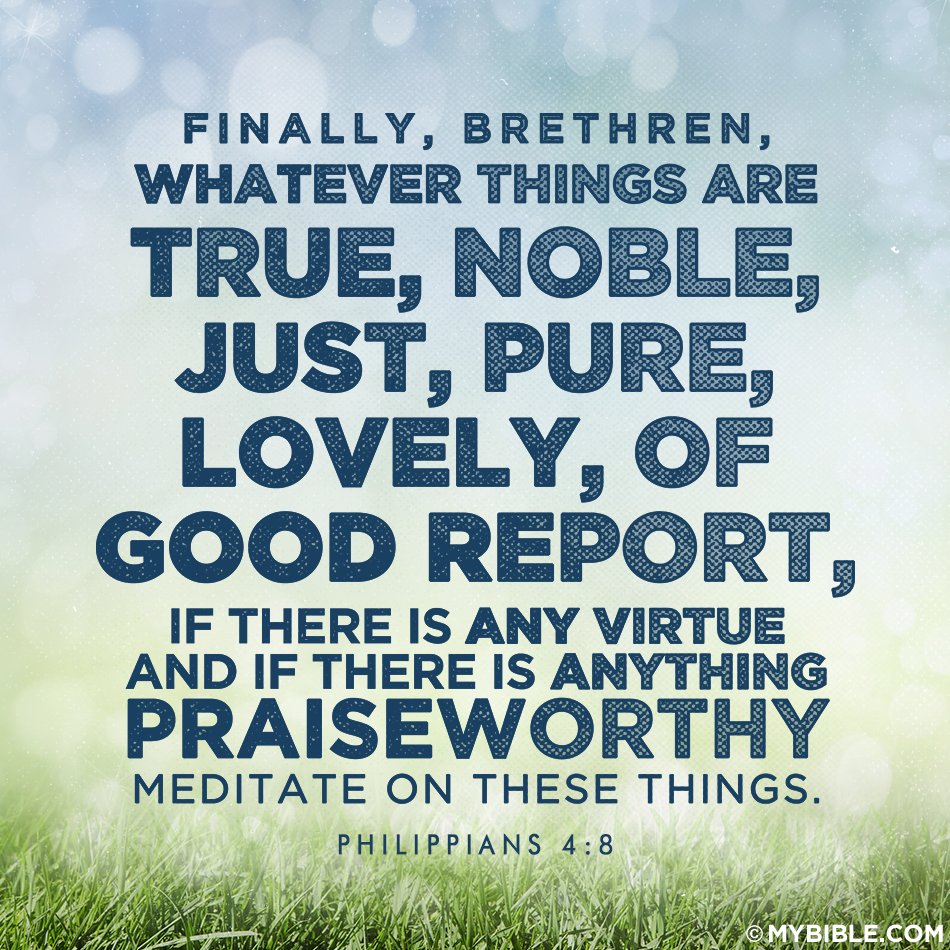
  1. We must resist self-pity—even in our thought life. Nowhere in scripture do we read that rehashing the negative is therapeutic. God’s way is to focus on the positive (Philippians 4:8).

Phil-4-8


  1. We can follow Paul’s example. He forgot what was in his past and pressed on to what lay ahead (Philippians 3:13). Not that amnesia had set in. Paul simply did not allow past failures to cripple his relationship with God and his service for God. God had forgiven and forgotten; Paul did too. No doubt he applied Philippians 4:8, not only to self-pity, but also to guilt. 
  1. We can leave the past in God’s hands. Oswald Chambers said it so well:

 c6d7d32bbdc18d2507a48f8aefa26359

(“Leave the irreparable Past in His hands, and step out into the Irresistible Future with Him”

–My Utmost for His Highest, Dec. 31.)


*     *     *     *     *     *     *     *    *     *    

Father, I do thank you for the gift of memories—the ability to remember with joy and appreciation the people, places, and experiences of the past. I even thank you for the not-so-good memories, knowing that you use every difficult situation for the development of my maturity (James 1:2-3). And may I take advantage of the wisdom gained in the past to guide me in the present, and lead me into the Irresistible Future with you.


Art & Photo credits:  www.trulia.com; http://www.westhighalumni.com; Steve’s photo collection; http://www.allrecipes.com; http://www.god.com; http://www.pinterest.com.

Read Full Post »


Title

Have you ever heard statements like these?

  • “Oh, yes.  God wants me to be happy. He’s promised to give me the desires of my heart.”
  • “If you have enough faith, anything you ask of God can be yours.”
  • “God will take care of me. I don’t need to budget or plan ahead.”
  • “I can’t help it if I’m moody; that’s the way God made me. He understands.”

Any person who holds such beliefs can point to a verse or two in scripture, proving their points.

The problem is, the Bible was not written in brief, stand-alone statements. Bible truths are based on the context of the whole. Historical and literary understanding are also important.

Another problem? We wish for God to conduct himself in a certain way.  We even find scriptures that seem to back up our desires. But the truth is, we must know God as he is.

If we don’t, we’re living in confusion.

“The sooner we accept God as he is, and do not imagine him as we would like him to be, the sooner we will move from the path of confusion to confidence” (Selwyn Hughes, 1928-2006, Welsh pastor and author).

However, so much of God is beyond our understanding.


ecclesiastes11_5


“Just as [we’ll] never understand

the mystery of life forming in a pregnant woman,

so [we’ll] never understand

the mystery at work in all that God does.”

Ecclesiastes 11:5, The Message.

Our finite brains cannot fully comprehend our infinite God. But that shouldn’t stop us from learning and experiencing all we can.

Learning comes from the Bible. In its pages we find a glorious treasure trove of wisdom, encouragement, and guidance.

Experience comes through exercising our faith.

“If we begin to worship and come to God again and again by meditating, by reading, by prayer, and by obedience, little by little God becomes known to us through experience” (Saint Bernard of Clairvaux, twelfth century monk).

It is impossible to fully explain this life of faith, just as you can’t fully explain what it’s like falling in love, getting married, or becoming a parent. Words fail to describe such beautiful and strong emotions.

We had to trust those who told us:

  • “You’ll know you’re in love when it happens to you.”
  • “Your wedding day will be the best day of your life to that point.”
  • “Perhaps the only ‘high’ better than falling in love or getting married is holding your newborn baby in your arms for the first time.”


slide_353491_3844254_free


Similarly, we have to trust what God tells us through his spokesmen in the Bible. For example:

“He is the Rock, his works are perfect,

and all his ways are just.

A faithful God who does no wrong,

upright and just is he.”

Deuteronomy 32:4

You might want to read that third line again. Our God is faithful—reliable, loyal, and completely trustworthy. HE. DOES. NO. WRONG.  Now that’s Someone in whom we can place our confidence!

Here is another example of scripture-truth about him:


ddc66ab5b08721b26a4ea53ab1bba3b7

 “Righteousness and justice

are the foundation of [God’s] throne;

love and faithfulness go before [him].”

Psalm 89:14

Those four characteristics—right-doing, justice, love, and faithfulness—are the bedrock of who our God is. Everything he does flows from those attributes, including difficult circumstances and painful events that make no sense to us.

“Our inability to discern why bad things sometimes happen to us does not disprove God’s benevolence; it merely exposes our ignorance” (Ravi Zacharias and Norman Geisler, Who Made God? And Answers to Over 100 Other Tough Questions of Faith, p. 46).

Someday we will understand why such events occur. For now we must trust.

But our trust is not blind. We can be confident in our God because:

“True faith rests in the character of God” (A.W. Tozer).


(Art & photo credits:  www.whatmykidsread.com; http://www.photobucket.com; http://www.huffingtonpost.com, http://www.pinterest.com.)

Read Full Post »

Check a map that traces the trek of the Israelites from Egypt to Canaan, and you’ll see a meandering, looping pathway:

Wilderness Journey

God could have taken them along the coast of the Mediterranean Sea, a much more direct route. One commentator says that route would have required just days of travel. A short journey would have been so much easier on everyone, right?  Less chance of fatigue, boredom, and impatience to develop and create problems.

But God had his reasons for a long, winding route.

Reason #1: The Philistines. That’s not conjecture; that’s exactly what scripture tells us. “When Pharaoh let the people go, God did not lead them on the road through the Philistine country though that was shorter. For God said, ‘If they face war, they might change their minds and return to Egypt’ ” (Exodus 13:17).

The Philistines’ territory stretched for fifty miles along the Mediterranean Sea, with the southern border touching Egypt. They were a well-organized, warring people. Five great cities, strategically located throughout their coastal holdings, created an alliance, the famous Philistine pentapolis.

A people suppressed by slavery for four hundred years would not be able to fight such an adversary. The Israelites didn’t have any trained soldiers among them either. Could God have given them a rousing victory over the Philistines anyway? Of course. But he chose not to.

Reason #2: Perhaps God determined his people needed some wilderness experience to train them in his ways and build their trust in him. Instead of quick and easy, God chose slow, step-by-step progress. He was like an eagle, teaching his fledglings by degrees how to fly (Deuteronomy 32:11).
4ffd5fa25fbd4e401e15ae1fe344938f

I wonder if the Israelites thought, Does God have any idea where he’s taking us? What is he DOING?!

In hindsight we can see God’s purpose:

  • To prepare them to be his holy people by giving them the law. (By the way, according to Exodus 19:1, Moses went up to Mount Sinai during the third month after they left Egypt. God was certainly in no hurry to get his children to the Promised Land.)
  • To teach them.  Through the laws he gave Moses, God taught the Israelites how to treat one another and how to worship him. They were to be different from all other peoples on earth.   “I am the Lord your God; consecrate yourselves and be holy,” he said, “because I am holy” (Leviticus 11:44).
  • To challenge them. For example, God let them experience great thirst and hunger. Then he stepped in and supplied their needs. By degrees God taught them to trust him.

I have to admit: my life experiences have paralleled the Israelites’ in a number of ways. I’ve encountered a few winding roads, puzzling detours, uncomfortable wait times, and unanswered questions of my own.

You, too?

Here’s what we can remind ourselves of: God may not direct us by the nearest, fastest way—even though he could. In his omnipotent wisdom, he knows a better way. And he has perfectly sound reasons for his decision.

My choice in the matter? I can plead for the shorter route, complain about the delay, try to forge ahead on my own self-chosen fast track, OR…

…trust my all-knowing, all-wise Heavenly Father.

5db138f980d331b5ee31f939d399464e

Seeing the choices laid out in black and white, here on my computer screen, the decision is easy. However, complete trust in the moment of uncertainty, fatigue, and discomfort is much more challenging.

Perhaps I can encourage myself by reviewing God’s purposes for the Israelites. Chances are, he desires the same results in me:

  • God prepared the Israelites; he may be preparing me for the next chapter in my life.
  • God taught the Israelites; he may be teaching me what the next level of maturity includes.  (Yes, even an old Christian like me still has growing to do!)
  • God challenged the Israelites; he may be challenging me to trust him—in spite of a long, winding road and uncomfortable wait time.

In summary:  As I cooperate with him, God can transform me into a prepared, mature, trusting servant for the next chapter of my life.   I like the sound of that!

You, too?

*     *     *     *     *     *     *     *     *     *

“Who compares with you, O God?  Who compares with you in power, in holy majesty, in awesome praises, wonder-working God” (Exodus 15:11, The Message)?  You are over-the-top trustworthy!  So, in advance, I thank you for the good that will come out of the winding road, detours, and wait time in my life–experiences you ordained for me, before one of them came to be (Psalm 139:16).  I place my hand in yours, my caring, constant Companion.  Help me to focus on your strong grip, not the uncertainties ahead.  Amen.


(Art credits:  www.registrypartners.net; http://www.pinterest.com.)

Read Full Post »

iStock_000013894567XSmall-300x199


“What traits should you look for when determining if someone is trustworthy?” asked the subtitle of a magazine article.

That question piqued my interest, and I read further.

According to the researcher, integrity is a crucial component, but there’s another trait that’s equally important: competence. The author gave the following scenario as an example: His best friend, Charlie, had proven himself completely reliable, but he wouldn’t want that friend performing an operation on him.  Charlie is not a surgeon.

So a trustworthy person is not only honest and fair, he is also competent for what you need him to do.

Those of us who know God have just such a friend.  Think of all we know from scripture about the character of our virtuous, competent God.  He is:

  • just, faithful, and upright (Deuteronomy 32:4).
  • righteous (Psalm 119:142) and holy (Leviticus 19:2).
  • wise (Daniel 2:20) and good (Psalm 106:1).
  • truthful (Psalm 31:5).

An  enlightened understanding of our trustworthy God should calm our fears and doubts, right?

But perhaps you’re like me—struggling a bit from time to time, asking questions like:

  • Lord, I know you have a plan, but when are you going to reveal it to me?
  • Why hasn’t Bill been healed? We’ve prayed so hard and for so long!
  • Dealing with Meredith day after day is sapping my strength, God.  When will the frustration end?

According to Philip Yancey, faith boils down to the matter of trust in the relationship. Do I have confidence in God or not? If I do stand on a bedrock of trust, the worst of circumstances will not destroy the relationship (Grace Notes, p. 198).

Vintage country


So how can I develop that strong bedrock of trust? Saturating myself in scriptures about the character of God, such as those listed above, is a good place to start. Another worthy study-pursuit: the promises of God, because…

…“God is not a man, that he should lie, nor a son of man that he should change his mind. Does he speak and then not act? Does he promise and not fulfill” (Numbers 23:19)?  No, of course not.

To truly impact my trust quotient, a change of habit is necessary–a habit such as: T-squared. Any time I find doubt or fear creeping at the edges of my thoughts, I want to Turn, Trust, and Thank. T x 3 includes:

  1. Turn away from thinking about the what-ifs, the negative, the hurtful.
  1. Express trust in God through song, prayer, and scripture. “Doubts are dismantled by declarations,” says my good blogger-friend, Jody Collins.*
  1. Thank God for his attributes that he’s bringing to bear on any negative situation.  Thank him also for every scripture-promise that applies.

I think I’ll try it right now.

*     *     *     *     *     *     *     *     *     *

psalm287-nlt1


Oh, Father, I praise you that you are strong, and protect like a shield.   My heart leaps for joy knowing you care for me and will help me. I praise you for surrounding me with your love, because I trust in you. All my life you have proved yourself trustworthy; why would I want to stop trusting you now? Oh, how I praise you that, as I keep my mind steadfast upon you, you will fill me with your peace. You are my trustworthy Rock—reliable and unchanging.      

(Psalm 28:7; 32:10b; 71:5-6; Isaiah 26:3-4)

 *Visit Jody’s blog at http://www.threewaylight.blogspot.com.


(Photo credits:  www.pixgood.com., http://www.katherinepasour.net., http://www.tyndalerewards.com.)

Read Full Post »

blog-prayer-woman


How would you finish this prayer: 

“Oh, Lord, what I need most right now is ____________________.”

What word would you put in the blank?

Guidance?

Provision?

Strength?

Purpose?

One glorious Bible verse tucked into Isaiah presents four comforting promises that cover each of those needs:


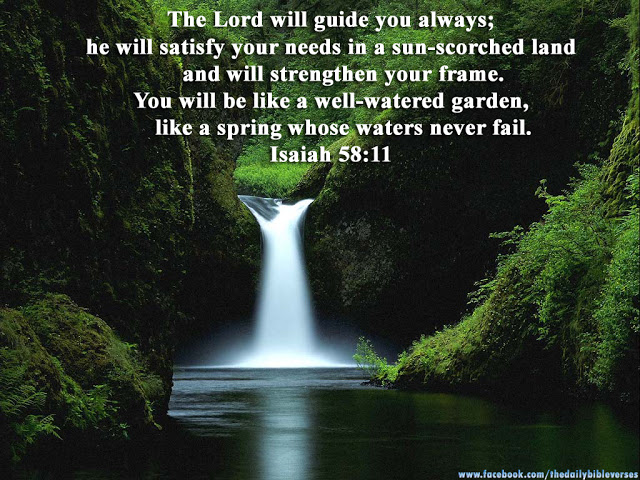
Isaiah58.11 

“The Lord will guide you always;

He will satisfy your needs in a sun-scorched land

And will strengthen your frame.

You will be like a well-watered garden,

Like a spring whose waters never fail” (58:11).

Lots of truth packed into five short lines. Each phrase warrants careful consideration. For example:


1.  The Lord will guide you always.


He’s not a life coach, counselor, or psychologist. The almighty God of the universe promises to be your guide—free of charge! And he’s available 24/7. Think, too, of his astounding attributes that make him the perfect guide:

  • God is omniscient—He knows everything (Psalm 139:1-6), including every detail of your situation and the people involved.
  • God is righteous—Everything he does is good (Deuteronomy 32:4). He can be relied upon to lead you down a perfect path.
  • God is merciful—He responds in loving compassion (Psalm 116:5). He’s your understanding Father, your strongest ally.
  • God is truthful—All that he says can be trusted (Titus 1:2). He will not lead you astray.
  • God is faithful—He keeps his Word (Psalm 33:4). God does not lie or forget what he said. Neither does he change his mind.

Notice that first phrase says God will always be your guide. Not every once in a while when you’re really in a quandary, but always. You are never left alone to your own devices—unless that’s the way you want to live. God is a gentleman; he leaves the choice up to you.


2.  He will satisfy your needs in a sun-scorched land.


Not he might satisfy your needs if he feels like it. He will. 

No matter what the landscape of your life looks like, God will see that your needs are met.

Have you ever been surrounded by sun-scorched land, perhaps a desert or wilderness where no life is visible?

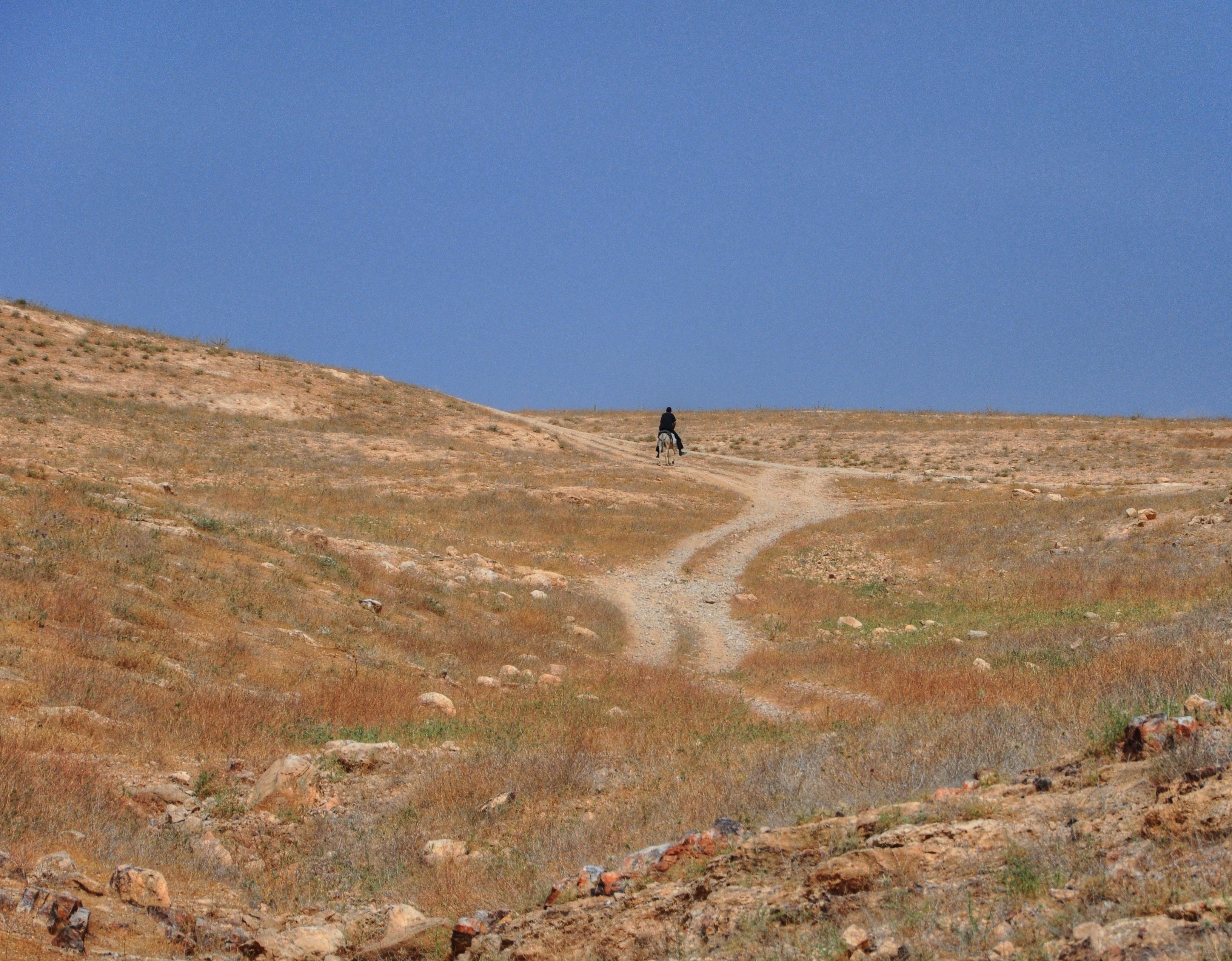
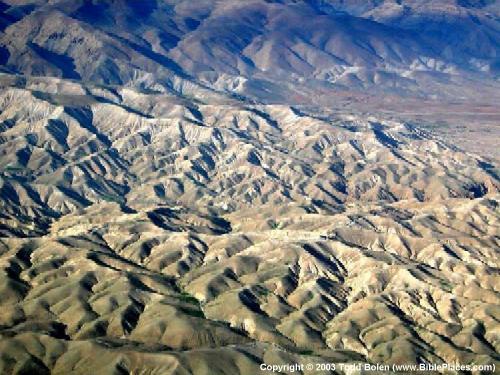
Steve and I visited Israel a number of years ago. One of our tour stops was in the Judean wilderness—a desolate and foreboding sight to behold. Not a single tuft of grass. No bushes or plants of any kind—not even cactus. Only two things are visible when standing in the midst of this desert: sky and pale gray-brown mountainous rock, as far as the eye can see.


judean_wilderness_west_of_jericho_ariel_tb_q010_03


Should you decide to live there, you’d have to bring with you everything necessary for survival: all your food, water, and clothing. For shelter, you might find a cave.

Ah! But what if there was Someone there ahead of you? Someone who already had at his disposal the supplies you required? And they would never run out? That’s the life-giving, unfailing provision of your Heavenly Father.

Let’s you and me rest in the assurance that the essentials—and even many delights!—will be generously supplied. If something is meant to be, he will take care of it—just as he’s been doing since each of us was born.

Think how he has led you through the wilderness of broken relationships and difficult circumstances. His grace has been sufficient for every challenge (2 Corinthians 12:9), right?

Now project that assurance into the future. Even if we walk through the valley of the shadow of death, we have no need to fear. Our all-powerful God is with us (Psalm 23:4)–guiding and providing.

(Please remind me of that when I come to a wilderness-patch, will you?)


*     *     *     *     *     *     *     *     *     *


Heavenly Father, I praise you that day by day, moment by moment, you are delighted to guide us in perfect wisdom. You generously provide for our needs and lovingly care for us body, soul, and spirit. Thank you for your compassion, your faithfulness, and grace to see us through the wilderness valleys. “I trust in you, O Lord; I say, ‘You are my God. My times are in your hands.’” (Psalm 31:14-15a).  


Please come back on Monday. We’ll meditate on the second half of Isaiah 58:11.


(Photo credits:  www.hischurchwomen.com; http://www.freerepublic.com; http://www.biblestudytools.com.)


Read Full Post »

« Newer Posts - Older Posts »

When the House is Quiet

Impressions Becoming Expressions

Mitch Teemley

The Power of Story

Still Traveling

Impressions Becoming Expressions

Living Our Days

Gaining a heart of wisdom

He Said What?!

I'm Patty, and my husband and I are living with our adult son who has autism and epilepsy. I love sharing lessons learned from life around me, especially life with Aaron.

Meditations of my Heart

Impressions Becoming Expressions

Linda Stoll

Impressions Becoming Expressions

Signora Sheila

Where faith meets la dolce vita

Heidi Viars

Finding the Image of God