Feeds:
Posts
Comments

Archive for the ‘God’ Category


In his Sermon on the Mount, Jesus included eight statements called beatitudes (Matthew 5:3-10). Each one highlighted a virtue that results in the highest kind of happiness: sweet contentment not based on circumstances but on joyful faith in God and his provision for all we need.

In addition to the beatitudes of Matthew 5, the Bible offers dozens of blessing-statements—each one an encouraging slice of truth about God and his ways for us. They just aren’t constructed in typical beatitude style.

For example, consider Psalm 37:4:


Written as a beatitude:


Blessed are those who delight in God

for they shall receive the desires of their hearts.


Of course, the desires of our hearts often reflect child-sized plans, while God may have designed a “hugely dimensional destiny” that will surprise everyone.[1]

Kara’s* story illustrates. She fully expected to attend university and then enter the world of business. But even with a straight-A average, no scholarship materialized, and her parents earned too much money to qualify for sufficient financial aid.

Unless she took out a large student loan, Kara’s only option was community college. Highly disappointed—embarrassed even—she applied. Meanwhile a letter happened to arrive from that local college, describing a new course of study in TV production.


Kara had just completed a high school course in multimedia programming and loved it, so she applied for this new program and was accepted. Better yet, God provided full tuition as she earned that degree. And best of all, he molded Kara’s desire to coincide with the delightful and satisfying plan he’d designed for her.

Now years later, Kara and her husband make their living in the entertainment industry. No doubt the two of them marvel how God brought them together to work in a medium they love.

Kara is a miracle.

Romans 5:3-4 offers another beatitude truth:


As a beatitude it might read like this:


Blessed are those who embrace their challenges,

for they shall be changed for the better.


Anne wanted to support her husband’s dream of a free counseling service in their community and began making pretzels to sell at the local farmer’s market.

Through long effort and a number of failures, Anne was able to grow the business into hundreds of franchises across the country. You’ve probably eaten one of Auntie Anne’s Soft Pretzels at a mall or airport.


Anne’s personal life also included struggles, failures, and even the death of one of her children. Yet she says, “I am now thrilled to live this life, feeling that each day is one to be enjoyed. God’s grace and forgiveness are what got me through it all.”[2]

Anne is a miracle.

Our third new beatitude is based on Mark 10:27b:


Beatitude style?


Blessed are those who care less about their limitations

and care more how limitless God is.


The bio on the backs of Jennifer Rothschild’s books informs the reader she is a wife, mother, and recording artist. Jennifer also travels the country as a speaker, and cofounded WomensMinistry.NET.

What the bio does not reveal is that Jennifer has been blind since age fifteen. In her book, Lessons I Learned in the Dark, she wrote: “God often wraps difficult gifts with His grace—and then uses them to display His glory.”[3] Jennifer’s productive and joyful life perfectly illustrates that statement.

Jennifer is a miracle.

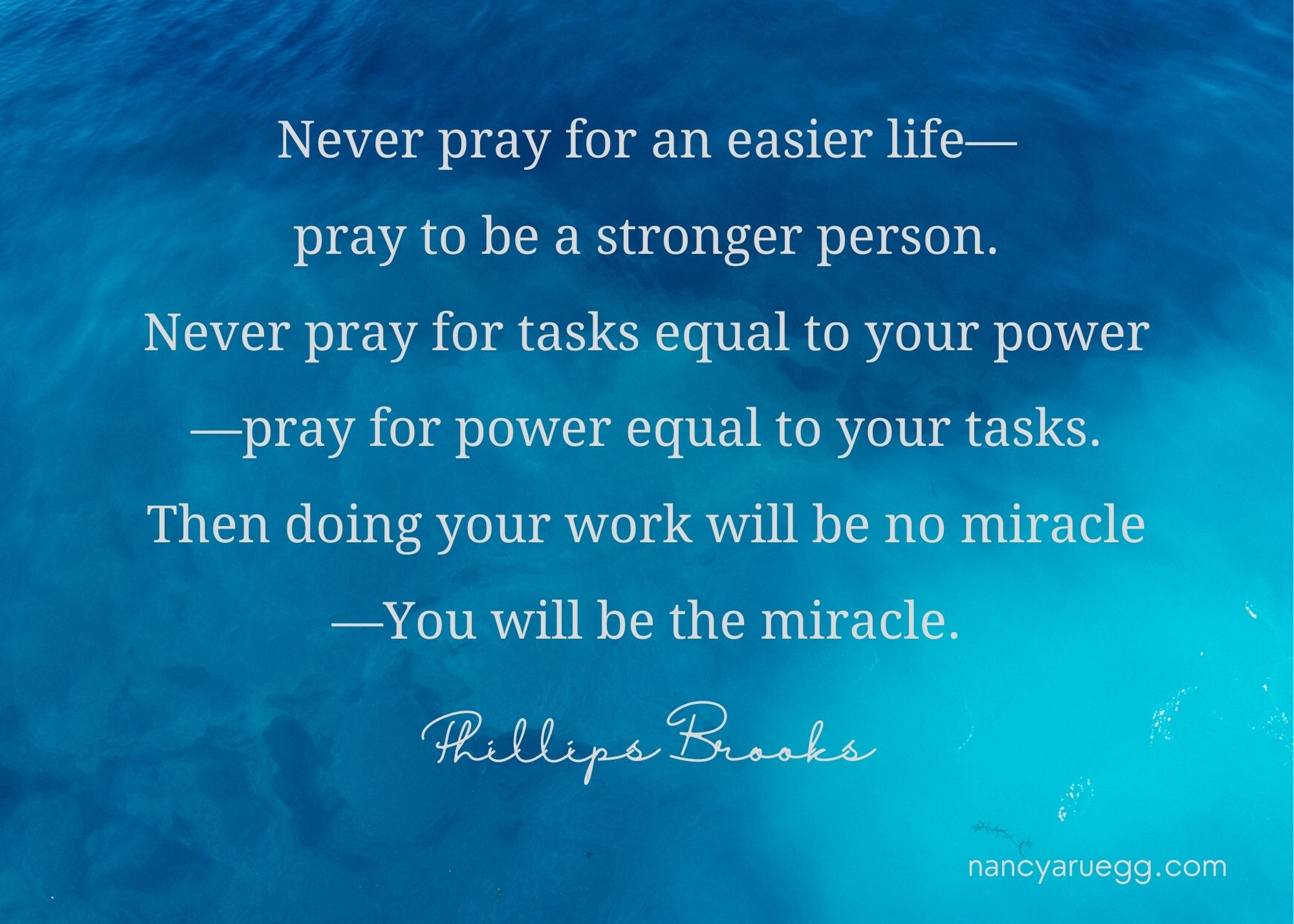
All three women exemplify what Rev. Phillips Brooks (1835-1893) wrote long ago:


Kara, Ann, Jennifer, and countless other believers demonstrate: When we embrace God’s be-attitudes, we not only experience the highest kind of happiness; we become miracles.


*Name changed.


Notes:

[1] Eugene Peterson, Under the Unpredictable Plant, pp. 160-161.

[2] Karol Ladd, Thrive, Don’t Simply Survive, pp. 147-148.

[3]  Jennifer Rothschild, Lessons I Learned in the Dark, p. 84.


Art & photo credits:  http://www.freebibleimages.org; http://www.heartlight.org; http://www.flickr.com; http://www.stocksnap.io; http://www.flickr.com; http://www.canva.com (2).


Read Full Post »


Attend a graduation ceremony, participate in a work-related seminar, or just join in a break room conversation, and you might hear one of these statements:

  1. God helps those who help themselves.
  2. If you can dream it, you can achieve it.
  3. Success = living life on your own terms.
  4. Believe in yourself.
  5. Follow your heart.
  6. You’ve got this.


Such statements are meant to encourage. But are they based on truth, or should a few be tossed in the trash?

Let’s consider:


Does God help those who help themselves?

Many people believe this idea comes from scripture. But the Bible teaches God helps those who recognize they can’t help themselves. The wisest course of action is to present each troubling situation to him in prayer before attempting any solution (1).


If I can dream it, is it a given I’ll able to achieve it?

Nowhere in the Bible are we told to pursue our dreams. Instead, God tells us to pursue righteousness, faith, love, and peace.

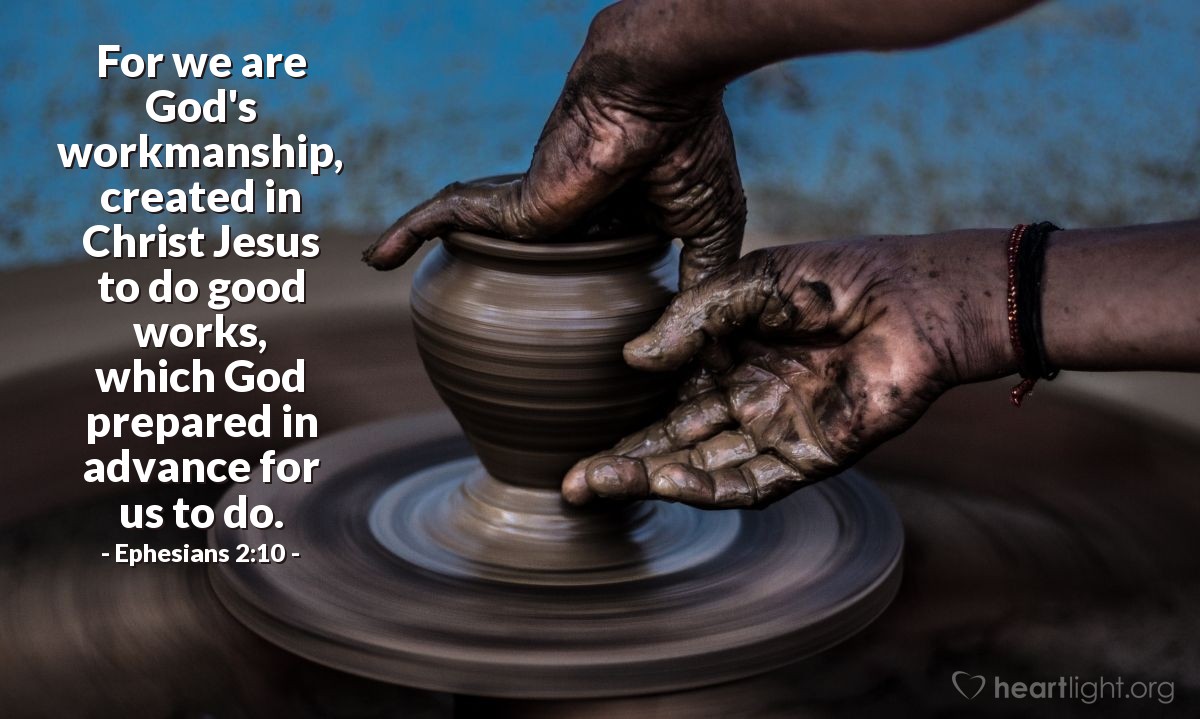
Not that God doesn’t place desires for the future on our hearts. He gladly helps us achieve all the good works He’s prepared in advance for us to do.

This is what we need to remember: “A God-given dream is never about position . . . it’s always about contribution.” And it’s through God-ordained contribution that we find satisfaction and fulfillment (2).


Is success a matter of living life on our own terms?

That kind of living most often leads to disappointment and dissatisfaction. Instead, God invites us to live the abundant life on his terms.

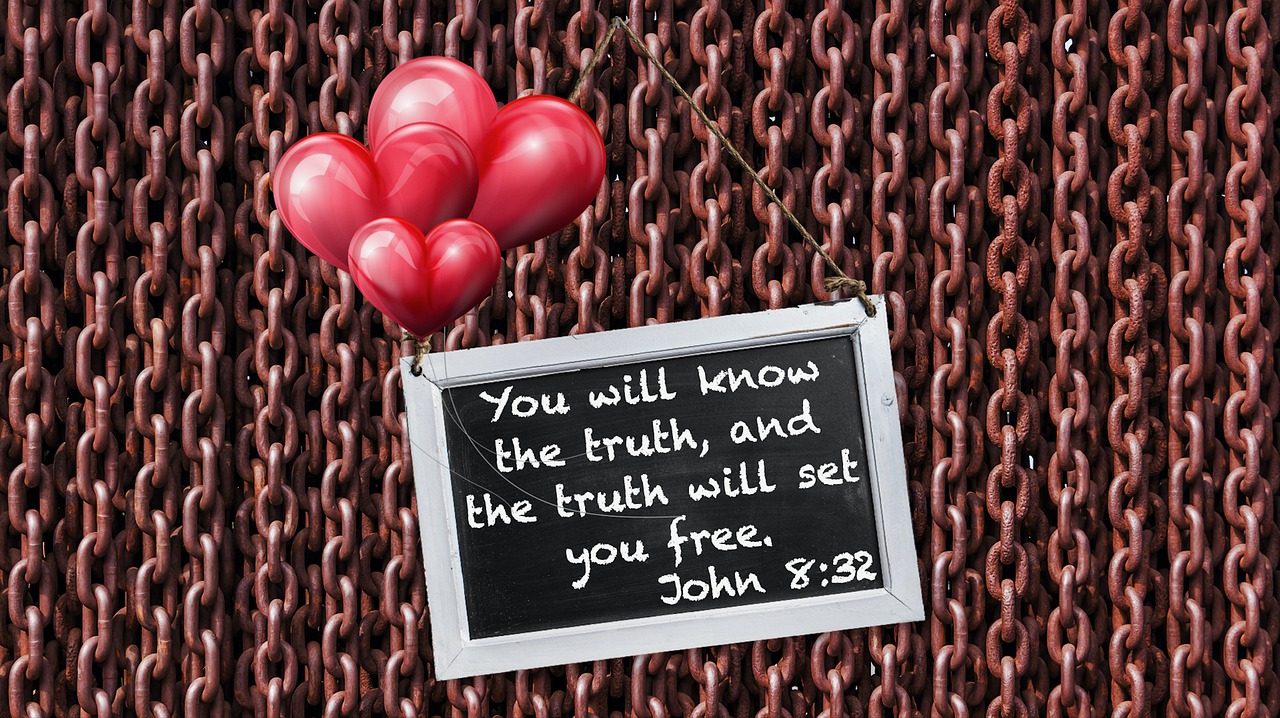
Some would say, “But God’s ways are so constrictive!” Actually, his truth provides freedom—freedom from the misery of sin and misguided choices. On the other hand, when we live the way he’s expertly designed for us, we enjoy a myriad of blessings (3).


Should we believe in ourselves?

That puts us in charge, which sounds appealing until you factor in our limited knowledge, imperfect judgment, and inadequate abilities. Due to these restrictions, stress and anxiety become constant companions while we try to keep control over our lives.

How much wiser to trust God who knows all things and can accomplish all things—including the best way to proceed through all our tomorrows.


Does it make good sense to follow our hearts?

No, our hearts are guided by feelings, desires, and emotions, which cannot always be trusted. Just ask Jennifer—Wife #2 of Jack. She believed his stories about self-centered, temperamental Wife #1. Jennifer told herself, Our marriage will be different. But she is now facing divorce herself as Jack’s eyes have wandered toward someone else.

No, we can’t just follow our hearts. We need the guidance of God’s perfect wisdom (4).


Have we got this?

Not really. Life can be turned upside down in a moment—bosses terminate employment, sure investments for retirement turn to ashes, doctors reveal devastating diagnoses. What then? I can’t imagine facing such hardships without God.

How much more encouraging to remember: he’s got this. Numerous experiences of others as well as my own have proven: God always sees us through with his perfect wisdom and almighty strength—whatever we face (5).


Notice how each of these statements in bold print revolves around usour effort, our planning, our confidence—even though we’re prone to make mistakes and foolish choices. God is the only One with the wherewithal to achieve what’s best for us—100% of the time.

As it happens, all these common statements can be tossed in the trash.

So when someone says, “Believe in yourself ,”or “You’ve got this,” perhaps we could respond with a gentle nudge toward truth:

Actually, I’m eternally grateful that Someone much stronger and wiser than I am is in charge. Experience has taught me, I am much better off trusting in God than in myself.


Notes:

  1. Isaiah 41:10; Psalm 56:3; 2 Chronicles 14:11; https://www.christianity.com/wiki/christian-life/why-god-helps-those-who-help-themselves-is-presumed-to-be-biblical.html
  2. 1 Timothy 2:22; Ephesians 2:10; https://www.crosswalk.com/faith/women/why-god-doesn-t-necessarily-want-you-to-pursue-your-dreams.html
  3. Proverbs 12:15; John 8:32; see Alphabet of Joy for examples of such blessings
  4. Romans 11:33
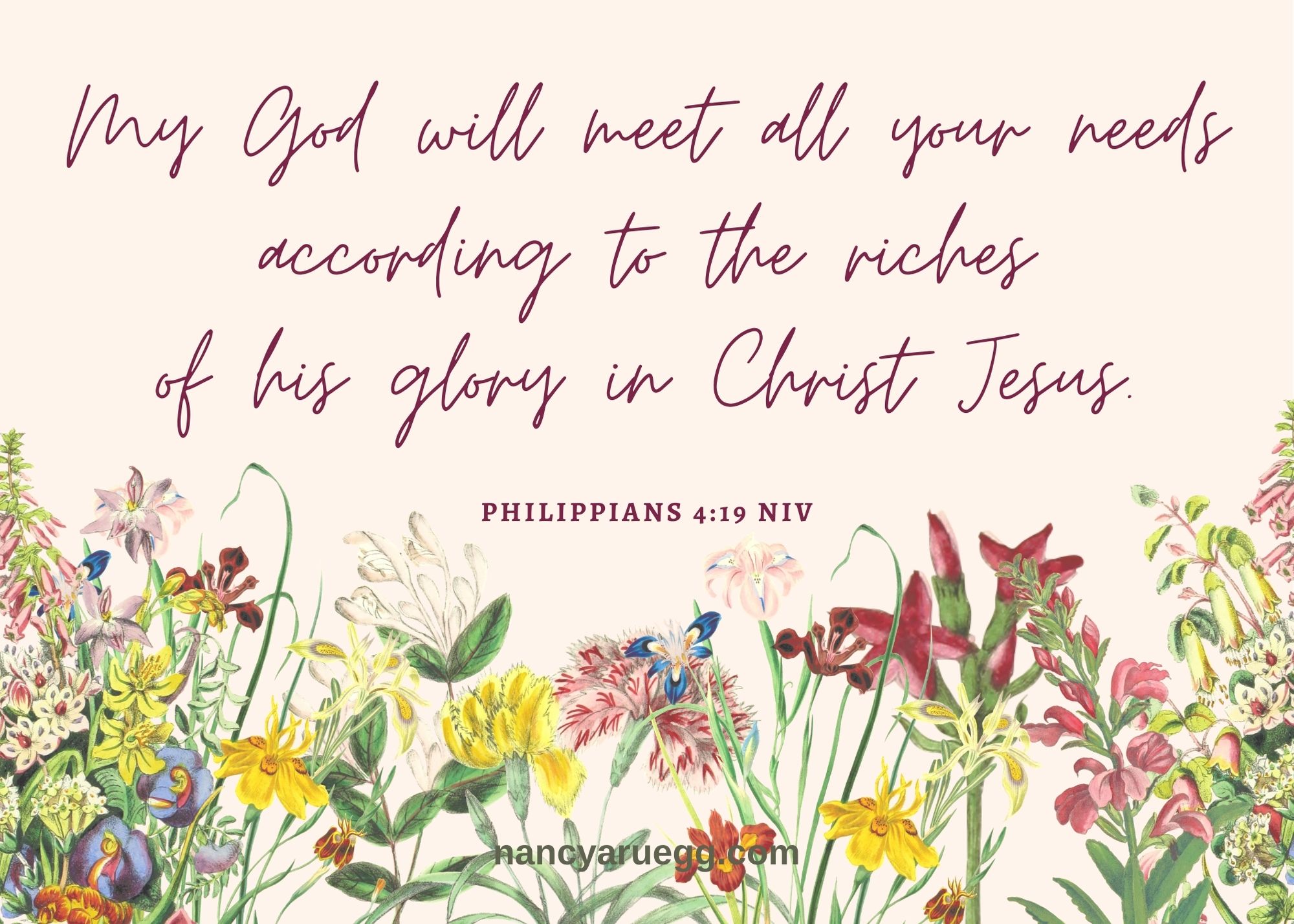
  5. Philippians 4:19


Art & photo credits:  http://www.pxhere.com; http://www.canva.com; http://www.dailyverses.net; http://www.heartlight.org; http://www.pixabay.com; http://www.geograph.org.uk; http://www.dailyveres.net; http://www.canva.com.


Read Full Post »

“Nancy—kitchen window!” Steve stage whispered, loud enough for me to hear.

And while dashing from the office I cried, “Coming!” because his tone meant Steve had spotted something unusual in the backyard or the strip of woods beyond that.

“Look down in the thicket to the right of the black walnut tree,” he directed. I carefully scanned the undergrowth but noticed nothing out of the ordinary.

“You don’t see four little eyes looking out?” Steve asked.

I did not.

“Stand here,” he directed, and stepped back so I could position myself directly in front of him. Then he leaned in, raised his hand to my eye level, and pointed. “Look up a foot from the base of the trunk, scan two feet to the right, under that diagonal branch, then look for four bright spots close together.”

I directed my eyes down the sight line he gave me and followed his instructions. Sure enough, two little foxes were peering out from thick foliage that provided excellent cover. But with Steve’s guidance, I was able to share with him that exceptional moment. We’ve never seen fox kits since.

God also invites us to stand close to him—not just for moments of exceptional blessing, although he offers plenty of those. No, our Heavenly Father offers us life support in the form of strength, help, serenity and more when we draw near to him. The question becomes how—how do we move in close to God? How do we best avail ourselves of all he has to offer?

Perhaps the best way to begin is:

Say yes to becoming well-acquainted with God.

As Steve explained how to spot the foxes, I never once thought he might suddenly say, “Ha-ha! Made you look!” He’s not one to play silly pranks; he has proven himself trustworthy.

The best place to become acquainted with God and his trustworthiness is in his Word. Years ago a Bible teacher recommended that whatever passage we may be reading, look for evidence of God’s attributes and think how they’re manifested in our lives. It’s a delightful, uplifting exercise.

Some are obvious. In the psalms, for example, we find many statements describing him. He is:

  • A shield around us (3:3)
  • Righteous (7:17)
  • Always loving (13:5)
  • Our rock, fortress and deliverer (18:2)
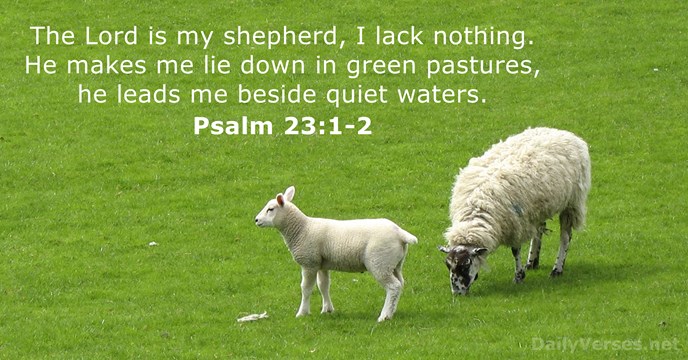
  • Our Shepherd who provides, protects, and guides (23:1-6)

Other attributes are less obvious to identify. But in the opening verses of Romans, for example, we find evidence that God is:

  • A purpose-setter for each of us (1:1)
  • a promise-keeper (1:2)
  • holy—separated from all other beings because of his perfection (v. 4)
  • gracious (v. 5)
  • our source of peace (v. 7)

And as we consider how each attribute has been manifested in our lives we soon discover: to know God is to trust God (Psalm 9:10).

Say yes to practicing his presence.

Identify stops throughout each day—moments to refocus attention on our Heavenly Father through praise, gratitude and prayer. For me that includes a quiet time each morning, exercising to Christian music, worship at the window while waiting for the microwave, and reciting scripture before falling asleep.

When I taught school, I would use the trips between my classroom and the gym, library, computer lab, etc. for moments of worship.

Say no to more screen time or whatever competes for your attention yet accomplishes little.

Years ago a young couple in our church decided to finish their college degrees—even though both worked full-time and they had two young children. How did they find time to study?

W. and T. went to bed at 8:00 when their kids did, then got up at 3:00 or 4:00 to complete assignments and prepare for tests. With discipline and perseverance they achieved their goal.

We can do the same to achieve our goal of knowing God: make time to stand close with him in his Word, in his presence.

James the brother of Jesus wrote:

Notice God leaves the choice to us; we have to make the first move.

The day of the fox kit sighting my response to Steve could have been, “Too busy—can’t come!” But I would have missed an exceptional moment.

I’m so glad my response was, “Coming!”

________________________

Other posts that address these topics:

Photo credits:  Nancy Ruegg; http://www.wikimedia.com; http://www.pixy.org; http://www.dailyverses.net; http://www.canva.com (3).

Read Full Post »


Uncertain times.

That phrase appears everywhere these days. Between the pandemic, political upheaval, social unrest, and concerns for the future, we can find ourselves desperate to find security—freedom from danger, fear, and anxiety.

But there is only one reliable source of security: God.


Out of his faithfulness to us, God always supplies what we need. And as it happens, the word FAITHFUL provides a tidy acrostic for eight blessings we enjoy–no matter what.

God is our:

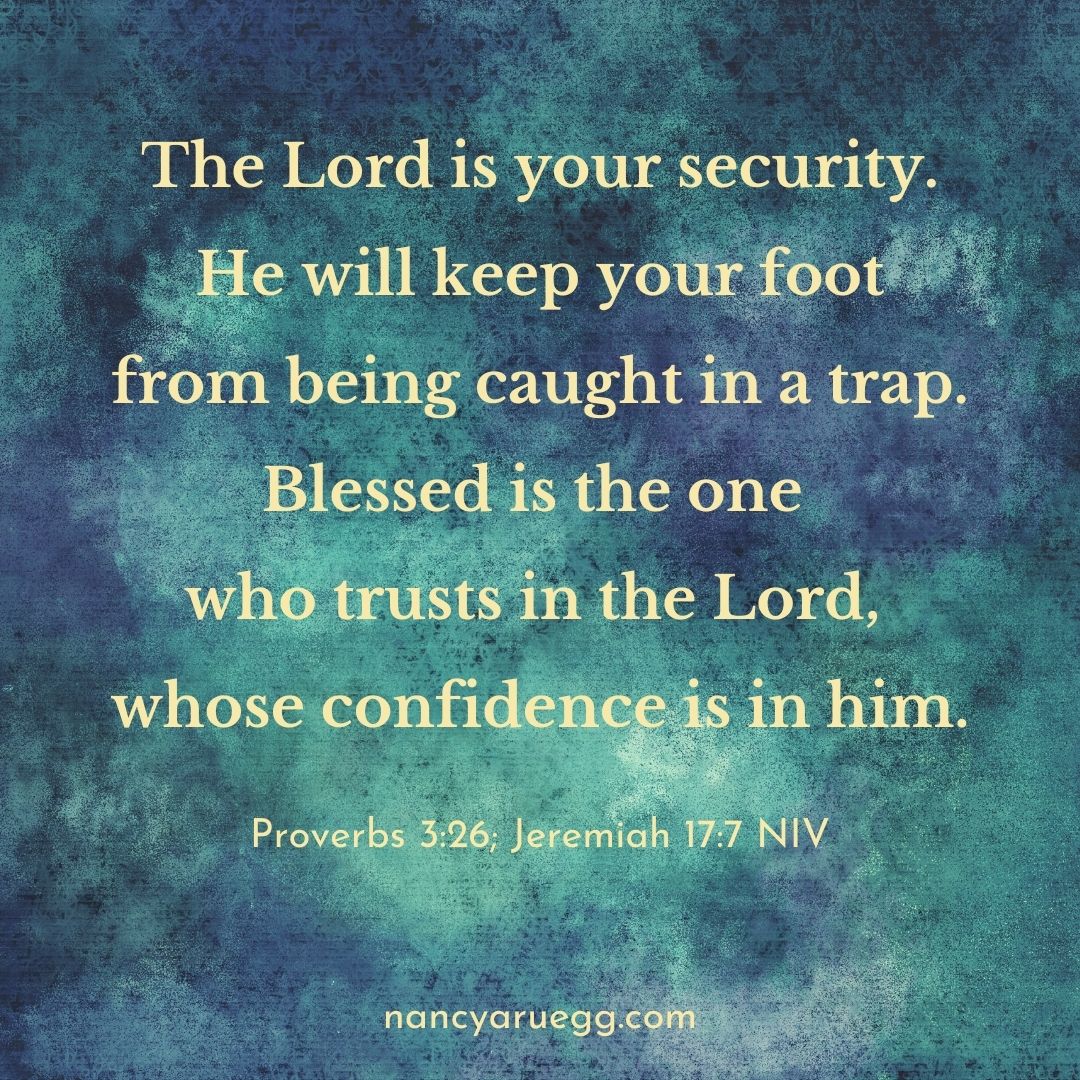
Faithful promise-keeper. He is already ahead of us in the uncertainty of 2021, just as he went ahead of Joshua and the Israelites into Canaan. He has promised not to fail us or abandon us[1]—even when we cross dark valleys of troubling circumstances.


Attentive Father. Before we put our needs into words, God is on his way to meet it.[2]

Immutable (unchanging) Rock. He “does not change like shifting shadows.”[3] In a world where situations and relationships can change unexpectedly, God remains his rock-solid, reliable, perfect self.

Truth-Revealer.   The truth of God’s Word has been proven through numerous disciplines and in the lives of millions. Within its pages we find the wisdom and support we need.[4]


“The remedy for discouragement is the Word of God.

When you feed your heart and mind with its truth,

You regain your perspective and find renewed strength.”

–Warren Wiersbe


Hope. Our God of hope fills us with all joy and peace as we trust him. Hope allows us to see his blessings even amid hardship, and know with certainty he will use even our painful circumstances to accomplish good.[5]

Foundation. God’s ways provide a strong foundation for life, especially when storms of sorrow come. He upholds us with his love and compassion, peace and comfort that transcend our ability to explain.[6]


Unerring and righteous Judge. “Your kingdom is founded on righteousness and justice,” wrote the psalmist, “love and faithfulness are shown in all you do.” And because he is righteous and just, everything will work toward the best outcome in the end.[7]

Light, even in dark times.[8] Too often we focus on the swirling blackness of circumstances around us. But “God’s lights in our dark nights are as numerous as the stars, if only we’ll look for them.”[9]


Throughout my years as a blogger, I’ve shared many experiences illustrating how God has been faithful to our family. One in particular comes to mind that encompassed all of the above blessings.

Leadership of our church denomination assigned my pastor-husband to another church across state.   We were not ready to move. God ministered to me during those dark days of transition as I journaled through the psalms, affirming his love and compassion, peace and comfort. And as a result, hope began to blossom.


I grew in spiritual strength, compelled to rely on him through the grief of leaving beloved friends and the uncertainty of what lay ahead. He miraculously provided a teaching position for me not far from our new home. And in the end everything did work for good as that struggling church became a thriving community. (You can read a fuller account at After the Fact.)

In a book of liturgy, St. Teresa of Avila (1515-1582) kept a bookmark with the following affirmation:


“Let nothing disturb you; let nothing dismay you;

all things pass: God never changes.

Patience attains all it strives for.

He who has God finds he lacks nothing.

God only suffices.”


God only—in all the numerous demonstrations of his faithfulness–is our certain security.


_______________________________________


Should you wish to read more examples of God’s faithfulness, you can click on the following links:


Notes:

[1] Deuteronomy 31:6

[2] Matthew 6:8

[3] James 1:17c CSB

[4] Psalm 119:24, 140, 160

[5] Romans 15:13; 8:28

[6] Isaiah 54:10; Philippians 4:6-7

[7] Psalm 89:14 GNT; Genesis 50:20

[8] Psalm 27:1

[9] Max Lucado, Grace for the Moment (J. Countryman, 2000) p. 195


Art & photo credits:  http://www.wikimedia.org; http://www.canva.com; http://www.pxhere.com; http://www.heartlight.org; http://www.dailyverses.net; http://www.pixy.org; http://www.heartlight.org.


Read Full Post »


Years ago my husband Steve and I lived in a small town outside Lexington, Kentucky. All through the area old stone walls stitch together fields and pastures into a landscape quilt. We often marveled at the workmanship as well as the time and effort required.

According to historians, the rocks were gathered out of the fields by Scot-Irish immigrants of the 1700s, who settled the area and needed to clear the land for farms. They used the same dry masonry skills of their ancestors back in the British Isles.

As decades passed new immigrants built more walls as did the slaves who followed.


(Similar walls in Ireland)


Those stone walls came to mind as I read again a story of Samuel, recorded in 1 Samuel 7:1-12. He set up a memorial stone in celebration of an Israelite victory over the Philistines. Samuel called it Ebenezer (which means Stone of Help), explaining that “thus far the Lord has helped us.”

Thus far in our lives the Lord has helped you and me also. And if we collected a rock to represent each time God has helped us, we’d surely accumulate enough to construct many walls, stitching together our experiences into a kingdom quilt—in the kingdom of God, that is.

And what a memorial it would be to God’s faithfulness!

As many of you know, I began a journal in 1983 of God’s faithfulness to our family—a record of his provision, protection, guidance, and blessing. To date there are nearly 1400 entries.


(Note how yellowed these early pages have become!)


If I gathered a Stone of Help for every event noted, I could build a wall ten stones high and nearly 140 feet long. No doubt a record of your life would produce a similar-sized wall, perhaps longer.

Imagine an aerial view of thousands of such walls criss-crossing the landscape—a visual reminder of God’s faithfulness to all of us. Our eyes would pop in wonder.

During this challenging year of 2020, God has demonstrated his faithfulness in numerous ways.


I am particularly thankful for:

  • Sightings of wildlife that turn window glances into marvel fests
  • Family and friends within easy reach through various forms of technology
  • Livestreamed church services that allow Sunday worship with our congregation
  • No hospitalizations for Steve in 2020 (Last year he was admitted four times for various problems related to his liver transplant and a subdural hematoma.)
  • Emotional and spiritual health in spite of isolation

And all of us have benefited from God’s unending supply of strength. We’d do well to remember:


I’m guessing you can remember a situation or two when you thought it impossible to press on. But you did—because of God’s enablement.

Other times responsibilities piled up to impossible heights, and the emotional crush was nearly unbearable. But then—miraculously—cancellations and postponements occurred, assistance materialized, and the pile decreased to manageable size–because of God’s intervention.

And why is all this looking back at the past significant? Because:


Where others might say, “So far, so good!” and hope for the best, we say, “So far, so God!” and rely on him whose help is certain. He never fails to do what he has spoken (Psalm 145:13b).

The millions of virtual Ebenezers among us provide reliable evidence we can count on–for 2021 and beyond.


A blessed and confident New Year to all!


Art & photo credits:  http://www.pxhere.com; http://www.needpix.com; Nancy Ruegg; http://www.heartlight.org; http://www.canva.com; http://www.pxhere.com; http://www.pixabay.com.


Read Full Post »

(One of Wilson Alwyn Bentley‘s photos)


Remember your first glimpse of a snowflake under a magnifying glass and your reaction to its tiny intricacies? I’ll bet your eyes grew wide and you leaned in for a close-up view. You probably uttered Wow! or Look at that!

And perhaps while gazing at such infinitesimal beauty you learned:


Only when we examine something closely

can we begin to appreciate its value.


Scripture urges us to magnify God.


To magnify God is to look closely at him and take careful notice of his actions and attributes. Mary, the mother of Jesus, did exactly that. We read an example in the account of her visit to Cousin Elizabeth (Luke 1:39-56).

Elizabeth was much older than Mary, well beyond child-bearing age. But like Sarah of the Old Testament, God had intervened for her. Elizabeth would soon be the mother of John the Baptist.


When Mary first arrived and offered her greeting, Baby John leaped in Elizabeth’s womb (Luke 1:41). (Can you imagine how that would feel, to have a baby jump inside you?)

Elizabeth responded with a blessing for Mary and the holy baby her young cousin carried. Then Mary became overcome with joy and incredulity herself, and burst into praise. Her song is called the Magnificat, Latin for magnifies.

For ten verses (Luke 1:46-55), Mary magnifies the Lord, examining the reason for her joy (vs. 46-49) and looking closely at God’s attributes and actions (50-55). Never mind her relative poverty, the misunderstanding and derision of others, or the uncertainty of the future. Mary focused on God who was working a miracle within her.


If your Bible includes cross-references you’ll notice Mary quoted bits and pieces of seven psalms. In addition, she included fragments from Isaiah, Habakkuk, Exodus, Genesis, 2 Samuel, and Jeremiah.

It would appear Mary wove such far-spread scriptures into this beautiful prayer–on the spot! She must have been an intelligent young woman.

Perhaps she grew up in a godly home where the Law and Prophets were highly esteemed. Her parents may have taught her or, if she had brothers, Mary listened as they recited their lessons, and she too learned the ancient scriptures.

Now as Mary and Elizabeth greet one another, the young woman rejoices in God her Savior. She highlights his mercy, might, faithfulness, holiness, and saving power.


And yet in spite of his awesome greatness the Mighty One has been mindful of her—a humble, peasant girl. He has done great things on her behalf. Notice she prays in past tense, as if the events Gabriel announced had already taken place (v. 49).

Then Mary itemizes specific ways God benefits his people:

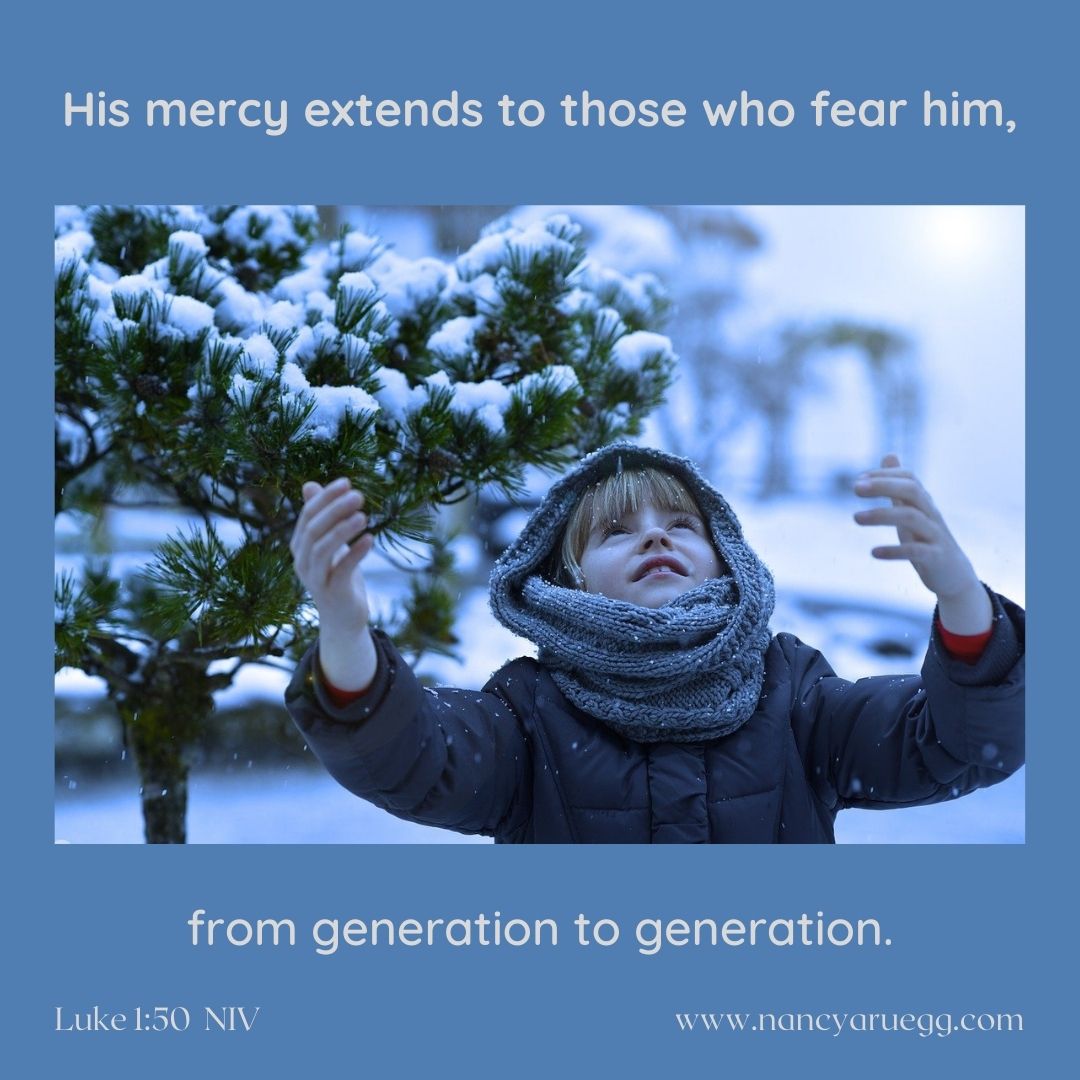
  • He extends mercy to those who reverence him
  • He performs mighty deeds
  • He has scattered the proud
  • He has brought down rulers, but lifted up the humble
  • He has filled the hungry, but sent the rich away empty
  • He has been merciful to Israel

We too are God’s people, if we believe in his Son, Jesus. And he benefits his people in these same ways today just as he has through all the eons of time.

No doubt God has been at work in your life too. He’s been mindful of you and blessed you (v. 48); he’s done great things for you (v. 49) and extended his mercy to you (v. 50).


View the activity of God in your life through the magnifying glass of meditation. Take note of his actions and attributes on display in the events of your life. And then please share with us an example in the comment section below.

Let us magnify the Lord together for his awesome deeds!


(Revised and reblogged from 12-20-2012.)


Art & photo credits:  http://www.metmuseum.org; http://www.pixabay.com; http://www.wikimedia.com; http://www.heartlight.org; http://www.pixabay.com (2).


Read Full Post »

No doubt about it: Christmas is going to look different this year. Some folks (like me) will opt to scale back the decorating. Church and school programs won’t be presented, parades won’t be processing down Main Street, and fewer families will be cozied up at Grandma’s house for gift giving and feasting.

As if mocking the disappointment already rooting in our spirits, Andy Williams comes on the radio singing, “It’s the Most Wonderful Time of the Year”—about friends coming to call, parties for hosting, and caroling out in the snow.

But wait. Perhaps this year could become a different kind of wonderful. Perhaps with less holiday preparation to complete and fewer activities to attend, we’ll have more time to revel in the preparation of our hearts.

How might we do that? According to pastor/author Handel H. Brown:

An attitude of expectancy includes an outlook of hope—hope in God’s provision for the here and now, and hope for what is to come. Even as we celebrate Christ’s first appearance on earth, we look forward to his second coming when he will “take us to heaven, to live with him there” (1).

Too often I’ve counted down the days until the Christmas tree is glowing, or the family is gathered, or the gift-exchange can finally take place. Those are all superb delights, but they quickly fade into wisps of memory.

We Christians can revel with expectant hope in a countdown of more substantive delight and importance. Peter called it a living hope, based as it is on our living Savior (1 Peter 1:3).

This hope is not just a feeling that fades like the euphoria of Christmas—once family members have departed and decorations are boxed and shelved. No, this hope is absolute certainty, placed in our faithful, eternal God . Everything he has promised he will deliver.

So how do we muster expectant hope? By immersing ourselves in God’s Word.

Hope is living constantly, patiently,

expectantly, resiliently, joyously

in the word of God.

–William Stringfellow

Here’s one scripture that fills me with expectant hope. See if these words don’t lift your spirit as well:

“Let us give thanks to the God and Father of our Lord Jesus Christ! Because of his great mercy he gave us new life by raising Jesus Christ from death.

“This fills us with a living hope, and so we look forward to possessing the rich blessings that God keeps for his people. He keeps them for you in heaven, where they cannot decay or spoil or fade away.

“They are for you, who through faith are kept safe by God’s power for the salvation which is ready to be revealed at the end of time”–1 Peter 1:3-5 GNT (2).

Praise God for his mercy!

Praise him for the new and abundant life he provides!

Praise him for all the blessings of past, present, and future!

Praise him for the perfected life yet to come–with him in heaven!

As we prepare our hearts for Christmas by immersing ourselves in such scriptures, expectant hope is bound to well up and produce wonderful results.

In addition:

“Expectancy is the atmosphere for miracles.”

–Unknown

So let’s put the WONDERFUL into Christmas 2020 with renewed, expectant hope in our glorious Father.

Let’s create the atmosphere for miracles!

What scripture fills your spirit with expectant hope?  Please share in the comment section below!

Notes:

  1. The last line from “Away in the Manger,” based on John 14:2-3.
  2. Other scripture passages to explore that foster expectant hope:  a) Isaiah 9:6-7 (See also a previous post, “His Name Shall Be Called.”) b) Isaiah 40:28-31, c) Ephesians 1:3-13, d) 1 Thessalonians 4:14-18.

Photo credits:  http://www.canva.com; http://www.wikimedia.com; http://www.piqsels.com; http://www.pxfuel.com; http://www.canva.com; http://www.piqsels.com; http://www.pixy.org.

Read Full Post »


The Advanced Placement Program launched in the 1950s. Perhaps you took advantage of A. P. classes as a high school student. Though more challenging than standard secondary courses, they provide a substantial payoff–up to a semester’s worth of college credit.

A couple of weeks ago, I thought of A.P. classes upon encountering a Charles Colson quote about gratitude. He presented a whole new level of challenge concerning this quality.

Instead of giving thanks for the goods received, Colson suggested we express appreciation for who God is—his character. Colson said such an act of faith provides evidence the Holy Spirit is working in a person’s life (1).


So, in spite of self-isolation and lockdowns, distress for our country and world, as well as the personal concerns we all carry, let’s aspire to A. P. gratitude on this Thanksgiving Day by reflecting upon:


God’s grace


God is . . . a personal Father who cares,

and not a God who merely wound up the world with a key

and then went away to let it run by itself.

God’s grace is a certainty, even amid the turmoil of today’s world.

–Unknown


God’s faithfulness


No matter what we are going through, no matter how long the wait for answers,

of one thing we may be sure: God is faithful.

He keeps His promises.

What He starts, He finishes . . .including His perfect work in us.

–Gloria Gaither (2)


God’s goodness


Of all the things our minds can think about God,

it is thinking upon his goodness that pleases him most

and brings the most profit to our soul.

–Julian of Norwich


God’s compassion


Do not look forward to what may happen tomorrow;

the same everlasting Father who cares for you today

will take care of you tomorrow and every day.

Either he will shield you from suffering,

or he will give you unfailing strength to bear it.

Be at peace then, put aside all anxious thoughts

and imaginings, and say continually:

‘The Lord is my strength and my shield;

my heart has trusted in him and I am helped.

He is not only with me but in me and I in him.’

–St. Francis de Sales


God’s love


All shall be well, all shall be well . . .

for there is a force of love moving through the universe

that holds us fast and will never let us go.

–Julian of Norwich


With these eternal gifts bestowed upon us—God’s fatherly care, promise-keeping faithfulness, ever-reliable goodness, soul-strengthening compassion, and never failing love, we surely have everything we need.


Notes:

  1.  http://www.crosswalk.com/faith-spiritual-life/inspring-quotes/30-christian-quotes-about-thankfulness.html 
  2. Quoted in Values for Life, Walnut Grove Press, 2004.


Art & Photo Credits:  http://www.wikimedia.org; http://www.canva.com (2); http://www.pixy.org; http://www.pixabay.com; http://www.canva.com; http://www.snappygoat.com; http://www.heartlight.org.

Read Full Post »


Just for fun I Googled “strategies that lead to a satisfying life.” Of course numerous articles popped up, offering a multitude of suggestions. One article listed twenty ways for achieving fulfillment.

But researchers have determined it takes sixty-six days on average to develop a new habit (1). That means twenty new habits would require concentrated effort for nearly four years. Sounds daunting, doesn’t it.

However, as you’ve already noted from the title of this post, it is possible to turn a humdrum life into exceptional with just one strategy: gratitude to God.


But how can one simple act make such a difference?

I’ll explain in a moment. First, let’s identify the key word in that statement above: God. Without someone to thank, gratitude is pointless. And he is responsible for every good gift in our lives. By thanking God for his blessings, we unlock the fullness of life (2).

Here’s how it happens:


Gratitude fosters joy and contentment.

When we aim to thank God for the benefits he bestows, the delightful encounters he provides, and the beauty he’s created, we soon realize our days overflow with his gifts. And each one gives reason to smile.


Gratitude leads to peace.

Remember Isaiah 26:3?  “You keep him in perfect peace whose mind is stayed on you” (ESV). Gratitude to God is a delightful way to stay focused on him and thereby calm our hearts into serenity.


Gratitude contributes to resiliency.

Researchers Tennen and Afflek (2002) found that when people express gratitude even while suffering adversity or trauma, they tend to persevere with greater strength than those who don’t practice thankfulness (3).

John MacArthur beautifully described the phenomenon with this bit of imagery:


“No matter how choppy the seas become, a believer’s heart is buoyed by constant praise and gratefulness to the Lord.”


Gratitude increases our trust in God.

We can begin with grateful remembering of his marvelous deeds in the past, to form a foundation of faith for the present. Also, by expressing thankfulness in difficult circumstances and gratefully acknowledging God’s support and supply, our perspective is transformed.


I trust in your unfailing love; my heart rejoices in your salvation.

I will sing the Lord’s praise, for he has been good to me.

–Psalm 12:5-6


And when all of these results-of-gratitude are present in one person—effervescent joy, sublime contentment, luminous peace, buoyant resiliency, and unshakable trust—we see an exceptional life.


It all begins with gratitude.


When it comes to life, the critical thing is whether

you take things for granted or take them with gratitude.

–G. K. Chesterton


And how do we learn to take things with gratitude?

Researchers have studied that too, and found gratitude journals to be highly effective (4).


They suggest keeping a record of pleasurable observations and positive experiences such as:

  • Happy squeals of neighbor children as Daddy pushes their swings
  • An overcast day made cozy with glowing candles, simmering soup, and rain thrumming on the roof
  • Being taught by a seven-year old granddaughter how to add two-digit numbers in a new and clever way
  • Those places where God has brushed all of autumn’s colors in one swath


Gratitude bestows . . .transcendent moments of awe

that change forever how we experience life and the world.

–Sarah Ban Breathnach


So instead of wishing you a Happy Thanksgiving Day, blog-friends, I pray for you an exceptional life–of gratitude!


____________________________


If you keep a gratitude journal, please share your experience in the comment section below. How has it contributed to an exceptional life for you?


Notes:

  1. https://www.healthline.com/health/how-long-does-it-take-to-form-a-habit#takeaway
  2. James 1:17 and https://melodybeattie.com/gratitude-2/
  3. https://positivepsychology.com/gratitude-happiness-research/
  4. https://www.pointloma.edu/resources/counseling-psychology/what-good-gratitude-role-thanksgiving-personal-development


Photo credits:  http://www.pickpik.com; http://www.pixabay.com; http://www.needpix.com; http://www.pikrepo.com; http://www.canva.com; Nancy Ruegg (3).


Read Full Post »


Up on a knoll toward the edge of her inherited property, Bea Leever sat on the familiar lookout rock, surveying the land they’d named Kerah Farm. The view from this vantage point never grew old.

Off to the west stretched the family’s fields—squat and leafy soybeans; thick, tall corn; and golden-topped wheat rippling in the breeze. Some of the harvest would feed her family and the farmhands, the rest they’d sell.


Close to the house on the south side, a large garden provided more vegetables, and a dozen hens in the chicken coop produced plenty of eggs.

Beyond the garden stood the orchard of apple, pear, and cherry trees—plenty of fruit for everyone on the farm to enjoy and more produce to sell. To the east, beyond the cow pasture, a large grove of oak and maple trees kept them supplied with fuel for the wood stove.


And all around the perimeter of Kerah Farm, stout fences and thick hedges provided security.

Yes, from time to time difficulties like storms, drought, and pests presented challenge. And the crops, garden, and animals certainly required much labor, but nothing offered greater satisfaction than watching seedlings become lush crops, blossoms become plentiful fruit, or garden produce become jewel-toned canning jars lined up on shelves.


Now that Bea Leever had tasted farm life, she would never leave.

Bea remembered the day she first entered the property, and the immediate sense of peace that engulfed her spirit. She’d been so wrapped up in her worries and doubts prior to making the turn at the gate, the complete change of heart surprised Bea. Very soon the farm became her beloved refuge.


From then on, when fear tried to overtake her, Bea would climb to this rock on the hill and survey the beautiful inheritance bestowed upon her. She praised God for the more-than-adequate provisions offered within the farm’s boundaries, the gratifying work it afforded, and the security within its borders.

In no time, that comforting sense of peace would return.

_______________________________


Like Jesus’ parable of the sower in which various types of soil represent various responses to his message, this parable-of-sorts includes various blessings of every believer (“Bea Leever”).

Did you find them, hidden among the imagery?  For example:

Bea inherited the physical blessing of land; we believers inherit the spiritual blessings of God (1).  She enjoyed the provision of crops and animals; we enjoy God’s provision of every need.


Bea found joy and satisfaction in her work; believers find joy in their work for God and the development of the fruit of the Spirit in their lives (2).

She experienced great peace within the security of Kerah Farm; we experience great peace within the shelter of the Almighty (3).

Her life changed forever upon entering the farm gate; believers’ lives are also changed forever upon entering the Gate—Jesus—and into relationship with their Heavenly Father (4).

Just as she often visited the rock on a hill, a place that strengthened her spirit, we also go to our Rock—the Lord Most High–who is perfect and just, faithful and upright.


Bea thanked her Lord for the blessed life of Kerah* Farm; believers thank him for the blessed and abundant spiritual life Jesus provides (5).

And just as Bea Leever prayed, so do we:

Gracious Father, in spite of challenging events that sometimes overtake us, we thank you for your beautiful and bountiful provision.  We also praise you for your gracious goodness, all manifested in your wonderful deeds. Who, oh Lord, can compare with you?!  

(Psalm 40:5; Isaiah 63:7; Psalm 113:5)


*Kerah is the ancient Hebrew word for provision.


What else might you envision on Bea Leever’s farm that coincides with our lives in God? Share your imaginings in the comment section below!

 

Notes:

  1. Psalm 16:6 NET Bible; Ephesians 1:3-14
  2. Colossians 3:23-24; Galatians 3:23-24
  3. Psalm 4:8; Psalm 91:1
  4. John 10:9
  5. John 10:10


Photo credits:  http://www.pixabay.com (2); http://www.pxfuel.com; http://www.repo.com; http://www.wikimedia.com; http://www.heartlight.org (2); http://www.canva.com.


Read Full Post »

« Newer Posts - Older Posts »

Sylvia Schroeder

Impressions Becoming Expressions

Mitch Teemley

The Power of Story

Still Traveling

Impressions Becoming Expressions

Living Our Days

Gaining a heart of wisdom

He Said What?!

I'm Patty, and my husband and I are living with our adult son who has autism and epilepsy. I love sharing lessons learned from life around me, especially life with Aaron.

Meditations of my Heart

Impressions Becoming Expressions

Linda Stoll

Impressions Becoming Expressions

Signora Sheila

Where faith meets la dolce vita

Heidi Viars

Finding the Image of God