Feeds:
Posts
Comments

Archive for the ‘Hope’ Category

“You have made man a little lower than the heavenly beings…

You made him ruler over the works of your hands…

All the beasts of the field, the birds of the air, and…

All that swim the paths of the seas” (Psalm 8:5-8, italics added).


4553514-More-Underwater-Fish-1


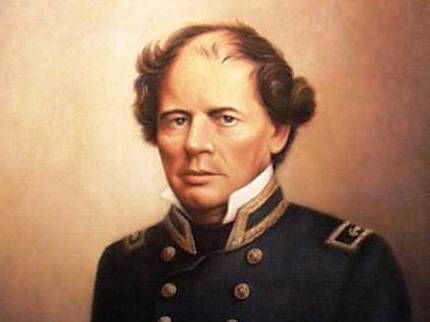
“Paths of the seas.” What might that refer to?  That question crisscrossed Matthew Maury’s mind frequently.

Maury had always loved the sea, prompting him to join the U.S. Navy at age 19, in 1825.

Life at Sea

The second ship on which he served, the Vincennes, included a library. Matthew was eager to learn and spent his spare time studying navigation. Sometimes he chalked out problems in spherical geometry on cannon balls. When the Vincennes circumnavigated the world, Matthew received practical experience in the subject.

Upon returning to the States, Matthew took an examination in navigation and passed. He was then appointed acting sailing master on the Falmouth. Along with the ship’s commander, he was responsible for navigating the course, steerage, and sail trim.

Next Matthew determined to learn about winds and currents. He discovered that no one had charted such information for the treacherous Cape Horn off the southern tip of South America. He kept meticulous records during the voyage and wrote about his findings in a paper, published by the American Journal of Sciences and the Arts.

In 1834, Matthew married Ann Herdon, and they settled in Fredericksberg, Virginia.

Maury’s life was certainly following a positive trajectory. And no doubt, as a strong Christian believer since boyhood, he saw each new opportunity as a blessing from God.

Plan B

But in 1839, Matthew was injured in a stagecoach accident.  The final result:   permanent lameness.  Never again would Maury be able to work aboard a naval vessel.  His career came to an abrupt end, and Maury fell into despair.

Surely he must have wondered, What am I to do, Lord? The sea is all I know.

But Maury did not allow his despair to debilitate him. He used his convalescence to continue studying navigation, meteorology, winds, and currents.

Was God behind that compulsion? Perhaps so. In 1841, Maury was offered a position as manager of the U.S. Naval Observatory and the depot for charts and instruments. This position was perfect for him, requiring the exact knowledge and abilities he had acquired.
 

4 arthur


In 1852-1853, Maury brought together ten major maritime powers of the world. In unanimous agreement, they began to compile unified records benefiting all mankind. For the next thirty-five years, more than a million ships’ logs were sent annually to the observatory. From those records were developed wind and current charts for the globe.

Pathfinder of the Seas

Meanwhile, Maury sought for the meaning of that mysterious phrase in Psalm 8:8, “the paths of the seas.”

As he studied those ships’ logs being sent to the observatory, he compiled charts of ocean-wind and sea currents. He set adrift weighted bottles that would float slightly below the surface of the water, where they would not be impacted by wind.

Instructions inside each bottle informed the person who found it to return the bottle, with the location and date of its discovery. From his charts and experiments, Maury was able to determine the “paths of the seas,” including the Gulf Stream.

Pathfinder of the Wind

Maury also proved the truth of Ecclesiastes 1:6:

“Blowing toward the south, then turning toward the north, the wind continues swirling along; and on its circular courses the wind returns.”

Further study and experiments indicated that the wind did indeed move in circular patterns. Today we call them jet streams. Maury’s investigations led to a better understanding of weather, and predictions became more reliable.

Plan C

But despair entered Maury’s life again when the United States declared civil war. As a citizen of Virginia, he felt obligated to side with the South, giving up the position in Washington at his beloved observatory. Jefferson Davis, President of the South, sent Maury to England as an ambassador for the Confederate States.

After the war Matthew spent three years exiled in England. Many honors were conferred on him during that time, but his heart was still in the U.S.

Did he wonder once again what God might be planning? Perhaps he prayed, “Lord, if it be your will, arrange circumstances so that we may return to America.”

In 1868, the U.S. offered general amnesty to ex-patriots and Matthew sailed back to the States. He accepted a position at Virginia Military Institute as professor of meteorology, a position he held to the day he died, February 1, 1873.


maury2187


Matthew Fontaine Maury, a self-taught navigator of the seas, astronomer, meteorologist, author, and educator, always sought to prove:

“The Bible is true and science is true,

and therefore each, if truly read,

but proves the truth of the other.”

–Matthew Maury


And though he may not have set out to do so, Maury also proved:

“I know the plans I have for you, plans to prosper you and not to harm you, plans to give you hope and a future” (Jeremiah 29:11).

With the advantage of hindsight, we can readily see this promise grandly fulfilled in Maury’s life. Yes, he suffered pain and hardship. All saints of God do (Romans 8:17).

But! God brought Maury through every challenge and used him in mighty ways—ways that impact our world to this day.

*     *     *     *     *     *     *     *     *     *

Lord, I am deeply grateful you are the one who plans each of our lives. What comfort to know that an all-seeing, all-wise God is orchestrating not only the main events of life, but every single day. I pray for your grace, in order to be accepting of disappointments, knowing that you will bring good out of every situation. In fact, you may very well be preparing something important. I want to trust you without hesitation.

(Psalm 139:16; Romans 8:28; Ephesians 2:10)


Sources:  The Founders’ Bible, https://answersingenesis.org; http://www.cbn.com; http://www.creation.com.)

Photo and art credits:  www.travelblog.org; http://www.firstladies.org.)

Read Full Post »

l-12422

“Be careful what you think,

because your thoughts run your life.”

–Proverbs 4:23, NCV


That would explain why worrisome thoughts can turn into paralyzing fear, pessimism into debilitating discouragement, and sadness into utter hopelessness.

No one wants to dwell in such misery.

But if a person is facing difficult circumstances, and she allows her thoughts to run amok on auto-pilot, she’s likely to slide downward into hyper negativity.  Climbing out is difficult.

“Snap out of it!” someone will say. Not very helpful.

“Look for the silver lining,” advises another. Easier said than done when tragedy strikes–and lingers.

“Spend some time in reflection.” That’s what one web site recommends, offering sixteen questions for a person to consider. Most of us don’t have time for that much introspection, nor the inclination, when we’re hurting.

So, how can we climb out of a miserable pit of despair?

By replacing negative thoughts with positive thoughts, especially scripture.

You see, our brains cannot focus on two things at once. Prove it to yourself by counting to ten and reciting John 3:16 at the same time. You’ll find you’re either counting or reciting, not both simultaneously.

We can apply the same strategy to negative thinking. At the first moment we realize our thoughts are headed in the wrong direction, we can confess it and ask God to help us renew our minds:

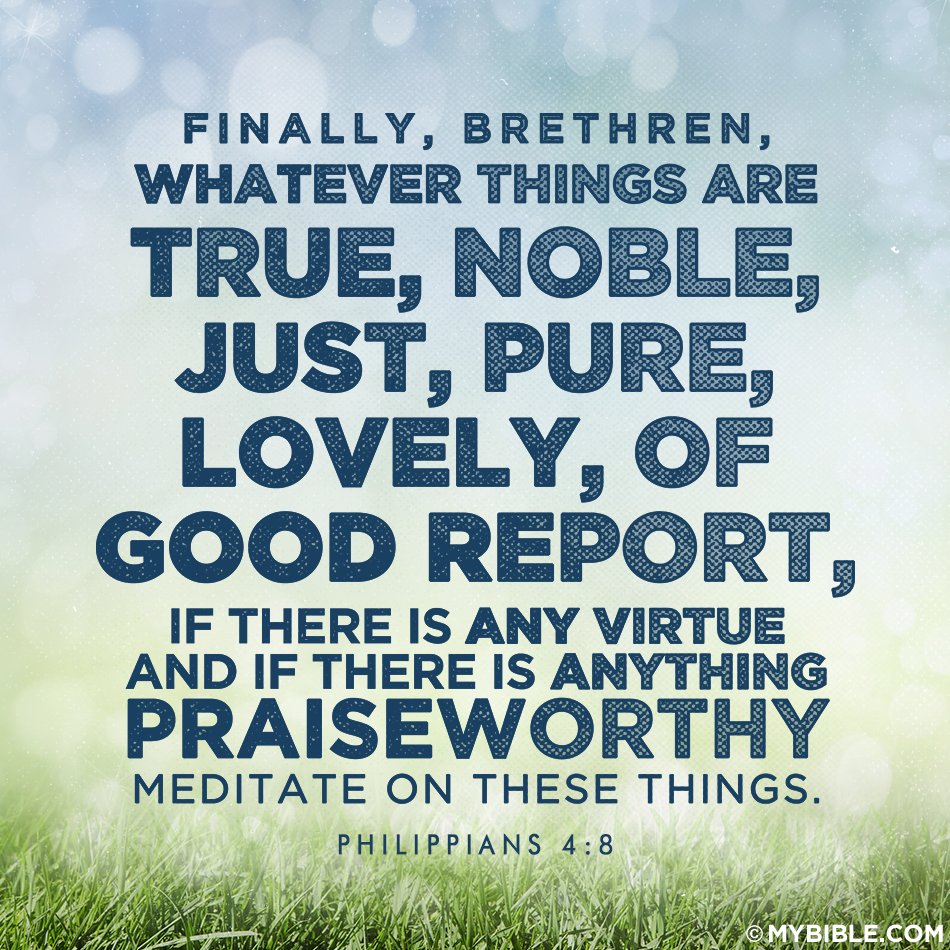
“Lord, I don’t want to think about this anymore.  I know it’s counter productive and does absolutely no good. Help me to refocus on what is noble and right, pure and lovely (Philippians 4:8).”                            

Then we start singing a favorite praise song, listing all the reasons we can trust God in this situation, or reciting an uplifting scripture.

For a start, the bulleted quotes below highlight some common threads of negative thinking.  Following each is a positive scripture as rebuttal:

  • “There is no way this situation is going to work out.”

 Oh? “In all things God works for the good of those who love him, who have been called according to his purpose” (Romans 8:28, italics added).

  • “I can’t stand another day of this.”

Oh, yes, I can stand. I can put on the full armor of God, so that in this day of trouble, I may be able to stand my ground” (Ephesians 6:13).

 Restoration will come. “Though you, [God], have made me see troubles…you will restore my life again…you will again bring me up” (Psalm 71:20).

  • “I am never going to succeed.”  

Not true.  God says [He] will accomplish all [his] purposes (Isaiah 46:10b, italics added).  What greater success could there be than to accomplish the purpose of Almighty God?

  • “I have no idea how to proceed. Maybe I should just quit. This is just too hard.”

 I can pray as the author of Hebrews did: “May the God of peace…equip me with everything good for doing his will, and may he work in me what is pleasing to him” (Hebrews 13:20-21).

  • “Sometimes I can’t seem to do anything right. How can God use me?” 

I am God’s workmanship, created in Christ Jesus to do good works, which he prepared in advance for me to do (Ephesians 2:10).

If the bulleted comments in bold print are our focus, our lives will surely head in a downward direction toward discouragement and hopelessness.

If, on the other hand, we focus on the promises and positive affirmations of scripture, we head in an upward direction toward wholeness, productivity, and joy.

habakkuk_3_19_scripture_memory_card_post_card-r720e7f7e571e4323b9c59aed790eee1b_vgbaq_8byvr_512

“He enables [us] to go on the heights” (Habakkuk 3:19)–above the doubts and uncertainties.

Focus determines direction.

*     *     *     *     *     *      *     *     *     *

What scripture promise or affirmation lifts you up when circumstances try to pull you down?  Add your favorites in the Comments below!

(Photo credits:  www.facebook.com/wonwithoutaword; http://www.zazzle.com.)


Read Full Post »

 cartoon-little-green-men-5535229


I was talking to a few aliens the other day–little green guys from outer space–trying to explain some earth-phenomena, since life in their galaxy is so different from ours.

First, a bit of background to explain what prompted the conversation.

Elena, our two-year old granddaughter, and I were exploring the church grounds across the street from her house.  She loves looking for treasures: sticks, stones, acorns, leaves, etc.


tumblr_ml0oqnNcYG1r68th6o1_1280


On this particular day I noticed the oak trees sporting chubby little buds. Another pair of trees were bursting with bud-clusters, ready to explode into bright pink finery.

Elena and I inspected the juvenile growth. I tried to explain what would soon happen. But with no remembrance of last spring, her understanding was no doubt very limited. I might as well be explaining this to an alien, I thought.

That’s when my imagination kicked in.

What if inhabitants from another galaxy did come to visit Earth? And what if they had never seen buds or seeds before?  Imagine trying to educate them on the process of germination…

“Now, inside this seed is the beginning of life. If we plant it in soil, making sure to choose a sunny spot, and we shower it with water when the weather doesn’t supply rain, it will grow into a plant, bush, or tree.”

They look at me with doubt in their big, round eyes.

“I know it seems impossible. The seed is just a small, lifeless speck.  But I can tell you, having seen it happen repeatedly, that’s what seeds do.”

So the little green guys and I plant the seed in a sunny spot and shower it with water.

A few moments later, one of them wants to dig it up to see the first signs of life.

“Oh, no,” I explain. “It takes time for the water to seep into the seed and for the miracle of germination to take place. But believe me. If we come back in a week or ten days, there will be a little green shoot coming up out of the soil in that very spot.”


Oak sapling


They like the idea of green, but shake their little round heads in disbelief.

I have to admit.  The progression of tiny seeds to plants, much less tall trees, does sound ludicrous.

And yet that’s exactly what God does.

Sometimes our lives resemble brown, lifeless seeds. There is no sign of hope that circumstances might change for the better.

Sometimes we think it’s too late for a reversal of destiny. It seems our best, productive years are behind us.

Not so fast.

Consider George*, our friend who has retired.  Twice. During his first career, George worked his way up in law enforcement to chief of police; his second career, associate pastor. Ten years or so later, he and his wife moved north to be near family.  When the boxes were unpacked and the pictures hung on the walls, George sat down and thought, Now what? I’m not ready to park on the porch and drink iced tea. What can I do, Lord?

No immediate answer.


four-men-walking-on-a-golf-course


One day George went golfing with his brother-in-law. They were paired with two more men at the course, to make a foursome. One just happened to be a high-ranking officer on the police force. As George and Tom* became acquainted, Tom expressed how they needed a chaplain on the force to minister to the officers. Stress was high, their jobs becoming more and more difficult as the years passed.

George’s heart started beating faster. A chaplain to police? Could this be the answer to his prayer? It would almost be like a merger of his first two careers into one challenging and fulfilling third career.

Yes, it was. For the next five or six years, George served as chaplain of police in his new community, impacting hundreds of lives in the name of Jesus.

We’ve all known people whose circumstances looked as promising as brown, lifeless seeds. Yet God caused miraculous change, and the lives of those folks burgeoned into glorious fruitfulness.

We can learn like those little aliens of my imagination. We can feed our hope by feasting on the miraculous springtime evidence around us. We can wait with confident expectation for the fulfillment of God’s plan.

And if hope seems all but gone, we can cling to the Source of hope.


romans_15_13_the_power_of_the_holy_spirit_powerpoint_church_sermon_Slide03


(“May the God of hope fill you with all joy and peace as you trust in him, so that you may overflow with hope by the power of the Holy Spirit”–Romans 15:13.)


*Names have been changed.


(Art & photo credits:  www.dreamstime.com; http://www.brilliantbotany.com; http://www.imagkid.com; http://www.allposters.fr.; http://www.slideteam.net.)


Read Full Post »

The spacious, free life is from God,

It’s also protected and safe.

God-strengthened, we’re delivered from evil—

When we run to him, he saves us.

(Psalm 37:39-40, The Message)

Freedom-Quote


There are folks who think that Christians surrender their freedom when they choose to follow Jesus. They think we give up our freedom to do as we please and take part in everything life has to offer.

Those folks miss an important fact: Self-centeredness does not satisfy in the long-term.

Even secular research has proven that truth. Several years ago, the Journal of Research in Personality published a study conducted by psychologists. They recorded their therapy sessions and found that individuals who used more of the first-person singular pronouns (I, me, my) were more likely to suffer from depression.

The truth of the matter is, real freedom is not freedom to, but freedom from. God offers us a number of glorious freedoms. For example:

  • Freedom from guilt. God forgives my sins and remembers them no more (Isaiah 43:25).  How loving, merciful and gracious He is!
  • Freedom from fear. He is my stronghold in time of trouble (Psalm 37:39.) How often have I called out, “Oh, Jesus,” with my heart pounding in my chest—at the moment a car crash was imminent, a child approached with blood oozing from his head, or the phone rang just before curfew, and our teenager wasn’t home yet.

bible11

But fears can be quieted as we affirm who is in control. God is Lord of every circumstance. He is also the Source of solace, perspective, strength and wisdom–whatever I need, for every situation.

  • Freedom from worry. God has promised to supply my needs (Philippians 4:19). 

When worries begin to whirl in my head, I try to put into practice what Kay Arthur teaches: “Focus on God. Rehearse his character, his promises, his works. Remember his names, his attributes and how they suit your situation” (His Imprint, My Expression, p. 117). Extolling God’s greatness causes my problems to shrink.

Notice I said try. I’ve not always accepted God’s offer of freedom from worry. Sometimes dark clouds of concern fill my thoughts and blot out his goodness—his character, promises, and works. Sometimes it takes awhile for me to remember: My God is all-sufficient. He will see me through.

 As I grow older, the gap is shortening between worry-onset and God-focused thinking. Practice hasn’t made perfect yet, but at least it’s producing improvement.

  • Freedom from foolish decisions. He provides wisdom when I ask (James 1:5).

“I need not despair because the living God is my partner. I do not have sufficient wisdom to meet these difficulties, but He is able to direct me. I can pour out my heart to God and ask Him to guide and direct me and to supply me with wisdom. Then I have to believe that He will do so. I can go with good courage to my business and expect help from Him in the next difficulty that may come before me” – George Mueller

816184962d6bdc67aaa7f052c00369bf

  • Freedom from discouragement, because God is omnipotent. With him all things are possible (Matthew 19:26). He specializes in redeeming disappointment. And while we wait, our loving Father provides strength.

The shroud of discouragement can also be lifted through gratitude, praise, and worship. Focusing on who our God is and what he has already provided can relieve the ache for what has not come to pass—yet.

 This post is getting long, so I’ll just list another five briefly:

  • Freedom from despair. He is my God of hope, joy, and peace as I trust in him, so I can overflow with hope by the power of the Holy Spirit (Romans 15:13.)
  • Freedom from loneliness, because He is always with me (Psalm 23:4).
  • Freedom from prolonged sadness.  Weeping may remain for a night, but rejoicing comes in the morning (Psalm 30:5).
  • Freedom from feeling helpless. In God’s hands are strength and power (1 Chronicles 29:12).
  • Freedom from feeling useless, as we live each moment for the praise of His glory (Ephesians 1:11-12).

0a44f1bd0f54a3d2e22c78ec65923491

Jesus said, “If the Son sets you free, you will be free indeed” (John 8:36). What he offers is the spacious, free life–to those who follow him, to those who become the children of God.


*     *     *     *     *     *     *     *     *     *


My heart is overwhelmed, Father, as I skim down this list of miseries for which you provide relief. No doubt there are even more freedoms that could be included. I pray that when these negative emotions threaten to overtake my spirit, you would tap me on the shoulder and remind me: the more I turn my thoughts and feelings over to you, the more spacious my soul will become to enjoy the freedom of your peace. Praise you, gracious God, for such glorious provision.

(Photo credits:  www.moreofimministries.org; http://www.wallpaper4god.com; http://www.treasuring-christ.org; http://www.887thebridge.com.)


Read Full Post »

slide_064_Wirtz_classroom

“Please write your name, home city and state, and your major on the index card in front of you,” requested Dr. R.

It was the first day of American History, my junior year of college.

We all complied, and Dr. R. collected the 3 x 5s. He took a few moments to study each face and card, commenting or asking a clarifying question. Then he proceeded to name every person in the class of thirty or so students—without the cards. Quite impressive.

Each day that first week of class, as we entered the room, we’d see Dr. R., leaning against the front of his desk, reviewing those 3 x 5s. He always used our names when addressing us.

On one occasion I ran into Dr. R. in the hall of one of the classroom buildings. “Hello, Nancy,” he called without hesitation. Now that might not seem very remarkable except I had graduated ten years before. Steve and I were on campus for homecoming.

Not only did Dr. R. remember my name that day, he asked if I still lived in Wheaton, and if I was teaching. I wasn’t simply “a” Nancy who had been in one of his classes. I was “the” Nancy from Wheaton, who majored in elementary education.  Who can remember such detail for so long?! And even if that moment was only the result of his incredible recall ability, I felt valued.

Few people have such a gift as Dr. R. But I know Someone with an even greater capability to remember names and details. Too many, in fact, to quantify.

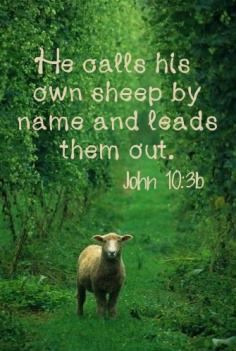
Jesus calls us by name (John 10:3).

5f0a69a406cc999a2cec2b5c02dc118d

Our names are more than labels to him, identifying one person from another. He knows our character and personalities, as well as intimate details—our likes and dislikes, concerns, feelings, and thoughts. He knows one Nancy from another, one Steve from another, one __________ (put your name here) from another.

However, calling us by name indicates not only profound knowledge about us but keen interest in us. He deeply cares about each individual (1 Peter 5:7).

fb6ee7a03664a8589ba2f3541c37745e

Now sympathy and compassion are comforting qualities, and Jesus demonstrates both. But true caring involves more. Care suggests action. And that’s exactly what he does. Jesus takes action when one of his own is in trouble (Luke 15:3-7).

In fact, every detail of our lives is under his capable, loving control.

  • His eye is ever watchful (Psalm 121:3).
  • His ear is always attentive (Psalm 34:15).
  • His heart beats with everlasting love (Jeremiah 31:3).
  • His powerful hand brings help when the time is right (Psalm 138:7-8).

Many of you are familiar with Sarah Young’s Jesus Calling (Thomas Nelson, 2004). Among the impressions from God she has recorded, is the following encouraging note. Our Heavenly Father wants us to know:

“If you could see how close I am to you and how constantly I work on your behalf, you would never again doubt that I am wonderfully caring for you” (December 12).

ex3-he-knows-your-name

God knows each and every one of our names.

How validating he is.

When God calls, “Nancy” or “Steve,” “John” or “Jennifer,” he’s remembering who we are—our unique personalities, backgrounds, needs, and deepest thoughts.

How compassionate our God is.

Best of all, is the love in his voice as he speaks. And the benevolent action he sets into motion—specifically tailored to our needs.

How astounding our God is.

*     *     *     *     *     *     *     *     *     *

Heavenly Father, I thank you for taking personal interest in each of your children. To think that you know me by name—out of the billions of people throughout the centuries–what a precious reality.   At those times I feel insignificant and small, may I hear your gentle voice calling my name.

(Photo & art credits:  www.cobniu.edu; pinterest.com; http://www.dwellingintheword.wordpress.com.)

Read Full Post »

 picture-uh=715ce81d4af48c56d62e992073bfe9-ps=3da463e4536b201b56c385877e59a7

 (Photo from http://www.trulia.com.)

“There it is, Mom, “ Steve remarked, as he pointed to a little white house in the middle of a city block. “That’s where we lived when I was growing up.”

“Oh, yes,” she replied. But did Mom really remember?

We were on an excursion through Columbus, Ohio, taking Steve’s mother past the landmarks of her life. Alzheimer’s disease had already stolen away much of her vibrancy and warmth, and, of course, her memory.

 corner

Steve drove by West High School and continued his commentary. “That’s where we all went to school, you, Dad, Karen, and me. You were the very first homecoming queen.  How about that?  No wonder Dad asked you out.”

She murmured assent to Steve’s comments, but added nothing of her own.

 unnamed

We drove past the brick ranch they built out in the country in 1966. Horses used to reside beyond the back fence. Just a few houses had dotted the area back then. By this time, however, they had been swallowed up by dozens more. The saplings Mom and Dad had planted were now tall shade trees.  And the glorious flower beds and window boxes that Mom had tended were gone. She registered no recollection.

 unnamed

But when we approached her childhood home, a white Dutch Colonial on a quiet street, all of a sudden she perked up.  Pointing to a second-story window, Mom stated firmly, “That was my room, right up there.”

In the midst of the fog that is Alzheimer’s, one memory–one glimmer of light–shone through that morning. Steve and I almost gasped at the wonder of the moment. Mom remembered!

And the rarity of her memories pointed to the preciousness of this ability. Memory is a gift to be treasured. The older I grow, the more I appreciate the miraculous power of the brain to store millions of memories—with astounding detail–and yet access a particular one in a mille-second.

 1033249144001_2034162247001_900944612-159-1355440419795

Not only do sights trigger memories, but also smells. Researchers say this sense is the most powerful memory-inducer. For me, the aroma of fresh-baked bread always takes me back to my grandmother’s kitchen.

Sounds trigger memories as well—particularly music. Tastes and textures work the same phenomenon.

But surely God had more purpose in mind for giving us memory than the pleasant pastime of reminiscing.

Indeed.

Memories foster gratitude, as we contemplate God’s goodness to us in the past:

  • His countless blessings (even when we haven’t been a blessing to him).
  • Those times he led us through the shadow of death, so that we might experience more completely the glory of his light.
  • Moments when we almost gave up hope, and God surprised us with his creative, abundant provision.
  • Leaving behind what we once were and celebrating what we have become, solely because of his Son, Jesus.

Memories foster faith, as we remember how God has met our needs in the past. See if each phrase from Psalm 103 doesn’t trigger a memory in your mind, and a song of praise in your heart:

“Oh, my soul, bless God,

Don’t forget a single blessing!

He forgives your sins—every one.

He heals your diseases—every one.

He redeems you from hell—saves your life!

He crowns you with love and mercy—a paradise crown.

He wraps you in goodness—beauty eternal…

…God makes everything come out right.

He puts victims back on their feet…

…God is sheer mercy and grace;

Not easily angered, he’s rich in love.

He doesn’t treat us as our sins deserve,

Nor pay us back in full for our wrongs.

(Psalm 103:2-10, The Message)

Memories inform the present and provide hope for the future. As we meditate on all those times God has wrapped us in his goodness (v. 5), we are strengthened for what we face today. As we consider the many times he made everything come out right (v. 6), we can trust he will continue to make our paths straight.

Of course, there are some memories we would like to erase—those that generate sadness, hurt, or regret. How do we deal with those? Here are a few suggestions I’ve collected over the years:

  1. We must resist self-pity—even in our thought life. Nowhere in scripture do we read that rehashing the negative is therapeutic. God’s way is to focus on the positive (Philippians 4:8).

Phil-4-8


  1. We can follow Paul’s example. He forgot what was in his past and pressed on to what lay ahead (Philippians 3:13). Not that amnesia had set in. Paul simply did not allow past failures to cripple his relationship with God and his service for God. God had forgiven and forgotten; Paul did too. No doubt he applied Philippians 4:8, not only to self-pity, but also to guilt. 
  1. We can leave the past in God’s hands. Oswald Chambers said it so well:

 c6d7d32bbdc18d2507a48f8aefa26359

(“Leave the irreparable Past in His hands, and step out into the Irresistible Future with Him”

–My Utmost for His Highest, Dec. 31.)


*     *     *     *     *     *     *     *    *     *    

Father, I do thank you for the gift of memories—the ability to remember with joy and appreciation the people, places, and experiences of the past. I even thank you for the not-so-good memories, knowing that you use every difficult situation for the development of my maturity (James 1:2-3). And may I take advantage of the wisdom gained in the past to guide me in the present, and lead me into the Irresistible Future with you.


Art & Photo credits:  www.trulia.com; http://www.westhighalumni.com; Steve’s photo collection; http://www.allrecipes.com; http://www.god.com; http://www.pinterest.com.

Read Full Post »

2d3c14e3fd1f6d47776b5a17f69d7fbd


With the Sunday morning congregation, she sang enthusiastically and with conviction in her voice:

“Our God is greater, our God is stronger,

God you are higher than any other.

Our God is Healer, Awesome in Power,

Our God! Our God!”*

She raised her hands, palms upward, offering her song as an expression of trust.

Other inspiring songs followed. By the time she sat down, her spirit already felt strengthened and uplifted. Then came the encouraging prayer time and an empowering sermon.

“Thank you, Lord,” she breathed while exiting the sanctuary. “My heart overflows with joy. You are the stronghold of my life—of whom shall I be afraid” (Psalm 27:1)?

Then came Monday morning, with its hectic commute to work, dozens of emails to process, a meeting that went too long and accomplished little, a disturbing phone conversation with a disgruntled caller, a notice from the boss asking for the impossible, etc., etc.

In a matter of hours the storehouse of strength was depleted, her joy gone. And on the way home that afternoon, she whispered, “God, I don’t understand. One day I’m on a mountaintop of faith, the next I’m crawling around in the mud of discouragement!”

How do I know the experience of this woman? Because I am she.

There are times I am no better than the Israelites of Moses’ time, allowing frustration, stress, and self-pity to nibble away at my faith.

Just three days after their miraculous rescue at the Red Sea, the Israelites lost their trust in God. (At least they lasted three days!)

Yes, they had witnessed the ten plagues that chipped away at Pharaoh’s resolve to keep his slaves at all costs.  Yes, they had watched as God parted the waters of the sea so they could walk across on dry land. And they saw all Pharaoh’s horses and chariot-driving horsemen drown.

After four hundred years of slavery, the Israelites walked away from the shores of the Red Sea, a free people. And they had done nothing to make it happen. God did it all.

But by the third day, they were tired and very thirsty. They had been traveling through the Desert of Shur and had found no water. Finally they came to Marah where water flowed. But it was too bitter to drink.

Discouragement quickly gave way to complaining. The people railed against their leader, Moses. “What are we supposed to drink?” they cried.

Note what they did not do. They did not cry out to God. But Moses did. God showed him a piece of wood to throw in the bitter waters, and the water became sweet (Exodus 15:22-25).

Scripture tells us this experience at Marah was a test (v.25). Perhaps God wanted to show them that their actions and reactions did not yet back up their words–words they sang when God rescued the Israelites at the Red Sea: “In your unfailing love you will lead the people you have redeemed. In your strength you will guide them” (Exodus 14:13).

Might miserable Mondays be a type of test for me?  Are you facing a test?  And how do we pass such tests?  Listed below are possible strategies.  We can:

  1. Pour out our hearts to God in total honesty as David did: “How long must I wrestle with my thoughts and every day have sorrow in my heart? How long will my enemy triumph over me?” (Psalm 13:1-2).  Honesty with God puts us in a humble frame of mind so he can help us.
  1. Turn our thoughts to expressions of praise and assurance. Again, that’s what David did. “But I trust in your unfailing love,” David affirmed in the same psalm. “My heart rejoices in your salvation. I will sing to the Lord, for he has been good to me” (vs. 5-6).  We cannot help but strengthen our faith when we meditate on the beautiful attributes of our God.
  1. Reaffirm that our Heavenly Father loves to bring good out of every circumstance (Romans 8:28).   We can look for the good in our lives instead of focusing on the negative.
  1. Resolve to be obedient to God’s Word. What he told the Israelites at Marah is true for us, too: “Listen carefully to the voice of the Lord your God and do what is right in his eyes…I am the Lord, who heals you (Exodus 15:26). He is the One who will heal us of discouragement, frustration, and stress–as we follow his instructions.
  1. Take encouragement from the very next stop in the Israelites’ journey: Elim. “There were twelve springs and seventy palm trees, and they camped there near the water (v. 27)” We can remind ourselves that our personal Elims may very well be just around the corner!

What strategies help when you are faced with frustration, stress, or discouragement?  Please share your ideas/experiences in the Comment section below!

* From the chorus of Chris Tomlin’s song, “Our God” (2010).

(Art credit:  www.pinterest.com.)

Read Full Post »


0ece76207bc564a5a08ba4dbb2a17fbf


I love all things Christmas–with a few exceptions for the silly (Dancing Santas I can do without.), the gaudy and over-glittered (unless my children made it), and the highly repetitious (“The Little Drummer Boy,” with its twenty-one pa-rum-pa-pum-pums is one example).

But I do look forward to:

  • Evergreen wreaths with cheery red bows perched on light poles in the business district.
  • Colorful lights twinkling from bushes and rooftops.
  • Vanilla-spice Christmas cookies, crisping in the oven and filling the house with sweet fragrance.
  • Candles glowing from table and shelf.
  • Delicate, porcelain figures, circled around Baby Jesus in our treasured family crèche.
  • Beloved carols resounding through the house or sung at church with family and friends.
  • Family gathered from near and far, nestled around the Christmas tree to hear the beloved story of the Nativity once more.

You get the idea.

I’m now getting to the age when all these things are very familiar. I’ve enjoyed them again and again over the decades. Yet they never lose their appeal. Every year, as Christmas approaches, I eagerly anticipate the repetition of each experience.

Why? Why hasn’t boredom set in? It’s not an easy question to answer. But these reasons occur to me as possibilities:

  • My relationship with Jesus influences my response to these Christmas traditions. My joy in the season is greatly augmented because I know him.  And celebrating Someone whom I love and worship is far superior to celebrating a stranger.
  • The Christmas story and its themes of peace, joy, and hope, provide stability in an uncertain, even fearful world. We Christians enjoy the benefit of Christ’s peace, joy, and hope in our hearts every day (Romans 5:1-2).  That, too, is something wondrous to celebrate.

But that’s not all! Jesus is coming again and all the perfections of heaven await those who believe in him. Did you know that for every single prophecy in scripture that foretold Jesus’ birth, there are eight which look forward to his return? Also consider: every prophecy about Jesus’ birth came true; therefore, we can be confident every prophecy about his second coming will also come true.  Christmas is a celebration that not only looks back with great joy, but forward with great hope.

  • Our King of kings and Lord of lords left his perfect heavenly home to dwell among us. He became human that we might be glorified (Philippians 2:6-9; Romans 8:30). He has made it possible for us to enjoy every spiritual blessing (Ephesians 1:3).   And, He is our:

Wonderful Counselor (Isaiah 9:6), guiding our way.

Emmanuel (Matthew 1:23), gracing us with his presence.

Shepherd (Hebrews 13:20), tenderly caring for us.

Rock (1 Corinthians 10:4), providing stability and refuge.

Advocate (Romans 8:34), interceding for us when Satan tries to condemn.

And so much more. Who can help but celebrate our loving Savior?

May all things Christmas turn our hearts and minds to him–his miraculous birth, his perfect life and sacrifice, his glory.

Read Full Post »

fall-foliage-2

Several weeks ago, in a post entitled, “Autumn Blaze,” I wrote about the glorious colors of fall foliage. The title was borrowed from a line of poetry by Helen Hunt Jackson (1830-1885): “The land is lit with autumn blaze.”

As most of you know, Steve and I lived in Florida for forty years. We retired in June to Ohio, so we could be near two of our three children and their families. In many ways our transition has been a homecoming because both of us grew up in the Midwest.

One of the things we missed most while living in the south was “autumn blaze.”  All through last summer I waited expectantly for October and the display of God’s rich tapestry among the trees.

But those of you who live in four-season states know only too well: the blaze is quickly snuffed out by northerly winds and chilly temperatures. By mid-November, many trees have already been stripped of every leaf.

And now those bare, bleak branches stand pitifully exposed, reaching uselessly toward the sun for warmth. The splendorous color is gone; dingy gray-brown bark is all we see. The trees stand lifeless. Hopeless.

If I’m not careful, such sad thoughts will lead me into the doldrums.

A better train of thought to follow? Reasons to appreciate this dormant stage of the trees. For example: When the leaves are gone, I can appreciate the delicate lace work of branches, hidden from view except in winter.   They too demonstrate the creative genius of our God.

OLYMPUS DIGITAL CAMERA

However, when numerous bare trees huddle together on a hillside, the individual branches are indistinguishable. Our younger son and daughter-in-law enjoy a hillside view from their kitchen window–in spring, summer, and early fall, that is. Indeed, just a few weeks ago, the trees were ablaze, dressed in autumn finery.

Now the scene is much different. Look out that window today and you’d be underwhelmed by the great swath of drab dullness. Time to close the curtains.

shen6913

But wait. What if we look at that sad scene and think HOPE. Because we know what’s in store.

“No winter lasts forever; no spring skips its turn” (Hal Borland).

Winter is a time of rest, recuperation, and preparation. When warmth and light return in the spring, new life will burst forth in all creation. Guaranteed.

Those lifeless branches can remind us of another HOPE. Because we know that the God who brings life to dead trees can redeem any situation. Guaranteed.

“Oh? What basis is there for such grand HOPE?” someone might ask.

  1. We base our HOPE on God’s love.

 Absolutely nothing can separate us from his love (Romans 8:39). And if he loves us, he will care for us. “With God on our side, how can we lose?” (v. 32, MSG).

HOPE in our loving God is not misguided.

  1. We base our HOPE on God’s character.

I love Psalm 145, the only one called “a psalm of praise,” in which David extols God’s character. Our Lord is great (v.3), gracious, good, and compassionate (vs. 8-9), glorious and mighty (v. 11), righteous and kind (v. 17).

These are not descriptors of a distant god who takes no interest in his creatures. Our God is a hands-on Heavenly Father who demonstrates all these glorious attributes–in our day-to-day lives. The Lord is always watching over us (v. 20).

HOPE in our powerful God is not just wishful thinking.

  1. We base our HOPE in God’s promises.

“The Lord is faithful to all his promises and loving toward all he has made” (Psalm 145:13).

HOPE in our reliable God is not blind optimism.

Christian HOPE is the trusting expectation that God will keep his Word.

This may sound strange, but let’s look to the bare trees for encouragement. See them as glorious HOPE on display! And let’s live in cheerful expectation of God’s plan, purpose, and blessing for the future.

(Photo credits:  www.staticweb.maine.edu; http://www.commons.wikimedia.org; http://www.terragalleria.com.)


Read Full Post »

2008_003703


We sat on the runway, awaiting take-off clearance for our flight. Low, thick clouds hung above us, shrouding the area in gloom. Folks in the plane sat quietly in their seats. Really quiet. Not very many smiles either. The oppressive bleakness outside seemed to cause a depressive state inside.

Finally we felt the plane move, pick up speed, and lift off the ground. In seconds the view out our windows was obliterated by the gray-white clouds. We could see absolutely nothing, as if curtains had been drawn outside the windows. Was the plane even moving? There was no way to tell, except for the loud drone of the engines and the upward angle of the plane.

Suddenly we escaped the cloud bank and were almost blinded by the brilliant sun. Some people turned off the overhead lights, others closed their window blinds against the glare.

As a result of the bright light, the atmosphere changed inside the plane. The dark mood of moments before turned to cheer. Some passengers shifted in their seats, sitting up a bit straighter. Soft chatter, even a few chuckles, peppered the air.

What a difference sunlight makes.

The physiological connection between sunlight and mood has been studied by scientists. They’ve determined that sunlight increases the production of serotonin in the brain, which is tied to wakefulness and feeling happy.

Those of us who know God can experience another source of light – his light — even when the dark clouds of trouble roll in (Psalm 18:28).  The benefits are incredible.

1.  “In [his] light we see light” (Psalm 36:9b). As we practice God’s presence and live according to the directions of his Word, we see the wisdom of his ways. We also become more aware of God’s glorious attributes shining into our lives—his power, loving kindness, grace, and more.

2.  “Blessed are those who have learned to acclaim you, who walk in the light of your presence, O Lord. They rejoice in your name all day long; they exult in your righteousness. For you are their glory and strength” (Psalm 89:15-17a).

Take note. God is righteous. Everything he does is good and right, absolutely perfect.

Did you catch that amazing statement at the end?  Our God of Light is our glory. He is magnificent, full of splendor, and grandeur, yet he is our Heavenly Father!  Could any state of circumstances be more incredible?

God is the source of all strength. Think of it. The all-powerful, all-knowing, sovereign God of the universe is on our side—all the time. He is completely, forever committed to us, until that day we see him in all his glory, our King of kings!

3.  “The Lord is my light and my salvation—whom shall I fear” (Psalm 27:1)?

Consider what dark clouds might symbolize in our circumstances: stress, problems, fear, and sorrow.

Now consider what the Lord of Light brings to us: guidance, wisdom, joy, provision, comfort, grace, and peace.

He is light within us and around us.

Sometimes when a thick cloud bank of difficulty settles over our lives, we think God has abandoned us. But take note of these wise words:


“Measure not God’s love and favor by your own feeling.

The sun shines as clearly on the darkest day as it does in the brightest.

The difference is not in the sun,

but in some clouds which hinder the manifestation of the light thereof”

– Richard Sibbes (Anglican theologian, 1577-1635).


Praise God for his glorious constancy!


(Photo credit:  www.vision.cs.uiuc.edu.)

Read Full Post »

« Newer Posts - Older Posts »

Still Traveling

Impressions Becoming Expressions

Living Our Days

Gaining a heart of wisdom

He Said What?!

I'm Patty, and my husband and I are living with our adult son who has autism and epilepsy. I love sharing lessons learned from life around me, especially life with Aaron.

Meditations of my Heart

Impressions Becoming Expressions

Linda Stoll

Impressions Becoming Expressions

Debby Thompson

Impressions Becoming Expressions

Signora Sheila

Notes on Life, Faith & Italy

Colleen Scheid

Writing, Acting, Living in God's Love

Mitch Teemley

The Power of Story

Heidi Viars

Finding the Image of God