Feeds:
Posts
Comments

Archive for the ‘Intimacy with God’ Category

Some of you may remember singing this song in Sunday School:

As a child, I knew God loved me. He proved it by sending his Son to take the punishment for my sins, provide the way for me to live in heaven one day, and know him in the present.  

But I also knew my little eyes, hands, and mouth were not as careful they should have been. Surely God was disappointed in me much of the time.

The truth that I could enjoy God never entered my mind. My false impression of his disapproval stood in the way for many years.

Somehow I’d missed the message of such scriptures as:

  • The joy you have in the LORD is your strength (Nehemiah 8:10 GWT).
  • Take delight in the Lord (Psalm 37:4a NIV).
  • I will go to the altar of God, . . . my joy and my delight (Psalm 43:4 NIV).

I read such passages as directives for prayer and worship rather than invitations to take pleasure in relationship with God.

Psalm 100 provides Exhibit A for enjoying him by praising him. “Shout for joy,” the psalmist begins. “Worship the Lord with gladness; come before him with joyful songs” (vs. 1-2, emphasis added).

Then he gives one example why: God has made us his own—in spite of our frailty—and cares for us like a compassionate, attentive shepherd (v. 3).

Parable of the Lost Sheep (Luke 15:3-7)

That’s certainly cause for thanksgiving and praise (v. 4), which in turn fosters our delight in God. Then the psalmist concludes with three more reasons to enjoy him: he is good, loving, and faithful (v. 5).

This psalm hints at another important truth. Dare I use a sport analogy?

My first attempts at playing tennis sent balls whizzing every which way. However, various drills and hitting the ball thousands of times against a wall built up my skills until I could actually play the game.

That’s when I began to enjoy the sport. The better I knew how to play tennis, the more pleasure I took in the game.

‘See the parallel in the spiritual realm? The more we know God, the more we’ll enjoy him.

But that’s not all.

The more we delight in God, the easier it becomes to obey him and live by his ways.

And as we see those ways contributing satisfaction, contentment, and purpose to our lives, we enjoy him all the more.

So how do we foster our pleasure in God? Here are three ways to get us started:

LEARN ALL YOU CAN ABOUT GOD—his character and his ways.

In January we explored the exercise of slowly reading through the psalms and writing down every mention of God’s character and deeds. As the list grows so does our delight in his multi-faceted splendor [1].

LEARN ALL YOU CAN ABOUT JESUS—his life, sacrificial death, provision of eternal life for us and all its implications.

For example, while reading the gospels, note his responses to people, his choices, and his behavior. What character traits can you identify?

While reading the letters written by the Apostles Paul, Peter, and others, consider all that Christ’s sacrifice has purchased for us.

The more we learn about Jesus, the more our love for him grows. The more our love grows, the more we find our hearts filled with joy in him.

REVEL IN GOD’S BEAUTY—his magnificence, the glory of his creation, and the beautiful blessings he bestows.

“His love notes are stashed everywhere,” says Sara Hagerty [2].

And as we discover them, we’ll find ourselves smiling and even laughing in pleasure with God, in the awesome works he performs [3].

Oh—and one more thing to celebrate. There will always be more to enjoy, and we can always acquire more ability to enjoy our God because . . .

quote from Morning by Morning, 268.

How do you enjoy God? Please share in the comment section below!


[1] https://nancyaruegg.com/2025/01/16/celebrating-god-through-the-psalms/

[2] Unseen, 206.

[3] https://nancyaruegg.com/2019/06/06/love-notes/

Image credits: http://www.youtube.com; http://www.dailyverses.net; http://www.freebibleimages.org; Nancy Ruegg; http://www.canva.com; http://www.pixahive.com (Vijay Richhiya).

Processing…
Success! You're on the list.

Read Full Post »

One way to get better acquainted with God is to read through the psalms, watch for statements pertaining to him, and write them down.

That last step is important, as research has proven: writing (not typing) helps us learn and retain what we’ve written [1]. In this case it will also increase our appreciation of God’s glorious attributes and gracious acts on our behalf.

I chose to participate in this exercise during Advent, and became astonished by the number of statements about God, totaling over three hundred by the time I reached Psalm 150. I even skipped over those that I remembered listing previously.

Some psalms offer a number of statements about God, one after another. Psalm 23 includes nine, Psalm 103, sixteen, and Psalm 145, twenty.

Perhaps that explains why these psalms are among the favorites of many people. Subconsciously we crave reassurance of God’s power, wisdom, and goodness working on our behalf.

A lesser-known psalm perhaps, #71, offers seven encouraging descriptors of God:

He is our sovereign Lord (v. 5) over all things, even our blunders and regrets.

No matter my poor choices, God can redeem them. “Our mistakes can never thwart the sovereign will of God” [2].

How thankful I am for that!

He is the One who’s been my hope and confidence since my youth (v. 5).

I’ve been a Jesus-follower since age four. Never have I toyed with the idea of abandoning my faith in him, because I learned early on from the saints around me:

  • God is a good and loving Father
  • There is purpose in everything God does
  • He will bring me through whatever I might face
  • He is accomplishing a good and eternal work in my life [3]

I’d be foolish to turn my back on Someone so invested in my welfare.

God is splendorous (v. 8).

We could surely add more attributes to Brooks’ list. God provides so many wonderful, spiritual blessings in Christ (Ephesians 1:3)!

He is the One who performs marvelous, mighty, and righteous deeds (vs. 16-18).

In truth, “The whole world is a series of miracles, but we’re so used to them we call them ordinary things” [4].

May we rediscover the wonder of God’s deeds in evidence all around us, and respond with gratitude and praise.

He is the One who’s taught me since my youth (v. 17).

Over time I’ve come to cherish God’ Word. And even though I’ve spent many happy hours in study, its inspiration never grows old.

That is very good news.

God is the One whose righteousness reaches up to the heavens (v. 19).

That’s good news too, because “there is no perfect life, no perfect job, no perfect childhood, no perfect marriage, and no set of people who always do what we expect them to do.

“What we do have is a perfect God who is able to lead us through this imperfect life with unfailing strength, infallible wisdom, and infinite love”—Unknown.

Praise God for his attentive participation in our lives!

He is the One who’s done great things. Who is like You, God (v. 19)?

All of these descriptors, among the dozens of others proclaimed in the psalms, do make clear:

P.S. My list of God-descriptors has become the basis for personal worship. Each morning I slowly read and pray back to him one page of the collected statements. The practice renews wonder and gratitude for my marvelous Heavenly Father.

Perhaps you’d like to try it too?


[1] Denise Hughes, Deeper Waters, 89.

[2] Bev Rihtarchik, contributor to A Moment to Breathe, 151.

[3] Dr. Charles Stanley, Advancing through Adversity, 101.

[4] Hans Christian Andersen

Photo credits: http://www.pxhere.com; Nancy Ruegg; http://www.flickr.com; http://www.pickpik.com; http://www.canva.com (2).

Processing…
Success! You're on the list.

Read Full Post »

(An imaginary conversation between God and me, but I invite you to put your name in the blanks):

ME: You’ve heard me say, Lord, “I can’t imagine life without You,” because You’ve been an invaluable, all-wise influence through the years.

You’ve provided protection, guidance, care, and more. Just knowing You are with me gives me comfort, strength, and peace.

GOD: Ministering to you in these ways has been My delight, __________. I do love to see you practicing My presence—asking for My help and connecting with Me through praise and prayer.

As you draw near to Me, you experience wonder, quiet, calm, and warmth.  

ME: Thank you Father for these blessings! But I’m still on the learning curve of sustained awareness. Distractions frequently interfere. It seems I’ll never attain moment-by-moment communion with You.

GOD: I understand, __________. Remember, I’m the One who made you and am well aware you cannot achieve perfection [1].

What I value is progress, and rest assured, that is occurring.

Think back to the days when you experienced great difficulty practicing My presence. Your thoughts rarely turned toward Me once your morning quiet time was over—unless you ran into trouble.

Now you come to Me much more frequently, giving Me the opportunity to strengthen and encourage you. Keep coming back to Me, __________.

The day will come when we enjoy almost-unbroken communion and it will be all the sweeter for the wait. Meanwhile, there are habits-of-thought to embrace that will advance your progress toward that day:

BE ATTENTIVE TO MY ATTRIBUTES

Stay alert to discover reminders of Me everywhere. And let each discovery bring to mind one or more of My attributes.

As attentiveness leads to praise and praise to joy, you’ll find yourself nestled more closely to My side. That’s where I long for you to be!

BE GRATEFUL FOR MY BLESSINGS

Ask yourself throughout the day, “What can I thank God for right now?”

For example, your answer in this moment might include the colorful fall flowers in the deck planter—a delight for your eyes—enjoyed in the surroundings of My living room [2].

And as we enjoy such blessings together, you’ll find your heart drawing close to Me.

AFFIRM MY PROMISES

Come worship at My footstool, __________ (Psalm 132:7).

Look up into My face and see in My eyes the love I have for you. See in My smile the delight you bring Me. Imagine My hand upon your back and feel My compassion.

Now, breathe out your cares and breathe in the truth of My promises. Listen closely as I affirm:

  • I love you __________ with an everlasting love (Jeremiah 31:3).
  • I will always help you (Isaiah 41:13).
  • My lovingkindness prevails over you (Psalm 117:2 AMP).
  • I am in control of all things (Ephesians 4:6).
  • I will work all things together for the good of those who love Me, who seek to live out My purpose for them (Romans 8:28).

It delights Me that you want to be more aware of My presence. Know that I take deep pleasure in every occasion you turn your attention toward Me.

Know too that beautiful transformation is taking place within you each time you do, because you can’t spend time in My presence and not grow more into My likeness [3].

 *      *      *     *     *     *     *     *     *     *

ME: Thank You, Father, for encouraging me toward greater intimacy with You, to enjoy You more fervently. Help me pause and sense Your presence, even in the ordinary moments of life.

May I create space for You through attentiveness to Your attributes on display, gratitude for Your countless blessings, and review of Your uplifting promises.

May I remember:

 I don’t want to miss that pleasure, even for a moment.


[1] Psalm 103:13-14

[2] Those of you who visit here often will probably remember that Michael Hyatt, former CEO of Thomas Publishing, is the one who calls the outdoors God’s living room. I love that imagery!

[3] 2 Corinthians 3:18

Photo credits: http://www.canva.com; http://www.heartlight.org; http://www.picryl.com; http://www.dailyverses.net; http://www.freerangestock.com; http://www.canva.com.

Read Full Post »

 No doubt all of us have heard those five words of the title.

We’re well aware that optimum food choices support optimum health while poor choices contribute to health conditions like heart disease, diabetes, and cancer, as well as quality-of-life ailments such as infection, fatigue, and brain fog [1].

But not everyone seems to know the same principle applies in the spiritual realm.

What we feed our souls impacts our spiritual health.

For example, research affirms a steady diet of isolation, dwelling on the negative, scrolling through social media, and binge-watching movies and TV all contribute to depression [2].

However, there is an alternative that results in less anxiety and more peace, less dissatisfaction and more contentment, less fear and more strength. That alternative is meditation on scripture.

What It Means to Meditate

Some might ask, So I’m supposed to read the Bible to make me feel better?

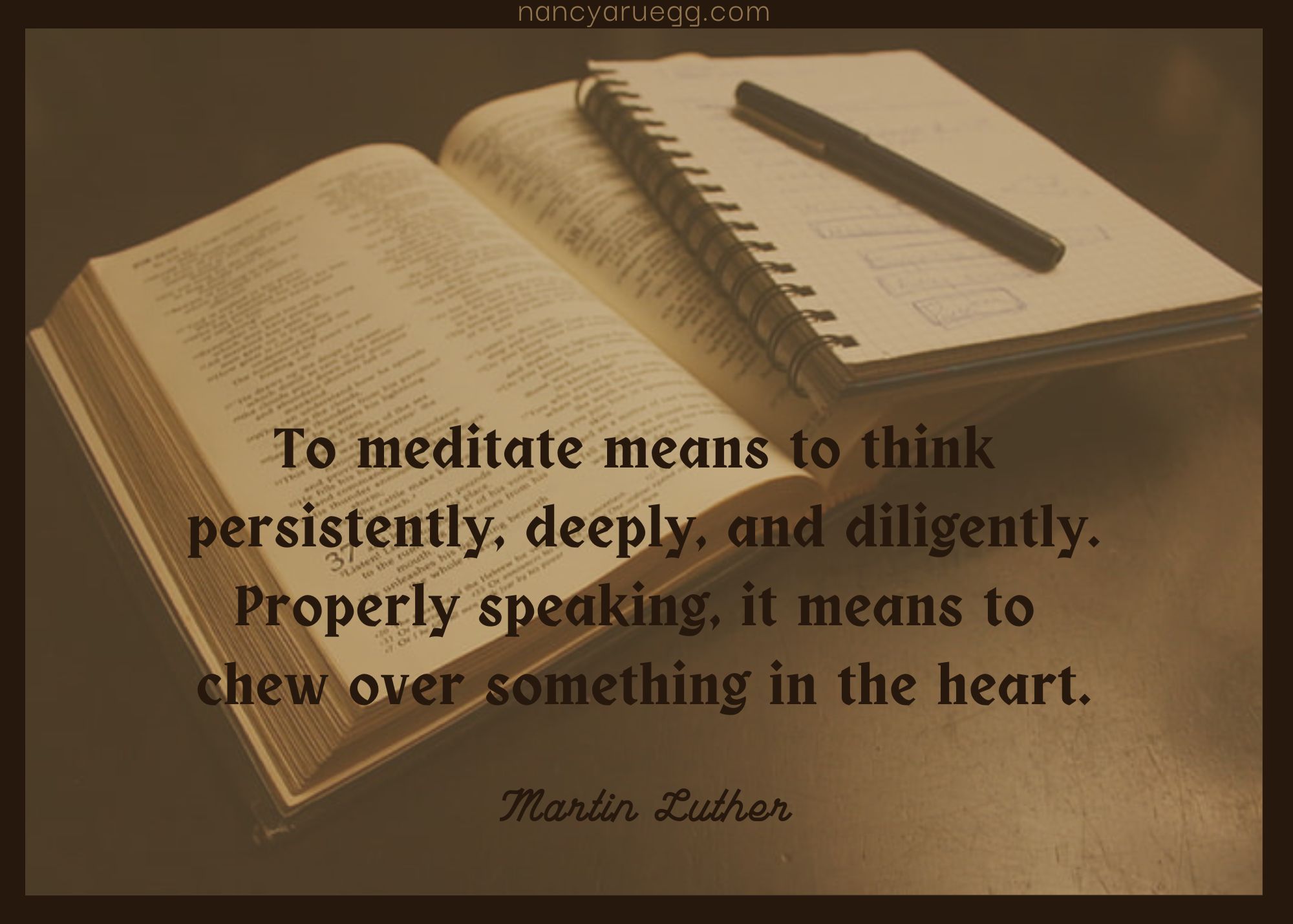
Actually, reading alone isn’t enough, any more than licking a carrot will provide the day’s requirement of vitamin A. No, to nourish the soul we need to regularly meditate on God’s Word.

“Biblical meditation is pondering the words of scripture with a receptive heart, and trusting the Holy Spirit to work in us through those words” [3] (emphasis added).

It’s slow-reading that contributes to savoring scripture much as slow-eating contributes to savoring food.

Why Meditate

My ponderings most often occur on paper. Sometimes I journal through the meaning of a passage; other times I might compose a prayer in response to what I’ve read.

Writing slows and augments my thinking. As I record impressions and prayers, new discoveries have a chance to surface, truths impact my spirit more profoundly, and encouragement nourishes my soul.

In addition, meditation on scripture offers transformation of:

  • Thought processes and choices, as God’s truth cultivates wisdom.
  • Attitudes as mentioned above—anxiety into peace, discontentment into satisfaction, fear into strength, and more.
  • Character, as I contemplate God’s attributes, and they begin to rub off on me [4].
  • Action, as a deeper relationship with God results in compassionate, loving action toward others [5].

How to Meditate

Not sure how to start? Perhaps these suggestions will be helpful. (You’ll also find a sample below.)

  • Write out the scripture or an especially-meaningful part of it. Look up definitions or synonyms of key words.
  • If you’re reading a narrative-passage, use your imagination to put yourself in the position of one of the characters. What might they be thinking and feeling?
  • Prayerfully consider what truth God wants you to understand from the verse(s).
  • Identify the characteristics of God on display or directly mentioned.  Praise him for who he is and what he has done (Psalm 150:2).
  • Write a sentence or two of prayer, presenting yourself before God to accomplish or become whatever he’s revealed during your time of meditation [6]. As you begin to write, you’ll discover more thoughts to express.

An Example of Meditative Writing

Below you’ll find an example of meditative prayer based on Psalm 31:14-15a:

I trust in you, Lord; you are my God. You’ve proven yourself faithful thousands of times in my life, demonstrating your love and compassion, wisdom and guidance, goodness and generosity [7].

Thank you for being such a gracious God! No matter what happens in the future, I know I can trust you to supply my needs. It’s a wondrous thing to rest in you, especially during these uncertain times.

You are my steadfast foundation, my shelter from the storms of life, and my strong tower of safety [8]. Thank you for these comforting images, giving vivid assurance of your power to care for your people in all circumstances. I’m so grateful my future is in your capable hands.

Just as we’d never wolf down a magnificent meal in a fine restaurant, we’d be wise not to wolf down the rich substance of scripture.

And in the savoring, we experience more intimately and powerfully the reality of God.


[1] https://my.clevelandclinic.org/department/wellness/integrative/shared-medical-appointments/eating-well-for-optimal-health-sma ; https://www.webmed.com/diet/what-is-a-balanced-diet

[2] https://www.webmd.com/depression/features/depression-traps-and-pitfalls

[3] https://ourdailybread.org/resources/what-is-biblical-meditation/

[4] Linda Dillow, Satisfy the Thirsty Soul, 15.

[5] https://www.gcu.edu/blog/theology-ministry/theology-thursday-christian-perspective-meditation

[6] See Tim Keller’s list of additional questions:

[7] These previous posts offer examples: After the Fact, Liquid Love, and Sweetness and Power.

[8] Isaiah 33:6 CEV; 25:4; Proverbs 18:10

Photo credits: http://www.pickpik.com; http://www.pexels.com; http://www.canva.com; http://www.pickpik.com; http://www.flickr.com (David Andrako); http://www.canva.com; http://www.pickpik.com; http://www.commons.wikipedia.org.

Read Full Post »

How would you fill in the blank of this statement?

_______________ is the key to everything we need to do and be in life.

Many of us might choose faith, obedience to God, or perseverance.

But according to Pastor/author Timothy Keller, the answer is prayer [1].

He would have us understand that “there is nothing more important . . . or richer, or more life-altering as prayer. There is absolutely nothing so great as prayer” [2].

However, Keller readily admits that prayer is hard. It’s a discipline to stay focused on Someone invisible. Not only do distractions cause interference, but doubts produce discouragement, and disappointments over prayers not answered (as we’d hoped) can breed demoralization.

It’s easy to put this key aside and “let God be God” without our participation.

Oh, what we miss.

Puritan preacher and writer John Bunyan would have us understand:

That is, through prayer, every cranny of our lives is impacted by his uplifting influence—our personalities, thoughts, choices, circumstances, and more. Through prayer he fills us with the totality of his excellencies and his empowering presence. 

Could anything be more sublime?

In addition, we can enjoy these blessings:

Prayer makes a sour heart sweet, a sad heart merry, a poor heart rich, a foolish heart wise, a timid heart courageous, a sick heart well, a blind heart full of vision, a cold heart ardent. For it draws down the great God into the little heart; it drives the hungry soul up to the plentitude of God; it brings together those two lovers, God and the soul.

— Mechthild of Madgeburg, a 13th century German woman, a mystic

Could anything be more satisfying?

To be honest though, there are days when my prayer time is more discipline than delight. I need an attitude-adjustment through review of such benefits as listed above, reminders of what prayer is supposed to be in the first place, and the positive outcomes of prayer.

What Prayer Is Supposed to Be

First, let’s address what prayer is not.

Prayer is meant to be an intimate, personal encounter with God himself, the King of the universe. We so easily forget what a precious gift this is, a privilege beyond comprehension.

In addition, prayer is meant to be a “link between his will and its accomplishment on earth. Amazing things happen, and we are given the privilege of being the channels of the Holy Spirit’s prayer” (Elisabeth Elliot).

Could anything provide greater honor?

Contemplation of such realities will surely renew our pleasure in prayer and produce joyful anticipation for what’s to come: amazement in our answered prayers.

The Impact of Prayer

Regardless of what the answers might be, prayer: 

  • fortifies human weakness with divine strength
  • transforms human irrationality into godly wisdom
  • gives to troubled minds the peace of God
  • unlocks the deepest joy
  • develops our friendship with God
  • augments our ability to discern the mind of God [3]

Those are life-transforming outcomes! And no doubt we could list more.

No wonder Timothy Keller named prayer as the key to everything.

*     *     *     *     *     *     *     *     *     *

Thank You, Father, for allowing us the privilege of prayer. What additional proof do we need of your marvelous loving kindness? Help us to use this gift wisely throughout this day [4].


[1] Prayer: Experiencing Awe and Intimacy with God, 18.

[2] Ibid, 32.

[3] The first three results from Charles Spurgeon, Morning by Morning, 287; points #4 & #5 from Sara Hagerty, Unseen, 201, 207; Point #6 from Oswald Chambers.

[4] Based on a prayer of Charles Spurgeon, Morning by Morning, 287.

Art & photo credits: http://www.freerangestock.com; http://www.picryl.com; http://www.snl.no/Oswald_Chambers; http://www.commons.wikimedia.org.

Read Full Post »

Imagine an impression, conviction, direction or affirmation imprinted so strongly upon your spirit that you knew for certain it came from God. It’s an appealing idea, but we may wonder:

How can we know when a thought is divinely bestowed?

The above promise from Jeremiah 33:3 indicates we can distinguish God’s voice. (Further evidence includes Isaiah 30:21, John 8:47, Revelation 3:20, and more.)

In addition, many respected Jesus-followers offer affirmation, based on their own experience.

Below you’ll find excerpts from some of these teachers, preachers, and authors, to answer our questions about hearing God speak within our hearts—questions like:

TO WHOM DOES GOD SPEAK?

To those who belong to God.

To those who make time for stillness.

To those willing to sit in silence.

To those who prepare themselves to hear.

WHY DOES GOD SPEAK INTO THE HEARTS OF HIS CHILDREN?

HOW CAN WE KNOW THAT GOD IS ACTUALLY SPEAKING TO US?

He speaks in love (Jeremiah 31:3), not condemnation (Romans 8:1).

Whatever God says will concur with his Word.

Confirmation from elsewhere may also present itself.

WHAT CAN WE DO TO IMPROVE OUR LISTENING ABILITY?

Spend time in God’s Word.

Pray.

Be still.

Take time to wait.

Stay alert.

Even at the kitchen sink.

“Just as this beautiful cluster of grapes once grew on a vine,

you are growing beautiful fruit as you abide in Me”–JESUS (John 15:5).

If we ask God to reveal himself, he’ll do it—as he chooses—through little whispers, confirmations, divine delays and heavenly echoes that corroborate with what he’s already saying through His Word and Spirit (Priscilla Shirer, Discerning God’s Voice, 193).

Let’s ask him now.

*     *     *     *     *     *     *     *     *     *

Jesus, please quiet all the loud voices that flood my heart and mind. Give me ears to hear the gentle sound of your voice. Speak Lord, your servant is listening. Amen (Chrystal Evans Hurst, Kingdom Woman Devotional, 41).

Psalm 37:7; 1 Samuel 3:9

Photo credits: http://www.heartlight.org; http://www.dailyverses.net; http://www.pexels.com (2); http://www.canva.com (2); http://www.pexels.com.

Read Full Post »

Sunday evening at our son’s house we reveled in a rare musical experience—a private mini-concert by a gifted violinist, Jenny Armor. She happens to be the daughter of friends, and they’d joined us for dinner.

Not only is Jenny able to play ultra-challenging music with superb technique, she plays from her heart. This week Jenny graduates from a music conservatory in Canada; in the fall she’ll begin a two-year master’s program in Europe.

Here’s a link to a video of Jenny playing a Schoenfeld trio for clarinet, violin, and piano, recorded two years ago.

You can imagine what two more years of training and practice have achieved. But one thing has been apparent since Jenny was very young: making beautiful music brings her blessed happiness.

Of course, Jenny’s violin experience didn’t begin with the works of Schoenfeld, Brahms, or Tchaikovsky. Most likely it was “Twinkle, Twinkle, Little Star.” But as she’s grown in knowledge and then put that knowledge into practice (lots of practice!), the pleasure Jenny derives from playing has only expanded.

The same could be said for many endeavors. The journey to become an expert in any field is to increase the pleasure of that activity along the way.

Even in the spiritual realm, a close parallel can be drawn:

Someone might ask, “How can just knowing the stories of Jesus increase my happiness?”

First, familiarity with the biblical accounts can provide pleasure. Who doesn’t enjoy a good story?  But the delight expands as we identify Christ’s attributes-in-action and then realize they also impact us

Those attributes would include:

  • Compassion—upon those who came to hear him teach and those who approached him for healing (Matthew 14:14; Mark1:40-41, et al.)
  • Mercy and grace to forgive sins (Matthew 9:2; Mark 2:5, et al.)
  • Respect and kindness for all people, including hated Samaritans (John 4), Roman occupiers (Luke 7:1-10), and disregarded pagans (Matthew 15:21-24)
  • Selflessness, ultimately expressed as he endured crucifixion (Matthew 20:26-28)

And as we develop awareness, we see more and more evidence of such attributes at work in and around us. Think of it: The King of the universe is participating in our lives (Revelation 17:14; Philippians 2:13)! And growing appreciation leads to greater joy.

The next question becomes, how might we see more evidence of his presence, in order to experience fresh delights? One way is meditation.

Meditation on Christ is what turns knowledge about him into an intimate relationship with him. It begins with slow, prayerful reading of New Testament verses or passages. Questions such as these can guide our thinking:

  • What does this text reveal about my relationship with Christ?
  • What am I learning about God the Son in this passage, about his character and/or activity?
  • What encouragement or instruction would he have me internalize and apply to my life?
  • What insights might I make a matter of prayer?

And if we record responses in a notebook or journal, we’ll deepen our reflection and receive even greater benefit, because oftentimes to write is to discover.

We can conclude our meditations with praise, for who our Savior is, what he has done, and the understandings brought to light by the Spirit. This prayer might also be written, to augment its imprint on our hearts.

And then, with Puritan minister and author John Flavel, we’ll be able to affirm:

Just as our young friend Jenny surely experiences happy blessedness as she pursues her violin studies, how much more will we experience fresh delight and happy blessedness in Jesus as we study him.

Art & photo credits: http://www.flickr.com; http://www.freerangestock.com; http://www.canva.com

Read Full Post »

After the cold starkness of winter, spring gleefully reawakens our senses with her: 

  • Effusion of colorful flowers
  • Scents of hyacinth, lilacs, and freshly-mowed grass
  • Symphony of bird song
  • Flavors of tender asparagus, luscious strawberries, and tart rhubarb
  • Textures of furry pussy willows, fuzzy moss, and silken magnolia petals

Praise God for our abilities to see, smell, hear, taste, and touch, allowing us to enjoy Spring in so many ways!

Even better, those abilities allow us to meet God in at least five ways.

Our five senses help us understand God more clearly.

Consider how the far-flung stars and planets speak of his power; the clever camouflage of lizard, fawn, and frog display his wisdom; the endless variety of colors, shapes, and textures prove his creativity; the instinctive parenting skills of adult animals demonstrate his goodness.

Our five senses help us experience God’s glory more profoundly.

  • We can see his power at work in the transformation of lives [1].
  • We can hear his wisdom in godly men and women, such as Thomas á Kempis or Corrie ten Boom (just two among millions!):
  • We can feel God’s loving touch through a hug that conveys compassion, a worship song that quickens the heart, or a landscape vista that gives us glory-goosebumps.
  • We can taste his goodness in all the variety of blessings we enjoy (Psalm 34:8).
  • We can smell the fragrance of his sweet presence (Psalm 45:6-8)—if we pay attention.

Our five senses help us connect with God more intimately in solitude.

Many people call it Quiet Time—moments they spend with God in scripture reading/study, prayer, perhaps journaling, and/or listening to peaceful worship music.

It’s in the quiet we begin to see important realities of the spiritual realm, hear God’s voice within our spirits providing wisdom and encouragement, feel his presence more palpably as we touch our knees to the floor in prayer, and again, smell the fragrance of his sweet presence as he meets us in our place of solitude.

   Our five senses help us worship God more intently in community.

Jerry Kerns [2]

Kerns would have us fully engaged–first to bless God’s heart and then to elevate the experience for us also.

How?

  • See the majesty and splendor of God on his throne–in your imagination. This is who you are worshiping [3]!
  • Hear the music and join in with grateful, enthusiastic praise [4].
  • Feel the presence of God as you pray. Try placing your hands on your lap, palms up—open and empty, symbolic of humility and receptivity [5].
  • Taste the bread and wine/juice with prayerful gratitude. Jesus is our Bread of Life who satisfies our spiritual hunger, who shed his blood for us so we might one day enjoy heaven with him. May we never become desensitized to the magnitude of his sacrifice.
  • Smell the fragrance of God’s saints as they leave the perfume of kindness, uplift, and joy in their wake.

Our five senses help us live out our faith more joyfully.

When our heart’s desire is to serve God by serving others, we’ll aspire to live so people:

  • See the Light of Jesus in our choices, behavior, and attitudes (Matthew 5:14-15)
  • Hear us speak truth, wisdom, and encouragement (Proverbs 10:20-21)
  • Feel the love of God in our interactions with them (John 13:35)
  • Taste the flavorful salt of God’s divine grace within us (Matthew 5:13)
  • Smell the fragrance of Christ in our lives (2 Corinthians 2:15-16)

 And as we engage all five senses in these five ways, what will happen?

We’ll bring more glory to God and enjoy more fully the satisfying, abundant life his Son provides.

That sounds mighty good to me. You too?


[1] Stunning examples include Jake DeShazer (https://nancyaruegg.com/2016/08/18/a-miracle-of-forgiveness/), Johnny Hart (https://nancyaruegg.com/2018/08/09/johnny-and-jesus/), and Isobel Kuhn (https://nancyaruegg.com/2024/04/11/goodness-and-mercy-followed/).

[2] https://www.experiencingworship.com/articles/general/2001-7-great-quotes-on-worship.html

[3] See: https://nancyaruegg.com/2023/07/06/in-awe-of-gods-magnificence/

[4] See: https://nancyaruegg.com/2015/09/07/when-worship-loses-the-wonder/

[5] See: https://nancyaruegg.com/2015/03/23/the-ultimate-delight/

Art & photo credits: http://www.pixabay.com; http://www.pexels.com; http://www.goodfon.com; http://www.stockvault.net; http://www.canva.com; http://www.pickpik.com (2); http://www.heartlight.org.

Read Full Post »

Most visitors to an art museum spend fifteen to thirty seconds looking at a painting, but art enthusiasts insist that’s not near long enough to fully enjoy each work.

Take for example da Vinci’s world-famous Mona Lisa. You’ve seen photographs; some of you may have viewed the original at the Louvre. Besides the model’s haunting expression, what makes this painting stand out from others?

First, note da Vinci’s use of shadow to give contour to the face and clothing. As a result, daVinci achieved more realism than other painters of his time.

Second, enlarge the image above and study da Vinci’s masterful attention to detail—the intricate gathers of the bodice, the graceful tendrils of her hair, the next-to-nothing veil.

Third, focus on the background. Mona Lisa appears to be sitting in front of a window with a lovely view of mountains, trees, and a lake. Da Vinci used a technique called foreshortening to condense the wide scene onto his narrow canvas.

Fourth, note the hazy atmosphere, created as da Vinci blurred the edges of his almost undetectable brushstrokes.

Of course, additional features also contribute to Mona Lisa’s magnificence. Yet even this short list makes clear: there’s more to the Mona Lisa than most of us realize.

And to know more makes us appreciate more and enjoy more. But such results require close observation through slow looking.

The same principle applies to God. To know God more will allow us to enjoy and appreciate him more.

But how do we observe closely Someone who’s invisible?

We begin with evidence of the Unseen. One example, his presence and character traits revealed in the events of our lives:

  • Caring protection from harm on numerous occasions
  • Generous provision of countless necessities, gifts, and blessings
  • Perfect wisdom, as certain desires of our hearts haven’t come true, recognized in hindsight
  • Unfailing faithfulness to see us through disappointment, difficulty, and uncertainty
  • Gracious goodness in every joyful moment, every delightful surprise. They all come from him.

Every day provides much evidence of his benevolent presence in the lives of each of his children. The more we look, the more we’ll find. And as each discovery is turned into praise our spirits fill with joy.

Another way to practice slow looking is to spend time in God’s presence, learning more about him through his Word.

It makes sense: “Delight in God cannot occur in an intellectual vacuum” [1].

“But I don’t know where to start!” someone might say.

The internet offers a variety of reading plans, and once a plan is in place, we apply the practice of slow looking as we read.

Writing the answers to such questions as these hones our observation skills:

  • What does this passage say about God and his character?
  • What truths does he teach?
  • What does God promise here that offers hope and encouragement?
  • Is there a prayer that applies to my life? (Write it out, perhaps in your own words, and personalize it.)
  • Has God included an example to follow or not follow [2]?

Slow looking through the act of writing also helps deepen our understanding and appreciation, expanding our capacity to enjoy God.

Another benefit? Taking joy in God and all his excellencies increases our strength to endure.

What moment of slow looking has led you to a recent discovery about God? Please share in the comment section below!


[1] Sam Storms, http://www.gracequotes.org

[2] Denise J. Hughes, Deeper Waters, 76.

Photo credits: http://www.pxhere.com; http://www.wikipedia.org; http://www.rawpixel.com; http://www.pexels.com; http://www.heartlight.org; unknown.

Read Full Post »

Online dating services have proved: you don’t have to see a person to fall in love. Through heart-to-heart sharing over the internet, couples can become acquainted with the likes and dislikes of one another, their opinions on current issues, and what brings them satisfaction in life.

The format provides the opportunity to learn about who the other person is before finding out what he/she looks like.  (One site requires five contacts back and forth before names are exchanged–much less photos.)

It’s possible that couples in new online relationships grow to know one another better than couples who meet face-to-face, because they communicate more and at a deeper level. (Assuming they’re being honest, of course.)

Similarly, we can grow to know and love God through heart-to-heart sharing, even though we can’t see him.

For example, we might share such whisper-thoughts as these, when:

The view from our deck one September morning

  • Our attention is drawn to sunbeams on mist-draped foliage, and we turn the observation into praise for God’s creative handiwork
  • Someone grabs us in an exuberant hug, and we thank God for family and friends who provide encouragement and support
  • An unpleasant task is finished, and we praise him for the fortitude to see it through
  • Humor comes into our lives and we laugh in response, but also in gratitude to the God of all joy
  • We light quiet-time candles, reminding us the Light of the world is with us in our solitude

There is no sweeter manner of living in the world

than continuous communion with God.

Brother Lawrence (1611-1691)

But one-sided communication doesn’t build a relationship. Listening for God’s words and watching for his works are essential. How do we do that? God rarely speaks audibly or shows himself physically. No one has seen his face (1).

However, God does reveal his heart to us in a number of ways through:

The Bible 

No surprise there. Its pages offer a lifetime of new discoveries about who our God is and how he works in our lives. We hear God’s wisdom in his words; we see God’s love in his actions (2).

Other reading 

Although Christian writers often provide personal impressions from God, he sometimes speaks through secular works as well. Such moments often catch me off guard.

Recently I read Natalie Goldberg’s Writing Down the Bones (1986). Among the many worthy morsels I wrote down, she said, “We walk through so many myths of each other and ourselves; we are so thankful when someone sees us for who we are and accepts us.”

O God, I thought, that describes YOU! You see more of my real self than anyone, yet you still accept me. How astounding that you, a perfect God, envelop me in absolute love–in spite of all my flaws.

People  

What a heart-lift when others provide encouraging words, warm smiles, or comforting hugs–especially when we remember such good and perfect gifts come from God himself (3).

Creation

John Calvin once described the world of nature as God’s glorious theater. As we take note of his infinite genius on display, we learn of his ingenuity, attention-to-detail, and ability to bring together disparate parts into harmonious habitats.   Our hearts fill with wonder.

Music  

Sometimes I can almost feel God’s warm touch on my shoulder as he speaks comfort, strength, and joy through the power of song.

Notice: when God communicates with us, there’s a heart-reaction.  We experience a quickening in our spirits as we recognize his truth, sense his loving attention, receive guidance and empowerment, or know without a doubt he’s with us and has everything under control.

So!

Keep your eyes open for God,

watch for his works;

be alert for signs of his presence.

Psalm 105:4 MSG

What a glorious way to live!

Notes:

  1. Exodus 33:20
  2. Hebrews 1:2-3
  3. James 1:17
  4. See “The Power of Song” for more on this subject.

Photo credits: http://www.wallpaperflare.com; Nancy Ruegg; http://www.commons.wikipedia.org; http://www.pxhere.com; http://www.pxnio.com; http://www.pexels.com (Gustavo Fring).

This post revised and reblogged from 9-17-2015 while we enjoy the company of old friends.

Read Full Post »

« Newer Posts - Older Posts »

Still Traveling

Impressions Becoming Expressions

Living Our Days

Gaining a heart of wisdom

He Said What?!

I'm Patty, and my husband and I are living with our adult son who has autism and epilepsy. I love sharing lessons learned from life around me, especially life with Aaron.

Meditations of my Heart

Impressions Becoming Expressions

Linda Stoll

Impressions Becoming Expressions

Debby Thompson

Impressions Becoming Expressions

Signora Sheila

Notes on Life, Faith & Italy

Colleen Scheid

Writing, Acting, Living in God's Love

Mitch Teemley

The Power of Story

Heidi Viars

Finding the Image of God