Feeds:
Posts
Comments

Archive for the ‘Jesus’ Category

When you say the name, Jesus, do images from his life flash to mind?  Images such as:
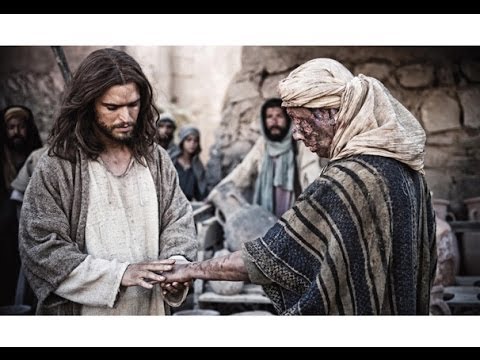
 

hqdefault

  • His healing hand gently touching a hideous leper, the lesions disappearing, fingers and toes miraculously being restored?  Do you see the love and joy on Jesus’ face as he watches the healed one, his eyes darting between arms and legs, elbows and knees, rejoicing that every inch of his skin glows with health (Matthew 11:5)?
  • Jesus standing in the bow of a lurching boat with arms raised, sleeves flapping in the whipping wind of a squall?  Do you hear his authoritative voice above the mayhem shouting, “Be still!”  Do you feel the boat stop pitching and rolling as the fearsome waves settle into calm ripples (Luke 8:22-25)?
  • Do you see Jesus leaning in, listening intently to the Samaritan woman at the well, eyes focused only on her, indicating genuine interest and tender compassion?  Do you sense his pleasure as she becomes a passionate believer (John 4:4-30)?
  • Do you breathe in the aroma of fresh bread and dried fish that permeated the hillside where 5,000 men (plus women and children) ate lunch one day, supplied by one boy’s meager fare–likely two small barley loaves and five sardines (Luke 9:10-17)?
  • Do you see Jesus reclining with his disciples at the Last Supper?  Do you hear the reverent tone of the ceremonial words?  Do you see the astonished expressions on the disciples’ faces, as Jesus changed the well-known ritual to speak of his body, his blood, and a betrayer among them?

Do you recognize the rich symbolism of his sacrifice-to-come in the elements of the meal?  1)  The unleavened matzah bread with its grill marks, reminding us of the stripes he bore on his back (Matthew 27:26).  2) The breaking of that bread, representing Jesus’ body broken for us (Matthew 26:26-28).   3) The lamb, symbolizing Jesus as the Lamb of God, sacrificed for our sakes that we might have eternal life (Romans 3:23-24).  4)  The third cup of wine during the Passover meal, called the cup of redemption, representing Jesus’ blood.**

Without our Jesus of gentleness, power, compassion, and sacrifice, we’d be reduced to lives of futility and fear.  Without our Jesus, we’d have no hope and promise of heaven’s ecstasy.

Every moment of his earthly life proved his perfection, his singular purpose, his love.

He is the sum total of all delights.

His name is:

music with which the bells of heaven sing;

a song in a word;

an ocean for comprehension,

although a drop of brevity;

a matchless oratorio in two syllables,

a gathering up of the hallelujahs of eternity

in five letters”

— Charles Spurgeon

    *     *     *     *     *     *     *     *     *

Precious Jesus, we praise you that the same attributes you demonstrated in Galilee and Judea so long ago are still at work among us today.  You are our faithful Rock, a Friend who never fails, a Shepherd who always attends.  May your name continually be on our lips!

**Jesus referred to his blood as the seal of a new covenant, a new promise.  By his death, the debt was paid–the one we owed because of our sin (Luke 22:20; Romans 3:23-25a).

(Photo credit:  http://www.youtube.com.)
Read Full Post »

tumblr_n6al7hhRSw1rzadffo1_500


For long stretches of time, life can roll along quite satisfactorily. The kids are healthy and doing well in school. Bills are paid on time. The house and cars are holding together with no major repairs required.


Stone_mold


And then suddenly, we hit a stone wall. The promotion goes to someone else.   The company requires a move across the country. An addiction is disclosed. A life-threatening prognosis is delivered.

Pow.   We’re broadsided by disappointment, fear, and pain.

For a few moments we’re frozen in disbelief.

We grieve.

And that’s to be expected.   These are normal reactions.

What we want to avoid is parking at the stone wall, allowing it to consume our thoughts and prohibit forward movement.

That’s much easier said than done, right? That wall of trouble looms over us–thick, tall, and menacing. It’s not like we want to meditate on it; the ugly thing demands attention.

But, oh, praise God, he can tear down walls! (Remember Jericho?)


80a8523580822ed8e5556777b2c3a552


We can also defy the enemy who built the wall. Satan, the father of all strife (1 John 5:19), is the one with whom we must battle.

How? There are a number of worthy tactics, but let’s focus on three:

Let the Lord Jesus Christ be as near to you as the clothes you wear and be strengthened (Romans 13:14 CEV).  We can praise him for such affirmations as the following to lift our spirits and nourish hope.

He is our:


6b7162242c49e27d145b54f99f524f14


Sing or recite scripture and be revived (Psalm 119:25b).

Start writing down every verse that applies to your situation, and read through them frequently.  Fellow blogger, Bev Rihtarchik (over at Walking Well with God) chooses one meaningful verse, and copies it on a slip of paper to carry in her pocket. When worry comes to call, out comes the verse—truth, in black and white.  Now there’s a surefire way to boost our faith!

Count your blessings and be encouraged.

Yes, it’s an old cliché, but naming God’s benefits is soothing balm to the soul.

Several years ago, I struggled through a particularly challenging year, giving me the opportunity to practice the disciplines of forgiveness, perseverance, renewing the mind, and more.

I continued to keep my blessings journal, more eager than ever to notice the evidence of God at work around me.


photolibrary_rf_photo_of_woman_writng_in_journal


On December 31, I tallied the entries. Imagine my astonishment to count twenty more than any other year to that point, and I’d been keeping that journal over twenty-five years.

God had indeed been at work.  but if I not been recording the evidence, I surely would have missed the generous extent of his blessing.

*     *     *     *     *     *     *     *     *     *

Oh, how I praise you, Heavenly Father, that you are in control. I can move on from that stone wall–strengthened by you, led by you, and encouraged by you. Help me to see the unseen steps ahead as an adventure with you, and fill my heart with your hope. You are my Rock whose works are perfect; all your ways are just. You are a faithful God who does no wrong (Deuteronomy 32:4). I cannot praise you enough!


(Photo credits:  www.vesselforchrist.tumblr.com; http://www.survivingtoxicmold.com; http://www.pinterest.com (2), http://www.web.md.com.)


How do you fight the battle against discouragement, fear, and hurt?  Please share with us in the comment section below!

Read Full Post »

SunsRays

The exhibition of God’s glory

and the deepest joy of human souls

are one thing.

–Jonathan Edwards

(1703-1758, preacher, theologian, author)


Wooh—that’s a mouthful! I have to break that down into smaller bites.

God’s glory includes his splendor and majesty, infinite power and wisdom, creative genius and perfect engineering, absolute holiness and righteousness, and much more. God’s glory is, in part, the sum of his glorious attributes.

The exhibition of God’s glory is all around us in creation, and visible to all people (Isaiah 6:3, Psalm 97:6).

36e8e624124bc4606ae3499824a2dded

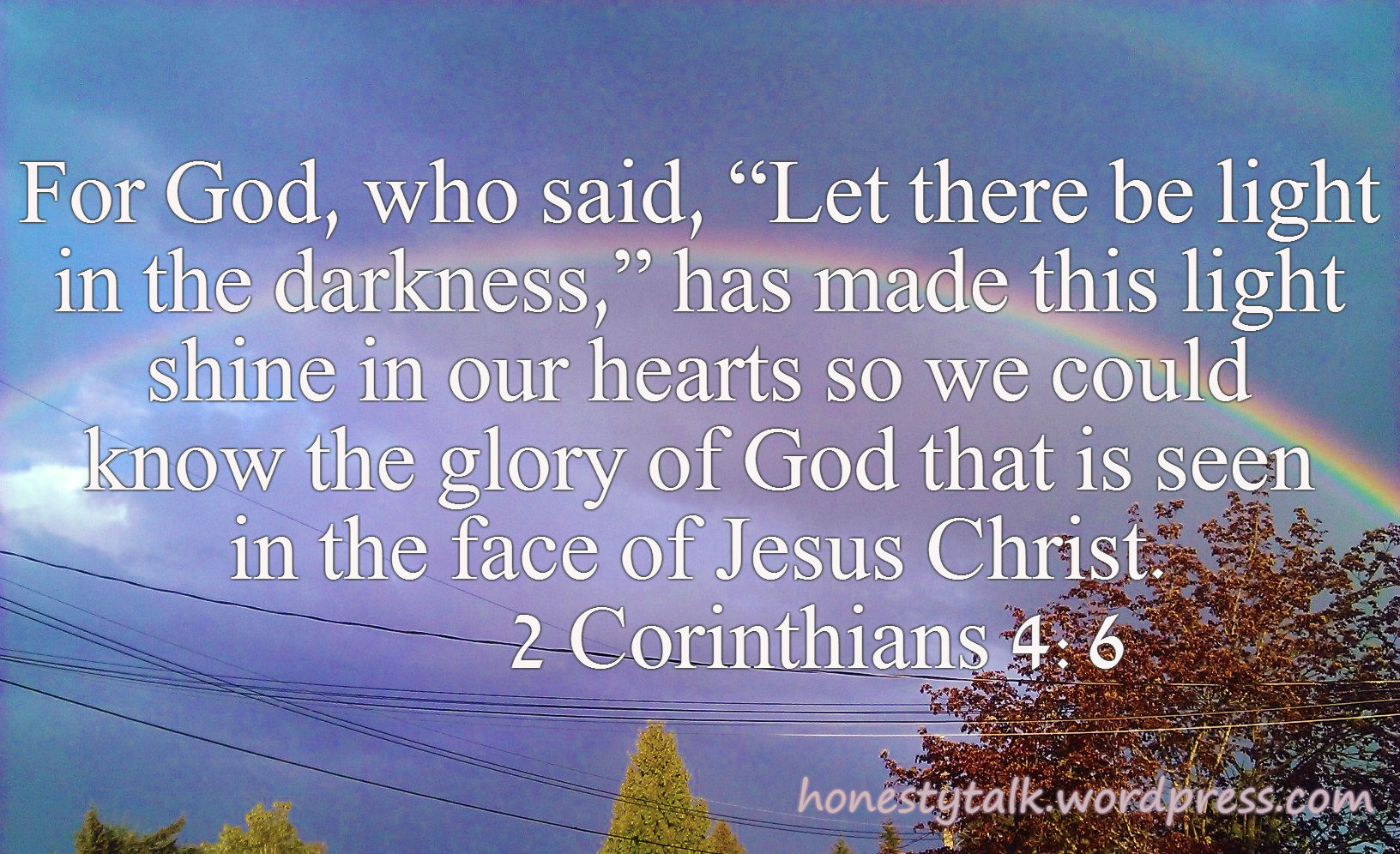
But more profound:  God’s glory is made known to us in our hearts—to those who have asked Jesus to save us from the ultimate consequence of our sin, and to become Master of our destinies (2 Corinthians 4:6).

2-corinthians-4-6

How incredible that we can experience God’s glory here and now, although in a limited way. And how wonderful that the deepest joy of humans souls is a result of knowing him now—not just when we get to heaven.

Someday, though, we will witness the full revelation of his splendor, and that of his Son, Jesus. It’s beyond our wildest imaginings (1 Corinthians 2:9).

1-Corinthians-2-9

Scripture does include a few glimpses, however. We see his:

  • Golden splendor and awesome majesty (Job 37:22)
  • Garment of light, wrapped around himself (Psalm 104:2a)
  • Clouds surrounding the throne (Daniel 7:13)
  • Belt of gold and gleaming, flaming eyes (Daniel 10:5-6)
  • Long robe with a golden sash across his chest, white hair, and blazing eyes (Revelation 1:13-16)

Charles Spurgeon eloquently expressed the glory of Jesus in a sermon, over 150 years ago. He proclaimed Christ…

 “…Radiant with splendor,

effulgent with light,

clothed with rainbows,

girded with clouds,

wrapped in lightning,

crowned with stars,

the sun beneath his feet.”


Doesn’t that give you holy goosebumps?

Yet there is more.

When he appears, we shall be like him (2 Thessalonians 2:14; 1 John 3:2).

1029-2TH003005ENGKJV08000480ISP05531394000

Can you imagine? We will share in the radiant splendor of our Savior. As if that wasn’t enough, we’ll finally be transformed into the holy and perfect beings we have always wanted to be.

And as we share in the glory of Jesus, we will enjoy incredible blessings that God has prepared. The following scriptures offer us tantalizing samples—to whet our appetites for what is to come:

  • There will be no need for sunlight; God will be our everlasting light. There will also be no more sorrow (Isaiah 60:19-20).
  • We will see Jesus face to face and finally have full understanding of all things (1 Corinthians 13:12-13).
  • We will bear the likeness of Jesus (1 Corinthians 15:49).
  • We will reign with Jesus forever (Revelation 3:21; 22:5).
  • There will be no night and no impurity (Revelation 21:23-27).

Now, there are those who worry that heaven will involve a lot of cloud-sitting and harp-playing. Well, yes, there are clouds and harps.  (I, for one, am very glad for the harps–it’s my favorite instrument. And, I have to admit, there are some days when a bit of cloud-sitting and harp-playing sounds rather appealing!)

However, I agree with theologian, Albert Barnes. “To reign with Jesus” means we will share in Christ’s dominion of the universe, administering the affairs of all the worlds.” That sounds exciting and fulfilling (but mind-boggling) to me!

Such glimpses of our glorious future really are too much for my mind to absorb. But, oh how thankful I am that God has tucked them into his Word, to fill our hearts with expectation and hope.

Also worth contemplating is the eternal expanse of time we’ll enjoy God’s majesty and splendor. According to John Piper, heaven’s joys will actually increase as we discover more and more of God’s glory. “The end of increased pleasure in God will never come” (God’s Passion for His Glory, p. 37).

Then “the exhibition of God’s glory and the deepest joy of human souls” will indeed be one perfect, sublime, eternal thing.

*     *     *     *     *     *     *     *     *     *

Lord God of heaven and earth, my heart shouts praise in honor of your glory! I praise you for being a holy God, completely separate from all else in the universe. No one is your equal in power, wisdom, creativity, splendor, or love. No one else is perfect in all he does. Thank you for your Word, where we can glimpse your glory and your plans–for our glorious and joyous future with you.

(Photo & art credits:  www.beforethebeginning.net; http://www.pinterest.com; http://www.honestytalk.wordpress.com; http://www.verseaday.com.)


Read Full Post »

 Zwald-62


One of the “Letters to the Editor” in the most recent issue of Country Magazine caught my attention. The writer, James, related an event from his boyhood days on a farm in the 1940s.

Seems he had injured his hand quite severely one day while tightening a chain. But work on a farm doesn’t wait, especially during hay-baling season when the hay is ripe for harvesting. So in spite of his injury, James had to wear rough work gloves as he operated the wire baler. Every day for a week when he removed the gloves, the scab on his hand would come off and the wound would bleed profusely again.

On Sunday afternoon he plopped down on the living carpet to take a nap. His dog, Shadow, came to lie down beside him. But instead of settling in for a snooze himself, Shadow began to lick James’ wound. It actually felt good, James explains, so he let the dog continue.

The next morning James was astonished to see that his wound was completely healed. “It was as if the injury had never happened.”

Not until much later did James find out that a dog’s saliva contains healing properties. That’s why, when injured, they will lick their own wounds over and over.

I found James’ story particularly interesting because of a question that had been niggling in my mind this Easter season: Why did Jesus bear the scars of the crucifixion—in his hands, feet, and side–after the resurrection? It was certainly within God’s power to return Christ’s physical body to perfect wholeness, “as if the injuries had never happened.”

Come to find out, I’m not the first one to consider this question. As far back as the seventh century, Saint Bede of England (672-735, A.D.) wrote about the possibilities. Many others throughout the ages of the church have contemplated the reasons, including the following:

  1. The scars were proof to the disciples that he was the same person after resurrection as before. Had Jesus been completely restored, his followers may have assumed that their first inclination was correct: that what they saw was an apparition of Christ. After all, he appeared to them out of nowhere—an impossibility for a physical body.

But they not only saw him, Jesus invited them to touch him, so there could be no doubt (Luke 24:36-42).

  1. The scars were part of the proof of the prophecy that Jesus spoke of himself, that he would suffer, be killed, and rise again on the third day (Matthew 16:21). “This is what I told you,” Jesus reminded them (Luke 24:44).
  1. The scars provided evidence of Jesus’ physical body. Early in church history there were those who taught that Jesus didn’t really suffer on the cross. He was not truly human, therefore he only appeared to suffer.

They could not fathom the sinless Son of God submitting himself to such humiliation and horrific pain.   But dismissing the agony of Christ on the cross as well as the scars is incomprehensible.

Those three answers do quiet our curiosity, but what relevance might Jesus’ scars provide for us today?

  1. The scars prove that Jesus knows what it means to suffer. Crucifixion is the most cruel of death penalties, the worst that man can deliver. No one can say, “Jesus doesn’t know what I’m going through.” No, he is well-acquainted with grief. He knows what it’s like to bear scars of suffering.
  1. The scars prove God’s love and compassion. As the Son of God, he didn’t have to suffer on our behalf. Surely he could have devised a less abhorrent way. Instead, he identified himself with humanity by becoming human himself. He took our physical, emotional, and spiritual pain upon himself.   And he will wear the scars of suffering for eternity (Revelation 5:6).
  1. The scars remind us of what is to come. On Good Friday, Jesus body was beaten, bruised, and pierced. On Easter Sunday, those wounds became scars. A miraculous healing of gruesome wounds had occurred in a matter of hours.

One day a miraculous healing of our gruesome wounds will take place. Pain, suffering, loss, illness, and physical challenges will cease. Every negative aspect of life will melt away.

*     *     *     *     *     *     *     *     *     *

Oh, Lord Jesus, thank you, THANK YOU for carrying our pains, our disfigurements, all the things wrong with us.  Thank you for taking the punishment we deserve and making us whole.  You are the one and only source of eternal salvation.  And only through your eternal bruises are we healed.  Out of overwhelming gratitude, we give ourselves to you.  We want to follow your example and please you.  Make us into what gives you pleasure.  

All glory to you, Jesus, forever and always!”  

 (Isaiah 53:4-6; Hebrews 5:9, 13:21, MSG)

Photo credits:  www.motherearthnews.com

Read Full Post »

Jesus-Praying-Last-Supper-570x377


Whether I heard it or read it, I don’t remember. But the words caught me by surprise, and I jotted them down:

“What was uppermost in Jesus’ mind as Good Friday approached?

“Joy.”

Do you find that surprising, too?

Yet at least three times on the eve of his crucifixion Jesus spoke about joy (John 15:11; 16:22, 24; 17:13)–a most unusual topic and completely unnatural.  Who thinks about joy when they know that catastrophe is about to strike?

Jesus, that’s who.

Within the next twenty-four hours he would face excruciating pain, total abandonment by his Father, and the most horrific death ever devised.

But his concern was for his disciples, not himself.  Jesus wanted them to remember the important principles of love, obedience, and joy–an empowering joy that no one could take away from them.

Perhaps you remember the scene. Jesus and his disciples had just finished their last Passover supper together. After the meal, he taught his final lesson.

The first mention of joy came near the end of his teaching about the vine and the branches:

“I have told you this

so that my joy may be in you

and that your joy may be complete”

(John 15:11).

The word, “this,” refers to the ways Jesus had just mentioned that will contribute to joy:

1.  Live close to him and produce much good in and through your life (vs.4-8).

2.  Live in obedience to Jesus and experience the warmth, peace, and care of His love (vs. 9-10).

 Note that Jesus wanted his joy to be in the hearts of his disciples. What characterized his joy, compared to that of others?

  1. Strong awareness of the Father’s love for him, and his own love for the Father (vs. 9-10).
  1. Absolute surrender and self-sacrifice of himself to his Father, and the joy of doing what his father had sent him to do. Even during his great travail in the Garden of Gethsemane, his one desire was to do his Father’s will (Luke 22:42).

Jesus’ joy coexisted with the profound sorrow of his impending suffering, because he was already well-acquainted with the satisfaction and fulfillment of obedience.

  1. The understanding that joy deferred to the future is anticipatory joy in the present. “For the joy set before him he endured the cross” (Hebrews 12:2).

And finally, Jesus told his disciples that he desired complete joy for them. What does complete joy look like? It is:

  • Not so much an emotion as it is a conviction (Keith Krell, “Moment by Moment,” http://www.bible.org).
  • Inner contentment, resulting from continually cultivating an intimate relationship with Jesus.
  • Constant, not dependent on circumstances.
  • Enduring, day after day. Indestructible.
  • Perfect—the perfect, joy-filled fulfillment of the destiny for which God created you, even when a portion of that destiny is suffering.

I’m thinking of the martyrs–Stephen, Polycarp, Ignatius of Antioch, William Tyndale, John Wycliffe and countless others who demonstrated complete joy even as they died in anguish.

Polycarp, disciple of the Apostle John and Bishop of Smyrna for many years, refused to revile Jesus. For that he was burned at the stake.

But before the flames rose up, Polycarp prayed:

“O Lord God Almighty, Father of thy blessed and beloved Son, Jesus Christ, through whom we have been given knowledge of thyself…I bless thee for granting me this day and hour, that I may be numbered amongst the martyrs, to share the cup of thine Anointed and to rise again unto life everlasting…”

Such devotion, courage, and supernatural strength are impossible to fathom apart from the enablement of the Holy Spirit.

Can you hear the grace in Polycarp’s voice as he blessed God for the privilege of dying a martyr?

That is complete joy, only experienced by those who trust in Jesus implicitly.

Complete joy that Jesus purchased for us at Calvary.

*     *     *     *     *     *     *     *     *

We marvel, Heavenly Father, in the extreme paradox that is the cross. Out of the evil unleashed upon your Son comes your holy, righteous goodness–upon us. Out of the horror of the crucifixion that Jesus endured comes inexpressible and glorious joy, to those who put their faith in him–not a temporary feeling of elation, but deep, abiding, abundant joy. 

All praise to you, our loving, gracious God!       

(Acts 3:13-16, 1 Peter 1:8, John 6:47, John 10:10)


(Photo credit:  www.rejesus.co.uk.)


Read Full Post »

The spacious, free life is from God,

It’s also protected and safe.

God-strengthened, we’re delivered from evil—

When we run to him, he saves us.

(Psalm 37:39-40, The Message)

Freedom-Quote


There are folks who think that Christians surrender their freedom when they choose to follow Jesus. They think we give up our freedom to do as we please and take part in everything life has to offer.

Those folks miss an important fact: Self-centeredness does not satisfy in the long-term.

Even secular research has proven that truth. Several years ago, the Journal of Research in Personality published a study conducted by psychologists. They recorded their therapy sessions and found that individuals who used more of the first-person singular pronouns (I, me, my) were more likely to suffer from depression.

The truth of the matter is, real freedom is not freedom to, but freedom from. God offers us a number of glorious freedoms. For example:

  • Freedom from guilt. God forgives my sins and remembers them no more (Isaiah 43:25).  How loving, merciful and gracious He is!
  • Freedom from fear. He is my stronghold in time of trouble (Psalm 37:39.) How often have I called out, “Oh, Jesus,” with my heart pounding in my chest—at the moment a car crash was imminent, a child approached with blood oozing from his head, or the phone rang just before curfew, and our teenager wasn’t home yet.

bible11

But fears can be quieted as we affirm who is in control. God is Lord of every circumstance. He is also the Source of solace, perspective, strength and wisdom–whatever I need, for every situation.

  • Freedom from worry. God has promised to supply my needs (Philippians 4:19). 

When worries begin to whirl in my head, I try to put into practice what Kay Arthur teaches: “Focus on God. Rehearse his character, his promises, his works. Remember his names, his attributes and how they suit your situation” (His Imprint, My Expression, p. 117). Extolling God’s greatness causes my problems to shrink.

Notice I said try. I’ve not always accepted God’s offer of freedom from worry. Sometimes dark clouds of concern fill my thoughts and blot out his goodness—his character, promises, and works. Sometimes it takes awhile for me to remember: My God is all-sufficient. He will see me through.

 As I grow older, the gap is shortening between worry-onset and God-focused thinking. Practice hasn’t made perfect yet, but at least it’s producing improvement.

  • Freedom from foolish decisions. He provides wisdom when I ask (James 1:5).

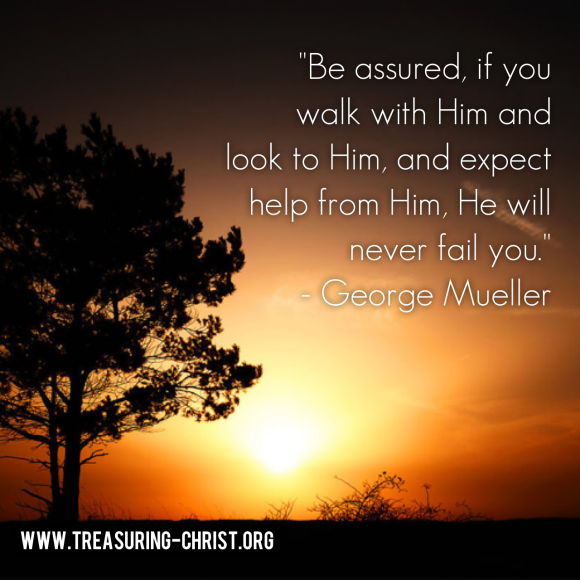
“I need not despair because the living God is my partner. I do not have sufficient wisdom to meet these difficulties, but He is able to direct me. I can pour out my heart to God and ask Him to guide and direct me and to supply me with wisdom. Then I have to believe that He will do so. I can go with good courage to my business and expect help from Him in the next difficulty that may come before me” – George Mueller

816184962d6bdc67aaa7f052c00369bf

  • Freedom from discouragement, because God is omnipotent. With him all things are possible (Matthew 19:26). He specializes in redeeming disappointment. And while we wait, our loving Father provides strength.

The shroud of discouragement can also be lifted through gratitude, praise, and worship. Focusing on who our God is and what he has already provided can relieve the ache for what has not come to pass—yet.

 This post is getting long, so I’ll just list another five briefly:

  • Freedom from despair. He is my God of hope, joy, and peace as I trust in him, so I can overflow with hope by the power of the Holy Spirit (Romans 15:13.)
  • Freedom from loneliness, because He is always with me (Psalm 23:4).
  • Freedom from prolonged sadness.  Weeping may remain for a night, but rejoicing comes in the morning (Psalm 30:5).
  • Freedom from feeling helpless. In God’s hands are strength and power (1 Chronicles 29:12).
  • Freedom from feeling useless, as we live each moment for the praise of His glory (Ephesians 1:11-12).

0a44f1bd0f54a3d2e22c78ec65923491

Jesus said, “If the Son sets you free, you will be free indeed” (John 8:36). What he offers is the spacious, free life–to those who follow him, to those who become the children of God.


*     *     *     *     *     *     *     *     *     *


My heart is overwhelmed, Father, as I skim down this list of miseries for which you provide relief. No doubt there are even more freedoms that could be included. I pray that when these negative emotions threaten to overtake my spirit, you would tap me on the shoulder and remind me: the more I turn my thoughts and feelings over to you, the more spacious my soul will become to enjoy the freedom of your peace. Praise you, gracious God, for such glorious provision.

(Photo credits:  www.moreofimministries.org; http://www.wallpaper4god.com; http://www.treasuring-christ.org; http://www.887thebridge.com.)


Read Full Post »

slide_064_Wirtz_classroom

“Please write your name, home city and state, and your major on the index card in front of you,” requested Dr. R.

It was the first day of American History, my junior year of college.

We all complied, and Dr. R. collected the 3 x 5s. He took a few moments to study each face and card, commenting or asking a clarifying question. Then he proceeded to name every person in the class of thirty or so students—without the cards. Quite impressive.

Each day that first week of class, as we entered the room, we’d see Dr. R., leaning against the front of his desk, reviewing those 3 x 5s. He always used our names when addressing us.

On one occasion I ran into Dr. R. in the hall of one of the classroom buildings. “Hello, Nancy,” he called without hesitation. Now that might not seem very remarkable except I had graduated ten years before. Steve and I were on campus for homecoming.

Not only did Dr. R. remember my name that day, he asked if I still lived in Wheaton, and if I was teaching. I wasn’t simply “a” Nancy who had been in one of his classes. I was “the” Nancy from Wheaton, who majored in elementary education.  Who can remember such detail for so long?! And even if that moment was only the result of his incredible recall ability, I felt valued.

Few people have such a gift as Dr. R. But I know Someone with an even greater capability to remember names and details. Too many, in fact, to quantify.

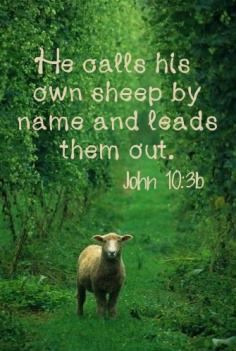
Jesus calls us by name (John 10:3).

5f0a69a406cc999a2cec2b5c02dc118d

Our names are more than labels to him, identifying one person from another. He knows our character and personalities, as well as intimate details—our likes and dislikes, concerns, feelings, and thoughts. He knows one Nancy from another, one Steve from another, one __________ (put your name here) from another.

However, calling us by name indicates not only profound knowledge about us but keen interest in us. He deeply cares about each individual (1 Peter 5:7).

fb6ee7a03664a8589ba2f3541c37745e

Now sympathy and compassion are comforting qualities, and Jesus demonstrates both. But true caring involves more. Care suggests action. And that’s exactly what he does. Jesus takes action when one of his own is in trouble (Luke 15:3-7).

In fact, every detail of our lives is under his capable, loving control.

  • His eye is ever watchful (Psalm 121:3).
  • His ear is always attentive (Psalm 34:15).
  • His heart beats with everlasting love (Jeremiah 31:3).
  • His powerful hand brings help when the time is right (Psalm 138:7-8).

Many of you are familiar with Sarah Young’s Jesus Calling (Thomas Nelson, 2004). Among the impressions from God she has recorded, is the following encouraging note. Our Heavenly Father wants us to know:

“If you could see how close I am to you and how constantly I work on your behalf, you would never again doubt that I am wonderfully caring for you” (December 12).

ex3-he-knows-your-name

God knows each and every one of our names.

How validating he is.

When God calls, “Nancy” or “Steve,” “John” or “Jennifer,” he’s remembering who we are—our unique personalities, backgrounds, needs, and deepest thoughts.

How compassionate our God is.

Best of all, is the love in his voice as he speaks. And the benevolent action he sets into motion—specifically tailored to our needs.

How astounding our God is.

*     *     *     *     *     *     *     *     *     *

Heavenly Father, I thank you for taking personal interest in each of your children. To think that you know me by name—out of the billions of people throughout the centuries–what a precious reality.   At those times I feel insignificant and small, may I hear your gentle voice calling my name.

(Photo & art credits:  www.cobniu.edu; pinterest.com; http://www.dwellingintheword.wordpress.com.)

Read Full Post »

Fantasyland_Full_17089

Visit a theme park and you soon learn that part of the adventure is waiting in line–even if you pay extra for fast passes.

Such was our experience at Disney World two years ago. The castle of Beauty and the Beast required wait time—well over an hour. But friends of our daughter had told her, “Don’t miss it,” so we joined the long, looping line.

You may also know that, while you wait, the folks around you can become like friends. Topics such as home state, kids’ ages, and other experiences in the park, get the conversation going. Commiserating over the long line adds to the camaraderie.

Finally we approached the entrance to the castle. Only fifty or so guests were allowed past the gilded rope. This was our first surprise, since most theater-attractions seat hundreds of people. (No doubt there are at least several theaters within the castle, to accommodate the crowds. But each group enters separately, totally unaware that there must be identical venues down alternate hallways.)

First, we were ushered into an outer room, hosted by a footman, I believe. He assigned roles to many of the guests. Among them, the father from Michigan with the four kids became a butler, the little ballerina (who had performed intermittently as we waited in line) became a teacup, our son-in-law, a knight, and our granddaughter, a salt shaker. Each participant was given a colorful placard to identify his or her part. The footman explained what they would need to do, once we entered the library to meet Belle.


Enchanted-Tales-with-Belle1


One particular role seemed completely inappropriate. For the Beast, the footman chose a little girl with an obvious limp.  It seemed cruel to choose such a child for the Beast, of all characters.  As he draped a red cape over her shoulders, I thought, He probably didn’t notice her difficulty walking. But those of us who had become acquainted outside the castle knew full well: this was going to be awkward.

Soon we were ready to enter the library and meet Belle. Our small gathering of almost-friends filed into the dimly lit, cozy room.  Most of us sat close together on benches.

Beautiful Belle, in her yellow satin gown, directed the teacups, salt shakers, and other dancers in a delightful little polka, while the knights stood guard. Such an elegant and charming princess, that Belle.

Then she said it was time for her dance with the Beast.

Our new little friend slowly and carefully approached Belle without any sign of self-consciousness. Her eyes locked with Belle’s, glistening with pleasure and adoration. Gently, they nearly waltzed, Belle being mindful to accommodate Beast’s handicap. And for a few precious moments, that little girl’s physical challenges were forgotten in the inexpressible delight of dancing with Belle.

Suddenly, my eyes filled with tears. That little girl had been the perfect choice for Beast. Her ecstatic joy was obvious in the non-stop smile and luminous eyes. She was the center of attention of a princess—someone whom she dearly loved and greatly admired. Even more poignant, the sweet look of love returned by Belle, her gracious intentness focused entirely upon the child.

Love soon encompassed the entire room. Surely every guest felt it, not just me. We loved the child for her precious innocence. We loved Belle for her warmth and kindness. We even loved each other, as almost-friends, sharing in this  miracle—a once-in-a-lifetime experience, never to be repeated.

But wait.  In actuality such euphoria and reverence is available to us–every day.

We can keep company with Jesus, our Prince of Peace —not just for a few miraculous moments, but  All.  The.  Time.  In fact, like the father of the prodigal son, he waits in eager anticipation for us to come “home” to him and linger there.

We can be transformed, just like that little girl.   For the length of that magical dance, she was blissfully unaware of her handicap. Why? Her attention was riveted on Belle.  Paul challenges us to do the same in the spiritual realm:   “Fix your attention on God,” he said.  “You’ll be changed from the inside out” (Romans 12:2, The Message).

We can experience love beyond imagination. Belle portrayed perfect love for one shining moment; God is perfect love (1 John 4:8). And the love of his Son, Jesus, is wider than any experience we encounter, longer than our lives last here on earth, and higher, purer, and deeper than any other love (Ephesians 3:18).

And then, one glorious gift that even the lovely Belle could not bestow.  We can be healed of our handicap, the handicap of sin.  Jesus paid the price for our sin when he died on the cross.  He sacrificed himself so that we could be healed of the ravages of sin and enjoy a God-enhanced life (1 Peter 2:24; John 10:10).

With ecstatic joy we can revel in all the privileges of one-on-one relationship with our Prince, who loves each of us as if there was only one of us (St. Augustine).

*     *    *     *     *     *     *     *     *     *

Oh, Prince of Peace, what an astounding privilege you grant us, to bask in your perfect love each day.  Thank you for the assurance of your love throughout scripture, reminding us that we are precious and beloved to you.  May our status as your precious ones free us to live unencumbered by self-consciousness, fear, and worry.  And may we never fail to express your gracious love to those around us.


(Photo credits:  www.wdwmagic.com; http://www.galleryhip.com)

Read Full Post »


6a00e54f0d380188340133f2ef50d4970b 

One of the delights of grand-parenting is recapturing the joys of childhood. In the name of entertaining the little ones, we get to return to such fun activities as drawing with crayons, molding Play-Doh, and building with blocks.

Little eyes watch in wonder as we sketch a flower, create a clay nest of eggs, or fashion a tall tower. It doesn’t take much to wow the little tykes.

Just the other day I demonstrated for our toddler granddaughter the first rule of constructing block skyscrapers: A solid, level foundation is a must. Without that strong base, the tower will lean and fall.

For centuries, the success of constructing real buildings depended on one foundation stone in particular: the chief cornerstone. Without the sophisticated tools of today, stone masons had to be certain that first stone was level and its corners squared accurately. The rest of construction conformed to that one stone. If the cornerstone was faulty in any way, the building would lean and fall.

The chief cornerstone also carried the weight of the structure. If laid properly, the weight of the building was evenly distributed and the structure remained sound.

Scripture tells us that Jesus is our cornerstone. God said,

“See, I lay a stone in Zion, a tested stone, a precious cornerstone for a sure foundation; the one who trusts will never be dismayed” (Isaiah 28:16).

Oh, my. So much good news in one short verse!

The “stone in Zion” is Jesus, our Rock (1 Corinthians 10:4), who has been tested for two thousand years. Billions of believers over the centuries have found him to be a trustworthy Savior, Shepherd, Friend, Prince of Peace, Teacher, and more.

Jesus is our precious cornerstone—highly valuable to us who believe in him. Think of the excellency of his character and his perfect, holy life. Think of his position. God exalted him to the highest place and gave him the name that is above every other name in the universe (Philippians 2:9). Think of the myriad ways he blesses, guides, comforts, and strengthens us, his followers.

He is also our sure foundation—strong and reliable. In his divine power he gives us everything we need for life. We can depend on his great and precious promises (1 Peter 1:5).

Those who trust in him will never be dismayed; their lives will not topple and fall into ruin. However, commitment to obedience is crucial. If I’m not following his blueprint for life, as provided in the Bible, I’m not demonstrating trust.  (Still working on that!)

Also important to understand: God’s architectural plan does not end with the placement of the chief cornerstone, his Son, in our individual lives. Each of us who believe in Jesus are like a stone or brick in the building of the Church universal.

The truth is, individual bricks by themselves are practically useless. They must be mortared together to realize their full potential. As Christians, we, too, must come together as the Church to realize our full destiny.

We become more significant, not less, as we gather to pray, encourage one another to lead godly lives, work together, and share with others the good news about Jesus.

We also become stronger, able to withstand storms and hardships because the stress from such forces is distributed over numerous bricks. We carry one another’s burdens.

Even better, we have a strong, sure foundation in Jesus. He is more than sufficient to carry the weight of our cares. On him rests the Spirit of power, which he dispenses on our behalf (Isaiah 11:2; Philippians 4:13).

*     *     *     *     *     *    *     *     *     *

Thank you, Father, for the wonderful, rock-solid saints you have brought into my life over the years, shining examples of living stones, spiritually well-hewn, and set apart for your service. I’m thinking of family members, pastors, Sunday School teachers, youth leaders, Bible study teachers, mentors, authors, friends. Countless saints have helped, encouraged, and challenged me to become a living stone for you also.

And oh, Lord Jesus, how I praise you for the sure foundation you provide in my life. When a storm of worry begins to stir, you offer reassurance of your power and strength. When I’m ready to topple from a multitude of cares, you uphold me. When fear wants to consume me, you soothe me with your Word. Over and over, with calm stability, you have steadied me. You are my foundational Rock.

(1 Peter 1:5; Isaiah 28:16; Matthew 6:25-26; 1 Peter 5:7; Isaiah 26:3; Psalm 18:31)

Photo credit:  www.amberdusik.com.

Read Full Post »

F7007


Christmas. The first syllable surely needs no explanation of origin. It speaks of the One we celebrate.

But what about the second syllable, -mas?

Christmas is a term that has been around for nearly a thousand years, coming to us from Old English. Cristes Maesse meant “Mass of Christ.” It was established by church leaders to disconnect the church celebration of Jesus’ birth from pagan holidays and customs—holidays such as Winter Solstice. (Even before the birth of Christ, Romans were celebrating the shortest day of the year, in anticipation of the sun’s gradual return.)

As a matter of fact, as early as the fourth century, Christians were creating their own wintertime celebration. One theologian pointed out in 320 A.D.: “We hold this day holy, not like the pagans because of the birth of the sun, but because of Him who made it.”

Yet there are those who wish to keep the customs of Christmas without including the One being celebrated. Seems they’d like to take away the first syllable, Christ. But then all that’s left is –mas.

Sounds like mess.

Indeed. I am confident that without Christ, my life would be a mess. 

A mess of fears.

A mess of brokenness.

A mess of worry.

A mess of guilt.

A mess of dissatisfaction.

It’s possible that for a long while I’d be able to hide the mess under glittery packages of stuff, noise and distraction, busy-ness.

But eventually, a body must stop and rest. That’s when my mind would kick into high gear and the mess would wreak havoc in my soul. Chances are I’d develop sleep problems, depression, or perhaps even physical manifestations like ulcers. Stress can do that to a person.

Shouldn’t I at least consider the alternative? What if I do allow Christ in my life?

Oh, my. The list of precious gifts He bestows is astounding and practically endless. To begin, he provides:

  • Calm in place of fear.

“Do not let your hearts be troubled. Trust in God; trust also in me” (John 14:1), Jesus said.

  • Restoration in place of brokenness.

 “Anyone united with the Messiah gets a fresh start, is created new. The old life is gone; a new life burgeons” (2 Corinthians 5:17, The Message)!

  • Peace of mind in place of worry.

 “Steep your life in God-reality, God-initiative, God-provisions. Don’t worry about missing out. You’ll find all your everyday human concerns will be met…God will help you deal with whatever hard things come up when the time comes” (Matthew 6:33-34, The Message).

  • Forgiveness in place of guilt.

 “Everyone who believes in [Jesus] receives forgiveness of sins through his name” (Acts 10:43).

  • Contentment in place of dissatisfaction.

 “Godliness with contentment is great gain” (1 Timothy 6:6).

 And among his many other gifts to us, Jesus grants us the incredible privilege of eternal life (John 3:16)—with him in heaven.

But how will I be able to enjoy all these gifts if I don’t give Christ a chance?

I really have nothing of value to lose. Just the mess.


“Thanks be to God for his indescribable gift” (2 Corinthians 9:15)–the Christ of Christmas!


(Art credit:  www.emblibrary.com .)

Read Full Post »

« Newer Posts - Older Posts »

When the House is Quiet

Impressions Becoming Expressions

Mitch Teemley

The Power of Story

Still Traveling

Impressions Becoming Expressions

Living Our Days

Gaining a heart of wisdom

He Said What?!

I'm Patty, and my husband and I are living with our adult son who has autism and epilepsy. I love sharing lessons learned from life around me, especially life with Aaron.

Meditations of my Heart

Impressions Becoming Expressions

Linda Stoll

Impressions Becoming Expressions

Signora Sheila

Where faith meets la dolce vita

Heidi Viars

Finding the Image of God