Feeds:
Posts
Comments

Archive for the ‘God’s Grace’ Category

One fall years ago, we visited friends in North Carolina during peak leaf season.  At the time, Steve and I lived in Florida. It had been years since we’d enjoyed autumn leaves.

The day after our arrival, plans included a drive along the Blue Ridge Parkway to take in all the festive foliage of: birch (yellow), dogwood (deep red), oak (russet to maroon), red maple (from yellow to maroon), sassafras (orange), and more.

But our much-anticipated excursion had to be postponed due to fog and rain.

On Day Three we finally ventured forth, and surveyed mountains transformed. Dust had been washed away, sunlight reflected from gleaming leaves, and the vibrant colors took our breath away.

Sometimes the dust of concern, discontentment, frustration and more can accumulate in my spirit, clouding the colors of joy and awareness of God’s presence. Life loses its luster.

My eyes miss his blessings, my ears miss his words, my heart misses moments of intimacy with him.

What then? Is there refreshing rain for the soul? Oh yes!

God himself renews. All we have to do is ask [1], perhaps with such a prayer as this:

Restore my EYES, Father. May the tears of repentance clear my vision to see more clearly the beauty of your perfections.

And with an enhanced view of you, I’ll be able to view all other things more clearly [2]–like what you want to show me instead of what I want to see.

Refresh my MOUTH, O God. May I be quick to share gracious words with others as well as appreciation and songs of praise to you for your marvelous deeds.

King Solomon wrote, “The tongue has the power of life and death.” Keep me mindful of this power, to use my words as refreshing balm for others, for my own spirit, and to celebrate you also [3].

Renew my EARS, O Lord—to be attentive to your gentle whisper within.  May I heed your instruction as you train me in the delight of right-doing, and lead me ever deeper into the abundant life you provide.

Tune my ears to hear your words of inspiration, cheering me on [4].

Restore my MIND, Father—my understanding, thoughts, and intentions. The things I think are the things that impact my soul.

May I meditate on all the wonders of your attributes and think Christ-honoring thoughts, becoming more Christ-like as a result [5].

Refresh my HEART, O Lord—my motivations, dreams, and desires. I want my heart to align with yours because I know that’s the first step toward fulfilling purpose and satisfaction in life.

Turn my heart, I pray, from what I’d like to have happen, to who you’d have me become—a reflection of your image. That’s where contentment lies [6].

Renew my SPIRIT, O God—my faith, passions, and confidence. May I navigate the challenges of this day with your strength pulsing through my spirit.

Remind me: when negativity or frustration begin to rise, you are my God of help to quell such emotions.

When setbacks occur, you are my God of guidance to show me the way forward, and when disappointments come, you are my God of hope who brings good out of every situation [7].

I praise you, Father, that I can rely upon you to wash away the grime of discouragement, listlessness, and aggravation.

Because of your compassionate love and with your omnipotent power you will restore, refresh, and renew my inner self—just as you have promised.

Begin this moment, I pray.

Restore my eyes, to see more clearly.

Refresh my mouth, to speak gratitude, grace, and praise.

Renew my ears to listen well (and then obey).

Restore my mind to think Christ-honoring thoughts.

Refresh my heart to align my desires with yours.

Renew my spirit to navigate this day with your strength.

P.S. Try renewing your spirit with “Thirty Days of Praise,” offered below (as part of the newsletter).


[1] Psalm 51:10b

[2] Psalm 119:15; 50:2. Last statement based on Selwyn Hughes, Every Day Light, Day 1.

[3] Psalm 98:1; Proverbs 16:24

[4] Proverbs 2:1-5; 1 Kings 19:11-13; John 10:10

[5] Hannah Whitall Smith, quoted in Values for Life, 256; Psalm 143:5; Romans 12:1-2

[6] 2 Corinthians 3:18

[7] Isaiah 41:10; Psalm 32:8; Romans 15:13

Image credits: http://www.pickpik.com; freerangestock.com (JJ Skys the Limit); http://www.canva.com; http://www.pxfuel.com; http://www.pickpik.com; http://www.canva.com; http://www.pexels.com (Furkan Idrizi).

Processing…
Success! You're on the list.

Read Full Post »

(A personal, prayer-response:)

How I love this passage, Lord, with its comfort and reassurance!

Paul reminds me here that You, O God, are all-wise and all-knowing; You know what’s best for each of us.

You cause all things to work together for our benefit, for those who love You (Romans 8:28).

Sometimes though, I have to admit, certain events confound and frustrate me. My finite mind cannot understand what good you could possibly bring out of:

  • Severe financial setbacks for a godly family
  • A rejection letter from a mission board for an eager candidate
  • An announcement of divorce between a respected couple in the church
  • A cancer diagnosis for a young mother
  • The death of a child

But those of us who trust in You know that we can count on Your wisdom and knowledge in all things, and the absolute dependability of Your character—Your benevolent goodness, Your perfect righteousness, Your deep compassion, Your unfailing faithfulness and infinite love (to name a few)—even in the face of struggle and tragedy.

Remind me, Father, that “making room for mystery in my worldview”(1) is an important element of spiritual maturity.

And to demonstrate that mature trust, I can follow Job’s example. His first response to catastrophe was worship (Job 1:20).

And as I worship, I can praise and thank You, not only for those blessings I see but also for those I can’t.

Help me Father to rest in the knowledge that:

  • Out of Your infinite wisdom, You select the best possible conclusion of events, and You adopt the best possible means for accomplishing that conclusion (2).
  • You are the Most High God, Lord of heaven and earth. You are subject to no one and influenced by no one; neither can anyone thwart or hinder Your plans (3).
  • Even my mistakes could never obstruct Your will.
  • You, on the other hand make no mistakes. Your choices for me are always right, because they come from Your perfect mind and heart. You always know exactly what you’re doing.
  • “Everything from You and for You” (v. 36) often includes mundane tasks, tedious routine, and lack of recognition. But I can count on the fact that, “in the midst of what seems terribly ordinary, You—in your wisdom and power–are doing something extraordinary” (4).
  • Everything serves Your purpose (5). You direct everything toward the conclusion you ordained for it.

May I be joyfully submissive to Your plans for me, in light of these marvelous truths!

Notes:

  1. Sarah Young, Jesus Always, 65. 
  2. Based on a J. L. Dagg quote, www.gracequotes.com.
  3.  Based on an A. W. Pink quote, www.gracequotes.com.
  4. Alice Mathews, A Woman God Can Use, 77.
  5. A quote my dad copied into one of his Bibles, source unknown.

Image credits: http://www.canva.com

Processing…
Success! You're on the list.

Read Full Post »

She stands before the judge, tears filling her eyes, as one misdeed after another plays out on a Jumbotron for all to see.

He waves his arm toward the mammoth screen. “The evidence is clear,” he thunders. “You’ve committed numerous indiscretions. What do you have to say for yourself?”

Her response is barely audible. “I am guilty as charged, your Honor.”

“Highly disappointing,” he asserts.  “However, my Book of Life does indicate you accepted the gift of eternal life made possible by my Son, so you will be allowed to enter heaven, but of course, your place will be far to the rear.

“You can also expect far fewer blessings in my celestial kingdom, compared to those who have lived truly saintly lives. You understand, of course.”

She nods and bows her head in shameful misery.  

Such a scene is imaginary, of course, but reflects the fear and foreboding I used to feel toward the Judgment Day to come, when it’s my turn to face the Judge of all the earth.

After all, he is holy and I am a wretched sinner—even as a Jesus-follower. And though God has provided the way for me to escape hell when I die, he’ll have every right to reprimand me, even banish me to some far corner of heaven.

Perhaps you’ve been plagued by such thoughts as well. If so, have I got good news for YOU!

First, consider this passage from a praise-psalm of King David:

A rather surprising reason to rejoice, agreed?

David goes on to explain: “He will judge the world in righteousness and the peoples in his faithfulness” (v. 13).

Could God judge any other way? No. He is holy and perfect in all that he does and says.

That means all his righteous and faithful perfections will come into play as he fulfills this role: his compassion and grace, wisdom and discernment, goodness, patience, and more.

We can rest assured: on Judgment Day God will not divorce himself from these attributes and become a stern, vindictive, and unforgiving judge.

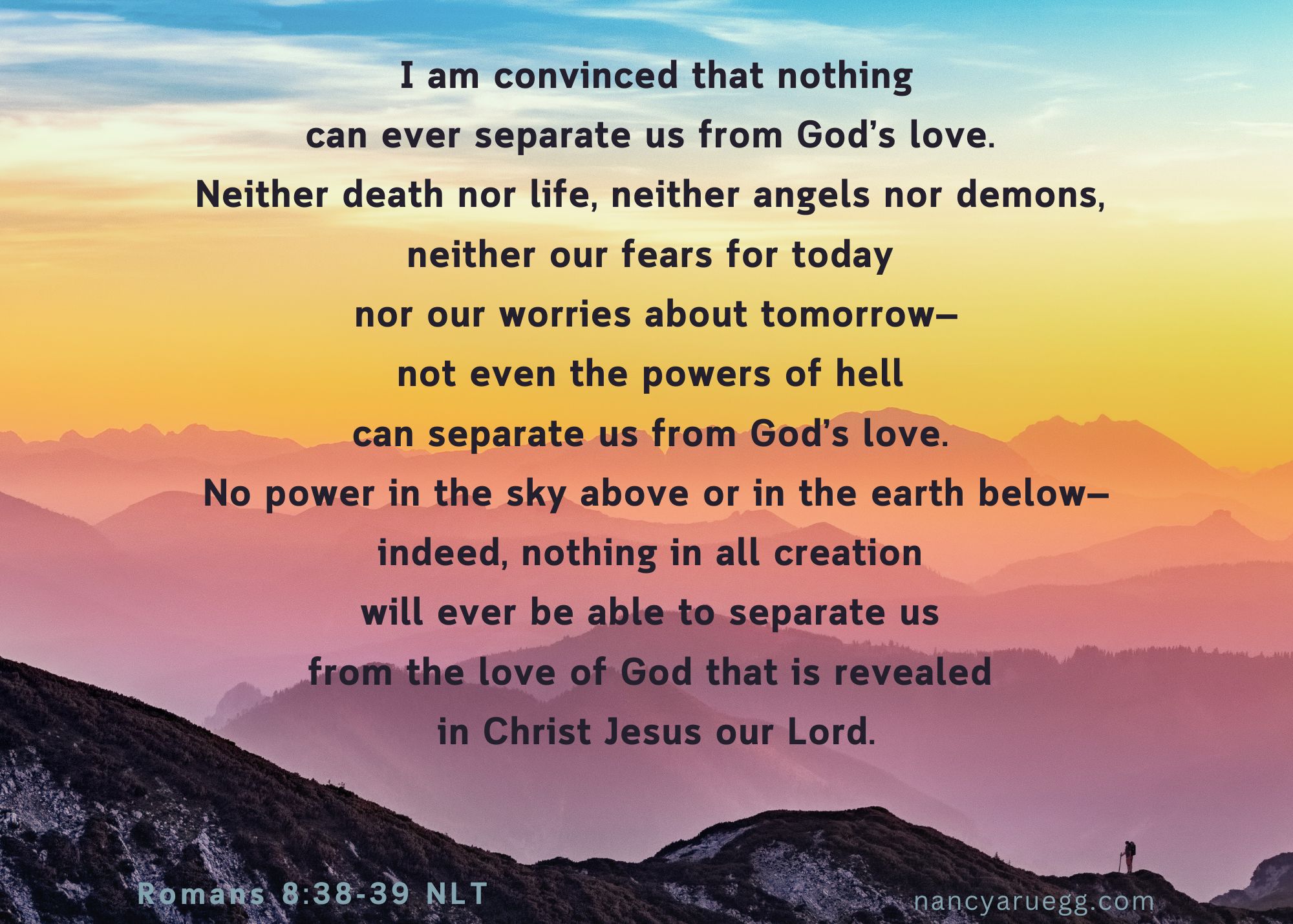
He is for us, not against us [1].

In addition we mustn’t forget that God is rich in mercy [2]–mercy “so great that you may sooner drain the sea of its water, or deprive the sun of its light, or make space too narrow, than diminish the great mercy of God”–Charles Spurgeon [3].

Another factor to keep in mind: the affirming promise the Apostle Paul included in his letter to the Romans. For clarity’s sake, here’s the Amplified Version:

“There is now no condemnation [no guilty verdict, no punishment] for those who are in Christ Jesus [who believe in Him as personal Lord and Savior]” [4].

Elsewhere Paul makes clear: the charge of our legal indebtedness has been cancelled.

I repeat, cancelled.

In fact, our sins are removed as far as the east is from the west [5].

So how might that opening scenario proceed differently for that Christ-following woman, standing before the Judge of all the earth?

He may open his Book of Life, find her name, and announce, “Ah! Here you are! Your debt has been fully paid by my Son.”

Then perhaps he’d lean forward on his forearms and smile warmly upon her. “Proceed through those doors to your right, my child, and enjoy forever my complete peace, joy, and blessing!”

 *     *     *     *     *     *     *     *     *     *

I praise you, O God, for your gift of salvation, not granted grudgingly because you feel sorry for us wretched creatures, but because you love us. That love is manifested by your kindness and compassion in spite of our sinful tendencies.

And now we can stand in a place of confidence and peace as we anticipate our homegoing to heaven—with no fear of retribution. Thank you, Lord God, our Father!

(Romans 5:8; Psalm 103:8-14; John 5:24)

P.S. Though all those who believe in Christ will receive all the benefits of eternal life in heaven, the rewards we receive for godly behavior will differ [6].

What might those rewards include and how do we earn them? Topics for another day!

[1] Romans 8:31b

[2] Ephesians 2:4-5

[3] Charles Spurgeon (1834-1892), British preacher and author

[4] Romans 8:1 AMP

[5] Psalm 103:12

[6] John 3:16; 1 Corinthians 2:9; 3:8

Image credits: http://www.itoldya420.getarchive.net; http://www.stockvault.net; http://www.canva.com (3); http://www.stockcake.com.

Processing…
Success! You're on the list.

Read Full Post »

Most tourists to Rome will visit St. Peter’s Basilica and find their way to the Chapel of the Pietá. There resides the striking statue carved by Michelangelo when he was only twenty-four years old.

For the viewer, the subject matter evokes sad commiseration with the grieving mother, and yet the artistry of the statue manifests incomparable beauty in Mary’s tranquil expression, the luxurious folds of her robe, and the peaceful repose of Jesus’ face.

Perhaps Michelangelo wished to convey Mary’s relief that the anguish of her Son was over. Jesus’ expression might indicate his satisfaction in perfectly executing the Father’s mission.  

The Pietá gives evidence: beauty may be its most captivating when viewed in juxtaposition against suffering. And Michelangelo superbly represented the two entities in this one statue.

Yet there is One who surpasses even the great Renaissance sculptor in the compelling intertwining of beauty and suffering: our heavenly Father. His medium? The lives of his children.

He can make all things beautiful—even suffering.

Perhaps you’ve known people who’ve endured much—physically, mentally, and/or emotionally. And among them are those who’ve manifested the beauty of strong faith.

We’ve seen heavenly joy in their eyes, even amidst the tears.

We’ve heard the winsome affirmations of God’s palpable, sustaining presence and even of God’s blessings during their season of trouble.

We’ve witnessed their striking maturity in the way they react to their circumstances.

 These saints have embraced the truth that:

How do people find the wherewithal to radiate such loveliness of spirit even as they suffer?

Beauty-in-Suffering Begins with Trust

Of course, it begins with strong trust in God—in his sovereignty over all things, his grace to uphold, and in his power to accomplish purpose through hardship. Such people can say:

–Dr. Charles Stanley, Advancing through Adversity, 78.

Can you also see the beauty of joy on the face of such a witness? How do we grow a strong trust like that?

Beauty-in-Suffering Grows with Intimacy

The formula for growing intimacy with God is quite simple: Prayer + the Word + Time [1].

The closer we walk with God, the less room there is for any other thing to come between us, including trouble, hardship, or pain. In addition, we begin to reflect the glory of his beautiful character [2]!

Beauty-in-Suffering Impacts Others

The question is, will the impact be characterized by the ugliness of complaining, negativity, and self-pity? Or will it be the beauty of vibrant faith, contagious joy, and a settled peace?

Meet Anik, a young African father who was suffering through illness and finding it difficult to provide for his family. Nearby another household also dealt with hardship, and yet their quick smiles and frequent laughter indicated a happiness Anik craved.

He could hear them worship God and pray. They even prayed for him! Anik finally asked them about this God they praised. They told him about Christ, and the family shared their Bible with him.

Upon reading the stories about Jesus, Anik prayed to receive him into his life. So did his family, and they found their hearts transformed.

Their circumstances didn’t change immediately, but they did [3].

May the beauty-in-suffering illustrated by the Pietá and reflected in those like Anik’s neighbor, be evidenced in us also.

*     *     *     *     *     *     *     *     *     *

We praise you, O God, for gifting us with extra measures of your peace and presence—even joy—when difficulty invades our lives. Only you can bring beauty out of suffering! Help us to lean upon you in ever-deepening faith, to carry us through until the final day of triumph. 

(Psalm 34:18; Philippians 4:5-7; Romans 5:3-5;

2 Corinthians 2:14)


[1] Joanna Weaver, Having a Mary Heart in a Martha World, 77.

[2] 2 Corinthians 3:18

[3] www.wycliffe.org/blog/posts/the-light-of-hope-scripture-passages-for-hard-times-.

Image credits: http://www.flickr.com; http://www.canva.com (2); http://www.en.wikipedia.org; http://www.heartlight.org.

Processing…
Success! You're on the list.

Read Full Post »

One delightful (and relatively easy) way to remember biblical concepts, celebrate God, and include our God-given creative side is to compose an acronym. (Perhaps you remember the process from elementary school?)

Start with a word, phrase, or even a short sentence. Write or type it vertically. Use each letter to begin another word, clause, or phrase (composed horizonatally).

For example, the letters P.R.A.Y. can remind us to:

And as we experiment with various words that fit our desired outcome, we’re planting concepts deeper into our consciousness where we’re more likely to remember them.

Of course, we want to make sure those concepts reflect biblical truth. I like to include a correlating scripture reference with each line. The research benefits my spirit also.

Recently in my reading I came across a familiar phrase to describe God, “beyond comprehension,” and decided to tackle an acronym that explores the question: In what ways does he surpass understanding?

Below you’ll find a celebration of the transcendence of God, reminding us just how glorious he is.

He is:

BEYOND COMPREHENSION!   

B  eautiful in his perfections (Psalm 27:4)

E  arnest in attending to our needs (Psalm 23:1-6)

Y  earning for relationship with us (Isaiah 30:18)

O  mnipotent over the universe (Psalm 103:19)

N  ourishing our souls with trustworthy truth (Psalm 19:7; Matthew 4:4)

D  eclaring his glory through all that he has made (Psalm 19:1)

C  ompletely loving of all, with no exceptions (John 3:16)

O  mniscient of all things (Job 37:16)

M  indful of each of us, every moment (Psalm 139:7-12, 17-18)

P  atiently waiting for us to respond to him (2 Peter 3:9)

R  ighteous in all his ways (Psalm 145:17)

E  xceedingly merciful (1 Peter 1:3)

H  oly in splendor and glory (Psalm 96:7-9)

E  ternally faithful to his people (Psalm 100:5)

N  urturing of his children (Isaiah 40:11)

S  upremely inventive as Creator of all things (John 1:3)

I  nfallibly wise (Romans 11:33)

O  mnipresent in every place (Psalm 139:7-10)

N  ear to all who call on him (Psalm 145:18)

We’d do well to remember:

“There is no perfect life, no perfect job, no perfect childhood, no perfect marriage, and no set of people who always do what you expect them do.

“What we do have is a perfect God who is able to lead us through this imperfect life with unfailing strength, impeccable wisdom, and infinite love [1].”

“May we see him as he is, the God of eternal excellence. May we stand in awe of Him [2].”

And . . .  


[1] Unknown

[2] Linda Dillow, Satisfy the Thirsty Soul, 31.

Image credits: http://www.pexels.com; http://www.canva.com; heartlight.org; http://www.canva.com.

Processing…
Success! You're on the list.

Read Full Post »

‘Ever watch home-makeover shows? I especially enjoy those where designers and their teams tackle old, dilapidated wrecks, with the goal of preserving as much original charm as possible.

And while they describe the process, you can hear the passion in their voices for the work they do.

Often they must remove dumpsters full of garbage, old appliances, and demolition refuse. Substandard wiring and plumbing have to be replaced, and sometimes even the foundation needs shoring up.

The designer also searches the home for such treasures as original doors, old fixtures, or hardware that can be restored.

Some walls are covered with faded, grimy wallpaper, causing a depressive atmosphere. What a difference when the paper is removed and replaced by a pastel shade of paint. The room radiates cheer.

For weeks the team repairs, rejuvenates, and re-beautifies in order to “return the home to its former glory.”

And when the project is complete, the previous eyesore is transformed into an eyeful of delights: refinished floors, gleaming woodwork, glittering chandeliers, and more.

A house that once appeared ready for the wrecking ball has been revived, ready to stand strong for another hundred years.

Like the attentive designers overseeing such projects, God too is an attentive Designer, overseeing projects of his own: you and me.

Although we may not be so dilapidated that we’re dreadful wrecks of humanity, all of us have to admit: there’s the grime of sin dingy-ing up the walls of our souls.

There may also be a sense of outdated faith because we’ve not paid much attention to God lately. Or we need the Designer’s help to remove substandard habits in favor of those that revitalize our spirits—less screen time and more scripture time, for example.

The Bible has much to say about our Designer’s work. For example:

Our Designer Revives

As you read that verse, do you hear the passion in his voice? Imagine: The God of heaven desires to dwell within us. Our part is to invite him to do so, with a repentant and humble heart.

Then, as he moves in God breathes new life into our spirits—new life that includes unsurpassed peace and pure joy through his Son, Jesus [1].

That’s not to say we never experience discouragement, pain, or crisis. But as we rely upon God, he shores up our foundation of faith and strength.

One morning years ago I confessed to my early morning prayer group that ongoing frustration at school plagued many of us on the faculty. Betty prayed for me.

Minutes later as I drove to school, God took my breath away with his artistry as shimmering sunbeams reached heavenward from behind great billowing clouds.

It seemed the glory of God was right there, just beyond that cloud bank. And I could almost hear him say, “You’re going to be fine—I’m right here to help you!”

I felt revived and ready to face the day.

Our Designer Restores

On a tour of antebellum homes in Charleston, South Carolina, we watched an artisan painstakingly remove layers of old paint from an intricately-carved fireplace surround–paint so thick it had obliterated the full beauty of the design.

Over our lifetimes, we can accumulate layers of erroneous thinking, harmful habits, and guilt. Underneath, however, are the people God created us to be–people intricately designed for purpose, to reflect “the unfading beauty of a gentle and quiet spirit,” and intended to enjoy his shalom [2].

Our Designer Renews

No doubt, when homeowners plan extensive renovations, they choose their designer carefully, wanting someone who’s congenial to work with, helpful, and trustworthy.

Imagine a designer who’s also encouraging, patient when faced with dozens of questions, and respectful of everyone. Such conduct wields positive influence on those around her.

Our Creator-Designer manifests all the above-mentioned traits and more. As we spend time with him through His Word, we find ourselves growing to be like him in our thoughts and attitudes, actions and reactions.

We experience renewal because:

Hallelujah!


[1] 2 Corinthians 5:17

[2] 1 Peter 3:4; Philippians 1:6;  https://www.preceptaustin.org/shalom

Image credits: http://www.stocksnap.io; http://www.pexels.com (landsmann); http://www.stockcake.com; http://www.heartlight.org; http://www.freerangestock.com; http://www.canva.com; http://www.flickr.com

Processing…
Success! You're on the list.

Read Full Post »

What would happen if the keeper(s) of the house gave up their responsibilities? Can you imagine the pile-up of dishes and dust, garbage and grime, dirty clothes and clutter? The house would soon become uninhabitable.

Now think of what would happen if the Keeper of the universe gave up his responsibilities–just on Planet Earth.

His carefully-engineered habitats for plants and animals would collapse, weather patterns conducive for agriculture would become sporadic, and the regulation of Earth’s orbit and rotation would end. Our planet would soon become uninhabitable.

Our God is indeed Keeper extraordinaire of creation!

But his preservation skills impact more than the physical realm. Skim-read these scriptures and see what categories-of-keeping you notice:

  • “The Lord bless you and KEEP you [protect you, sustain you, and guard you]” (Numbers 6:24 AMP).
  • “Lord God of heaven, . . . you faithfully KEEP your promise and show mercy to those who love you and obey your commandments” (Nehemiah 1:5 NIV).
  • “You Lord, KEEP my lamp burning and turn darkness to light” (Psalm 18:28 CEV).
  • “The Lord will KEEP you from evil; he will KEEP your life” (Psalm 121:7 ESV).
  • “You will KEEP in perfect peace all who trust in you, all whose thoughts are fixed on you” (Isaiah 26:3 NIV).
  • “He will KEEP you strong to the end” (1 Corinthians 1:8 NLT).

More scriptures could be added, but even this short list makes clear: We are cared for, guarded, preserved, protected, provided for, shielded, upheld, and watched over (all synonyms for kept).

I’ve lived long enough to see much evidence of God’s keeping, including:

  • His provision when the A/C repairman “just happened” to have in his truck the part we needed, slightly used but still good, which he gave us without charge.
  • God’s protection when the IRS declared our son owed the government $5000. He engaged a tax accountant who verified he only owed $1500. But she also found additional deductions and discovered the IRS owed him $1500!
  • God’s care during sieges of too much to do and not enough time to do it, relieved by changes of plans, help from unforeseen sources, and tasks that didn’t take as long as expected.
  • God’s preservation when troubling events haven’t happened: exposure to illness and we didn’t get sick, dangerous weather projected by meteorologists turned out to be much less severe, or a meeting expected to be stressful actually went smoothly.

Such circumstances occur more frequently than we realize. In fact, “There are not five minutes in the day when [we] do not need the Almighty Keeper to keep charge of [us]” [1].

For some, however, keeping sounds constrictive, like God is repressing us under his thumb, insisting on control, spoiling our fun.

Charles Spurgeon offers a different perspective: “It is . . . a delightful thing to be kept of God . . .  They are kept indeed whom God keeps: they are preserved from evil; they are reserved unto boundless happiness” [2]. The above examples offer proof.

“No, no,” some will say. “Evil happens to good people much too often; sadness intrudes upon every life. Where is God’s keeping then?”

Surely the Apostle Paul was addressed such a question, while held under house arrest in Rome.

He might have answered, “I’ve known and served Christ for many years, and have enjoyed countless blessings along with dynamic relationships. I’ve watched God perform astounding miracles and seen people’s lives transformed by faith in Christ.

“But I’ve also experienced hardship, persecution, suffering, and sorrow, including my imprisonment now. God doesn’t necessarily remove us from difficulty; he preserves us through it.

“We’re upheld by his light in darkness, his comfort in stress, his strength in trouble, his peace in upheaval, and even his joy in spite of disappointment” [3].

And because he wanted everyone to remember that nothing can interfere with God’s compassionate keeping of our lives, Paul wrote:    

How has God demonstrated his compassionate keeping in your life? Please share in the comments below!


[1] Andrew Murray, The Spiritual Life, Whitaker House, 1996, 235.

[2] Faith’s Checkbook, August 4.

[3] Psalm 55:22; 139:12; 23:4; Isaiah 41:10; Nehemiah 8:10c.

Image credits: ww.flickr.com; stockcake.com; http://www.canva.com; stockcake.com; http://www.canva.com (2).

Processing…
Success! You're on the list.

Read Full Post »

“God preserved me so I might tell the story of my life and of God’s goodness to me,” wrote Jeanette Li in her autobiography. And readers might expect her to share stories indicating a life of continual blessing.

They would be wrong.

Jeanette Li (known first as Li Mao Ya, or “Jasmine Bud”), was born in 1899 and grew up in Southeast China with a large extended family of forty-plus people. They lived in hardship and poverty along with most everyone else in the village.

At age six, Jeanette suffered her first trauma—her beloved father died.

Many more ordeals followed, including:

At age 9: Jeanette contracted malaria and received treatment at a mission hospital. One blessing: while there, she and her mother, Taai-So, became Christians.

Perhaps a mission such as this one in central China

When Jeanette was released, they returned home, only to be turned away by their Buddhist family because they’d become Christians.  Taai-So and Jeanette returned to the mission and lived there.

Age 10: The mission was closed due to political strife; all their missionary-friends had to leave.

Age 16: Against Jeanette’s will, Taai-So arranged a marriage for Jeanette, in order to provide for her daughter’s future. Jeanette went to live with her husband’s family under the thumb of a domineering mother-in-law.

Age 20: Jeanette bore a son. But her husband was rarely home, first because he was in school, and then because he was hired as a teacher some distance away. Eventually he married someone else.

Age 32: Jeanette left all she knew to live and serve in bitter-cold Manchuria, requiring her to learn a new language and culture. For thirteen years she traveled by cart on unpaved roads, telling people about Jesus.

Age 38: War broke out between China and Japan in 1937, lasting eight years. Millions died in combat or the result of starvation or disease.

Age 47: The Communists warred against the Nationalists in a three-year civil war, resulting in more suffering and the death of another million-plus people.

Jeanette returned to South China, to the mission where she and her mother had lived. Jeanette was questioned many times by Communist Army officials.

Age 50: All foreign missionaries were constrained to leave China as the Communist Party took power. Jeanette assumed responsibility for the mission-orphanage.

Age 51: She suffered imprisonment for seventeen months, accused of being a counter-revolutionary. Jeanette had to sleep on the floor “in a damp cell infested by mosquitoes, with hardly any food”[1].

They forced her to perform hard labor, and interrogated her day and night. she became ill with fever and developed hemorrhaging dysentery. Her captors offered no medical treatment [2].

Some would ask, “Where was God in all this? The poor woman endured such hardship, pain, and unfair treatment!”

Jeanette would have us know that God graciously involved himself throughout her life, blessing her, and bringing her joy:

He was there during the siege of malaria that took Jeanette and her mother to the regional mission. God spared Jeanette’s life and introduced them to Jesus.

When they returned home, God used the family upheaval to lead the two back to the mission. Taai-So obtained employment and they grew in their Christian faith.

God brought good out of the abandonment of Jeanette’s husband, providing the opportunity for her to obtain a teaching certificate. She was able to support her son as a teacher and then as school administrator.

God fulfilled Jeanette’s desire to tell others about Jesus and made it possible for her to serve in Manchuria, teaching in village after village.

God led her to return to South China where he used her to assume leadership of the mission-orphanage, putting to use her skills as educator and administrator.

God sustained Jeanette during her imprisonment as she suffered acute misery with grace, courage, and stamina—a witness to all in the prison of God’s power at work in her life.

God also spared her life as illness and weakness nearly overcame her.

After her release, God provided for her recovery and subsequent missionary-work in Canton.

God bestowed a miraculous escape from Communist China, first to Hong Kong where she ministered to children and refugees, and finally, in 1962, to Los Angeles, California where her son already lived.

Throughout her life, Jeanette was one of those “true saints who [could] wear the mismatched pairing of suffering and joy” [3]. And as a result,  she drew attention to Christ.

May we do the same.

Addendum: For six years prior to a fatal stroke, Jeanette ministered in the Chinese community of Los Angeles, told her story at every opportunity, and wrote her autobiography.


[1] https://www.placefortruth.org/blog/jeanette-li-and-her-faith-in-gods-promises

[2] Ibid.

[3] https://jenniferdukeslee.com/on-suffering-and-joy-a-lesson-from-the-garden-tomato/ 

Other Sources:

https://www.bdcconline.net

https://rpwitness.org

Image credits: http://www.commons.wikimedia.org; http://www.getarchive.net (2); http://www.canva.com (2); http://www.freebibleimages.org; http://www.getarchives.net.

Processing…
Success! You're on the list.

Read Full Post »

Steve and I had stopped for brunch at a restaurant near an interstate exit. When he slipped the waitress his usual extra-generous tip, she gasped and her eyes began to fill with tears.

“I don’t know what to say,” she cried. “Thank you! You don’t know what this means to me.”

She was right; we didn’t. Emily[1] never said a word about the challenges she faced. We’d seen her radiant smiles, enjoyed her friendly attitude, and appreciated her thoughtfulness to keep our coffee cups filled.

We’d heard respect and cheerfulness in her voice–all coming from a heart submitted to Jesus. We knew that much.

The three of us chatted a bit and we affirmed to Emily the fine character traits we’d witnessed, and the truths that God loved her and had her best interest at heart. It was our prayer God would use our gift as a demonstration of his attentive care.

On the way out, the hostess stopped us. “Emily just told me what you did for her,” she said quietly. “That girl is going through a very rough time right now; she will never forget your gift!”

No doubt you too can remember when a word of affirmation or gift of appreciation greatly ministered to your spirit. Perhaps it occurred when you were struggling, wondering what God was up to, and feeling starved for encouragement.

Like Emily, when the affirmation came, your spirit filled with wordless wonder.

Also a wonder? That those who give are even more blessed than those who receive [2]. Have you noticed that such moments of benevolence seem divinely energized by the Spirit of God?

It’s downright thrilling to be used by him in uplifting others with affirmation and encouragement—two words not as synonymous as I once thought.

Affirmation indicates approval of what is already known or perceived—like the character traits we’d seen in Emily.

Encouragement inspires a person to persevere into the future—like the truths about God we shared with her. We benefit from both.

Scripture includes numerous passages that remind us what is true about God and what he thinks about us, passages that encourage and affirm our own spirits, equipping us to share the same with others.

Here are several verses and assurances to get us started. I pray you find affirmation and encouragement in the following:

  • I have been remarkably and wonderfully made (Psalm 139:14).
  • “My Father is always at his work to this very day, and I too am working”—Jesus (John 5:17).
  • “You do not realize now what I am doing, but later you will understand”—Jesus (John 13:7).
  • I am one of God’s special possessions, commissioned to declare his excellencies (1 Peter 2:9).

I pray your spirit is affirmed and encouraged.

And now, who can you refresh today?

(Our experience with Emily hasn’t been a one-time event. Should you wish to read similar, special-moment stories, click on one of these posts:


[1] Name changed.

[2] Acts 20:35

Art & photo credits: http://www.pixabay.com; http://www.pickpik.com; http://www.canva.com (2); http://www.pexels.com; http://www.rawpixel.com (2); http://www.pxhere.com.

Processing…
Success! You're on the list.

Read Full Post »

One way to get better acquainted with God is to read through the psalms, watch for statements pertaining to him, and write them down.

That last step is important, as research has proven: writing (not typing) helps us learn and retain what we’ve written [1]. In this case it will also increase our appreciation of God’s glorious attributes and gracious acts on our behalf.

I chose to participate in this exercise during Advent, and became astonished by the number of statements about God, totaling over three hundred by the time I reached Psalm 150. I even skipped over those that I remembered listing previously.

Some psalms offer a number of statements about God, one after another. Psalm 23 includes nine, Psalm 103, sixteen, and Psalm 145, twenty.

Perhaps that explains why these psalms are among the favorites of many people. Subconsciously we crave reassurance of God’s power, wisdom, and goodness working on our behalf.

A lesser-known psalm perhaps, #71, offers seven encouraging descriptors of God:

He is our sovereign Lord (v. 5) over all things, even our blunders and regrets.

No matter my poor choices, God can redeem them. “Our mistakes can never thwart the sovereign will of God” [2].

How thankful I am for that!

He is the One who’s been my hope and confidence since my youth (v. 5).

I’ve been a Jesus-follower since age four. Never have I toyed with the idea of abandoning my faith in him, because I learned early on from the saints around me:

  • God is a good and loving Father
  • There is purpose in everything God does
  • He will bring me through whatever I might face
  • He is accomplishing a good and eternal work in my life [3]

I’d be foolish to turn my back on Someone so invested in my welfare.

God is splendorous (v. 8).

We could surely add more attributes to Brooks’ list. God provides so many wonderful, spiritual blessings in Christ (Ephesians 1:3)!

He is the One who performs marvelous, mighty, and righteous deeds (vs. 16-18).

In truth, “The whole world is a series of miracles, but we’re so used to them we call them ordinary things” [4].

May we rediscover the wonder of God’s deeds in evidence all around us, and respond with gratitude and praise.

He is the One who’s taught me since my youth (v. 17).

Over time I’ve come to cherish God’ Word. And even though I’ve spent many happy hours in study, its inspiration never grows old.

That is very good news.

God is the One whose righteousness reaches up to the heavens (v. 19).

That’s good news too, because “there is no perfect life, no perfect job, no perfect childhood, no perfect marriage, and no set of people who always do what we expect them to do.

“What we do have is a perfect God who is able to lead us through this imperfect life with unfailing strength, infallible wisdom, and infinite love”—Unknown.

Praise God for his attentive participation in our lives!

He is the One who’s done great things. Who is like You, God (v. 19)?

All of these descriptors, among the dozens of others proclaimed in the psalms, do make clear:

P.S. My list of God-descriptors has become the basis for personal worship. Each morning I slowly read and pray back to him one page of the collected statements. The practice renews wonder and gratitude for my marvelous Heavenly Father.

Perhaps you’d like to try it too?


[1] Denise Hughes, Deeper Waters, 89.

[2] Bev Rihtarchik, contributor to A Moment to Breathe, 151.

[3] Dr. Charles Stanley, Advancing through Adversity, 101.

[4] Hans Christian Andersen

Photo credits: http://www.pxhere.com; Nancy Ruegg; http://www.flickr.com; http://www.pickpik.com; http://www.canva.com (2).

Processing…
Success! You're on the list.

Read Full Post »

« Newer Posts - Older Posts »

Sylvia Schroeder

Impressions Becoming Expressions

Mitch Teemley

The Power of Story

Still Traveling

Impressions Becoming Expressions

Living Our Days

Gaining a heart of wisdom

He Said What?!

I'm Patty, and my husband and I are living with our adult son who has autism and epilepsy. I love sharing lessons learned from life around me, especially life with Aaron.

Meditations of my Heart

Impressions Becoming Expressions

Linda Stoll

Impressions Becoming Expressions

Signora Sheila

Where faith meets la dolce vita

Heidi Viars

Finding the Image of God