Feeds:
Posts
Comments

Archive for the ‘Joy’ Category

Girl-praying

Long ago in Sunday School, our teachers taught us proper respect for God. The rules of reverence included:

  1. Be quiet and solemn in worship.
  2. Bow your head, close your eyes, and fold your hands to pray.
  3. Always treat God’s house with utmost respect. Never run.
  4. Never place your Bible on the floor.

The first rule was the most difficult to keep. I failed many a Sunday. My legs wanted to swing, my hands wished for crayons and paper, my eyes longed for a book. Sitting still in church was tortuous.

Years later as an adult, I came across the Westminster Shorter Catechism, a list of 107 questions and answers that explain the Christian faith.

The first question asks, “What is the chief end of man?” The answer shocked me.

“Man’s chief end is to glorify God, and to enjoy him for ever.”

The beginning of the statement made perfect sense. Paul clearly stated: “Whatever you do, do it all for the glory of God” (1 Corinthians 10:31).

But I was caught off guard by the second part.

Enjoy God?”

That was a startling, new idea for me, even though the Shorter Catechism has been in use since 1647. (Yes, that was well before my days in Sunday School.)

That new idea warranted further consideration. Did I enjoy God?

His blessings and benefits certainly brought me joy. But God himself? How could I enjoy Someone who’s invisible and rarely speaks audibly?

As the years have passed, I’ve discovered that, although God deserves the utmost reverence and respect, we need not always be solemn. We can laugh and sing for joy in his presence (Psalm 68:3 MSG).

In fact, enthusiastic praise of God, especially in the company of others, is an invigorating way to enjoy him. We can revel in who he is—our God of goodness, grace, and love. We can celebrate what he has done—supplying our needs, guiding the way, and surprising us with gifts we didn’t even ask for.

While we’re worshiping, we can lift our hands toward God (Psalm 63:4). That simple act alone, symbolizing our openness,  augments our connection to him.

hands raised in prayer

Even hands placed palms up on the lap can add to our enjoyment of God. Steve and I learned this posture from one of his professors, when he attended seminary. After a teaching session on prayer, Dr. Stanger instructed us to place our hands in our laps, palms up. We sat in silence for a few moments, and suddenly I felt a tingling in my hands! Was the Spirit of God actually holding my hands as we prepared to pray?

Dr. Stanger explained that the pressure on the backs of our hands was causing the phenomenon.   But wasn’t it wonderful to imagine God gracing each of us with his personal touch? Yes, supremely delightful.

We can also take the celebration outside and enjoy God as the Creator and King of the universe. Look to the sky and contemplate the galaxies of stars in infinite space. Smile at him in wonder because each one of those infinite celestial bodies is under his control.

110822102057-large

Another way to enjoy God is to take delight in his scripture. We can express appreciation to him for the strength, comfort, and peace his Word provides, as well as those passages that are the joy of our hearts (Psalm 119:111).

Those of us who like to write find great joy in composing journal entries, poetry, personal psalms, and more, addressed to God, as a way of expressing our pleasure in him. Sarah Young, author of Jesus Calling, has inspired some of us to follow her example and go a step further: record thoughts or impressions we receive from God as we wait in his presence.

In these ways and more God has made it possible for us to enjoy him now and forever.

Psalm 89 15, 16(1)

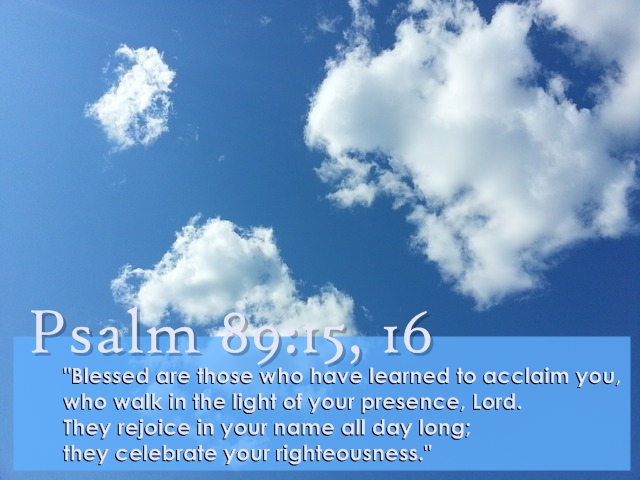
 “Blessed are those who have learned to acclaim you,

Who walk in the light of your presence, O Lord.

They rejoice in your name all day long;

They exult in your righteousness.

For you are their glory and strength”

(Psalm 89:15-16).

*     *     *     *     *     *     *     *     *     *

Dare I say it?  Is it too irreverent? You are FUN, God! I love spending time with you, rejoicing in you, celebrating your works, reveling in your presence, taking delight in our communication back and forth. What a glorious privilege you have granted us, Father, to nestle close to you and experience fullness of joy and pleasures for evermore.  Thank you for being our ultimate delight!

(Psalm 100:1-2; John 10:27; Psalm 65:2; Isaiah 40:11; Psalm 16:11)


What are some ways YOU enjoy God?  Please share in the comment section below!


(Photo credits:  www.imgarcade.com; http://www.pam-intheshadowof his wings.blogspot.com; http://www.sciencedaily.com; www. specificfeeds.com.)


Read Full Post »

prd_007161


His kayak paddle provided more steering than propulsion, as the tourist enjoyed a quiet excursion past tall conifers and wide-armed hardwoods. Slowly he meandered southward, confident that returning to his launching point would not be a challenge.  The man at the kayak-rental shack had assured him: surface water flowed at just over one mile per hour. And should he fall out of his craft, no real danger would threaten. The water was only three feet deep, and the shore not more than ten feet to either side.

It’s hard to imagine, the kayaker thought,  that this narrow, shallow stream actually becomes a mammoth river. He’d been told the stream was fed by underground springs, and flowed another 2,300 miles from where he paddled. Along the way, more rivers would flow into it. And when the fresh water finally met salt, the river would be over a mile wide.

Mississippi-River

Have you guessed the name of this waterway? It’s the grand and powerful Mississippi. Yet its headwaters is a tame little stream, fed by a few underground springs or fountains.

Such a river offers an illuminating picture of our relationship with God. We are the rivers, and…

…“[God] is the fountain of life,” (Psalm 36:9).

Anglican bishop John James Stewart Perowne (1823-1904) said: “These are some of the most wonderful words in the Old Testament. Their fullness of meaning no commentary can ever exhaust.”

But if we don’t at least try to grasp the wealth of truth in these six words, we stand to lose much profit.

So let’s consider that, as our fountain of life:

  • God the Son is the source of all life, and all life is sustained by him (Hebrews 1:3). Without him, all life would cease.
  • In him we live, and move, and have our being (Acts 17:28).
  • He is like a spring of water welling up to eternal life in our spirits (John 4:14).

Those are wonderful concepts, which Dr. Perowne surely had in mind as he contemplated Psalm 36:9. Yet our triune God is like a fountain of spring water in more ways.

First, a bit of digression. No doubt you’re aware that bottled spring water is a big business these days, supposedly offering water that is much superior to what comes out of the tap. Critics have their doubts.

But our God is 100% perfect! No doubt about it.

 psalm8-how-excellent-your-name0

“He is the Rock, his works are perfect, and all his ways are just. A faithful God who does no wrong, upright and just is he” (Deuteronomy 32:4).

Consider as well the following scriptures, which itemize his excellent perfections. And keep in mind they come to us in unending supply:

  • Presence.  “I am with you always” (Matt. 28:20).
  • Reliability.  “The plans of the Lord stand firm forever; the purposes of his heart through all generations” (Psalm 33:11).
  • Right-Doing. “His righteousness endures forever” (Psalm 111:3).
  • Faithfulness.  “The faithfulness of the Lord endures forever” (Psalm 117:2).
  • Sovereignty.  “He rules forever by his power, is eyes watch the nations” (Psalm 6:7).
  • Love.  “His love endures forever” (Psalm 100:5).
  • Compassion.  “[The Lord’s] compassions never fail” (Lam. 3:22).
  • Protection.  “Save your people and bless your inheritance; be their shepherd and carry them forever” (Psalm 28:9).
  • Stability.  “The Lord is the Rock eternal” (Isaiah 26:4).
  • Joy.  “With joy you will draw water from the wells of salvation” (Isaiah 12:3).
  • Blessing.  “Surely you have granted him eternal blessings and made him glad with the joy of your presence” (Psalm 21:6).
  • Grace.  “God is able to make all grace abound to you, so that in all things at all times, having all that you need, you will abound in every good work” (2 Cor. 9:8).

That’s an even dozen attributes. But since our God is infinite, his attributes are also infinite. We’ve barely begun to explore his perfections. In addition, he will forever expend those attributes for our good (Romans 8:28)—not only outwardly, as he engineers circumstances, but inwardly as we allow his attributes to flow in us.

In addition, God is flowing through us, so we can provide life-giving grace to those around us—grace that expresses itself in love, compassion, and blessing.

And that brings me to another metaphor–for those tributaries that pour into the Mississippi. They remind us of the influence of others in our lives–faithful and mature family members, friends, pastors, and teachers, who come alongside us by example and with wisdom, providing strength and growth.

Mississippi_watershed_map_1

Chances are, those tributaries of the Mississippi are also fed by springs. For every believer, our triune God is the pure, ever-flowing, life-giving source of all that is excellent, and everything we need for a fulfilling life.

Is your heart overflowing with praise?

*     *     *     *     *     *     *     *     *     *

We do give you praise, oh God! You are the fountain of our abundant and excellent spiritual life. You are the only spring that quenches our thirst for fulfillment, joy, peace, and satisfaction.  Thank you for flowing in us, so these desires and more are fully met. And thank you for flowing through us, so we might have the privilege of sharing your living water with others.


(Information about the headwaters of the Mississippi from the Mississippi Headwater Board and wikipedia.org.  Photo & art credits:  www.nature.org; http://www.1mississippi.org; http://www.fbcphil.org; http://www.agodman.com; http://www.wikipedia.org.)


Read Full Post »

 picture-uh=715ce81d4af48c56d62e992073bfe9-ps=3da463e4536b201b56c385877e59a7

 (Photo from http://www.trulia.com.)

“There it is, Mom, “ Steve remarked, as he pointed to a little white house in the middle of a city block. “That’s where we lived when I was growing up.”

“Oh, yes,” she replied. But did Mom really remember?

We were on an excursion through Columbus, Ohio, taking Steve’s mother past the landmarks of her life. Alzheimer’s disease had already stolen away much of her vibrancy and warmth, and, of course, her memory.

 corner

Steve drove by West High School and continued his commentary. “That’s where we all went to school, you, Dad, Karen, and me. You were the very first homecoming queen.  How about that?  No wonder Dad asked you out.”

She murmured assent to Steve’s comments, but added nothing of her own.

 unnamed

We drove past the brick ranch they built out in the country in 1966. Horses used to reside beyond the back fence. Just a few houses had dotted the area back then. By this time, however, they had been swallowed up by dozens more. The saplings Mom and Dad had planted were now tall shade trees.  And the glorious flower beds and window boxes that Mom had tended were gone. She registered no recollection.

 unnamed

But when we approached her childhood home, a white Dutch Colonial on a quiet street, all of a sudden she perked up.  Pointing to a second-story window, Mom stated firmly, “That was my room, right up there.”

In the midst of the fog that is Alzheimer’s, one memory–one glimmer of light–shone through that morning. Steve and I almost gasped at the wonder of the moment. Mom remembered!

And the rarity of her memories pointed to the preciousness of this ability. Memory is a gift to be treasured. The older I grow, the more I appreciate the miraculous power of the brain to store millions of memories—with astounding detail–and yet access a particular one in a mille-second.

 1033249144001_2034162247001_900944612-159-1355440419795

Not only do sights trigger memories, but also smells. Researchers say this sense is the most powerful memory-inducer. For me, the aroma of fresh-baked bread always takes me back to my grandmother’s kitchen.

Sounds trigger memories as well—particularly music. Tastes and textures work the same phenomenon.

But surely God had more purpose in mind for giving us memory than the pleasant pastime of reminiscing.

Indeed.

Memories foster gratitude, as we contemplate God’s goodness to us in the past:

  • His countless blessings (even when we haven’t been a blessing to him).
  • Those times he led us through the shadow of death, so that we might experience more completely the glory of his light.
  • Moments when we almost gave up hope, and God surprised us with his creative, abundant provision.
  • Leaving behind what we once were and celebrating what we have become, solely because of his Son, Jesus.

Memories foster faith, as we remember how God has met our needs in the past. See if each phrase from Psalm 103 doesn’t trigger a memory in your mind, and a song of praise in your heart:

“Oh, my soul, bless God,

Don’t forget a single blessing!

He forgives your sins—every one.

He heals your diseases—every one.

He redeems you from hell—saves your life!

He crowns you with love and mercy—a paradise crown.

He wraps you in goodness—beauty eternal…

…God makes everything come out right.

He puts victims back on their feet…

…God is sheer mercy and grace;

Not easily angered, he’s rich in love.

He doesn’t treat us as our sins deserve,

Nor pay us back in full for our wrongs.

(Psalm 103:2-10, The Message)

Memories inform the present and provide hope for the future. As we meditate on all those times God has wrapped us in his goodness (v. 5), we are strengthened for what we face today. As we consider the many times he made everything come out right (v. 6), we can trust he will continue to make our paths straight.

Of course, there are some memories we would like to erase—those that generate sadness, hurt, or regret. How do we deal with those? Here are a few suggestions I’ve collected over the years:

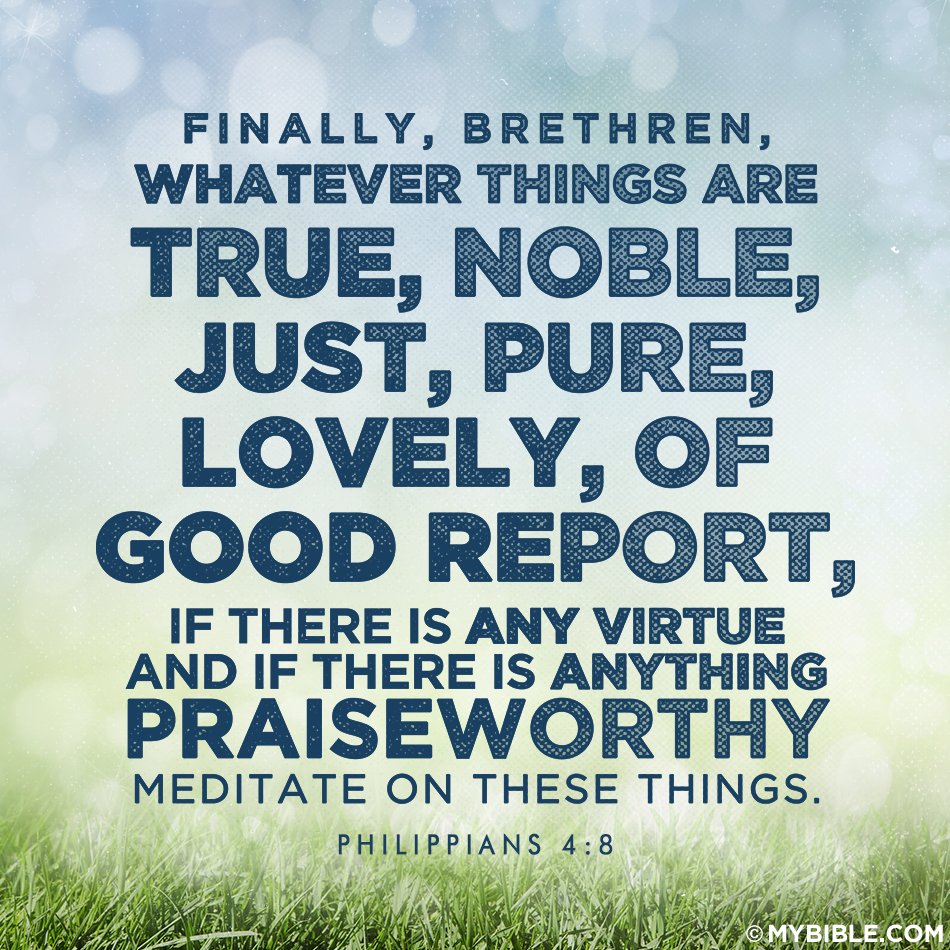
  1. We must resist self-pity—even in our thought life. Nowhere in scripture do we read that rehashing the negative is therapeutic. God’s way is to focus on the positive (Philippians 4:8).

Phil-4-8


  1. We can follow Paul’s example. He forgot what was in his past and pressed on to what lay ahead (Philippians 3:13). Not that amnesia had set in. Paul simply did not allow past failures to cripple his relationship with God and his service for God. God had forgiven and forgotten; Paul did too. No doubt he applied Philippians 4:8, not only to self-pity, but also to guilt. 
  1. We can leave the past in God’s hands. Oswald Chambers said it so well:

 c6d7d32bbdc18d2507a48f8aefa26359

(“Leave the irreparable Past in His hands, and step out into the Irresistible Future with Him”

–My Utmost for His Highest, Dec. 31.)


*     *     *     *     *     *     *     *    *     *    

Father, I do thank you for the gift of memories—the ability to remember with joy and appreciation the people, places, and experiences of the past. I even thank you for the not-so-good memories, knowing that you use every difficult situation for the development of my maturity (James 1:2-3). And may I take advantage of the wisdom gained in the past to guide me in the present, and lead me into the Irresistible Future with you.


Art & Photo credits:  www.trulia.com; http://www.westhighalumni.com; Steve’s photo collection; http://www.allrecipes.com; http://www.god.com; http://www.pinterest.com.

Read Full Post »


finding_contentment_wide_t_nv


According to research, guess what percentage of our happiness is based on circumstances.

A. 10%?

B. 25%?

C. 50%?

D. 80%?

 The answer? Just 10%.

Now why would that be? My guess is, our perspective matters more than our circumstances.


Contentment-723x1024


 (“Contentment is not the fulfillment of what you want,

but the realization of how much you already have.”)


Ah, yes. Gratitude. Definitely an important attitude, contributing to the sweet, even-keel life of contentment. But it doesn’t come naturally to most of us.

Our thoughts, if left untended, can easily fall into a dark hole of:

  • Self-centeredness. “Yeah, the budget’s tight, but I really need a new car. It’s downright embarrassing to drive around in our old clunker.”
  • Self-pity. “It’s not fair that I’m not paid what I’m worth. I work so hard.
  • Self-justification.  “I deserve that new car.”

Note the focus on self. And half the time (or more) we don’t even realize how much of our thought life spins around in that dark hole.

How can we possibly climb out?   Time and attention are required to develop a mind that frequently contemplates thanks-giving and praise instead of complaint-making and dissatisfaction.

Even the apostle Paul said he had to learn how to be content whatever the circumstances (Philippians 4:12).  And like any new skill, developing contentment requires a bit of knowledge and a lot of practice.


dad1ef5d3113528298849bf74da82f41


The best place for knowledge on such a topic is scripture. Several passages can inform our understanding of contentment.

  1. King Solomon said, “The fear of the Lord leads to life; then one rests content, untouched by trouble” (Proverbs 19:23).

Not that reverencing God protects us from trouble and every day is glorious. Bad things still happen to good people. But those who reverence God and worship him see life from a different perspective. They can be content even when catastrophe strikes, knowing that God will see them through.

 Think about Daniel in the lions’ den, or Peter and Paul in prison.

  1. Paul said he didn’t really care if he was living in plenty or in want (Philippians 4:12).  How is that possible? He answers in the next verse, and it’s a familiar one: “I can do everything through him who gives me strength.”

Living in plenty–with God–taught Paul how to keep his priorities straight.   Living in want–with God–taught Paul to detach himself from “things.”

  1. Paul told Timothy, “Godliness with contentment is great gain” (1 Timothy 6:6).

 When we think of a man with “great gain,” we imagine a person with a large, beautifully decorated home, designer suits, two or three cars (for his own use—family members have their own cars), and the capability to go on expensive vacations.

But what about the young Christian father who thanks God every day for his loving wife and two precious kids? Who enjoys a circle of fun, supportive friends at church that also help him keep his priorities straight? This guy lives in a two-bedroom ranch, drives a ten-year old car, and spends vacations taking day trips from home.

Yet he’s rich, too–maybe even more so. It’s just that his riches fall into a different category. He’s rich in relationships, especially with God. “True godliness with contentment is itself great wealth” (I Timothy 6:6, NLT).


contentment


Now that we’ve absorbed a bit of scriptural understanding, it’s time to practice what we’ve learned. How can we foster contentment in our spirits?

  1. Cultivate a positive, faith-filled perspective by turning “I wish” statements into “I praise” statements.

Paul was under house arrest in Rome when he wrote to the Christians at Philippi. His days as an adventuring missionary were most likely over; the future looked bleak. Once his trial took place before Nero, Paul knew he could be facing execution.

He might well have said, “I wish I could be back on the road again preaching the gospel. It makes no sense why God has let this happen. I wish he’d get me out of here!“

But Paul’s response was far removed from wishful thinking. He actually praised God that his circumstances were advancing the gospel (Philippians 1:12-18).

  1. Feed our confidence in God, not our comparisons to others. Contentment wells up in our spirits when our thoughts are grounded in scripture, praise, worship, and gratitude.
  1. Focus on the present—look for the blessings of right now. “We will become content as we enjoy each day for what it is rather than moan about what we imagine it could have been” – Bruce Goettsche.


833b4774bad851af93b88d4b5f8824e3_new_medium


An airline pilot was flying over a lake when he turned to his copilot and remarked, “See that little lake? I used to fish there a lot when I was a kid. Every time a plane would fly overhead I’d think, “Boy, I sure wish I was flying that plane. It must be so wonderful to soar through the sky and see for miles and miles. Now do you know what I’m thinking? How I wish I was down on that lake fishing!”

I don’t want to be like that pilot. I want to be like Paul.


(Art credits:  www.covgrace.org; www,janellenichol.com; http://www.quoteimage.com; http://www.ponderingtheheartofjesus.com;  www.i.mobypicture.com.)


Read Full Post »

Fantasyland_Full_17089

Visit a theme park and you soon learn that part of the adventure is waiting in line–even if you pay extra for fast passes.

Such was our experience at Disney World two years ago. The castle of Beauty and the Beast required wait time—well over an hour. But friends of our daughter had told her, “Don’t miss it,” so we joined the long, looping line.

You may also know that, while you wait, the folks around you can become like friends. Topics such as home state, kids’ ages, and other experiences in the park, get the conversation going. Commiserating over the long line adds to the camaraderie.

Finally we approached the entrance to the castle. Only fifty or so guests were allowed past the gilded rope. This was our first surprise, since most theater-attractions seat hundreds of people. (No doubt there are at least several theaters within the castle, to accommodate the crowds. But each group enters separately, totally unaware that there must be identical venues down alternate hallways.)

First, we were ushered into an outer room, hosted by a footman, I believe. He assigned roles to many of the guests. Among them, the father from Michigan with the four kids became a butler, the little ballerina (who had performed intermittently as we waited in line) became a teacup, our son-in-law, a knight, and our granddaughter, a salt shaker. Each participant was given a colorful placard to identify his or her part. The footman explained what they would need to do, once we entered the library to meet Belle.


Enchanted-Tales-with-Belle1


One particular role seemed completely inappropriate. For the Beast, the footman chose a little girl with an obvious limp.  It seemed cruel to choose such a child for the Beast, of all characters.  As he draped a red cape over her shoulders, I thought, He probably didn’t notice her difficulty walking. But those of us who had become acquainted outside the castle knew full well: this was going to be awkward.

Soon we were ready to enter the library and meet Belle. Our small gathering of almost-friends filed into the dimly lit, cozy room.  Most of us sat close together on benches.

Beautiful Belle, in her yellow satin gown, directed the teacups, salt shakers, and other dancers in a delightful little polka, while the knights stood guard. Such an elegant and charming princess, that Belle.

Then she said it was time for her dance with the Beast.

Our new little friend slowly and carefully approached Belle without any sign of self-consciousness. Her eyes locked with Belle’s, glistening with pleasure and adoration. Gently, they nearly waltzed, Belle being mindful to accommodate Beast’s handicap. And for a few precious moments, that little girl’s physical challenges were forgotten in the inexpressible delight of dancing with Belle.

Suddenly, my eyes filled with tears. That little girl had been the perfect choice for Beast. Her ecstatic joy was obvious in the non-stop smile and luminous eyes. She was the center of attention of a princess—someone whom she dearly loved and greatly admired. Even more poignant, the sweet look of love returned by Belle, her gracious intentness focused entirely upon the child.

Love soon encompassed the entire room. Surely every guest felt it, not just me. We loved the child for her precious innocence. We loved Belle for her warmth and kindness. We even loved each other, as almost-friends, sharing in this  miracle—a once-in-a-lifetime experience, never to be repeated.

But wait.  In actuality such euphoria and reverence is available to us–every day.

We can keep company with Jesus, our Prince of Peace —not just for a few miraculous moments, but  All.  The.  Time.  In fact, like the father of the prodigal son, he waits in eager anticipation for us to come “home” to him and linger there.

We can be transformed, just like that little girl.   For the length of that magical dance, she was blissfully unaware of her handicap. Why? Her attention was riveted on Belle.  Paul challenges us to do the same in the spiritual realm:   “Fix your attention on God,” he said.  “You’ll be changed from the inside out” (Romans 12:2, The Message).

We can experience love beyond imagination. Belle portrayed perfect love for one shining moment; God is perfect love (1 John 4:8). And the love of his Son, Jesus, is wider than any experience we encounter, longer than our lives last here on earth, and higher, purer, and deeper than any other love (Ephesians 3:18).

And then, one glorious gift that even the lovely Belle could not bestow.  We can be healed of our handicap, the handicap of sin.  Jesus paid the price for our sin when he died on the cross.  He sacrificed himself so that we could be healed of the ravages of sin and enjoy a God-enhanced life (1 Peter 2:24; John 10:10).

With ecstatic joy we can revel in all the privileges of one-on-one relationship with our Prince, who loves each of us as if there was only one of us (St. Augustine).

*     *    *     *     *     *     *     *     *     *

Oh, Prince of Peace, what an astounding privilege you grant us, to bask in your perfect love each day.  Thank you for the assurance of your love throughout scripture, reminding us that we are precious and beloved to you.  May our status as your precious ones free us to live unencumbered by self-consciousness, fear, and worry.  And may we never fail to express your gracious love to those around us.


(Photo credits:  www.wdwmagic.com; http://www.galleryhip.com)

Read Full Post »

Our neighbor, Christine, happened to be in her yard yesterday morning (in spite of frigid temperatures), as I was leaving to babysit our granddaughter. Christine was picking up trash that had blown in front of her house.

“I’ll be so glad when this weather warms up,” she called, stooping to gather more bits in her bag-covered hand. We encouraged each other with the forecast for the weekend: temperatures approaching fifty degrees.

Actually, I haven’t minded the deep freeze that has gripped the Midwest for most of January.  After living in Florida for forty years, I see cold weather as a pleasant change from stifling hot temperatures and hard-to-breathe humid air. (Give me a few years up here, and I might be longing for that heat again.)

th1

For now, these wintry January days offer a multitude of pleasures:

  • A bit of rest after the bustle of Christmas.
  • Feathery cirrus clouds gracing the sky.
  • Cardinals, juncos, and flickers cavorting in the trees on the occasional temperate, sunny day. (Without foliage to obscure the view, we can watch their antics unobstructed.)
  • The soft, pale glow of winter sunsets.
  • Plumes of smoke winding lazily upward from the neighbors’ chimneys.

stock-footage-little-town-s-morning-winter-view-the-main-accent-in-the-shot-is-rising-sun-and-rising-up-smoke

  • Candles glimmering cheerily as dusk falls.
  • The scent of homemade chicken soup simmering on the stove. (Granted, soup can be enjoyed anytime, but it takes a chilly evening to bring out the best of a savory bowl.)
  • Hibernating by the fire, computer on my lap, hot tea in a thermal mug at my side.
  • Layering myself in soft, cozy clothing—and Smartwool socks!
  • Quenching my thirst with a drink of water from the faucet–and it’s already cool – no ice necessary.
  • That first “Ah” moment upon entering the warm house. (Entering a cool house in Florida is more of a “Whew!” moment!) The coziness of home is most appreciated when cold winds blow outside.
  • Nature renewing itself for the life-burst of spring. One sign: buds on the magnolia tree are already growing plump.

Winter_Snow-covered_trees_at_the_lake_046387_

And what about those times when snow covers the landscape? Oh my. The enjoyment is magnified ten times.

  • Delicate flakes waltz in quiet descent.
  • Trees become dressed in lace.
  • Light glistens and sparkles from the brilliant snowscape.
  • A quiet hush surrounds us, as the freshly fallen snow absorbs sound.

All precious gifts, indeed.

*     *     *     *     *     *     *     *     *     *

Heavenly Father, I thank you that the whole earth is full of your glory, even in bleak winter.

In the snowflakes we see your never-ending creativity.

In the full magnolia buds we see the hope of spring, symbolic of our sure hope in you.

In the pleasure of a warm home and crackling fire we glimpse the refuge you offer to us: a place of safety, comfort, rest, and delight.

In the purity of white snow that covers the gray and the dismal, we see a reminder that you cleanse away our sins and make them white as snow (Isaiah 1:18).

And in the beauty and hush of a winter snowscape, we find our attention drawn to you. In quiet, wondrous worship. we give praise to you, our gracious, glorious God!


*     *     *     *     *     *     *     *     *     *


What gifts of winter do you most appreciate?


(Photo credits:  www.zatavki.com; http://www.blog.snyderac.com; http://www.shutterstock.com.)


Read Full Post »

Ec3.11

“Everything is beautiful in its time,” Solomon wrote (Ecclesiastes 3:11).

That means today is beautiful—in spite of the long to-do-list, the stress, the mess, the frustrations, the disappointments, the uncertainty, the pain.

How can that be?

Because the negative aspects of our lives do not need to supersede the positive.

God’s glory—his splendor, his creative genius, his love—is being expressed all around us, every day, as…

…pinpoints of sunshine glimmer on a fresh dusting of snow.

…cups of hot tea warm the hands and spicy citrus flavors warm the spirit.

…the baby squeals with delight while chasing bubbles in the kitchen.

…the mail includes a handwritten note.

…a song on the radio speaks encouragement, perfectly suited to a current situation.

…the fire crackles merrily, enticing one to sit and rest in its glow.

The question is, am I aware of the God-infused beauty around me? Am I pausing from my work every now and then to look for it?

Sometimes my vision is clouded by the past. Guilt over poor choices and hurt over unfair treatment can interfere with the enjoyment of now. Even past blessings can be a distraction, if my attitude is, “Oh, if only I could go back to __________. Those were the best years of my life.”

Not that the past doesn’t serve us in the present. Experience is an important teacher. But when I keep looking back with longing, I miss the present.

On the other hand, a preoccupation with the future (the way I would like life to be next month or next year) can also interfere with my full participation in the present. Wishful thinking can easily slip into covetousness.

“Watch out!” Jesus said. “Be on your guard against all kinds of greed; a man’s life does not consist in the abundance of his possessions” (Luke 12:15). Would I be stretching the truth of his statement to say: A beautiful life does not consist of the perfect spouse, perfect children, a perfect house, and a perfect job—even if such perfection existed.

A joy-filled life comes from embracing the gifts of each day. “We should make the most of what God gives, both the bounty and the capacity to enjoy it, accepting what’s given and delighting in the work. It’s God’s gift! God deals out joy in the present, the now (Ecclesiastes 5:19-20a, MSG).

I need to train myself to stay in the present, to enjoy the beautiful moments God is granting me now—to the fullest.

If the to-do list is long, I want to invite God to set the priorities and help me accomplish what is needful for that day. Those items that must be held over to another day may be postponed guilt free, because “there is a time for everything” (Ecclesiastes 3:1). A simpler, slower-paced life will certainly be a more beautiful life.

If uncertainty plagues my thoughts, I want to embrace the truth that God is in control, including the timing of events. He will keep me in perfect peace when I keep my mind steadfastly on him and trust in him (Isaiah 26:3). Trust is at the heart of a beautiful life.

If Plan A (that I was counting on) suddenly becomes Plan B (a debilitating disappointment), I want to accept and even appreciate the change of plan as an opportunity to grow. After all, Plan B did not catch God by surprise. There will be beauty in Plan B, too.

*     *     *     *     *     *     *     *     *     *

Dear God, I thank you that you have made everything beautiful in its time. May I rest in the knowledge that this season of my life, with its particular challenges, was appointed by you. On this day may I:

  • embrace the blessings of NOW,
  • celebrate the completed tasks you gave me to do,
  • handle the challenges with grace and trust in you,
  • grow to be a little more like your beautiful Son, and
  • behold your beautiful glory, on display all around me.  

(Art credit:  www.biblia.com.)

Read Full Post »


0ece76207bc564a5a08ba4dbb2a17fbf


I love all things Christmas–with a few exceptions for the silly (Dancing Santas I can do without.), the gaudy and over-glittered (unless my children made it), and the highly repetitious (“The Little Drummer Boy,” with its twenty-one pa-rum-pa-pum-pums is one example).

But I do look forward to:

  • Evergreen wreaths with cheery red bows perched on light poles in the business district.
  • Colorful lights twinkling from bushes and rooftops.
  • Vanilla-spice Christmas cookies, crisping in the oven and filling the house with sweet fragrance.
  • Candles glowing from table and shelf.
  • Delicate, porcelain figures, circled around Baby Jesus in our treasured family crèche.
  • Beloved carols resounding through the house or sung at church with family and friends.
  • Family gathered from near and far, nestled around the Christmas tree to hear the beloved story of the Nativity once more.

You get the idea.

I’m now getting to the age when all these things are very familiar. I’ve enjoyed them again and again over the decades. Yet they never lose their appeal. Every year, as Christmas approaches, I eagerly anticipate the repetition of each experience.

Why? Why hasn’t boredom set in? It’s not an easy question to answer. But these reasons occur to me as possibilities:

  • My relationship with Jesus influences my response to these Christmas traditions. My joy in the season is greatly augmented because I know him.  And celebrating Someone whom I love and worship is far superior to celebrating a stranger.
  • The Christmas story and its themes of peace, joy, and hope, provide stability in an uncertain, even fearful world. We Christians enjoy the benefit of Christ’s peace, joy, and hope in our hearts every day (Romans 5:1-2).  That, too, is something wondrous to celebrate.

But that’s not all! Jesus is coming again and all the perfections of heaven await those who believe in him. Did you know that for every single prophecy in scripture that foretold Jesus’ birth, there are eight which look forward to his return? Also consider: every prophecy about Jesus’ birth came true; therefore, we can be confident every prophecy about his second coming will also come true.  Christmas is a celebration that not only looks back with great joy, but forward with great hope.

  • Our King of kings and Lord of lords left his perfect heavenly home to dwell among us. He became human that we might be glorified (Philippians 2:6-9; Romans 8:30). He has made it possible for us to enjoy every spiritual blessing (Ephesians 1:3).   And, He is our:

Wonderful Counselor (Isaiah 9:6), guiding our way.

Emmanuel (Matthew 1:23), gracing us with his presence.

Shepherd (Hebrews 13:20), tenderly caring for us.

Rock (1 Corinthians 10:4), providing stability and refuge.

Advocate (Romans 8:34), interceding for us when Satan tries to condemn.

And so much more. Who can help but celebrate our loving Savior?

May all things Christmas turn our hearts and minds to him–his miraculous birth, his perfect life and sacrifice, his glory.

Read Full Post »

desert

Last Thursday we pondered these promises from Isaiah 58:11:

 “The Lord will guide you always,” and

“He will satisfy your needs in a sun-scorched land.”

 Today, more discoveries and encouragement await as we meditate upon the last two promises:

  • “[He] will strengthen your frame.”
  • “You will be like a well-watered garden, like a spring whose waters never fail.”

garden-waterfall-design


Do you long for strength within your frame, that is, inner strength? Perhaps you’re moving as fast as you can, but never quite reaching the end of the to-do list. And you’re bone-weary from the effort.

Perhaps the stresses of life—difficult relationships, a high-pressure job, financial obligations—are squeezing in hard.

Perhaps boredom or depression surround you in a gray shroud, and you haven’t the energy to fight against them.

“He will strengthen your frame.”

But God doesn’t wave a magic wand over us and suddenly turn weakness into strength. Usually he invites us to be part of the process.   And his solutions are radical.

For example, celebrate anything and everything (Philippians 4:4).

3095781994_90a392c03f

Take joy in:

  • Your cozy robe to ward off the morning chill
  • That cute tuft of hair sticking up on your toddler’s head
  • A parking place opening up when and where you need it
  • Licking the stamp just as the mail carrier pulls up in her truck
  • An earring lost last week turns up between the counter and stove this week.

You see, joy and strength are closely related. Ezra told the people of Israel, “The joy of the Lord is your strength” (Nehemiah 8:10).

Those five examples above, and thousands like them, are gifts from your Heavenly Father. “Every good gift and perfect gift is from above, coming down from the Father of the heavenly lights” (James 1:17).

In the same way we can build up physical strength with exercise, we can build up spiritual strength with praise—by expressing gratitude and joy for every good and perfect gift.

And now, the last promise of this verse describes in metaphor the result of living according to God’s design.

“You will be like a well-watered garden, like a spring whose waters never fail.”

TotalChildCareVegetables7 

Visualize a flourishing garden, with rich, green plants overflowing with healthy, ripe produce.

Those can be descriptors of you and me.  We are:

  • Rich in God’s grace, which he has lavished on us with all wisdom and understanding (Ephesians 1:8).
  • Green and flourishing, because we spend time with the Master Gardener and allow him to cultivate our spirits (Psalm 1:2-3).
  • Healthy and prosperous of soul (v. 3). As we soak up God’s Word, we’ll produce actions and attitudes that honor God and bring us inner satisfaction.
  • Ripe and mature, lacking in nothing (James 1:3).

God offers us “a continual source of thirst-quenching, drought-ending, fruit-producing, spiritual hydration” (James MacDonald).

Doesn’t that sound refreshing?  Who could turn down such provision?

*     *     *     *     *     *    *     *     *     *

Thank you, Father, for the precious assurances of these promises: 

  • You are leading me along the path you preordained before time began.
  • Every day of this earthly journey I can count on you to supply my needs.
  • Every day you provide fresh strength. One way is through the exercise of praise.  
  • As I spend time in your presence, I will be transformed–like a garden replenished by hydration. In fact, I can grow into your likeness with ever-increasing glory!

 “Such knowledge is too wonderful for me. It is too lofty for me to attain.” Yet I know it to be true because these are truths from your reliable Word.  My heart overflows with wonder and gratitude.

(Psalm 139:16; Philippians 4:19; 2 Corinthians 3:18; Psalm 139:6)

(Photo and art credits:  www.dayofgrace.me; http://www.anativegarden.blogspot.com; http://www.flickr.com; http://www.naturalearning.org.)


Read Full Post »

jeremiah-3133_3733_1600x1200


While skimming through my grandmother’s Bible, I came across a notation she made next to Jeremiah 31:33.

First, the verse:

 “I will put my law in their minds

And write it on their hearts.

I will be their God,

And they will be my people.”


Perhaps a bit of context would be helpful.

Jeremiah was a prophet of Judah for over forty years. He was instructed by God to speak strong judgment against the people because of their sin. They were following worthless idols and had become worthless themselves (2:5). God promised disaster from the north, even terrible destruction (4:6).

Babylon, the empire from the north, did attack in 586 B.C. and Jerusalem was destroyed.

But Jeremiah offered great hope, recorded in chapters thirty and thirty-one. The verse in bold print above makes clear two glorious assurances.

Assurance #1

“It is God’s work.” (That’s what my grandmother wrote in the margin of her Bible next to Jeremiah 31:33.)

See the phrase “I will” used twice in the verse?  It is our Heavenly Father who initiates the work of transformation in our minds and hearts. We couldn’t make ourselves godly no matter how hard we tried. It is his Spirit who enlivens the instruction of God’s Word to our hearts.

A friend of mine accepted Jesus into her life as an adult. M. once told me that before becoming a Christian, she had tried to read the Bible, but it didn’t hold her attention and didn’t make much sense. But after coming to Jesus? Oh, my! What a difference! Suddenly M. became a ravenous reader of God’s Word. Every word spoke wisdom and encouragement to her heart.

You see, what God provided for my friend (and for all of us who seek him) is a miraculous, spiritual heart transplant.

“I will give you a new heart and put a new spirit in you,” God says.  “I will remove from you your heart of stone and give you a heart of flesh. And I will put my Spirit in you and move you to follow my decrees and be careful to keep my laws” (Ezekiel 36:26-27).

God is not saying he will force us into surgery.   We can accept or reject his offer of a new heart and spirit.

When you receive an appealing offer, how do you decide whether to accept or not? Do you consider the reliability of the person or company making the offer? Probably so.

And when you are given advice to follow, do you consider the source? No doubt.

So let’s consider the One making the offer of a new heart and a new spirit–God Almighty himself.   His love for us is limitless.  He is the all-knowing, all-wise God of the universe. We can trust that his instructions are for our good, that following them will bring peace, contentment, joy, and more.

(Tell me again why we rebel?!)

Assurance #2

He will be our God.

 “When this is fulfilled, you are the possessor of all things,” Spurgeon said.

Think of it: innumerable blessings are ours, beginning with a precious, personal relationship with the King of the universe.

His comforting presence, 24/7.

His guidance and provision for every day of our earthly lives.

And the glory of heaven assured.


*     *     *     *     *     *     *     *     *     *


We praise you, holy God, the One who has informed us through your Word, who transforms us by your Spirit, and conforms us, day by day, to be like Jesus. Praise you for the privilege to be yours, guided and cared for by an all-wise, all-powerful God!

(Photo credit:  www.wallpaper4god.com.)


Read Full Post »

« Newer Posts - Older Posts »

When the House is Quiet

Impressions Becoming Expressions

Mitch Teemley

The Power of Story

Still Traveling

Impressions Becoming Expressions

Living Our Days

Gaining a heart of wisdom

He Said What?!

I'm Patty, and my husband and I are living with our adult son who has autism and epilepsy. I love sharing lessons learned from life around me, especially life with Aaron.

Meditations of my Heart

Impressions Becoming Expressions

Linda Stoll

Impressions Becoming Expressions

Signora Sheila

Where faith meets la dolce vita

Heidi Viars

Finding the Image of God