Feeds:
Posts
Comments

Archive for the ‘Wisdom’ Category

psalm-90-12-230-130

“Teach us to number our days,

that we may present to you

a heart of wisdom”

–Psalm 90:12 (NAS)


I did the math and numbered my days: over 24,000 so far. That means I’m well past the half-way point of the average earthly life. And such a sobering thought would surely weigh heavy on my mind, if I did not have heaven to look forward to.

But I’m certain Moses (the author of Psalm 90, above) wasn’t asking God for a multiplication lesson.

Perhaps in learning how to number his days Moses wanted to: 

  • make each day count by accomplishing worthwhile tasks, or
  • live mindfully so steady growth and learning took place, or
  • dedicate himself to the well-being of others, or
  • look for God throughout each day, worshiping and praising, or
  • revel in the positive instead of grovel in the negative.

Perhaps Moses was thinking of all those things.

According to two commentators, Numbering our days means:  1) living in such a way that each day has value, and 2) living intentionally in ways that bring glory to God and blessing to others.

Then notice what Moses indicates will happen when we live with those supreme purposes:

We’ll be able to present to God a heart of wisdom—a heart with “the ability to see life from God’s perspective, and then to know the best course of action to take” (p. 1055, Living Application Bible). 

That seems to me a lovely gift to present to my Heavenly Father—accepting his perspective and acting upon it.


Charles-Spurgeon-Quote-Wisdom


But learning to number our days and grow in wisdom are such abstract processes. It’s difficult to determine progress. So how might we know that we’re learning and growing? These ten questions may help; they’re based on the Book of Wisdom, Proverbs. Try answering in the context of the last ten—maybe even twenty—years:

  1. Am I more aware of God’s daily gifts and more grateful to him for these blessings (15:13)?
  2. Do my thoughts frequently turn to God during the day? Am I continually turning to him for guidance? (2:1-6)
  3. Do I express trust in God more often than worry about circumstances (3:5-6)?
  4. Am I pursuing biblical instruction (8:33-34a)?
  5. Do I take great pleasure in building up others (10:11)?
  6. Am I able to think before I speak (10:19b)?
  7. Do I give people the benefit of the doubt (19:11)?
  8. Am I becoming more patient and kind–especially toward challenging people (25:21-22)?
  9. Do I thoughtfully consider the advice of those who are knowledgeable and wise (19:20)?
  10. Am I able to do what’s right even when there’s no one around to notice (10:9)?


a0ea4e208506c36a35ddbfffcd0cd872


Scripture tells us that when Abraham died, he was “satisfied with life” (Genesis 25:8, NAS).  Surely satisfaction with life includes the development of a heart of wisdom, which Abraham demonstrated by his life of faith–in spite of challenges, disappointments, and uncertainties.

But the pinnacle of satisfaction must have been presenting that heart of wisdom to God Almighty on the day he entered heaven’s gates.

My prayer is that I’ll be able to do the same.

You, too?

“What we weave in time

is what we’ll wear in eternity.”

– Mart DeHaan


(Photo and art credits:  www.faithgateway.com; http://www.quotesgram.com; http://www.pinterest.com.)

Read Full Post »

Depressed young woman


“I don’t understand why this is happening,” Kelly cried. “Doesn’t God want me to be happy?”

*     *     *

“I’m not sure what God is doing, but business is bound to pick up soon,” Dave asserted. “I’m working harder than ever—like seventy hours a week. God helps those who help themselves, right?”

*     *     *

“I thought I was where God wanted me to be, but that loser job was not a good fit—such boring work and for such a lousy salary,” moaned Erika. “I just had to quit! But I’ll be OK. God loves me; he’ll take care of me.”

*     *     *

Ever hear comments similar to these? Each one represents a misunderstanding about God. The truth is:

  • God’s primary concern is our welfare, not necessarily our happiness (Philippians 4:19). The two are not synonymous.
  • God has not promised to help those who help themselves. That proverb is not in the Bible.
  • Neither has God promised to take care of us if we live irresponsibly (2 Thessalonians 3:10).

So, I’m sorry, Kelly, Dave, and Erika. Somewhere along the way you’ve heard these ideas about God’s ways which were misrepresented as truth.

But how can we know the truth of how God works in our lives? (They might ask!)

By becoming better acquainted with God’s Word. Within its pages we find such wonders as perfect wisdom, inspiring encouragement, hope-giving promises, and practical instruction.

For example:

Kelly, God loves you too much to grant everything you want. Over-indulgence leads to spoiled children. Discipline demonstrates true love; permissiveness demonstrates foolishness. Sometimes God exercises tough love in order to develop our characters, grow our faith, and prepare us to serve him in greater capacities.


no-pain-no-gain

(“The Lord disciplines those he loves”–Hebrews 12:6a).

Dave, God is compassionate and good to his people (Psalm 103:4-5). He has promised to be our help, but it has nothing to do with our effort prompting him to come alongside. It’s the person who trusts in God wholeheartedly and follows his ways who may anticipate divine help:

“You who fear him, trust in the Lord—

he is their help and shield.”

–Psalm 115:11

and…


16072

(“May your hand be ready to help me, for I have chosen your precepts” –Psalm 119:173.)


Erika, God certainly does care for you (1 Peter 5:7), but he does not condone irresponsibility. A wise course of action would include prayerful assessment of the current job as well as other possibilities, while asking God for his guidance. Meanwhile:

“Do your best.

Work from the heart for your real Master, for God,

confident that you’ll get paid in full

when you come into your inheritance.

Keep in mind always that

the ultimate Master you’re serving is Christ.”

–Colossians 3:22-24 (The Message)

To all of us: When our corner of the world is rocked by challenges and disappointment, our best strategy is to turn to God’s Word. We can steady ourselves with the truth about his character and his ways, even experience joy and peace as those truths soak deep into our hearts (Psalm 119:35, 165).

“It is only when we understand who God is

that we begin to understand what he does.”

– Selwyn Hughes

*     *     *     *     *     *     *     *     *   *

Thank you, Father, for the precious gift of your Word, for the way it continues to minister afresh, day by day, year after year, with reliable truth and uplifting encouragement. As if that wasn’t enough, you reveal yourself through its pages, allowing us to know you, the King of the universe. Open my eyes that I may see even more wonderful things in your Word (Psalm 119:18)!

b4015e676ff0bec5726ece111fd8d5ee

(Art & photo credits:  www.med-health.net; http://www.kristamcgeebooks.com; http://www.biblepic.com; http://www.pinterest.com.)

Read Full Post »

FORTUNE COOKIE WITH BLANK FORTUNE

‘Cracked open a fortune cookie not long ago and discovered this bit of wisdom:

“It’s not the years in your life,

but the life in your years

that counts.”

Come to find out, that’s not from Confucius or any other Chinese sage.  It’s from a beloved, former U.S. president, Abraham Lincoln.

Many folks might interpret this proverb to mean:

Live each day to the fullest; a full life is a meaningful life.

But what brings fullness to the day? And what makes a life meaningful?

The answers to those questions lie in another collection of proverbs, not found in fortune cookies, but in the Bible:

  1. A meaningful life comes from finding favor with God and with others (Proverbs 3:4; 21:21). 

Proverbs 3:3 names the qualities that garner favor: faithfulness and love.

It’s true.  Those two character traits play out in goodness, generosity and grace. Without fail, that kind of person experiences great satisfaction in her relationships. After all, that’s how God designed us (Acts 20:35).

“A full life cannot be measured by the quantity

but rather the quality of one’s relationships

with others and with God.”

–Warren Mueller

  1. A meaningful life comes from living wisely (Proverbs 8:35).

And just how do we do that? By applying integrity to our actions, discretion in our conversations, and prayerful, Spirit-led discernment in our decisions.

“Wisdom is the power to see

and the inclination to choose

the best and highest goal,

together with the surest means of attaining it.”

–J. I. Packer

And wisdom leads to peace of mind, contentment, and a clear conscience—important foundation stones for a meaningful life.

  1. A meaningful life comes from internalizing God’s ways (Proverbs 11:28, 21:21). 

These proverbs, (11:28 and 21:21), provide a corollary to the previous one. A wise person follows the course of conduct established by the Father of Wisdom and revealed in the Bible.  He made us; he knows the best way for us to live.

Countless millions have devoted their lives to the accumulation of stuff, the pursuit of fame, and the climb to a position of power.

Yet King Solomon (who had it all) proclaimed: “Meaningless! Meaningless! Utterly meaningless! Everything is meaningless” (Ecclesiastes 1:2).  Did you notice that four words out of seven in that verse are the same?   “Meaningless!” I hear a bit of frustration in Solomon’s voice, don’t you?

Wouldn’t it be wise for us to avoid the mistakes he made? Maybe we should post that verse on the fridge, to keep us grounded in what really matters: God’s purpose for our lives.

“No real meaning exists

apart from linking our lives

to God’s purpose.”

–John Maxwell

  1. A meaningful life comes from reverencing God (Proverbs 14:27; 19:23). 

And reverence includes honor, respect, adoration, and awe. Embracing these attitudes toward God leads to deep satisfaction, complete peace, and true joy, because:

“The man who has God as his treasure

has all things in One.”

–A.W. Tozer

  1. A meaningful life comes from trusting God (Proverbs 16:20b).

God alone knows me better than I know myself. He alone is aware of what’s going on in the lives of those around me. And he alone can see into the future. Why do I think I’m capable of moving ahead on my own?

Even when trouble comes to call, I can rest assured that such experiences have purpose and meaning (Romans 8:28).

I would do well to remember: 

“Relinquishment is a prerequisite to fulfillment.”

–Eugene Peterson

  1. A meaningful life comes from an attitude of humility (Proverbs 22:4).

Humility is the proper perspective of oneself, especially in relation to God. He is all-powerful, all-wise, all-seeing, and more. Reminding ourselves of his magnificence is one way to foster humility.

Another way is to be thankful. A full, satisfied life is grounded in humble gratitude.

“Gratitude can transform common days into thanksgiving,

turn routine jobs into joy,

and change ordinary opportunities into blessings.”

–William Arthur Ward (italics added)

M-m-m. Living thankfully, joyfully, and blissfully aware of each blessing. Yes, that does sound like a highly satisfactory way to live.

*     *     *     *     *     *     *     *     *     *

Service, Wisdom, Obedience, Reverence, Trust, Humility, and Gratitude.  That’s a long list, Lord.  Perhaps the full, meaningful life is out of reach for me.  Oh, but if I consider the interrelatedness of these qualities, the reach is shortened considerably.  Obedience includes service, and reverence naturally leads to humility.  Humility includes gratitude, and trust leads to wisdom.  Most important of all, YOU want all of your children to experience life to the fullest. Oh, how  I praise you for your direction and provision to make that happen! 

(John 10:10; Philippians 1:6; 2 Peter 1:3)  

(Photo credit:  www.kitchendaily.com.)


Read Full Post »

seagrape03

“Oh, what a beautiful tree!” my mother-in-law exclaimed with enthusiasm. Her comment referred to a tall bush, planted near the house and visible outside our kitchen window. “What’s the name of it?” she asked.  Being from Ohio, Mom wasn’t familiar with some of the unique foliage of our area in south Florida.

“That’s a sea grape,” I told her. “It’s actually a shrub, but they can grow quite tall.”

“Well, it’s lovely. Such big leaves!”

Now clearly there’s nothing remarkable about this conversation, until you know that Mom had asked the very same question with the very same enthusiasm every morning of her visit. And each morning I supplied the same answer.  Mom was in her late 80s, and her dementia was becoming more and more noticeable.

Mom’s fresh outlook each morning reminded me of Lamentations 3:22-23: 

The faithful love of the LORD never ends!

His mercies never cease.

Great is his faithfulness;

his mercies begin afresh each morning (NLT).

his-mercies-are-new-wallpaper_1366x768

Just as Mom brought new enthusiasm to each morning, so God brings new mercies for each day. Yes, the challenges we faced yesterday required wisdom, strength, and perseverance. But today we’ll need a fresh supply.   Praise God he never runs out of such gifts; he is always able to provide.

In the same way, God’s new mercies for today are not meant to be sufficient for tomorrow. In other words, we shouldn’t expect to feel confident and in charge this morning for the potential challenges of the future—much as we’d like to. (Who hasn’t wished to know now exactly how the next day or week will unfold, and how best to respond?)

Instead, our wise and loving Heavenly Father has chosen to lead us one day at a time. And just what is so wise and loving about keeping us in the dark?  So as to protect us from being overwhelmed, easy prey to depression, and paralyzed by fear.

No, our best course of action is to avail ourselves of God’s mercies for this one day. As for tomorrow, we can trust God to supply new mercies, more than sufficient for whatever we might face when the time comes (Matthew 6:34).

I’m remembering Corrie ten Boom. (Maybe this post brought her to your mind, too.)

g25143_u22597_corrie_ten_boom

Corrie and her family suffered cruel hardships in the concentration camps of Nazi Germany, as a result of helping Jews escape the Holocaust.

After the war, people would often say to Corrie, “I wish I had such great faith as yours. I could never live through the experiences you survived.”

Corrie would tell a story to explain.

When she was a child, Corrie happened to see a dead baby. A terrible fear gripped her that one of her family might also die. When Papa ten Boom came to tuck her in that night, she burst into tears.

“I need you!” she sobbed. “You can’t die!”

Her sister, Betsy, explained why Corrie was so afraid.

Papa asked, “When you and I go to Amsterdam, when do I give you your ticket?”

“Just before we get on the train,” she responded.

“Exactly,” Papa replied. “And God knows when you’re going to need things, too. Don’t run out ahead of him, Corrie. When the time comes that some of us have to die, you will look into your heart and find the strength you need—just in time.”

Papa ten Boom was proven right. When Corrie needed supernatural strength, God did provide. We can rest assured that his mercies will be new and fresh each morning for each of us, as needed.

*     *     *     *     *     *     *     *     *     *

I praise you, Lord God, that we can face each day with fresh enthusiasm, because for each trial, you have prepared for us great mercies like endurance, strength, and wisdom. I thank you that in the midst of trouble, you also provide blessings: a more acute awareness of your presence, peace that defies explanation, family and friends to come alongside, miraculous provision, and delightful surprises to make us smile. You are not just a sufficient God; you are an abundantly gracious God!

(Photo credits:  www.mgonline.com; http://www.coffee4thesoul.com; http://www.myhero.com.)

Read Full Post »

200270098-001_XS

 “By myself!” “By myself!” “By myself!” Numerous times each day our granddaughter asserts herself, announcing with much gusto that whatever the task, she can handle it.

But Elena just turned two. Although her confidence is high, skills are limited. When it’s time to go upstairs, “by myself” means down on all fours, one limb at a time. One hand up, and then the other. One foot up and then the other. It is a slow and laborious process.

In addition, the grown-up in her wake must be very sly about offering support. No hand on the back, or even hovering where Elena can see it. She’ll cast aside such safety precautions and announce firmly once again, “By myself!”

Child Washing Hands

Hand washing is another activity she prefers to do independently. But her attempts to pump out a dollop of liquid soap often end unsuccessfully. The soap usually lands in or around the sink—not in her hand.

And once the soap is in her palm, Elena reaches for the faucet. Forget the actual washing. If we try to help, she pulls her hands away. “By myself!” Even when she acquiesces, her scrubbing efforts leave much to be desired. Squeezing is her version.

And rinsing is another issue. “By myself” often results in enthusiastic splattering of water on dry dishes, counter, and backsplash.

spoons

Mealtimes offer more opportunities for autonomy. “By myself” means she will hold her spoon or fork as she chooses, not as the grown-ups have shown her numerous times. Elena has yet to figure out that holding a utensil at the very end of the handle is not very efficient.  (The child in the photo is not our Elena, but is demonstrating the same technique.)

Because of her unwieldy grip, Elena ends up turning the spoon upside down as it approaches her mouth. Needless to say, most of the food ends up on her chin, in her bib pocket, on her clothes, on the tray, or back in the dish.

We shake our heads and roll our eyes. Toddlers!

Then it dawns on me. Sometimes I’m not much more mature than a toddler in God’s family. I’ve been known to proclaim “by myself,” too:

  • “Yes, Lord, I need you to take care of the important matters, but I can handle the small stuff by myself. ”
  • “I’ll make this decision by myself, Lord, because—to be honest–I’m not sure I’ll like your choice.”
  • “I can decide by myself what will make me happy, Lord.”

Yep, I can be as foolish as a toddler, even though great wisdom is available to me.

way of wisdom the_t_nv

Wisdom such as:

“Start with God.

The first step in learning

is bowing down to God.

Only fools thumb their noses

at such wisdom and learning”

(Proverbs 1:7, MSG).

Ouch. But Solomon is right.  God made me; he knows the best course for me. Over and over again he has proven himself worthy of my trust — guiding my way, providing for my needs, empowering me to accomplish his plans.

If I can’t trust the One who died for me, who can I trust?

Any time I’m tempted to approach a situation or decision by myself, I need to remember:

“God always gives the best

to those who leave the choice to him”

–Selwyn Hughes

*     *     *     *     *     *     *     *     *     *

Oh, Father, forgive me for the times I have foolishly asserted my independence. Help me to relinquish control to you. I’ve lived long enough to know from experience that living life by myself does not result in satisfaction. Help me become a person who turns to you first, and asks, “What do YOU want me to do, Lord?” because you are the all-wise One of the universe.  And I know the benefits of following you will far outweigh any costs.

(Photo credits:  www.motherhood.modernmom.com; http://www.childcare.oxfordcounty.ca; http://www.cleftstories.com; http://www.covedevotions2010.blogspot.com.)

Read Full Post »

 picture-uh=715ce81d4af48c56d62e992073bfe9-ps=3da463e4536b201b56c385877e59a7

 (Photo from http://www.trulia.com.)

“There it is, Mom, “ Steve remarked, as he pointed to a little white house in the middle of a city block. “That’s where we lived when I was growing up.”

“Oh, yes,” she replied. But did Mom really remember?

We were on an excursion through Columbus, Ohio, taking Steve’s mother past the landmarks of her life. Alzheimer’s disease had already stolen away much of her vibrancy and warmth, and, of course, her memory.

 corner

Steve drove by West High School and continued his commentary. “That’s where we all went to school, you, Dad, Karen, and me. You were the very first homecoming queen.  How about that?  No wonder Dad asked you out.”

She murmured assent to Steve’s comments, but added nothing of her own.

 unnamed

We drove past the brick ranch they built out in the country in 1966. Horses used to reside beyond the back fence. Just a few houses had dotted the area back then. By this time, however, they had been swallowed up by dozens more. The saplings Mom and Dad had planted were now tall shade trees.  And the glorious flower beds and window boxes that Mom had tended were gone. She registered no recollection.

 unnamed

But when we approached her childhood home, a white Dutch Colonial on a quiet street, all of a sudden she perked up.  Pointing to a second-story window, Mom stated firmly, “That was my room, right up there.”

In the midst of the fog that is Alzheimer’s, one memory–one glimmer of light–shone through that morning. Steve and I almost gasped at the wonder of the moment. Mom remembered!

And the rarity of her memories pointed to the preciousness of this ability. Memory is a gift to be treasured. The older I grow, the more I appreciate the miraculous power of the brain to store millions of memories—with astounding detail–and yet access a particular one in a mille-second.

 1033249144001_2034162247001_900944612-159-1355440419795

Not only do sights trigger memories, but also smells. Researchers say this sense is the most powerful memory-inducer. For me, the aroma of fresh-baked bread always takes me back to my grandmother’s kitchen.

Sounds trigger memories as well—particularly music. Tastes and textures work the same phenomenon.

But surely God had more purpose in mind for giving us memory than the pleasant pastime of reminiscing.

Indeed.

Memories foster gratitude, as we contemplate God’s goodness to us in the past:

  • His countless blessings (even when we haven’t been a blessing to him).
  • Those times he led us through the shadow of death, so that we might experience more completely the glory of his light.
  • Moments when we almost gave up hope, and God surprised us with his creative, abundant provision.
  • Leaving behind what we once were and celebrating what we have become, solely because of his Son, Jesus.

Memories foster faith, as we remember how God has met our needs in the past. See if each phrase from Psalm 103 doesn’t trigger a memory in your mind, and a song of praise in your heart:

“Oh, my soul, bless God,

Don’t forget a single blessing!

He forgives your sins—every one.

He heals your diseases—every one.

He redeems you from hell—saves your life!

He crowns you with love and mercy—a paradise crown.

He wraps you in goodness—beauty eternal…

…God makes everything come out right.

He puts victims back on their feet…

…God is sheer mercy and grace;

Not easily angered, he’s rich in love.

He doesn’t treat us as our sins deserve,

Nor pay us back in full for our wrongs.

(Psalm 103:2-10, The Message)

Memories inform the present and provide hope for the future. As we meditate on all those times God has wrapped us in his goodness (v. 5), we are strengthened for what we face today. As we consider the many times he made everything come out right (v. 6), we can trust he will continue to make our paths straight.

Of course, there are some memories we would like to erase—those that generate sadness, hurt, or regret. How do we deal with those? Here are a few suggestions I’ve collected over the years:

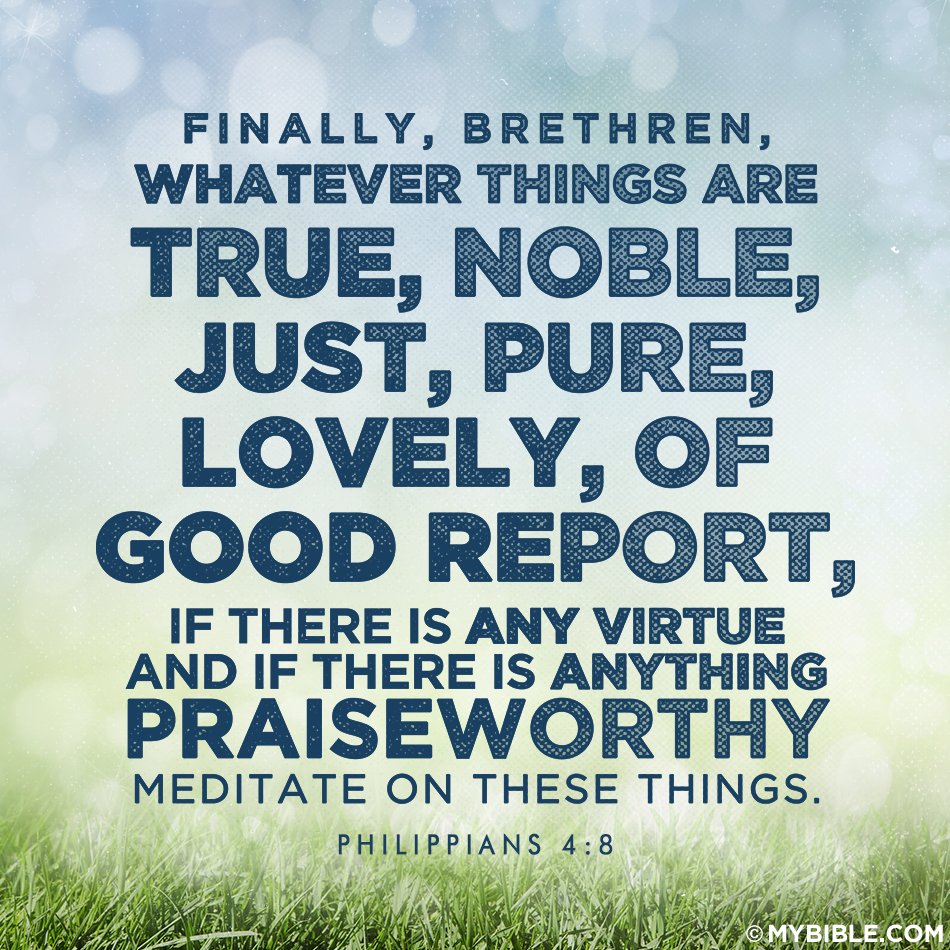
  1. We must resist self-pity—even in our thought life. Nowhere in scripture do we read that rehashing the negative is therapeutic. God’s way is to focus on the positive (Philippians 4:8).

Phil-4-8


  1. We can follow Paul’s example. He forgot what was in his past and pressed on to what lay ahead (Philippians 3:13). Not that amnesia had set in. Paul simply did not allow past failures to cripple his relationship with God and his service for God. God had forgiven and forgotten; Paul did too. No doubt he applied Philippians 4:8, not only to self-pity, but also to guilt. 
  1. We can leave the past in God’s hands. Oswald Chambers said it so well:

 c6d7d32bbdc18d2507a48f8aefa26359

(“Leave the irreparable Past in His hands, and step out into the Irresistible Future with Him”

–My Utmost for His Highest, Dec. 31.)


*     *     *     *     *     *     *     *    *     *    

Father, I do thank you for the gift of memories—the ability to remember with joy and appreciation the people, places, and experiences of the past. I even thank you for the not-so-good memories, knowing that you use every difficult situation for the development of my maturity (James 1:2-3). And may I take advantage of the wisdom gained in the past to guide me in the present, and lead me into the Irresistible Future with you.


Art & Photo credits:  www.trulia.com; http://www.westhighalumni.com; Steve’s photo collection; http://www.allrecipes.com; http://www.god.com; http://www.pinterest.com.

Read Full Post »

progressive_detail


Remember your first attempt to use a microscope? If your experience was like mine, countless adjustments had to be made to find the object under the lens and then bring it into focus.

I’m so glad our eyes don’t work that way! God made them to automatically adjust for distance, intermediate, and near. Granted, as we get older glasses are often required. Some of us even need trifocals. But the miracle of physical sight is incredibly precious, even with corrective lenses.

God offers us another miraculous gift of vision—that of spiritual sight. It, too, is trifocal–to see  lessons of the past,  opportunities of the present, and possibilities of the future.

First we need to understand where spiritual vision (godly insight and foresight) comes from.  It is a function of faith and wisdom.

Faith grows with our knowledge of God. For example, our vision of his future for us is based on such truths as: 1) He has designed a special plan for each of us. 2) He can do the impossible.   And, 3) he empowers the weak.  Embrace such truths and wishful thinking for your future can become a statement of conviction.

Faith also focuses on God’s promises.

Do you have a vision of a productive life, fulfilling his purpose? Focus on John 15:5. “I am the vine; you are the branches. If a man remains in me and I in him he will bear much fruit; apart from me you can do nothing.”

Do you need courage to step forward toward a God-inspired goal? Focus on Joshua 1:9. “Have I not commanded you? Be strong and courageous. Do not be terrified; do not be discouraged, for the Lord your God will be with you wherever you go.”

Do you feel overwhelmed and incapable of completing the task God has whispered into your spirit? Focus on Psalm 121:2. “My help comes from the Lord, the Maker of heaven and earth.”

In addition to faith, godly wisdom contributes to spiritual vision.

Godly wisdom grows with our knowledge of God’s Word. Of course, knowledge by itself is not enough; we must apply it (Psalm 19:7).

And as we absorb his truth, God gives us the ability to see those lessons of the past, opportunities of the present and possibilities of the future.

Now before I share a few examples please understand: I am no visionary with extra-spiritual powers to see the invisible. I’ve just lived long enough, had the privilege to learn from stellar Bible teachers, and spent glorious hours getting to know God and discovering his Word for myself. As a result…

…I can see lessons from my past.

One lesson:  God knows what he is doing.  Consider that…

  • He put me in a Christian home and in churches where my spirit and character were formed.
  • As a short-term missionary in Honduras and Ecuador, he grew my reliance upon him.
  • Serving at six churches with my pastor-husband stretched me emotionally and spiritually, but I also experienced much joy and fulfillment.
  • Each of the four teaching positions I held represented God’s ability to engineer circumstances in stunning ways.

Oh, yes, I can see clearly that God knows what he is doing.

I also see opportunities of the present as we babysit our granddaughter. What an awesome privilege to pass on to a new generation the heritage of faith we have treasured. I can envision the value of sweet memories, sound truth, and especially the example of godly integrity in her life. (Lord, help me provide those gifts to both of our granddaughters!)

And, I see possibilities for the future, where my husband and I might serve—perhaps at a soup kitchen. (Steve loves to cook.) And a volunteer tutoring service for under-privileged children might be able to use a retired teacher.  Each locale would provide possibilities for planting seeds of faith into the lives of others.

I want to live out the advice of missionary to India, William Carey (1761-1834):

“Expect great things from God; attempt great things for God.”

But we’ll need tri-focal, spiritual vision for that to happen.

*     *     *     *     *     *     *     *     *     *

What are you envisioning right now?


(Photo credit:  www.prescription.lensesrx.com.)


Read Full Post »

If I asked you, “What’s the most popular flower?”, you’d probably get the answer right. It’s the rose. En masse on the bush, they provide a striking sight—dozens of large blooms framed by dark green leaves.


Rose-bush


But most of us can’t pass by a rose-bush without leaning in close to view the soft petals, and breathe in the singular scent. To study a blossom up close enhances our appreciation.


3513957969_384a6f45ac


We notice the varying colors, the delicate curl of each petal, the intricate, spiraling pattern. Our sense of wonder increases the more we gaze.

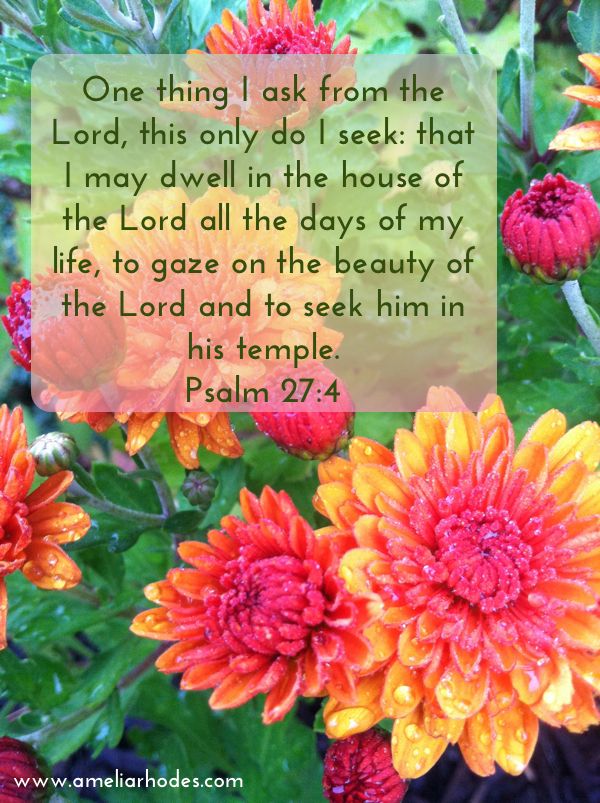
Might the same be true as we study the beauty of our God? That’s what David wanted to do:


1b799f481eab9b6e3bb2af8eab01c1dc

(“One thing I ask of the Lord, this is what I seek: that I may dwell in the house of the Lord all the days of my life to gaze upon the beauty of the Lord and to seek him in his temple” (Psalm 27:4).


But how can we gaze upon an invisible God? By contemplating all his glorious attributes. One commentator described the beauty of the Lord as the harmony of his perfections. I like that.

Just as the petals of a rose create a harmony of color, pattern, symmetry, and form, so the traits of our holy God manifest a harmony of perfect grace, holiness, triunity, and power.

And though we may be acquainted with a number of God’s attributes, appreciation of their beauty expands with a close-up view—through the lenses of scripture and personal experience.  For example:

God’s beautiful grace becomes visible in the story of the prodigal son, as we witness the father actually running to welcome his wayward son home.  He throws his arms around the filthy youth, even kissing him (Luke 15:11-20).

prodigal-son

God’s glorious holiness (purity, righteousness, and separateness from everything else in the universe) is highlighted in Revelation 4:1-11 as John strains for words to describe the Lord of heaven…

… ”Seated on the Throne, suffused in gem hues of amber and flame with a nimbus of emerald…Lightning flash and thunder crash pulsed from the Throne. Seven fire-blazing torches fronted the Throne (these are the Sevenfold Spirit of God)” — vs. 3-5, The Message.  

God’s harmonious triunity (Father, Son, and Holy Spirit) is celebrated in Ephesians 1. Paul reminds us that:

  • God the Father bestows all spiritual blessings upon us (v.3).
  • God the Son provided redemption and forgiveness of our sin (v.7).
  • God the Spirit guarantees our inheritance in heaven and gives us assurance (vs. 13b-14).

And God’s magnificent power is on display throughout scripture and creation, even in our personal lives.  Our Heavenly Father is a God of infinite wisdom, unfailing guidance, strong empowerment, attentive care, competent help,  rich blessings, and more.

We can contemplate each of these attributes as we would the individual petals of a perfect rose.  We can remember occasions when he has demonstrated each trait in our lives.  And perhaps we’ll burst into song as Moses did:


who-is-like-you

(“Who among the god is like you, O Lord?  Who is like you–majestic in holiness, awesome in glory, working wonders?” — Exodus 15:11).

*     *     *     *     *     *     *     *     *     *

My heart fills with wonder and praise, O Lord, because you are a beautiful, holy God.  No one is your equal in power, wisdom, creativity, splendor, or love.  No one else is perfect in all he does.  And you, in all your holy glory are  My.  Heavenly.  Father.   Such statements are too glorious to comprehend!  

But oh, how grateful I am that they are true.

(Photo & art credits:  www.dorsetcereals.com; http://www.flickr.com; http://www.ameliarhodes.com; http://www.luke-15.org; http://www.praisejesustoday.com.)

Read Full Post »

 proverbs-36_2821_1024x768

(“In all your ways acknowledge [God] and he will make your paths straight.” — Proverbs 3:6, NIV)

M-m-m.  God will make my paths straight? Sounds as if he is promising a life of ease on a flat, straight course. Smooth transitions from Point A to Point B.

But I know God doesn’t work that way. Life on Easy Street can result in laziness and worthlessness.

In checking other translations of the Bible, I discovered fresh insights for this familiar verse.

Berkeley says, “He will direct your paths.”

The Douay-Rheims Bible presents a nuance of difference: “He will direct thy steps.”

New Living Translation, “He will show you what path to take.”

Holman Christian Standard Bible, “He will guide you on the right paths.”

And my personal favorite: “He’s the one who will keep you on track” – The Message.

I wonder if I could compose my own amplified version, combining all these translations? Something like: “He will direct my steps along the path that he knows is right and keep me on track.”

How glorious that our Heavenly Father cares enough to guide us so attentively. What a relief to know…

…we can trust the One who knows us  better than we know ourselves. After all, God made us.   He can be trusted to choose just the right path for each of us. “He will teach [us] his ways, so that [we] may walk in his paths” (Isaiah 2:3).

…we don’t have to direct our own steps. In fact, “It is not for man to direct his steps” (Jeremiah 10:23). How wonderful to depend on God, who can see into the future. We certainly can’t!

…He won’t just set us off in the right direction, then leave us to our own devices. He will remain by our side, providing guidance all along the way.  Our God is all-wise; we are not.

I’m remembering a visit to the Governor’s Palace in Colonial Williamsburg, Virginia. In back of the large home is a labyrinth of boxwood bushes, replicating the maze that was first constructed there hundreds of years ago. Children and adults alike find it hard to resist the challenge, including me.


D2004-DMD-0413-1176.tif


Oh, my. With my lousy sense of direction, I became hopelessly lost. Every time I thought the next corner would be the way out, a wall of greenery would greet me. What I needed was somebody with a bird’s-eye view of the path who could tell me which way to turn.

That’s exactly what we have in our Heavenly Father.

“Whether you turn to the right or to the left, your ears will hear a voice behind you saying, ‘This is the way; walk in it.’” (Isaiah 30:21).

And we’re talking about much more important matters than a labyrinth of bushes! We’re talking about:

  • Day-to-day choices that form our character
  • Decisions that impact our influence upon those around us
  • Selections of what church to attend, what friendships to cultivate, what activities to pursue, and more
  • Guidance for those unexpected twists and turns of life

In all these ways, “He will direct our steps along the path that he knows is right and keep us on track.”

*     *     *     *     *     *     *     *     *    *

Oh, Lord, help me to look up toward you—often! I want to walk the right path you have chosen for me, with confidence and strength, because I am trusting in you. May I turn my thoughts to you and your Word continually—so I can receive frequent instruction. And thank you for walking with me, offering support and encouragement, every step of the way. “Show me the way I should go, for to you I lift up my soul” (Psalm 143:8b).


(Photo credits:  www.rockchurchofindia.org; http://www.colonialwilliamsburg.photochelter.com.)


Read Full Post »

Northern Cardinal


For several weeks this spring we enjoyed a special visitor to our home, a male cardinal.

At least once each day he perched on the window sill above our front door.  His head would cock from side to side as he considered his reflection in the glass. Then he would flutter upwards, sometimes as high as two feet or so, his wings batting against the window.


DSCF9641


No doubt he thought the reflection was another cardinal, and he wasn’t about to allow an interloper to move in on his territory!

Every morning I heard his fluttering wings against the glass and stood to watch his proprietary dance.

What if he hurts himself, I thought. Too bad I can’t communicate with the little guy, and let him know his fight for territory is unnecessary.

 M-m-m-m.

We humans ARE capable of receiving communication.  And God has graciously given us his Word–full of infallible wisdom–so we don’t waste time and energy on worthless pursuits.

Too often, though, I am like that little cardinal, fluttering my wings in a frenzy of self-gratification, or questions that have no answers, or worthless contemplation of what ifs.  The results are as unproductive and meaningless as territorial rituals with a nonexistent rival.

Unlike that red bird, I can understand instruction, but sometimes I fail to pay attention.

It’s not as if God hasn’t clearly explained through many scriptures the way to peace and contentment. Some are embarrassingly familiar:

Do not fret…Trust in the Lord and do good…Delight yourself in the Lord and he will give you the desires of your heart.  Commit your way to the Lord; trust in him and he will do this (Psalm 37:1-5).  [So, it boils down to this:  Am I going to believe that God will do what he says?  Am I going to lean into him and trust?]

“It is more blessed to give than to receive” (Acts 20:35).  [That principle applies to gifts of time and effort as well as monetary.  And just how often does the giver experience more blessing than the receiver?  Almost always!]

“Do not be anxious about anything, but in everything, by prayer and petition, with thanksgiving, present your requests to God.  And the peace of God, which transcends all understanding, will guard your hearts and you minds in Christi Jesus” (Philippians 4:6-7). [Note to self:  Focus on your all-powerful, all-knowing, all-wise God.  He is bigger than any problem, any need.]

Instead of beating my wings in a flutter-frenzy, I want to take inspiration from another activity cardinals are known for:  singing!

I lift my voice in praise to you, my God and King!

Your majesty and greatness are beyond comprehension,

yet you care for me.

You extend your mercy to forgive,

your grace to provide,

your wisdom to direct,

your strength to uphold.

Everything you do is right.

May my heart be steadfast

to trust you and follow your Word.

Turn my heart toward your ways

and away from worthless pursuits.

If I’m serving and singing, I won’t have time for flutter-frenzies!

(Photo credits: http://www.planetofbirds.com; http://www.coldhandswarmearth.blogspot.com.)


Read Full Post »

« Newer Posts - Older Posts »

Still Traveling

Impressions Becoming Expressions

Living Our Days

Gaining a heart of wisdom

He Said What?!

I'm Patty, and my husband and I are living with our adult son who has autism and epilepsy. I love sharing lessons learned from life around me, especially life with Aaron.

Meditations of my Heart

Impressions Becoming Expressions

Linda Stoll

Impressions Becoming Expressions

Debby Thompson

Impressions Becoming Expressions

Signora Sheila

Notes on Life, Faith & Italy

Colleen Scheid

Writing, Acting, Living in God's Love

Mitch Teemley

The Power of Story

Heidi Viars

Finding the Image of God