Feeds:
Posts
Comments

Simple Blessings

“Life holds so many simple blessings, each day bringing its own individual wonder”–John McLeod

Grab a scrap of paper and list a few simple blessings you’ve enjoyed lately—maybe even today. I’ll wait for you!

…OK. Did anyone choose clouds?

Yes, clouds.

English: Cumulus humilis clouds in the foregro...


I love clouds. I love how varied they are. From feathery wisps to dollops of froth. From great swaths of flat sheets to billowing thunderheads that soar miles into the atmosphere.


Several types of Cirrus clouds.


Wait a minute. Clouds can’t really be considered a simple blessing. True, the glorious views are available to all, free of charge. And on most days, some sort of cloud is visible.

But the process by which clouds are formed is not so simple.

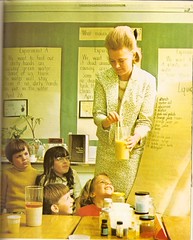
Perhaps your second grade teacher performed the same experiment for your class that Mrs. Sturgess demonstrated for mine. (Don’t ask me how long ago!) She put a pie plate of water on the window sill/shelf on Friday. On Monday we measured the level of water, and marveled that some of the water had disappeared! Where had it gone?

Mrs. Sturgess explained evaporation to us. Little water droplets, too tiny to see, were floating in the air. They gathered up in the sky to form clouds. Incredible!

Water cycle

 Her answers generated more questions. If it’s just water that forms the clouds, how can there be so many different forms? And how do all those little droplets get together in groups anyway?

Clouds are not a simple blessing.

Now look at your list. Are there any truly simple blessings? I doubt it. God’s creative, powerful genius is behind each one. And it’s probable that multiple steps are involved to provide each blessing.

Then consider this: we experience hundreds, perhaps thousands of these miracles—every day. “He performs wonders that cannot be fathomed, miracles that cannot be counted” (Job 9:10).

In the final analysis, “simple blessing” has to be the most contradictory oxymoron in existence.

But John McLeod did get one thing right: the wonder part.

Thank you, Heavenly Father, for your abounding love that prompts you to lavish blessings upon us every day. Each one is a miracle, a precious treasure to savor. My mind staggers under the immensity of your magnificence. My heart overflows with inexpressible joy when I consider your abundant goodness.

May your praise always be upon my lips (Psalm 34:1).

A Song for Commuters

For ten years of my twenty-six year teaching career, I commuted almost fifty miles each day. Those of you who endure the same or worse understand that it is: 1) boring, 2) a waste of time, and 3) FRUSTRATING! The roadways are filled with thoughtless, rude drivers who can raise your blood pressure to dangerous levels if you’re not careful.

One day, after yet another encounter with a dreadful driver, I started to sing, “To God Be the Glory”—an old hymn that is still a favorite of many folks. Only I stumbled upon new words that fit my situation: “To God be the glory in spite of the jerks who travel the turnpike and drive me berserk!”

It made me chuckle. The tension in my shoulders began to relax.

M-m-m, I thought. I may be on to something.

For the next several weeks I spent my commuting time working thoughts into rhymes and rhymes into the rhythm of the old hymn. Here are the results.

The South Florida Commuter Song

To God be the glory in spite of the jerks
Who travel the turnpike and drive me berserk!
I’ll focus on Jesus and all of His works,
Improving my attitude and calming my nerves.
Praise the Lord for the trees, and the birds on the wing!
Praise the Lord for the clouds, and this song I can sing!
I’ll thank Him for His promises and victories won,
And for taking frustration and making it fun!

I’ll pray for the poor bloke who speeds out of sight.
He’s clueless I’ll see him at an upcoming light.
I’ll pray for his safety, since he’s unconcerned,
And hope in the process some patience I learn!
Praise the Lord for the sun as it spangles the sky.
Praise the Lord for the ponds, and the mist on the rise.
I’ll thank Him for creation, its beauty sublime.
Renouncing frustration, His peace I shall find.

And when drivers speed by then squeeze in ahead,
Replace my frustration with your grace instead.
Remind me they don’t know you, they’re striving alone.
I pray they may seek you, and make you their own.
Praise you, Lord! I am yours, and you’re always with me.
Help me lean, and be serene, even when folks are mean.
I pray for Your Spirit to take full control
As over the highways and byways I roll.

There’s one more group of drivers that I must address.
They pull out in front of me, then drive like Aunt Bess!
They poke along slowly, yet still make the light,
But then the light turns red—I’M stuck! What a fright
How upset I can get when others drive thoughtlessly!
But I have heard from Your word how You want me to be:
As loving and forgiving as You are to me.
So when others drive like Aunt Bess, I’ll say, “God bless!”

© Nancy Ruegg 2008

Are you smiling? I hope so. And perhaps you’ll be inspired to turn a frustration in your life into an attitude-changing song. If you do, please share it with us!

God’s Rebuttal

dramatic dream


As the new year makes its entrance, a fresh breeze of possibilities and dreams fills the mind:

• Perhaps this year…

• Wouldn’t it be wonderful if…

• All things are possible with God, so…

But no sooner do I start finishing those statements with starry-eyed optimism, than some scratchy, irritating thoughts demand my attention.  Thoughts such as:

• You’re too old, terribly unworthy, and under-qualified.

• You’ve already waited so long. Your dream obviously isn’t God’s dream for you. How could you have missed it so completely?

• You are wasting your time. You don’t even know what God wants. HA!

And my heart cries out: I need your Word, God, your Sword of the Spirit, to slay these lies. And though I am grateful for familiar sword-strokes such as Romans 8:28, Jeremiah 29:11, and Philippians 4:13, to wield against the untruths listed above, a few new moves would surely strengthen my resolve. “Strengthen me according to your word” (Psalm 119:28b).

Alright, Nancy, let’s look at each statement from my viewpoint.

You are too old? Not so. Moses was eighty when he became the leader of the Hebrew nation, bringing them out of Egypt and into Canaan. Daniel served as prime minister in Babylon well past the age of eighty. John was quite elderly when he received the Revelation. Age has nothing to do with usefulness.

You are unworthy? Also not so. You are one of My chosen people, a royal priestess, who belongs to me, the King of the universe (1 Peter 2:9a). You are precious and honored in my sight because I love you (Isaiah 43:4).

You are under-qualified? All the better for my purposes! My G.R.A.C.E. (God’s Riches at Christ’s Expense) includes wisdom, power, strength, discernment, all spiritual gifts, all fruit of the Spirit, ad infinitum. My grace is more than sufficient for you; it’s all you need. “My strength comes into its own in your weakness” (2 Corinthians 12:9, The Message).

You have waited too long? Think again. Abraham waited 25 years for Isaac. Joseph waited seventeen years for his dream to come true. Caleb waited 45 years for his special parcel of the Promised Land.

You are wasting your time? Please refer to Ephesians 1:11. You have been chosen. I have put into place a plan that will accomplish my will. Your singular purpose is to display my glory, that is, my attributes: love, joy, peace, patience, goodness, and more. Wherever you are. ..“whatever you do, work at it with all your heart, as working for the Lord, not for men” (Colossians 3:23).

One closing thought to keep in mind: Joseph would never have been an effective leader without training in humility and trust. Rest assured there is method and reason to every choice I make. I AM the almighty, all-wise God, your Heavenly Father.

From a Crooked Stick

Somewhere along the way, someone gave golf clubs the nickname of “crooked sticks.” In fact, if you Google that term, you’ll bring up a golf course in Indiana. Beautiful. Even boasts a red barn.

But this post has nothing to do with golf. It’s about usefulness, taken from a metaphor written several centuries ago:

God can make a straight stroke with a crooked stick

– John Watson, Puritan preacher.

I am a crooked stick—unlovely and full of imperfections.

Yet I take great encouragement from the fact God specializes in redeeming crooked sticks. The Bible gives dozens of examples. Abraham, Moses, David, Jonah, and Peter are just a few that readily come to mind.

Abraham took a shortcut which has negatively impacted his descendants ever since.

Moses was a murderer.

David committed adultery.

Jonah refused to follow God’s plan.

Peter was brash and impulsive.

Yet consider what God did through these crooked sticks.

Abraham became the father of God’s chosen people.

Moses led the chosen people from Egypt into the Promised Land.

English: Moses Pleading with Israel, as in Deu...

David ruled Israel as a strong, much-loved Shepherd-King. Son of David became a title for God’s own Son.

National Cathedral_King David (Parmelee window...

Jonah brought an entire city to repentance.

Peter became a leader of the early church. His first sermon alone convinced 3,000 people to believe in Jesus and follow the Way.

Apostle Peter Preaching

*     *     *     *     *     *     *     *     *     *

Heavenly Father, thank you for not discarding crooked sticks. Thank you for forgiving our foolish choices, lousy attitudes, wrong motivations, prideful actions, and somehow using us anyway to make straight strokes. As 2013 approaches, I pray you take the crooked stick of my life and produce positive strokes as only you can do.

Christmas Afterglow

christmas 2007

The main events are over: the decorating, the programs, the gift-giving. Yes, there may be a few more get-togethers to enjoy. You may still have family camped out in the living room (we do), and there’s still New Year’s Eve to look forward to.

But most of us are now experiencing the afterglow of Christmas—an agreeable feeling following a pleasant experience. (Thank you, Mr. Webster.)

In an effort to extend the euphoria, I skimmed through my blessings journal to remember special moments of Christmases past. I was surprised by the number of them and the fact I had forgotten many.

Example #1:

One year my husband’s parents were going to fly the five of us from South Florida to their home in Ohio for Christmas. Our kids could hardly wait, excited by the prospect of a new phenomenon—snow.

I was teaching school at the time, and a colleague, Beth*, asked me early in December, “Do you have warm clothes to take with you?”

“We have a few things,” I responded. “But I’m going to check the thrift stores over the weekend, and we can layer up.”

“Well, we have a bunch of stuff. Our family usually heads north for Christmas, but we’re not going this year. Let me loan you our gear.”

Beth gave me sweaters, hats, gloves, and five coats. I think every item fit someone in our family.

Example #2:

As the kids became teenagers, their schedules became busier. Getting five people where they needed to be with only two cars was a challenge. Then a friend from church offered to sell us his car at a very low price. (He was buying a new one.) It was a blessing we hadn’t pursued, hadn’t even prayed for. But it proved Matthew 6:8 perfectly: “Your Father knows what you need before you ask Him.”

Our older son got a car for Christmas that year.

Example #3:

Another year I needed a long black skirt for the Christmas musical at church. Pushing through a long to-do list each day, I kept postponing the eventual mall trip. But the afternoon I finally went shopping, God met me at Macy’s! Not long after arriving in the misses’ department, there it was: the perfect, ruffle-and-lace-trimmed skirt for almost 75% off!

How amazing is our God? He keeps track of planetary movements and weather patterns, yet he cares what we wear (Matthew 6:28-33)!

Thank you, Heavenly Father. Reviewing Christmases past does give me a lovely afterglow. But it’s not the holiday memories as much as your involvement in those moments that causes the glow in my heart. Each instance proves your loving care, and the obvious pleasure you take in surprising your children with good things. I celebrate your abundant goodness and joyfully sing of your righteousness (Psalm 145:7).

What Christmas memory gives you an afterglow?

My Soul Exalts the Lord

 bibles

Dad has a large collection of Bibles in many different versions. Recently he gave me two of them. Very precious gifts, indeed. They represent countless hours of study and recording, because the margins are filled with his notes.

When I say countless, I’m not exaggerating. On numerous pages, Dad has squeezed five or six lines of fine, tiny printing in the upper margin, a space just ¾” wide. I almost need a magnifying glass.

To read his collection of word meanings, explanations, and applications has been bittersweet. Dad now has severe arthritis and Parkinson’s disease. Although he is still an avid reader, he is no longer able to write.

As Christmas has approached, I’ve wondered, what might Dad have written in his Bibles about the birth of Jesus?

The first note that caught my attention was from his New American Standard, Ryrie Study Bible (1976, Moody Press). The note concerns Mary’s song, the Magnificat, found in Luke 1:46-55). We looked at her beautiful prayer last Thursday, in the post titled, “Mary’s Song.”

Mary began her song by saying, “My soul exalts the Lord” (NAS). The New International Version translates that sentence, “My soul glorifies the Lord.”

Before we proceed to the quote itself, let’s examine those words, exalt and glorify. (No doubt that’s what Dad would do. And surely somewhere in one of these two Bibles I’ll come across a pithy definition or two for exalt and glorify. For now, I’m on my own!)

Exalt means to raise in status, to elevate, to glorify and praise.

Glorify means to give glory, honor, or high praise, to exalt.

Put in simple terms: to exalt and glorify is to compliment truthfully and profusely.

Now here’s what Dad wrote:

To exalt the Lord at Christmas, we need to refocus our attention on the event we celebrate rather than on the celebration of the event.

Oh, Lord Jesus. My eyes fill with tears as I think of all the times my attention has been on the celebration and not on the sacred moment when you became flesh and made your dwelling among us. Too often my focus has been on…

…the gifts under the tree instead of the implausible Gift of Yourself. You left the glorious riches of heaven, to be born into the depravity of humanity. I cannot fathom the depth of such love.

…the joyous, boisterous family get-togethers, instead of the supernatural get-together of all believers (including me, of all people) and God Almighty. Your birth, and especially your death and resurrection make our relationship with you possible. I cannot fathom that kind of sacrifice.

…the decorations and twinkling lights that make the house sparkle and glow, instead of You, the Light of the world, who makes my sin-bent heart sparkle and glow. I cannot fathom such transformation.

For these last precious hours of the Christmas season, 2012, I want to focus on You. I want to give you honor and praise for everything Your birth has made possible: the experience of your love, the benefit of your sacrifice, and the glorious transformation you generate within each of us. In the name of our Savior, Christ the Lord, Amen.

*See the post titled, “Mary’s Song,” from December 20, 2012.

Mary’s Song

Can you remember the first time you studied a snowflake under a magnifying glass? What was your reaction to those delicate intricacies of pattern?

Or how about your first glimpse through a microscope at a drop of pond water? Suddenly you were viewing infinitesimal, squiggly creatures you never knew existed. Chances are your responses included “Wow!” “Look at that!” “I can’t believe it!”

And perhaps that’s when you learned: Only when we examine something closely can we begin to appreciate its value.

Like our Heavenly Father.

Scripture urges us to “magnify” God: “O magnify the Lord with me, and let us exalt his name together” (Psalm 34:3, KJV, RSV).

To magnify God is to look closely at Him and take careful notice of his actions and attributes. Mary did exactly that, when she visited her cousin, Elizabeth. Elizabeth was much older than Mary, well beyond child-bearing age. But like Sarah of the Old Testament, God had intervened for her. Elizabeth would be the mother of John the Baptist.

When Marry first arrived and greeted her cousin, Baby John leaped in Elizabeth’s womb. (I’m not exaggerating. That’s the exact word in Luke 1:41, NIV. Can you imagine how it would feel to have a baby jump inside you?)

Elizabeth responded with a blessing for Mary and the baby she carried. Mary was so overcome with joy and incredulity, she burst into praise. Her song is called the Magnificat. (See Luke 1:39-45 for more details.)

For ten verses, Mary magnifies the Lord, examining the reason for her joy (vs. 46-49) and looking closely at God’s attributes and actions (50-55) that contribute to her joy. If your Bible includes cross references you’ll notice that Mary recites a varied collection of verses from the psalms, specifically from chapters 34, 138, 71, 103, 98, and 132.

Take note: that’s six psalms. It would seem she chose appropriate thoughts, and wove them together into this beautiful prayer. On the spot, no less! Dare I suggest that Mary was a highly intelligent young woman?

Such an ability would also indicate Mary grew up in a godly home where scripture was highly esteemed. Her family evidently took to heart the words of Psalm 1:2, “His delight is in the law of the Lord, and on his law he meditates day and night.”

Full of emotion, Mary rejoiced in God, her Savior. He had been mindful of her, a humble peasant girl. God had blessed her beyond imagining, to be the mother of the Messiah.

Then Mary itemized specific ways God had benefited all his people:

• He extends mercy to those who reverence him (v. 50)
• He has performed mighty deeds (v. 51)
• He has scattered the proud (v. 51)
• He has brought down rulers, but lifted up the humble (v. 52)
• He has filled the hungry, but sent the rich away empty (v. 53)
• He has been merciful to Israel (vs. 54-55)

Has God been at work in your life, perhaps in similar ways? Has God been mindful of you and blessed you (v. 48)? What great things has He done for you (v. 49)? Has his mercy been extended to you (v. 50)?

View the activity of God in your life through the magnifying glass of meditation.

Feel free to comment below, and share with us your observations!

Here’s another idea to consider: as a Christmas gift to your Savior, write a Magnificat of your own.

Mary’s Choice

The Annunciation by Eustache Le Sueur, an exam...

The Annunciation by Eustache Le Sueur, an example of 17th century Marian art. (Photo credit: Wikipedia)

Imagine a young woman, engaged to be married. Her mind is occupied with a long to-do list that includes preparations for the wedding, and for the new home she’ll create with her husband.

Husband. Just thinking about him sends her mind floating to dreams for the future. And all her plans and dreams rise and fall over hills of emotion: great excitement in the new adventure to come, yet melancholy, too, because life-as-it’s-always-been will soon be no more.

Surely Mary, the mother of Jesus, must have been thinking similar thoughts as she planned and prepared for her wedding and married life, just like any other bride.

Now imagine her surprise when the angel, Gabriel, appeared to her. The Bible tells us that as Gabriel spoke, Mary was greatly troubled (Luke 1:19). I like Eugene Peterson’s choice of words: “She was thoroughly shaken” (The Message).

Do you suppose Mary jumped at the sound of his voice? Did her eyes grow wide and her hand clap over her mouth? Might she have taken in a quick gasp of air as her heart began to pound?

Gabriel hurried on to explain God’s plan for her—so radically different from the plans she and Joseph were making. Mary was no doubt envisioning a small wedding (after all, they were not wealthy), and settling down to a quiet life in Nazareth. Little did she know that a trip to Bethlehem was in her future—during her ninth month of pregnancy no less.

Mary had been chosen by God to bear the Messiah! The Jews had been waiting centuries for this event. God could have chosen any time or any place for the birth of his Son. He could have named any woman to be the mother of Jesus. He chose Mary, a small-village girl. No wealth, no sophistication, no influence. Did Mary’s cheeks burn with modesty, to be selected for such a monumental privilege?

Yet the magnitude of this honor quickly gave way to practical matters. She asked Gabriel, “How will this be, since I am a virgin” (v. 34)?

Gabriel explained as best he could. I wonder if God the Father had given him explicit instructions about what to say. After all, he was trying to explain cosmic, miraculous, humanly impossible events.

And Mary stood on the precipice of eternity, facing a decision with eternal consequences. Which way would she choose?

She could have said, “Oh, no, Sir. This cannot be. I am not qualified. Such a responsibility is much too frightening even to consider! Please choose someone else.” A very logical answer, right?

But instead, Mary responded, “I am the Lord’s servant. May it be to me as you have said” (v. 38).

Perhaps it was Gabriel’s last words that gave her such boldness. “For nothing is impossible with God” (v. 37). Did the numerous miracles of the Old Testament whisk through her mind, as proof of Gabriel’s words?

Might it be, as Gabriel began to relate what would happen, that the Holy Spirit came upon her right then? And the power of the Most High overshadowed her (v. 35) even as Gabriel spoke? Perhaps, at that very moment, the presence and empowerment of God rushed into Mary’s mind and heart.

We won’t know this side of heaven. But I do know is this:

In her defining moment, young Mary exemplified the epitome of innocent trust in God and unfaltering obedience.

*     *     *     *     *     *     *     *     *    *

Oh, Father, I want to trust you with pure abandon, just as Mary did. Too often I fret about consequences.

I want to live out your plan, in the place you have chosen, at the selected time, just as Mary did. Too often I’m in a hurry and want things to happen here and now.

And like Mary, I want to stand strong on the edge of eternity, with my arms spread wide, and jump into the abyss of your plan—confident in the knowledge that you will carry me on eagles’ wings (Exodus 19:4).

Just trying to put words on the screen brings tears to my eyes.

The horror gripping Newtown, Connecticut right now is incomprehensible and heart-wrenching.

And the unanswerable questions flash in garish neon across my mind:

• Why, God? Why didn’t you intervene?
• Where were you?
• How is it possible for such gross evil to take place?

Yes, scripture gives some answers.

• “My thoughts are not your thoughts, neither are my ways your ways,” declares the Lord (Isaiah 55:8).

• “If I go up to the heavens, you are there; if I make my bed in the depths, you are there” (Psalm 139:8).

• “Our struggle is not against flesh and blood, but against the rulers, against the authorities, against the powers of this dark world and against the spiritual forces of evil in the heavenly realms” (Ephesians 6:12).

But it’s not enough right now. Such abhorrent evil as was carried out in those kindergarten classrooms makes us sick. A few words of platitude don’t help. Not even scripture.

But this tragedy does have me thinking: What happened at Sandy Hook Elementary is an example of the dark wickedness any one of us is capable of—without Jesus.

Lord, have mercy on those suffering families and friends of Newtown. Yet, in the midst of great sadness, I thank you for the mercy you have already flooded upon us, in sending your Son, Jesus. He is indeed our way through calamity. He is our truth when no other truth suffices. And most glorious of all, he is our life—eternal life (John 14:6). We cling to you, Father, Son, and Spirit. Amen.

As I was decorating the house for Christmas and listening to carols, “God Rest Ye Merry, Gentlemen” caught my attention. The words proclaim the joyous news of “Jesus Christ our Savior, born on Christmas Day, to save us all from Satan’s power when we were gone astray.” Yet the tune is in minor key, which gives the song an air of sadness. My curiosity kicked in (it doesn’t take much), wanting to know why the composer would make such a choice.

After a bit of research, here’s what I discovered: This is an old carol, dating back to 15th century England. The composer is unknown, so we have no record of the musical/ lyrical choices he made. However, we can make an educated guess about his motivation, to answer the question why he wrote this carol.

Church music of that time was rather dreary, and sung in Latin. The common folk would never have been allowed to compose music for worship, especially in English. So historians surmise that a peasant wrote this song, perhaps to be sung in his own home.

(May I be so bold as to suggest a woman may have created the song, as a diversion during household chores?!)

Whatever its inception, the carol grew in popularity and soon was sung by many. It remained a favorite through subsequent generations and was finally published in 1833. Charles Dickens even chose the song for a scene in The Christmas Carol (1843):

“…at the first sound of — ‘God bless you merry, gentlemen! May nothing you dismay!’— Scrooge seized the ruler with such energy of action that the singer fled in terror, leaving the keyhole to the fog and even more congenial frost.”

Back to the question that began this investigation: Why such a positive message expressed with such a sad-sounding tune? Without much background information to go on, my curiosity has to be satisfied with conjecture. What would be a logical explanation for uplifting words set in a minor-key?

Perhaps the composer was trying to express the dichotomy in which we live.

First, the minor key suggests the sad reality that we live in a world oppressed by “Satan’s power” (from verse 1 of the carol). He is a roaring lion, prowling around for someone to devour (1 Peter 5:8) with his lies and temptations. And what do lions choose to prey upon? The weakest of creatures who cannot easily flee.

The second half of the dichotomy comes from the cheerful lyrics, retelling the glorious story of Jesus’ birth. The chorus resounds again and again with “tidings of comfort and joy.” Why? “This day is born a Savior of virtue, power, and might” (from verse 3 of the carol).

And now the icing on the cake. (Or, more appropriately for this time of year, the star on top of the tree!) This Savior of virtue, power, and might is in us! Somehow His Spirit entwines with each of ours. We can experience His comfort and joy, just as the carol proclaims.

Yet there’s more. We can experience His presence. We can rest in His peace, rely upon His wisdom, and go to Him for help and guidance. Not even these seven blessings cover the gamut of His loving-kindness to us.

Now, because our Savior of virtue, power, and might lives within us, we are not weak creatures, who cannot easily flee that roaring, prowling lion called Satan. Jesus, our Lord and Savior, is much greater than he is (1 John 4:4)!

My heart almost skips a beat, just thinking about such astounding realities. With a humbled, grateful, merry heart, I “now to the Lord sing praises” (verse 6 of the carol)–enthusiastically!

Will you join me?

When the House is Quiet

Impressions Becoming Expressions

Mitch Teemley

The Power of Story

Still Traveling

Impressions Becoming Expressions

Living Our Days

Gaining a heart of wisdom

He Said What?!

I'm Patty, and my husband and I are living with our adult son who has autism and epilepsy. I love sharing lessons learned from life around me, especially life with Aaron.

Meditations of my Heart

Impressions Becoming Expressions

Linda Stoll

Impressions Becoming Expressions

Signora Sheila

Where faith meets la dolce vita

Heidi Viars

Finding the Image of God