Feeds:
Posts
Comments

Posts Tagged ‘Faith’

sepia-praying-woman

Abby has prayed for years that her estranged son would come home.

Stacie has faced the loss of one job and a stressful transition to another–with a broken leg.

Jack has worked hard to qualify for a prized promotion, but the boss’s unpleasant nephew was awarded the position instead.

Tricia can’t seem to shake a gray cloud of despondency, ever since her fiancé broke off their engagement.

Kate goes through the motions at church and even continues with her quiet time. But God seems to have distanced himself. She hasn’t sensed his presence for weeks.

These circumstances and more can cause a downward spiral in our spirits, as debilitating emotions take over–emotions like frustration, anger, hurt, worry, and depression. If we feed these emotions with negative thoughts, our faith in God begins to falter.

The devil’s lies begin to sound like truth:

  • So much time has passed; God is never going to answer your prayer.
  • Bad things keep happening; God has obviously abandoned you.
  • God doesn’t care about your life. Otherwise, why would he allow you to fail?
  • They say God offers love, hope, peace, and joy. Right. None of it is coming your way.
  • It looks like God has forsaken you and to make matters worse, you don’t even know why.

Is it possible to fight against such feelings and fortify our faith? Oh, yes!

Our fight begins with truth—straight from God’s Word. We have to choose fact over feelings—just like a pilot does, as he flies through miles of thick clouds. In order to stay on course, he can’t trust what he feels is proper speed, direction, and altitude; he has to rely on the facts presented by his instruments.

47056693.14

So what scriptural truths might help us maintain our spiritual equilibrium? There are dozens, perhaps hundreds of passages that address our various needs with pinpoint perfection.

Other scriptures provide broad-sweeping truth that covers almost any situation. One example:

“The Lord is faithful to all his promises and loving toward all he has made.  The Lord upholds all those who fall and lifts up all who are bowed down” (Psalm 145:13-14).

If we read the Bible with the intent of finding applicable truth for our circumstance, we will not be disappointed.

april13

(“Such things were written in the Scriptures long ago to teach us.  And the Scriptures give us hope and encouragement as we wait patiently for God’s promises to be fulfilled”–Romans 15:4, NLT.)

 Now the question is: Are we going to take God at his word and then act upon it?

Hebrews 11 gives us a line-up of faith-stars who did just that–based their actions on faith, not feelings.

By faith Noah built at ark (v. 7).   He did not allow feelings of inadequacy to stop him.

By faith Abraham left home with no notion of where he was going (v. 8). He did not allow fear of the unknown to deter him from following God’s direction.

By faith, the parents of Baby Moses hid him from Pharaoh. They did not allow fear of punishment to stop them. “They were not afraid of the king’s edict” (v. 23).

By faith the people of Israel marched around Jericho seven times, even though it didn’t make sense (v. 30).

Bottom line: Faith is the exercise of our minds, based on the stable truth of God’s Word, in spite of what we might feel. Emotions are just the unreliable, fluctuating condition of our minds (J. Clarke, http://www.writtentreasures.org).

On the other hand, God doesn’t ask us to ignore our feelings. Job, David, and the prophets honestly expressed frustration, fear, disappointment, and discouragement. But they didn’t allow their emotions to cripple them.

f7ea3e3945226580cc4cd80213db5133

Also worth noting:  None of these faithful people were perfect, yet God honored their faith.  He doesn’t need perfect people to accomplish his purpose, just willing and faithful ones.


*     *     *     *     *     *     *     *     *     *


Forgive me, Lord, for allowing feelings to impact my faith, to weaken my trust in you. Together with you, may I fit every thought and emotion and impulse into the structure of life shaped by Christ.  Thank you for listening and offering encouragement as I confess to you my feelings.  You even supply strength, peace, and hope.  And finally, I praise you that you preserve the faithful. I am secure in you.  In fact, you, my all-powerful God, are security itself.      

(2 Corinthians 10:5, MSG; Psalm 10:17; Psalm 29:11; Psalm 31:23.)

Art & Photo credits:  www.hem-of-his-garment-bible-study.org; www. pbase.com; http://www.scentoffaith.com; http://www.pinterest.com.

Read Full Post »

Check a map that traces the trek of the Israelites from Egypt to Canaan, and you’ll see a meandering, looping pathway:

Wilderness Journey

God could have taken them along the coast of the Mediterranean Sea, a much more direct route. One commentator says that route would have required just days of travel. A short journey would have been so much easier on everyone, right?  Less chance of fatigue, boredom, and impatience to develop and create problems.

But God had his reasons for a long, winding route.

Reason #1: The Philistines. That’s not conjecture; that’s exactly what scripture tells us. “When Pharaoh let the people go, God did not lead them on the road through the Philistine country though that was shorter. For God said, ‘If they face war, they might change their minds and return to Egypt’ ” (Exodus 13:17).

The Philistines’ territory stretched for fifty miles along the Mediterranean Sea, with the southern border touching Egypt. They were a well-organized, warring people. Five great cities, strategically located throughout their coastal holdings, created an alliance, the famous Philistine pentapolis.

A people suppressed by slavery for four hundred years would not be able to fight such an adversary. The Israelites didn’t have any trained soldiers among them either. Could God have given them a rousing victory over the Philistines anyway? Of course. But he chose not to.

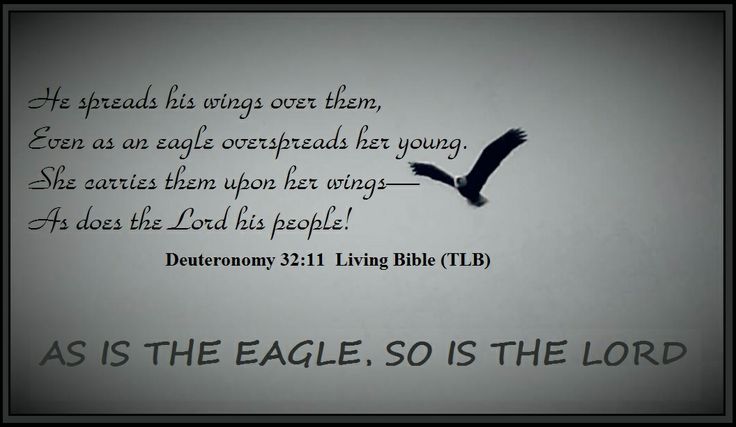
Reason #2: Perhaps God determined his people needed some wilderness experience to train them in his ways and build their trust in him. Instead of quick and easy, God chose slow, step-by-step progress. He was like an eagle, teaching his fledglings by degrees how to fly (Deuteronomy 32:11).

4ffd5fa25fbd4e401e15ae1fe344938f

I wonder if the Israelites thought, Does God have any idea where he’s taking us? What is he DOING?!

In hindsight we can see God’s purpose:

  • To prepare them to be his holy people by giving them the law. (By the way, according to Exodus 19:1, Moses went up to Mount Sinai during the third month after they left Egypt. God was certainly in no hurry to get his children to the Promised Land.)
  • To teach them.  Through the laws he gave Moses, God taught the Israelites how to treat one another and how to worship him. They were to be different from all other peoples on earth.   “I am the Lord your God; consecrate yourselves and be holy,” he said, “because I am holy” (Leviticus 11:44).
  • To challenge them. For example, God let them experience great thirst and hunger. Then he stepped in and supplied their needs. By degrees God taught them to trust him.

I have to admit: my life experiences have paralleled the Israelites’ in a number of ways. I’ve encountered a few winding roads, puzzling detours, uncomfortable wait times, and unanswered questions of my own.

You, too?

Here’s what we can remind ourselves of: God may not direct us by the nearest, fastest way—even though he could. In his omnipotent wisdom, he knows a better way. And he has perfectly sound reasons for his decision.

My choice in the matter? I can plead for the shorter route, complain about the delay, try to forge ahead on my own self-chosen fast track, OR…

…trust my all-knowing, all-wise Heavenly Father.

5db138f980d331b5ee31f939d399464e

Seeing the choices laid out in black and white, here on my computer screen, the decision is easy. However, complete trust in the moment of uncertainty, fatigue, and discomfort is much more challenging.

Perhaps I can encourage myself by reviewing God’s purposes for the Israelites. Chances are, he desires the same results in me:

  • God prepared the Israelites; he may be preparing me for the next chapter in my life.
  • God taught the Israelites; he may be teaching me what the next level of maturity includes.  (Yes, even an old Christian like me still has growing to do!)
  • God challenged the Israelites; he may be challenging me to trust him—in spite of a long, winding road and uncomfortable wait time.

In summary:  As I cooperate with him, God can transform me into a prepared, mature, trusting servant for the next chapter of my life.   I like the sound of that!

You, too?

*     *     *     *     *     *     *     *     *     *

“Who compares with you, O God?  Who compares with you in power, in holy majesty, in awesome praises, wonder-working God” (Exodus 15:11, The Message)?  You are over-the-top trustworthy!  So, in advance, I thank you for the good that will come out of the winding road, detours, and wait time in my life–experiences you ordained for me, before one of them came to be (Psalm 139:16).  I place my hand in yours, my caring, constant Companion.  Help me to focus on your strong grip, not the uncertainties ahead.  Amen.


(Art credits:  www.registrypartners.net; http://www.pinterest.com.)

Read Full Post »


6a00e54f0d380188340133f2ef50d4970b 

One of the delights of grand-parenting is recapturing the joys of childhood. In the name of entertaining the little ones, we get to return to such fun activities as drawing with crayons, molding Play-Doh, and building with blocks.

Little eyes watch in wonder as we sketch a flower, create a clay nest of eggs, or fashion a tall tower. It doesn’t take much to wow the little tykes.

Just the other day I demonstrated for our toddler granddaughter the first rule of constructing block skyscrapers: A solid, level foundation is a must. Without that strong base, the tower will lean and fall.

For centuries, the success of constructing real buildings depended on one foundation stone in particular: the chief cornerstone. Without the sophisticated tools of today, stone masons had to be certain that first stone was level and its corners squared accurately. The rest of construction conformed to that one stone. If the cornerstone was faulty in any way, the building would lean and fall.

The chief cornerstone also carried the weight of the structure. If laid properly, the weight of the building was evenly distributed and the structure remained sound.

Scripture tells us that Jesus is our cornerstone. God said,

“See, I lay a stone in Zion, a tested stone, a precious cornerstone for a sure foundation; the one who trusts will never be dismayed” (Isaiah 28:16).

Oh, my. So much good news in one short verse!

The “stone in Zion” is Jesus, our Rock (1 Corinthians 10:4), who has been tested for two thousand years. Billions of believers over the centuries have found him to be a trustworthy Savior, Shepherd, Friend, Prince of Peace, Teacher, and more.

Jesus is our precious cornerstone—highly valuable to us who believe in him. Think of the excellency of his character and his perfect, holy life. Think of his position. God exalted him to the highest place and gave him the name that is above every other name in the universe (Philippians 2:9). Think of the myriad ways he blesses, guides, comforts, and strengthens us, his followers.

He is also our sure foundation—strong and reliable. In his divine power he gives us everything we need for life. We can depend on his great and precious promises (1 Peter 1:5).

Those who trust in him will never be dismayed; their lives will not topple and fall into ruin. However, commitment to obedience is crucial. If I’m not following his blueprint for life, as provided in the Bible, I’m not demonstrating trust.  (Still working on that!)

Also important to understand: God’s architectural plan does not end with the placement of the chief cornerstone, his Son, in our individual lives. Each of us who believe in Jesus are like a stone or brick in the building of the Church universal.

The truth is, individual bricks by themselves are practically useless. They must be mortared together to realize their full potential. As Christians, we, too, must come together as the Church to realize our full destiny.

We become more significant, not less, as we gather to pray, encourage one another to lead godly lives, work together, and share with others the good news about Jesus.

We also become stronger, able to withstand storms and hardships because the stress from such forces is distributed over numerous bricks. We carry one another’s burdens.

Even better, we have a strong, sure foundation in Jesus. He is more than sufficient to carry the weight of our cares. On him rests the Spirit of power, which he dispenses on our behalf (Isaiah 11:2; Philippians 4:13).

*     *     *     *     *     *    *     *     *     *

Thank you, Father, for the wonderful, rock-solid saints you have brought into my life over the years, shining examples of living stones, spiritually well-hewn, and set apart for your service. I’m thinking of family members, pastors, Sunday School teachers, youth leaders, Bible study teachers, mentors, authors, friends. Countless saints have helped, encouraged, and challenged me to become a living stone for you also.

And oh, Lord Jesus, how I praise you for the sure foundation you provide in my life. When a storm of worry begins to stir, you offer reassurance of your power and strength. When I’m ready to topple from a multitude of cares, you uphold me. When fear wants to consume me, you soothe me with your Word. Over and over, with calm stability, you have steadied me. You are my foundational Rock.

(1 Peter 1:5; Isaiah 28:16; Matthew 6:25-26; 1 Peter 5:7; Isaiah 26:3; Psalm 18:31)

Photo credit:  www.amberdusik.com.

Read Full Post »

iStock_000013894567XSmall-300x199


“What traits should you look for when determining if someone is trustworthy?” asked the subtitle of a magazine article.

That question piqued my interest, and I read further.

According to the researcher, integrity is a crucial component, but there’s another trait that’s equally important: competence. The author gave the following scenario as an example: His best friend, Charlie, had proven himself completely reliable, but he wouldn’t want that friend performing an operation on him.  Charlie is not a surgeon.

So a trustworthy person is not only honest and fair, he is also competent for what you need him to do.

Those of us who know God have just such a friend.  Think of all we know from scripture about the character of our virtuous, competent God.  He is:

  • just, faithful, and upright (Deuteronomy 32:4).
  • righteous (Psalm 119:142) and holy (Leviticus 19:2).
  • wise (Daniel 2:20) and good (Psalm 106:1).
  • truthful (Psalm 31:5).

An  enlightened understanding of our trustworthy God should calm our fears and doubts, right?

But perhaps you’re like me—struggling a bit from time to time, asking questions like:

  • Lord, I know you have a plan, but when are you going to reveal it to me?
  • Why hasn’t Bill been healed? We’ve prayed so hard and for so long!
  • Dealing with Meredith day after day is sapping my strength, God.  When will the frustration end?

According to Philip Yancey, faith boils down to the matter of trust in the relationship. Do I have confidence in God or not? If I do stand on a bedrock of trust, the worst of circumstances will not destroy the relationship (Grace Notes, p. 198).

Vintage country


So how can I develop that strong bedrock of trust? Saturating myself in scriptures about the character of God, such as those listed above, is a good place to start. Another worthy study-pursuit: the promises of God, because…

…“God is not a man, that he should lie, nor a son of man that he should change his mind. Does he speak and then not act? Does he promise and not fulfill” (Numbers 23:19)?  No, of course not.

To truly impact my trust quotient, a change of habit is necessary–a habit such as: T-squared. Any time I find doubt or fear creeping at the edges of my thoughts, I want to Turn, Trust, and Thank. T x 3 includes:

  1. Turn away from thinking about the what-ifs, the negative, the hurtful.
  1. Express trust in God through song, prayer, and scripture. “Doubts are dismantled by declarations,” says my good blogger-friend, Jody Collins.*
  1. Thank God for his attributes that he’s bringing to bear on any negative situation.  Thank him also for every scripture-promise that applies.

I think I’ll try it right now.

*     *     *     *     *     *     *     *     *     *

psalm287-nlt1


Oh, Father, I praise you that you are strong, and protect like a shield.   My heart leaps for joy knowing you care for me and will help me. I praise you for surrounding me with your love, because I trust in you. All my life you have proved yourself trustworthy; why would I want to stop trusting you now? Oh, how I praise you that, as I keep my mind steadfast upon you, you will fill me with your peace. You are my trustworthy Rock—reliable and unchanging.      

(Psalm 28:7; 32:10b; 71:5-6; Isaiah 26:3-4)

 *Visit Jody’s blog at http://www.threewaylight.blogspot.com.


(Photo credits:  www.pixgood.com., http://www.katherinepasour.net., http://www.tyndalerewards.com.)

Read Full Post »

DSCN3147


No Christmas season would be complete without the reading of the second chapter of Luke—the account of Mary and Joseph traveling to Bethlehem, presiding over the birth of Jesus in a stable or cave, and receiving shepherd-guests.

Toward the end of the account, as those shepherds were spreading the word of Jesus’ birth, Luke wrote, “Mary treasured up all these things and pondered them in her heart” (v. 19).

Indeed. She had much to process:

  • Her baby was the Messiah, the Promised One, who would save his people from their sin. I wonder if she studied him, looking for signs that he was different from other infants.
  • This was the Prince of Peace cradled in her arms. Yet he had been born to a common village girl in very primitive conditions.  Did that seem strange to her?
  • The shepherds had learned of his birth when angels visited them, just as the angel, Gabriel, had visited Mary and then Joseph.  Gabriel had also visited Zechariah, the father of John the Baptist. Four angel visitations in a matter of months. Never had that happened before.

I find myself pondering, too—pondering Mary herself–this dear, young girl who carried a tremendous burden for a long time.

Dear means beloved and valued. Mary is certainly that for numerous reasons.

  • She embraced Gabriel’s announcement with great faith. “May it be to me as you have said,” (Luke 1:38). She put herself in the care of God in spite of incomprehensible circumstances.
  • Her prayer, the Magnificat (Luke 1:46-55), gives indication of a heart fully committed to God.
  • She endured much: shame for her pregnancy, a long, uncomfortable journey to Bethlehem, and crude circumstances for the birth of her Son.

Mary was young—perhaps between thirteen and fifteen years of age. That was the typical age for a girl to be married in Bible times.

Yet, young as Mary was, Gabriel praised her for being “endued with grace” (v. 28, AMP). In addition, Mary demonstrated stamina, maturity, and gentleness beyond her years, in dire circumstances. No doubt God graced her with these traits. But I have to believe Mary also had freedom of choice, as we all do, to embrace God’s way for her.

But what I ponder most about Mary is the fact she carried a tremendous burden, given to her by an elderly man, Simeon, eight days after Jesus was born.

You undoubtedly remember the story. Joseph and Mary took Jesus to the temple at Jerusalem to be circumcised. There they met the righteous and devout Simeon who had been waiting decades for the Messiah. The Holy Spirit had revealed to him he would not die until he had seen the Lord Christ.

Immediately upon seeing the child, Simeon knew this was the One. He praised God for keeping his promise, blessed Mary and Joseph, and then spoke particularly to Mary, saying Jesus would cause some to rise and some to fall, and the thoughts of many hearts would be revealed.

Simeon’s last words must have caused Mary’s eyes to grow wide and her heart to skip a beat: “And a sword will pierce your own soul too” (Luke 2:21-35).

What?! Wasn’t the worst behind her? Surely Mary wanted to ask Simeon, “What do you mean?” Scripture gives us no indication that she did so. Perhaps Simeon walked away, leaving the stunned couple to stand speechless there in the temple court.

For thirty-three years those last words of Simeon must have echoed in Mary’s mind again and again. How does a person live with such long-term foreboding? Perhaps her mind turned back to the night of Gabriel’s visitation. Perhaps, for thirty-three years, Mary repeated what she had told the archangel: “I am the Lord’s servant. May it be to me as you have said” (1:38).

Mary may very well have developed the calm assurance that even when God’s ways are baffling, we can rest assured he is orchestrating events to accomplish far more than we could ever imagine (Ephesians 3:20). She had been witness to such orchestration in Bethlehem.

Mary knew that even our personal hardships can fulfill purposes that extend far beyond ourselves.

That’s a lesson for all of us to embrace with calm assurance.


(Art credit:  www.seekerville.blogspot.com.)

Read Full Post »


Mayflower_compact


They had been at sea for sixty-six days, enduring overcrowded conditions. Storms had caused damage to their ship and sea sickness plagued them all– passengers and crew alike. Meager provisions and no heat on chilly autumn days caused further discomfort.

So on November 9, 1620, when they finally saw the coastline of North America in the distance, the Pilgrims and others aboard the Mayflower must have cheered enthusiastically. Soon they could abandon the cramped, cold, and fetid ship and begin new lives in a new world.

But. All had not been peaceful and congenial among the passengers during the crossing. And when it became apparent the storms had blown them too far off course to land in the Virginia Colony as planned, relations deteriorated further.

Not all of the travelers were Pilgrims. Also aboard were merchants, craftsmen, skilled workers, and indentured servants. The Pilgrims called them “strangers.”

No sooner had the decision been made to anchor off Cape Cod, than an argument ensued. Several of the “strangers” pointed out that, since they were not going to be under the jurisdiction of the Virginia Company, they would “use their own libertie” and do as they pleased. “None had the power to command them, they said.” (Quoted words are from William Bradford’s records. He served as historian for the Pilgrims.)

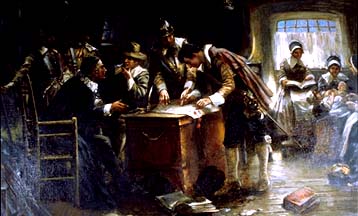
To avoid anarchy, five men gathered in the cabin of the ship to create a basis for law and order. The result of their efforts: the Mayflower Compact.

The first words of the document give strong indication of the Pilgrims’ hearts.

In the name of God, Amen.

“Everything they did started with God” (The Founders’ Bible, p. 187).

Next, the Pilgrims stated their purpose for coming to America.

We, whose names are underwritten,…by the grace of God,…having undertaken for the glory of God, and advancement of the Christian faith, and honor of our King and country…

Several phrases indicate the Pilgrims’ desires for their new colony:

  • “For the glory of God” would be a guide for all manner of decisions.
  • “Advancement of the Christian faith” would encourage them to remain strong in Christian faith among themselves and to introduce others to Jesus.
  • “Honor of our King and country” indicates their loyalty to native England and its monarch, in spite of his untoward actions that caused their flight to America in the first place.

…[We] do solemnly and mutually in the presence God and of one another, covenant and combine ourselves together into a civil body politic…

The Mayflower Compact expressed their commitment to live together in a civil manner, in the sight of God.

[We] will enact…such just and equal laws, ordinances, acts, constitutions, and offices, from time to time, as shall be thought most meet and convenient for the general good of the colony, unto which we promise all due submission and obedience.” 

Note:  there is no mention of a leader who would oversee the colony. The Pilgrims created a democratic, representative form of government, in covenant with one another, rather than by a monarchy or dictatorship.

It was the first document of its kind in the history of the world.

But the Mayflower Compact would only be as good as the commitment of Pilgrims and Strangers alike to abide by its guidelines.

Would the mutinous Strangers sign?

John Carver, church deacon and one of the organizers of the voyage, was the first to affix his signature. Other Pilgrims followed.

One book says there was a long pause. Then Captain Myles Standish stepped forward to sign. Standish had been hired by the Pilgrims to be their military captain; he was with them, but not one of them.

Soon other Strangers followed Standish’s example.  In total, forty-one signatures appeared on the document. One freeman, two hired men and seven servants declined.

At long last, Pilgrims, Strangers, and crew were able to disembark. And what did they choose to do first?

Pray.

According to Bradford, they “blessed the God of heaven, who had brought them over the fast and furious ocean..and a sea of troubles before.” Then he quoted scripture:

“Let them therefore praise the Lord, because He is good and His mercies endure forever.” (Psalm 106:1).


*     *     *     *     *     *     *     *     *     *


We, too, praise you, Lord, for your goodness and mercy upon America all these years.  As we celebrate Thanksgiving on Thursday, may we remember the solemn history behind this occasion.  Thank you for the supreme example and sacrifice of our Pilgrim forefathers–strong in faith, commitment, and perseverance.  May we follow their example, not only because you are faithful to the faithful (2 Samuel 22:26), but out of appreciation for what you, our loving God, have already done.


(Sources:  By These Words by Paul M. Angle; The Founders’ Bible; The Intellectual Devotional:  American History by David S. Kidder & Noah D. Oppenheim; The Rebirth of America;  http://www.learningtogive.org; http://www.humanities360.com; http://www.crf-usa.org; http://www.americanhistory.about.com; http://www.tparents.org; http://www.mrkash.com; http://www.mayflowerhistory.com; http://www.plimoth.org.)


Art credit:  www.washingtonmayflower.org.  


Read Full Post »

desert

Last Thursday we pondered these promises from Isaiah 58:11:

 “The Lord will guide you always,” and

“He will satisfy your needs in a sun-scorched land.”

 Today, more discoveries and encouragement await as we meditate upon the last two promises:

  • “[He] will strengthen your frame.”
  • “You will be like a well-watered garden, like a spring whose waters never fail.”

garden-waterfall-design


Do you long for strength within your frame, that is, inner strength? Perhaps you’re moving as fast as you can, but never quite reaching the end of the to-do list. And you’re bone-weary from the effort.

Perhaps the stresses of life—difficult relationships, a high-pressure job, financial obligations—are squeezing in hard.

Perhaps boredom or depression surround you in a gray shroud, and you haven’t the energy to fight against them.

“He will strengthen your frame.”

But God doesn’t wave a magic wand over us and suddenly turn weakness into strength. Usually he invites us to be part of the process.   And his solutions are radical.

For example, celebrate anything and everything (Philippians 4:4).

3095781994_90a392c03f

Take joy in:

  • Your cozy robe to ward off the morning chill
  • That cute tuft of hair sticking up on your toddler’s head
  • A parking place opening up when and where you need it
  • Licking the stamp just as the mail carrier pulls up in her truck
  • An earring lost last week turns up between the counter and stove this week.

You see, joy and strength are closely related. Ezra told the people of Israel, “The joy of the Lord is your strength” (Nehemiah 8:10).

Those five examples above, and thousands like them, are gifts from your Heavenly Father. “Every good gift and perfect gift is from above, coming down from the Father of the heavenly lights” (James 1:17).

In the same way we can build up physical strength with exercise, we can build up spiritual strength with praise—by expressing gratitude and joy for every good and perfect gift.

And now, the last promise of this verse describes in metaphor the result of living according to God’s design.

“You will be like a well-watered garden, like a spring whose waters never fail.”

TotalChildCareVegetables7 

Visualize a flourishing garden, with rich, green plants overflowing with healthy, ripe produce.

Those can be descriptors of you and me.  We are:

  • Rich in God’s grace, which he has lavished on us with all wisdom and understanding (Ephesians 1:8).
  • Green and flourishing, because we spend time with the Master Gardener and allow him to cultivate our spirits (Psalm 1:2-3).
  • Healthy and prosperous of soul (v. 3). As we soak up God’s Word, we’ll produce actions and attitudes that honor God and bring us inner satisfaction.
  • Ripe and mature, lacking in nothing (James 1:3).

God offers us “a continual source of thirst-quenching, drought-ending, fruit-producing, spiritual hydration” (James MacDonald).

Doesn’t that sound refreshing?  Who could turn down such provision?

*     *     *     *     *     *    *     *     *     *

Thank you, Father, for the precious assurances of these promises: 

  • You are leading me along the path you preordained before time began.
  • Every day of this earthly journey I can count on you to supply my needs.
  • Every day you provide fresh strength. One way is through the exercise of praise.  
  • As I spend time in your presence, I will be transformed–like a garden replenished by hydration. In fact, I can grow into your likeness with ever-increasing glory!

 “Such knowledge is too wonderful for me. It is too lofty for me to attain.” Yet I know it to be true because these are truths from your reliable Word.  My heart overflows with wonder and gratitude.

(Psalm 139:16; Philippians 4:19; 2 Corinthians 3:18; Psalm 139:6)

(Photo and art credits:  www.dayofgrace.me; http://www.anativegarden.blogspot.com; http://www.flickr.com; http://www.naturalearning.org.)


Read Full Post »

blog-prayer-woman


How would you finish this prayer: 

“Oh, Lord, what I need most right now is ____________________.”

What word would you put in the blank?

Guidance?

Provision?

Strength?

Purpose?

One glorious Bible verse tucked into Isaiah presents four comforting promises that cover each of those needs:


Isaiah58.11 

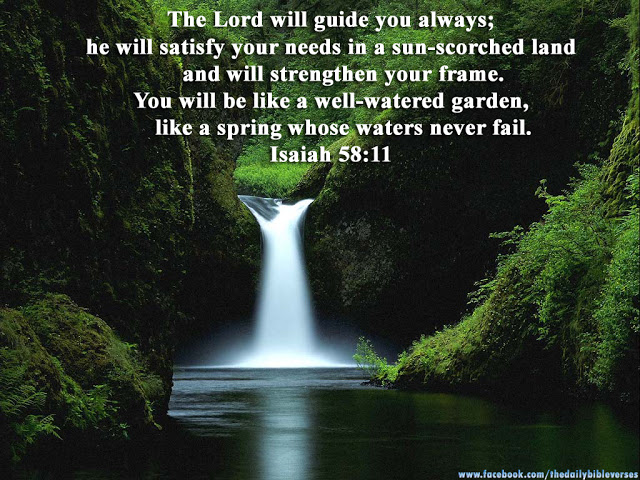
“The Lord will guide you always;

He will satisfy your needs in a sun-scorched land

And will strengthen your frame.

You will be like a well-watered garden,

Like a spring whose waters never fail” (58:11).

Lots of truth packed into five short lines. Each phrase warrants careful consideration. For example:


1.  The Lord will guide you always.


He’s not a life coach, counselor, or psychologist. The almighty God of the universe promises to be your guide—free of charge! And he’s available 24/7. Think, too, of his astounding attributes that make him the perfect guide:

  • God is omniscient—He knows everything (Psalm 139:1-6), including every detail of your situation and the people involved.
  • God is righteous—Everything he does is good (Deuteronomy 32:4). He can be relied upon to lead you down a perfect path.
  • God is merciful—He responds in loving compassion (Psalm 116:5). He’s your understanding Father, your strongest ally.
  • God is truthful—All that he says can be trusted (Titus 1:2). He will not lead you astray.
  • God is faithful—He keeps his Word (Psalm 33:4). God does not lie or forget what he said. Neither does he change his mind.

Notice that first phrase says God will always be your guide. Not every once in a while when you’re really in a quandary, but always. You are never left alone to your own devices—unless that’s the way you want to live. God is a gentleman; he leaves the choice up to you.


2.  He will satisfy your needs in a sun-scorched land.


Not he might satisfy your needs if he feels like it. He will. 

No matter what the landscape of your life looks like, God will see that your needs are met.

Have you ever been surrounded by sun-scorched land, perhaps a desert or wilderness where no life is visible?

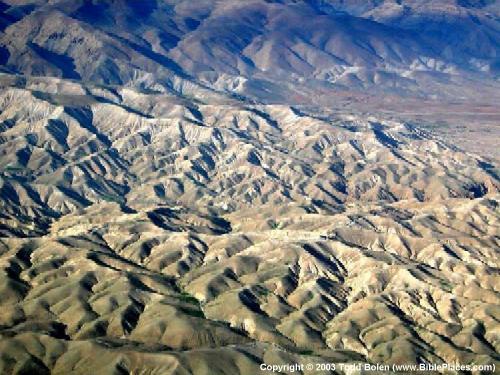
Steve and I visited Israel a number of years ago. One of our tour stops was in the Judean wilderness—a desolate and foreboding sight to behold. Not a single tuft of grass. No bushes or plants of any kind—not even cactus. Only two things are visible when standing in the midst of this desert: sky and pale gray-brown mountainous rock, as far as the eye can see.


judean_wilderness_west_of_jericho_ariel_tb_q010_03


Should you decide to live there, you’d have to bring with you everything necessary for survival: all your food, water, and clothing. For shelter, you might find a cave.

Ah! But what if there was Someone there ahead of you? Someone who already had at his disposal the supplies you required? And they would never run out? That’s the life-giving, unfailing provision of your Heavenly Father.

Let’s you and me rest in the assurance that the essentials—and even many delights!—will be generously supplied. If something is meant to be, he will take care of it—just as he’s been doing since each of us was born.

Think how he has led you through the wilderness of broken relationships and difficult circumstances. His grace has been sufficient for every challenge (2 Corinthians 12:9), right?

Now project that assurance into the future. Even if we walk through the valley of the shadow of death, we have no need to fear. Our all-powerful God is with us (Psalm 23:4)–guiding and providing.

(Please remind me of that when I come to a wilderness-patch, will you?)


*     *     *     *     *     *     *     *     *     *


Heavenly Father, I praise you that day by day, moment by moment, you are delighted to guide us in perfect wisdom. You generously provide for our needs and lovingly care for us body, soul, and spirit. Thank you for your compassion, your faithfulness, and grace to see us through the wilderness valleys. “I trust in you, O Lord; I say, ‘You are my God. My times are in your hands.’” (Psalm 31:14-15a).  


Please come back on Monday. We’ll meditate on the second half of Isaiah 58:11.


(Photo credits:  www.hischurchwomen.com; http://www.freerepublic.com; http://www.biblestudytools.com.)


Read Full Post »

fall-foliage-2

Several weeks ago, in a post entitled, “Autumn Blaze,” I wrote about the glorious colors of fall foliage. The title was borrowed from a line of poetry by Helen Hunt Jackson (1830-1885): “The land is lit with autumn blaze.”

As most of you know, Steve and I lived in Florida for forty years. We retired in June to Ohio, so we could be near two of our three children and their families. In many ways our transition has been a homecoming because both of us grew up in the Midwest.

One of the things we missed most while living in the south was “autumn blaze.”  All through last summer I waited expectantly for October and the display of God’s rich tapestry among the trees.

But those of you who live in four-season states know only too well: the blaze is quickly snuffed out by northerly winds and chilly temperatures. By mid-November, many trees have already been stripped of every leaf.

And now those bare, bleak branches stand pitifully exposed, reaching uselessly toward the sun for warmth. The splendorous color is gone; dingy gray-brown bark is all we see. The trees stand lifeless. Hopeless.

If I’m not careful, such sad thoughts will lead me into the doldrums.

A better train of thought to follow? Reasons to appreciate this dormant stage of the trees. For example: When the leaves are gone, I can appreciate the delicate lace work of branches, hidden from view except in winter.   They too demonstrate the creative genius of our God.

OLYMPUS DIGITAL CAMERA

However, when numerous bare trees huddle together on a hillside, the individual branches are indistinguishable. Our younger son and daughter-in-law enjoy a hillside view from their kitchen window–in spring, summer, and early fall, that is. Indeed, just a few weeks ago, the trees were ablaze, dressed in autumn finery.

Now the scene is much different. Look out that window today and you’d be underwhelmed by the great swath of drab dullness. Time to close the curtains.

shen6913

But wait. What if we look at that sad scene and think HOPE. Because we know what’s in store.

“No winter lasts forever; no spring skips its turn” (Hal Borland).

Winter is a time of rest, recuperation, and preparation. When warmth and light return in the spring, new life will burst forth in all creation. Guaranteed.

Those lifeless branches can remind us of another HOPE. Because we know that the God who brings life to dead trees can redeem any situation. Guaranteed.

“Oh? What basis is there for such grand HOPE?” someone might ask.

  1. We base our HOPE on God’s love.

 Absolutely nothing can separate us from his love (Romans 8:39). And if he loves us, he will care for us. “With God on our side, how can we lose?” (v. 32, MSG).

HOPE in our loving God is not misguided.

  1. We base our HOPE on God’s character.

I love Psalm 145, the only one called “a psalm of praise,” in which David extols God’s character. Our Lord is great (v.3), gracious, good, and compassionate (vs. 8-9), glorious and mighty (v. 11), righteous and kind (v. 17).

These are not descriptors of a distant god who takes no interest in his creatures. Our God is a hands-on Heavenly Father who demonstrates all these glorious attributes–in our day-to-day lives. The Lord is always watching over us (v. 20).

HOPE in our powerful God is not just wishful thinking.

  1. We base our HOPE in God’s promises.

“The Lord is faithful to all his promises and loving toward all he has made” (Psalm 145:13).

HOPE in our reliable God is not blind optimism.

Christian HOPE is the trusting expectation that God will keep his Word.

This may sound strange, but let’s look to the bare trees for encouragement. See them as glorious HOPE on display! And let’s live in cheerful expectation of God’s plan, purpose, and blessing for the future.

(Photo credits:  www.staticweb.maine.edu; http://www.commons.wikimedia.org; http://www.terragalleria.com.)


Read Full Post »

Woman with piggy bank at rainy window


“Save for a rainy day,” financial experts advise.  And they’re right.  It is smart to have funds set aside in case of emergency.

But we would also be wise to save up for another kind of rainy day:

  • The day great disappointment shatters our joy
  • The day the doctor begins a consult by saying, “I’m terribly sorry, but…”
  • The day a loved one calls with disturbing news

What could we possibly save up that would help in such circumstances?

Consider: monetary deposits in a bank account insulate us against financial emergencies.

Similarly, we can make faith-statement deposits into our soul-accounts, to insulate us against life’s emergencies.  A healthy soul-account offers peace of mind, confidence, and a sense of well-being.

The most valuable faith statements are those straight from scripture, since the Bible is our source of truth.

Statements such as these are worthy starting points:

  • God is with me, even in the midst of trial.

“Those who know Your name will trust in You, for You, Lord, have never forsaken those who seek You” (Psalm 9:10).

  • God is my stronghold in time of trouble, offering help and deliverance.

“The salvation of the righteous comes from the Lord; he is their stronghold in time of trouble.  The Lord helps them and delivers them” (Psalm 37:39-40).

  • He will supply all my needs.

“My God will meet all your needs according to his glorious riches in Christ Jesus” (Philippians 4:19).


Sometimes God makes deposits in our soul-accounts through other reading.  Here are a few examples I’ve collected:

  • “God makes good things out of the hard times.” – Erica Hale
  • “Difficulties are sent to make us grow. Move from complaining to proclaiming what God is doing through the problem. Remind yourself, for every Calvary, there is an Easter.” – Barbara Johnson
  • “When we understand that life is not about us, we learn to overlook the trivial and fix our gaze on the eternal. What is an offense compared to His love? What is a rejection compared to His unconditional acceptance? What is a momentary trial compared to an eternity with Him?” – Emmanuelle Gomez


Faith statement deposits also come through experiences, such as:

  • The spontaneous hug of a good friend who knows of our struggles. That’s God’s way of assuring us…

…We are not alone.

  • An answered prayer—and the answer is far beyond what we asked for. That’s God’s way of showing us…

…His love and blessing never fail, even in the midst of difficulty.

  • A transformed spirit through worship.  Worry becomes faith. Fear becomes courage. Depression becomes gladness. That proves…

…The joy of the Lord is our strength (Nehemiah 4:8).


Faith-statements, deposited in our souls even before we have need of them, provide a deep, sweet sense of security.

When difficulties arise, and the time comes to make withdrawals, we can praise God for each truth. Praise will fill our hearts with song and drown out the voices of worry and fear.

*     *     *     *     *     *     *     *     *     *

Your faithfulness, O God, is unwavering and unfailing.   Oh, how I want to be faithful to you, especially during difficult circumstances.  You have provided the tools.  I praise you for the deposits your Spirit makes into my soul account, offering solace, perspective, strength, and wisdom.   Help me to avail myself of your gracious provision.  


(Photo credit:  www.dailyfinance.com.)


Read Full Post »

« Newer Posts - Older Posts »

When the House is Quiet

Impressions Becoming Expressions

Mitch Teemley

The Power of Story

Still Traveling

Impressions Becoming Expressions

Living Our Days

Gaining a heart of wisdom

He Said What?!

I'm Patty, and my husband and I are living with our adult son who has autism and epilepsy. I love sharing lessons learned from life around me, especially life with Aaron.

Meditations of my Heart

Impressions Becoming Expressions

Linda Stoll

Impressions Becoming Expressions

Signora Sheila

Where faith meets la dolce vita

Heidi Viars

Finding the Image of God