Feeds:
Posts
Comments

Archive for the ‘Worship’ Category

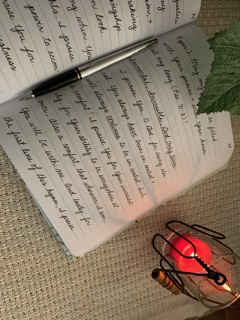
In April of this year I shared an idea borrowed from blogger Michele Morin, about journaling through hymns and praise songs. Such an exercise allows us to meditate on the lyrics, discovering more meaning than when we quickly sing through the words.

In that post I shared from my thoughts on “Come, Thou Fount of Every Blessing.” (Here’s a link to that post, Opening Up New Spaces.)

Today, let’s look more closely at another hymn rich with implications, “Immortal, Invisible, God Only Wise.”

If you don’t know this hymn, you can listen to a contemporary version here,  https://www.youtube.com/watch?v=6S97XYCkJhY, then soak with me in the first verse:

“Immortal, invisible, God only wise”

I praise You, O God, for your immortality. There is much comfort in the fact that you–in all your sovereignty, power, and wisdom–have always existed and always will.

I praise You for your invisibility, which allows you to reside within the spirits of all your children. We marvel at the wonder of such a phenomenon–such a privilege–to enjoy intimacy with you, the King of the universe!

I praise you for your incomparable wisdom. Nothing is ever a mystery to you. You’re never puzzled, confused, or uncertain.[1] You always know the best course of action that will best serve everyone involved—even those who are part of the ripple effect, perhaps years later.

How amazing that you make your wisdom available to us–including an ordinary person like me.[2]

“In light inaccessible hid from our eyes”

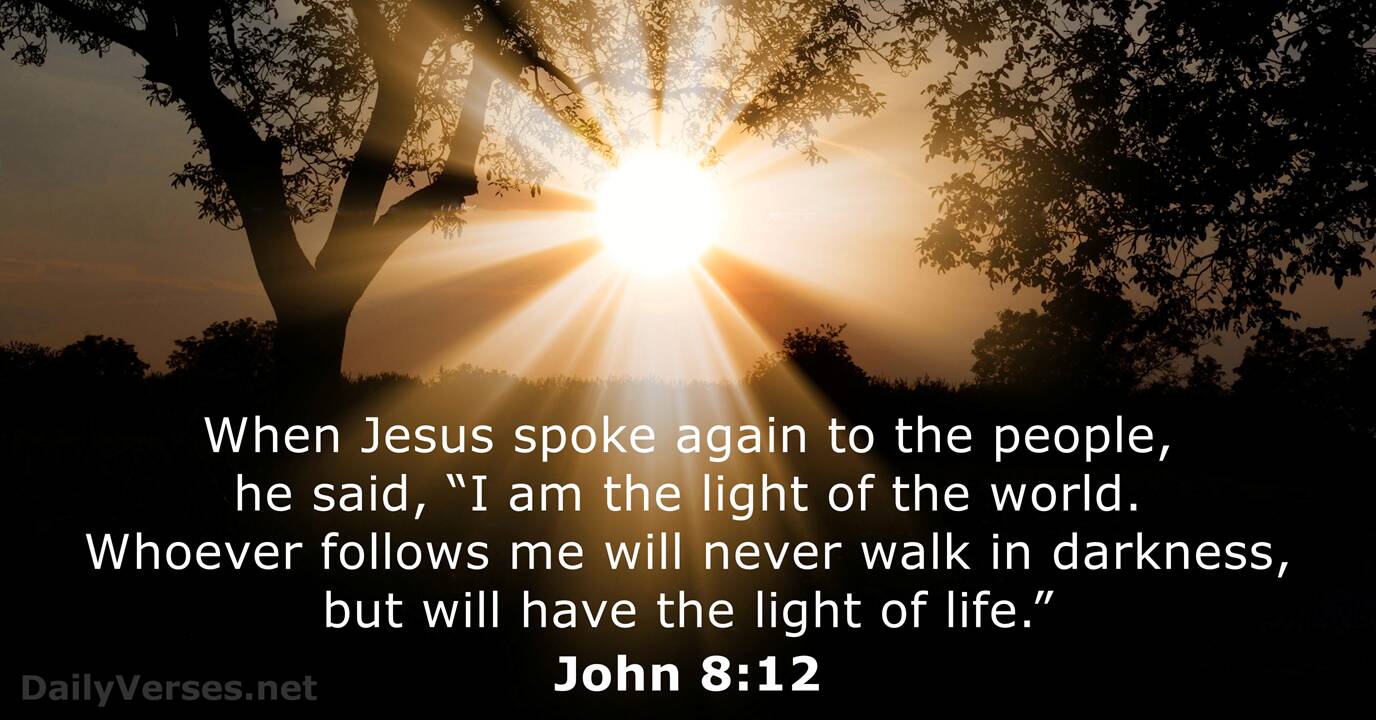
You are light.  Your radiance is like sunlight, and rays flash from your hands! No one can physically look upon such brilliance.

But your light also symbolizes the purity of your character. Just as sunlight brightens our world, your multi-beamed goodness brightens my soul with grace, strength, blessings, and more.

You also illuminate truth in my life, through the light of your Word. And by the power of your Spirit I can walk daily in the guiding, cheering light of your presence.[3] 
“Most blessed, most glorious, the Ancient of Days”

I praise You that you are most blessed. That is, you are fully satisfied within yourself. (Of course this is true–you’re perfect!)

You’re also most blessed because of your holiness–transcendent and “totally other” from anything else in the universe.

In addition, you’re “most glorious.” Your breath-taking attributes astound us, including your:

  • omnipotence, omniscience, and omnipresence
  • infinity, changelessness, and self-sufficiency
  • faithfulness, goodness, and justice
  • mercy, grace, and love
  • holiness, righteousness, and immanence

I praise you for demonstrating all these traits with acts of power. You perform wonders that cannot be fathomed, and miracles that cannot be counted![4]

Our family has witnessed numerous wonders and miracles. “We are filled with the good things of your house” (Psalm 65:46), many of which are recorded in my God -Is-Faithful journal.

I also praise you for being our Ancient of Days—a name that speaks of your regality, endurance, and sound judgment.  You have reigned in supremacy through eons past and will continue to reign into eternity yet to come.

Again, what sweet comfort and joyful wonder to contemplate that you, such an incredible God, are with me and within me, wielding your attributes for my benefit.

“Almighty, victorious—Thy great name we praise.”

King David wrote, “How majestic is your name in all the earth” (Psalm 8:1)! Perhaps he had in mind the multiplicity of your names, each one highlighting different facets of your character. You are:

  • Elohim, God of supreme power and might
  • El Roi, the God Who Sees, who watches over all
  • Jehovah Jireh, our God who provides
  • Jehovah Rapha, our God who heals
  • Yaweh Shalom, our God of peace

And that’s just a few out of many. I thank you that as each one reveals more truth about you, we grow to know you better. I also praise you for the hope and encouragement we find in your glorious names.

You, O God, are most worthy of praise because of your infinite excellencies. I praise you for your greatness–beyond human comprehension!


[1] Lloyd Stilley, https://www.lifeway.com/en/articles/sermon-wisdom-god-romans-16-1-corinthians-1

[2] James 1:5; Psalm 19:7 CEV

[3] 1 John 1:5; Habakkuk 3:4; 1 John 3:3; Psalm 12:6; 119:105; Psalm 89:15; John 8:12

[4] Psalm 150:2; Job 5:9

Photo credits: Nancy Ruegg; http://www.flickr.com; http://www.wikimedia.org; http://www.dailyverses.net; http://www.canva.com; http://www.pixnio.com; http://www.heartlight.org.
Read Full Post »

Approximately 250 times in scripture we’re told to praise the Lord[ 1].

Some would see all these calls to praise as the directives of an ego-maniacal god, but that’s hardly the case. Upon further investigation of scripture we find that praise of God is actually good for us.

Isn’t that just like our Heavenly Father? We seek to bless him by offering our praises, and he turns right around and blesses us when we do.

What are those blessings of praise? I’m so glad you asked. Here are just seven as a starter-list.  You may find a surprise or two.

Praising God alleviates anxieties.  

As we remind ourselves Who’s in charge and how he provides for those in his care, fears are calmed.  (Psalm 146 offers an example).

Praising God enhances prayer.

Instead of focusing on the problem which presses us downward, praise turns our attention to what God can do and lifts our spirit upward. (See Psalm 103.)

Praising God kicks Satan to the curb.

James 4:7 reminds us, “Resist the devil, and he will flee from you.” What better way to resist him than to focus on God’s power, promises, and past provisions?

Praise brings the consciousness of the presence of God,

and the liars from the pit cannot effectively market their wares

in the atmosphere of praise.

—Jack Taylor[2]

Praising God magnifies blessings.

When we look through a magnifying glass at an object, we often experience greater appreciation of that object. Hold a magnifying glass of praise to God for the day’s blessings and experience greater appreciation of Him and his benefits (Psalm 77:11-14).

Praising God offers comfort.

Are you disappointed? Praise God that he brings good out of every situation (Romans 8:28). Are you hurting? Celebrate God’s abundant goodness in spite of circumstances (Psalm 145:7). Are you fearful? Rejoice in God, a strong refuge in times of trouble; he is ready and willing to help (Psalm 46:1).

Praising God provides pleasure.

“Praise the Lord, for the Lord is good” encouraged one of the psalmists. “Sing praise to his name, for that is pleasant” (Psalm 135:3). Numerous times in scripture we’re urged to sing and shout for joy because of who God is and what he does. Why?

Praising God replenishes faith.

Meditate on Psalm 145 and note all the attributes of God highlighted, including: his greatness, (v. 3), the mighty acts he performs (v. 4), the splendor of his majesty (v. 5), his goodness and righteousness (v. 7).   

The more you praise God, the more you become God-conscious

and absorbed in His greatness, wisdom, faithfulness, and love.

Praise reminds you of all that God is able to do

and of great things He has already done.

Wesley L. Duewel

Add these to the list:

  • Praising God in the company of others encourages them (Colossians 3:16).
  • Praising God fine-tunes our perspective as our focus shifts from self to him (Psalm 121).
  • Praising God grows our hope, humbles our spirits, and ushers in peace (Psalm 33:18-22, Psalm 8, Psalm 62:1-2).

Surely there are still more blessings of praise to be discovered. No wonder G. K. Chesterton wrote:

  • * * * * * * * * * *

Thank you, Father, for these many blessings you lavishly supply as we learn to enjoy you through praise. May we grow each day in our capacity to celebrate you at every turn.

Did any of these blessings of praise surprise you? Tell us about it in the comment section below!


Notes:

[1] https://faithalone.org/grace-in-focus-articles/praise-the-lord/

[2] quoted in Satisfy the Thirsty Soul by Linda Dillow, 191.

Photo credits: http://www.heartlight.org; http://www.flickr.com; http://www.pxhere.com;www.maxpixel.net; http://www.flickr.com.

Read Full Post »

“The Lord is my Shepherd; I shall not want” (Psalm 23:1 KJV).

Many of us memorized those words as children. And some of us may have thought, “Wow! That means God will give me whatever I want!”

So we prayed for new bicycles, the latest gadgets, and swimming pools in our backyards—absolutely certain that if God gave us these hearts’ desires, we’d be truly satisfied.

Some of our prayers were answered affirmatively. A new bicycle with sparkling spokes actually materialized by the Christmas tree. Or Aunt Kate heard the pleas for Mattell’s Magical Music Thing, and sent it as a birthday gift.

But as the years went by, the wise and introspective among us realized:

1. When one desire is fulfilled, another quickly takes its place.

Years ago I heard that a famous actress had accumulated seven houses, each one a different style from the others. Why? Because moving from one to another eased her boredom. (I wonder how long it took to become discontented with House #4, or #5, or #6, before she hired an architect to start the next?)

2. God isn’t in the business of making wishes come true.

Psalm 23:1 doesn’t mean: “I’m one of God’s flock! I’m gonna live on Easy Street!”

If he did grant every whim, we’d soon become self-centered and spoiled.

Perhaps a clarifying interpretation of the opening scripture would be: “God is my loving Care-Giver. All that I enjoy in my relationship with him far outweighs anything this world has to offer. I really don’t need another single thing.”

Ah, to be as soul-satisfied as King David, the author of this psalm!  How can we become that contented?

One place to begin is with gratitude and praise.

Think of all we enjoy as a result of our relationship with God.  Peace, joy, and provision quickly come to mind.

Here are a few more:

  • Companionship with a perfect Friend—every moment of every day–into eternity.  He is always listening, always watchful, always diligent.
  • Hope. No situation is beyond the control of our Almighty God.
  • Settledness, because he is in control, and “makes good things even out of hard times” (Erica Hale).
  • Truth. We don’t have to muddle through life like a do-it-yourselfer with no instruction manual. “The unfolding of [God’s] words gives light; it gives understanding to the simple” (Psalm 119:130).

The bottom-line is this: No possession or position, no place or person on earth can fill our hearts with contentment.

3. True satisfaction flourishes when we affirm that in God we have all we need.

Remember Jesus’ invitation in Matthew 11:28?

Are you weary of the dissatisfaction that results from striving for the next desire?  Are you burdened by unfulfilled wishes and dreams?

Come to Jesus.  Count the scores of blessings he’s already provided in the past, is currently providing this very moment, and has already prepared in the glory of heaven yet to come.

Cultivate true satisfaction in your heart with gratitude and praise!

*     *     *     *     *     *     *     *     *     *

What helps you cultivate true satisfaction?  Please share in the Comments section below!

Art & photo credits: http://www.canva.com; http://www.flickr.com; http://www.rawpixel.com; http://www.wikimedia.org.

(Revised and reblogged from 7-10-14 while we enjoy house guests.)

Read Full Post »

Some time ago, wise-and-insightful blogger Michele Morin (at Living Our Days) shared that she was journaling through some of the old hymns. I imagined her digging into the meaning of some of the rich language and theology, personalizing the truths, and/or using them as the basis for prayer.

Putting pen or pencil to paper in such a way slows down our thinking, allowing wonderful blessings to emerge:

  • Increased knowledge of God and his Word
  • Clarity of understanding
  • A record of discoveries
  • A record of faith deposits for later encouragement
  • Renewal of the mind
  • Augmented intimacy with God

If writing a meditation sounds intimidating, adopt the attitude of Isaac Asimov:

“Writing to me is simply thinking through my fingers.”

Isaac Asimov

For Christian journalers, writing can be worshiping through our fingers.

But how do we even begin such a process? Try Anne Sexton’s approach:

When we invite Jesus into our lives, the Spirit of God takes up residence within our spirits (1). We can put our ears down close to our souls and listen hard for him to guide our thoughts and lead us to the insights he would have us discover.

And then, we fill our pages with the breathings of our hearts (2).

The following is an example of a journal entry, based on the first verse of the hymn, “Come, Thou Fount of Every Blessing”(3). The next four images contain the lyrics.

You, oh God, are the Source of every blessing—every provision, every answered prayer, every wise decision, every creative idea, every moment of joy. All good and perfect gifts come from you (4).

Out of your lavish generosity, blessings flow continually from your hand. May I be quick to praise you for each one as they demonstrate your lovingkindness.

This fount of blessing includes your mercy also. I praise you for your forgiveness, undeserving as I am. Thank you for looking upon me with compassion and tenderness in spite of my weaknesses, failures, and sins.

And I praise you that your mercy never ends! You are faithful to forgive me every time I come to you in repentance. Such grace is beyond comprehension. Yes, I want to sing songs of loudest praise, to honor you rightly for all you’ve done for me and continue to do.

Perhaps if I had the voice of an angel and knew the songs of heaven I could sing the full praise you deserve!

Nevertheless, I celebrate your name(s)—Shepherd, Lord of Peace, God of Grace, Father of Compassion and more. I glory in all the attributes indicated by each one. And I remember: the one trait that is part of them all: your unfailing love.

Thank you for loving me, in spite of my shortcomings; thank you for redeeming me from the consequences of my sins so I might enjoy you forever!

Should you decide to journal through a hymn or praise song, remember: perfection is not the goal, getting to know God better and worship him more passionately are the aims.

An added benefit? Our meditations will positively impact our words and actions (5).

Notes:

  1. 1 Corinthians 3:16
  2. based on a quote from William Wordsworth
  3. by Robert Robinson, text adapted by Margaret Clarkson
  4. James 1:17
  5. Joshua 1:8

Photo credits: http://www.pxfuel.com; http://www.canva.com; http://www.pxhere.com; http://www.canva.com (2); http://www.flicker.com; http://www.freebibleimages.org.

Read Full Post »

One of the psalmists proclaimed, “I will go to the altar of God, to God, my joy and my delight” (Psalm 43:4). The statement raises the question, How do you delight in someone who can’t be seen or touched?

Perhaps we can discover the answer by considering how we delight in the people around us. My father offers a perfect example.

First let me tell you: Dad worked miracles with his numerous tools.  He could fix or build practically anything, as well as paint and wallpaper like a pro.

We were probably among the first to have a built-in sound system.  Dad wired and hooked up a speaker in every room (each with its own on-and-off switch), so anything on the radio or hi-fi could be heard anywhere in the house. 

Dad also built custom-sized furniture:  in the living room–a bookcase (with open shelves above and enclosed shelves below) along with Mom’s music cabinet; in the kitchen—new cupboards and a storage cabinet; in Mom’s and Dad’s bedroom—a large dresser; and for my brother John and me—desks. Each project displayed his careful attention to detail.

But Dad’s admirable qualities weren’t only on display in his home improvement projects.  He demonstrated patience while teaching us how to play Muggins (an old card game), how to use his tools, and how to plant seeds.

He exemplified selflessness by taking us sledding and kite-flying in the park, swimming at the community pool, and biking around town. Dad proved his generosity by volunteering time and effort to help neighbors and fulfill various needs at church.  

When Dad said, “Who wants to pick up some lumber with me?” or “Who wants to go to the hardware store?” John and I were ready to drop whatever we were doing. 

It’s not that these were exciting activities in themselves, it was Dad who made them a special delight–conversing with us as we rode to and from, pointing out items of interest along the way, and holding our small hands in his big ones as we crossed streets.  

Now all this activity and industriousness took place decades ago of course, yet I still take pleasure in remembering his noteworthy undertakings and attributes. In fact, appreciation and admiration for him have only increased over time.  I consider myself privileged to have known Dad and spent time with him.

(Dad and me, mid-1960s)

To know our Heavenly Father we turn to the Bible, of course.  There we learn about his wonderful deeds and miracles. We see God’s glorious character traits on display, including his astounding abilities, his goodness, generosity, and love. We soon find ourselves delighting in all that he is.

We also delight in God as we spend time with him–celebrating what he’s done in our past and praising him for what he’s accomplishing today. We learn important life lessons from him.  And we consider the benefits bestowed by our Heavenly Father, his eternal commitment to us, unfailing love for us, and strength-infusing presence with us.

We find ourselves happily praising God:

This image has an empty alt attribute; its file name is 7335.jpeg

Then we turn all these contemplations into gratitude.

The daily practice of the discipline of gratitude

is the way to daily practice the delight of God.

–Ann Voskamp*

And what will be the result of such a practice?  Pleasurable wonder, resilient faith, and serene contentment—as a start. Doesn’t that sound glorious? Especially during these turbulent times.

In addition, we’ll bring delight to him also (Psalm 147:11). Imagine that!

Perhaps we’d do well to turn Psalm 43:4 into a New Year’s resolution for 2022:

[Daily] I will go to the altar of God,

to God, my joy and my [deep] delight.

____________________

*One Thousand Gifts, 82.

Photo credits: http://www.wikimedia.org (2); http://www.pixnio.com; Henry Mensinger (my grandfather); http://www.heartlight.org (2); http://www.pixabay.com.

Read Full Post »

The first Christmas carol ever composed rarely appears in a collection of Advent songs.  But you will find it in the Bible, Luke chapter one.  It’s Mary’s song, shared with her cousin Elizabeth soon after she arrived at the older woman’s home.

Using much scripture, Mary artfully wove this prayer-song to praise God for his work in her life and in the world-at-large, especially now that the Messiah would soon be born.

Mary’s prayer is often referred to as the Magnificat, because in a number of translations it begins, “My soul magnifies the Lord,” as if Mary is holding up a magnifying glass to God’s attributes while she draws attention to each one.

I too have seen God’s attributes at work, and have experienced countless blessings.  While contemplating Mary’s song recently, I wondered: could I compose a Magnificat? What follows is the result.

My soul proclaims your greatness, O Lord . . . (Luke 1:46 HCSB)

. . . on display in the wonders of creation, events that defy explanation, and in the transformed lives of people—including my own. 

“You are the God who performs miracles; you display your power among the peoples”[1] as needs are met, disasters avoided, and the way forward provided. You alone are omnipotent, with all resources at your disposal.

My spirit rejoices in God my Savior (v. 47 NIV).

I praise you for saving me from the consequences of my sin through the sacrifice of your Son.  Upon my last breath, you will take me to heaven to live with you forever. In that moment I’ll be healed of all ailments and released from all adversity.

Until that day, you gladly save me from worry, fear, discouragement and stress when I trust you and follow your ways. Thank you, dear Father!

You have looked [with loving care] on the humble state of your maidservant (v. 48 AMP).

By the world’s standards I’m a nobody–no wealth, no fame, no power. Little do some know my true status, the daughter of the King of the universe, and the numerous delights I enjoy as a result:

  • glorious moments in your presence
  • generous gifts not even asked for
  • friendships with your other children (augmented by your involvement and influence)
  • your frequent intervention in difficult circumstances, as only a powerful King could arrange

From one generation to another you have demonstrated your mercy (v. 50 GNT).

I think of my grandparents, each of whom you sustained and helped through difficulty.  I think of my parents who also experienced your faithfulness as they were faithful to you.

And now we can testify of your gracious kindness. You have dealt compassionately, especially in times of distress.

Your mighty power has been on display (v. 51 GWT) . . .

 . . . through healings that doctors can’t explain, needs met in miraculous ways, monetary gifts arriving just in time, and moments of desperation turned around in an instant.

“You satisfy the hungry with good things” (v. 53, HCSB). 

The list is lavishly long: your undeserved love, comforting presence, inexplicable peace, fullness of joy, heartening encouragement, fulfilling purpose, undying hope, sure promises, abundant provision, generous blessings, wise counsel, abiding strength—to mention a few! “In your giving we have a sea without a shore.”[2]

My God, the King, I exalt you for your glorious attributes,

and will praise your name forever and ever.

 Your ways are absolutely holy—no one is like you. 

You are the God who performs miracles!

Your power is on display in glorious ways all over the earth,

yet you have chosen to do great things for me and those I love.

My heart is filled with joy!

(Psalm 145:1; 77:13-14; 126:3)


[1] Psalm 77:14

[2] Herbert Lockyer, Seasons of the Lord, 255.

Photo credits: http://www.pixabay.com (twstringer); http://www.pxhere.com (dorothe); http://www.pxhere.com; http://www.pixaby.com (Simon); http://www.wikimedia.com (VinceTraveller); http://www.heartlight.org; http://www.pixabay.com (nastya_gepp); http://www.pix4free.

Read Full Post »

Sanders’ statement above begs the question:  where might seeing eyes focus?  No doubt there are a number of areas, but for today, let’s look at—or rather, see (!)–just two:

Seeing Eyes Focus on the Evidence of God

First, all areas of science from astronomy to zoology are grounded upon such laws of nature as gravity, the 24-hour cycle of light and dark, and the evaporation / condensation cycle of water.  Such regularities beg the question, why is everything in the universe so structured?

“There is no logical necessity for a universe that obeys rules,”[1] and yet it clearly does. Someone had to give order to what would otherwise be chaos.

Second, the more cytologists study the structure of cells, the more complexities they discover. Even so, five years ago they did create a cell with 473 genes.  However, they have a long way to go to match God’s engineering skills.  The single-cell organism, E. coli bacteria, contains 4,000 genes; a human cell, 30,000.[2] 

Third, all around us are examples of God’s artistry, but, “for lack of attention, a thousand forms of loveliness elude us every day.”[3]  Such loveliness—right outside our door–includes:

  • A sunrise back-lighting the tree-tops
  • Ethereal mist swathing the woods’ undergrowth
  • Dewdrop jewels sparkling in the grass
  • Scampering squirrels making thin tree limbs dance
  • Hydrangeas transforming their finery from shell pink to deep salmon

And seeing eyes turn heavenward in worship.

Seeing Eyes See People

Perhaps a true story will illustrate best:

There I stood over my son’s open suitcase, staring at the tag on his new school uniform pants. They were the wrong size. J. needed those pants the very next morning when all the sixth graders of his school would head to Washington D. C. for a three-day field trip. 

We’d ordered those pants the previous week when the uniform store didn’t have his size in stock.  They’d arrived on Saturday, but I never checked the tag till that moment. A glance at my watch confirmed:  if we left immediately, we might arrive at Harris Prep Shop (a half hour away) before it closed.

But a long night lay ahead with another hour added to the agenda. And what if they still didn’t have J.’s size?  Several scenarios played in my mind while I called the store.

Mrs. Harris apologized for the mix-up, then informed me a shipment had arrived that morning, including pants. I told her we’d get there ASAP, but it would take thirty minutes.

“Wait a minute,” she replied.  Her voice became muffled while she spoke to someone else, then came back to me. 

“Mrs. Ruegg?  There’s another mom here from your school, and she says she’ll pick up the pants for you. You can return the others another time.”

“Oh—that would be fantastic!” I cried.  “What’s her address?  I’ll meet her there.”

More muffled conversation ensued, then Mrs. Harris relayed, “She says, give her your address and she’ll drop them off.”

An hour of precious time was suddenly regained by this thoughtful mother.  Granted, she didn’t see my eyes widen upon discovering the size-tag, or my brows furrow as I fretted over several less-than-satisfactory solutions to our dilemma.

This woman was able to see me across the miles with the eyes of empathy and responded with gracious kindness.

Now that kind of sight is rare indeed.


[1] https://www.everystudent.com/features/is-there-a-god.html

[2] https://kenboa.org/apologetics/scientific-evidence-of-gods-existence/; https://www.nist.gov/news-events/news/2021/03/scientists-create-simple-synthetic-cell-grows-and-divides-normally

[3] Evelyn Underhill

Art & photo credits: http://www.maxpixel.net; http://www.flickr.com; http://www.pixaby.com; Nancy Ruegg; http://www.publicdomainpictures.net; http://www.facebook.com; http://www.piqsels.com.

Read Full Post »

(a personalized psalm, based on Psalm 143)

O Lord, we are in serious trouble as a nation.  Selfish gain and a lust for power have taken precedence over the common good.  E pluribus unum is deteriorating into tribalism; “In God We Trust” is being replaced by “In US We Trust.”

Have mercy upon us, O God!  Our arch enemy Satan is wreaking havoc across our land; numerous problems vie for attention. Among them: soaring crime rates in our cities, increasing drug addiction and homelessness, failing schools, mounting national debt, escalating inflation, and threats to our national security.

If I focus on these monumental problems, my spirit is overwhelmed, my heart overcome with dismay (2).

BUT!  THIS I KNOW:

You are a faithful God who never leaves his children to fend for themselves.  You never forget, never fail, and never falter (3).

I KNOW you are a righteous God of complete integrity and consistency, always acting in accordance to the perfections of your character, always at the right time.

I KNOW you are a reliable God.  Scripture, history, the lives of present-day saints, and events in my own life provide countless examples of your miraculous care for your children.  As I consider all your hands have accomplished my spirit is lifted, my faith increased.

There is no trouble so great, no situation so hopeless that you cannot resolve it.  If you do not provide rescue, you supply ample strength and courage to endure.  Even more wondrous, during times of distress you grant heightened awareness of your glorious presence, your infinite peace, and radiant joy.

Therefore, I not only cry out for rescue from ruin; I cry out for you.  Like a little child who raises her hands for a loved one to pick her up and hold her close, I desire intimacy with you, the only One who can help me and keep me from falling (4).

I KNOW you are a loving God of never-failing devotion. I can trust you for guidance and support, whatever the future holds.  And as I bask in the warmth of your lavish love, anxiety and fear will melt away.  Your love is active, seeking my good more than my pleasure, working toward my divine transformation more than my comfort. And as your wisdom grows within me, I see the supreme value of the former over the latter.

I KNOW you are my God.  I’m in awe that you, the Creator and Sustainer of the universe, are my Heavenly Father! You are the almighty One leading everything to the conclusion you ordained before time began–by the same power, wisdom, and love with which you made it (4). Yet in spite of that power, in spite of your perfection and majestic glory, you desire to be my constant Companion and Friend. 

So I humbly ask:

Hear me as I pray (v. 1). 

Show me the way I should go (v. 8).

Hide me in you (v. 9).

Teach me and lead me (v. 10).

Bring me out of trouble and into the shelter of your refuge  (v. 11; Psalm 46:1-3).

For America I pray we’d corporately look to you for the way we should go. Bring us out of our troubles and rescue us from our enemies, including those that war within the spirit.  Preserve us, I pray (vs. 9, 11).

Amen.

Notes:

  1. Psalm 143:4 AMP and HCSB
  2. A. W. Pink
  3. Psalm 54:4 CEV
  4. Julian of Norwich

Photo credits: http://www.dailyverses.net; http://www.picryl.com; http://www.depositphotos.com; http://www.pxfuel.com; http://www.pixabaycom; http://www.dailyverses.net (3); http://www.wikimedia.com.

Read Full Post »

This quote became the basis for a post in September 2017 titled Expect Great Things.  At the time Murray’s words were speaking new encouragement into my prayer life.  I copied the quote on a 3 x 5 and have kept it in my prayer box ever since.

Now four years later, I must confess my worship of God in his glory has become a bit stale.  I find myself using the same words to repeat such attributes as:  his wisdom to solve problems, his goodness to provide blessing, and his power to generate miracles. My loving Father deserves so much more than rote repetition.

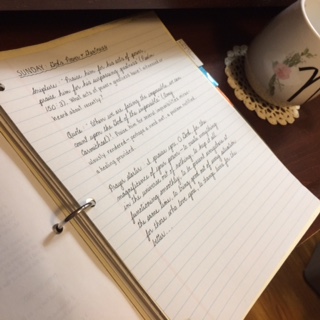
Then a new idea occurred to me, likely inspired by the Spirit himself.  What if I devoted each day of the week to a different aspect of God’s glory?  And what if I prepared a separate page in my quiet time notebook for each attribute and began collecting appropriate scriptures, quotes, personal thoughts—different praise-starters for each day so my worship might remain fresh?

To that end, I chose the following attributes to focus on first:

  • Sunday—God’s power and greatness
  • Monday—God’s splendorous names
  • Tuesday—God’s wisdom and counsel
  • Wednesday—God’s love
  • Thursday—God’s faithfulness
  • Friday—God’s goodness
  • Saturday—God’s grace and compassion

To keep this post of reasonable length, I’ll just include what I’ve collected so far for Sunday, Monday, and Tuesday.

Sunday—God’s power and greatness

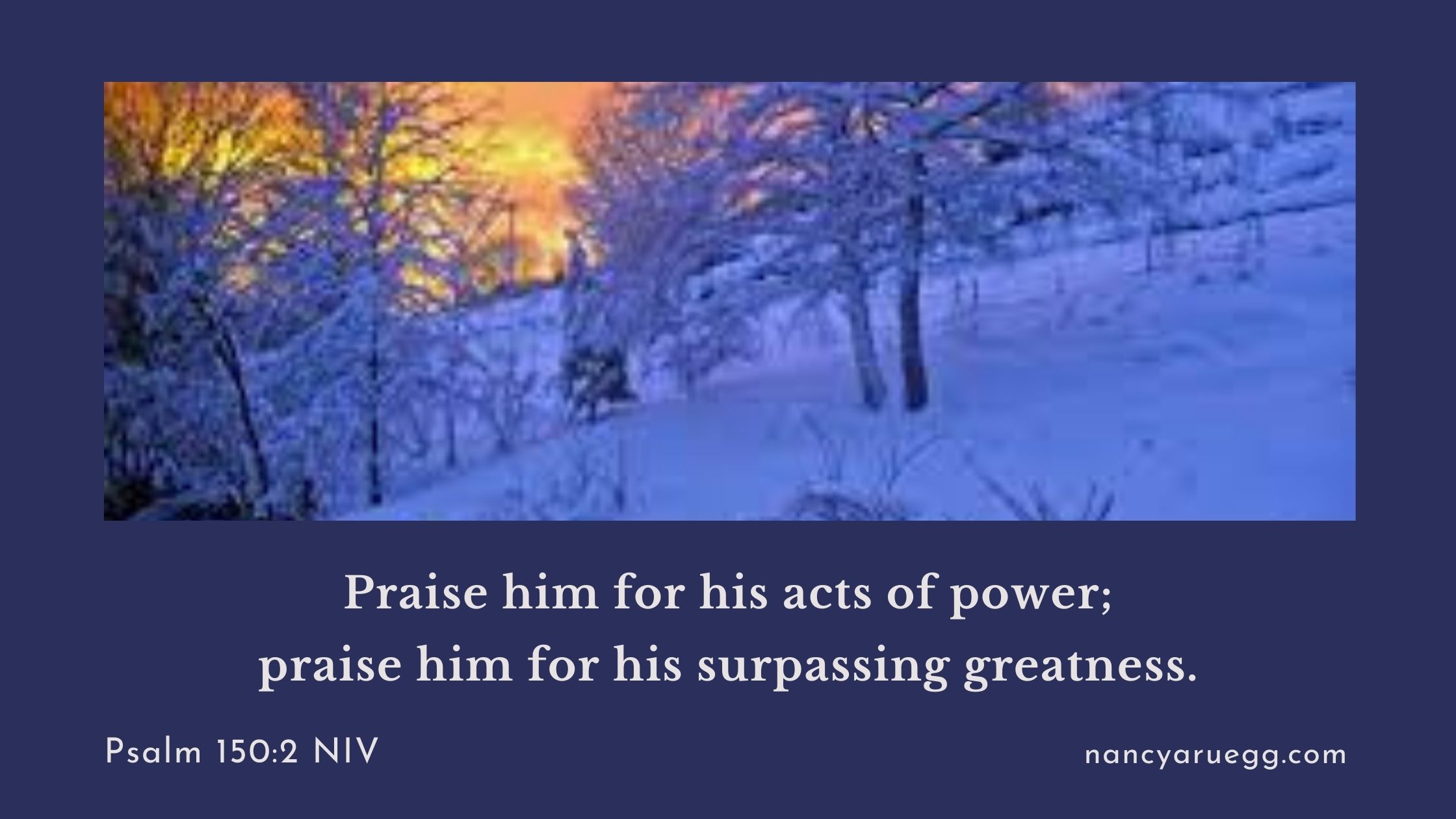
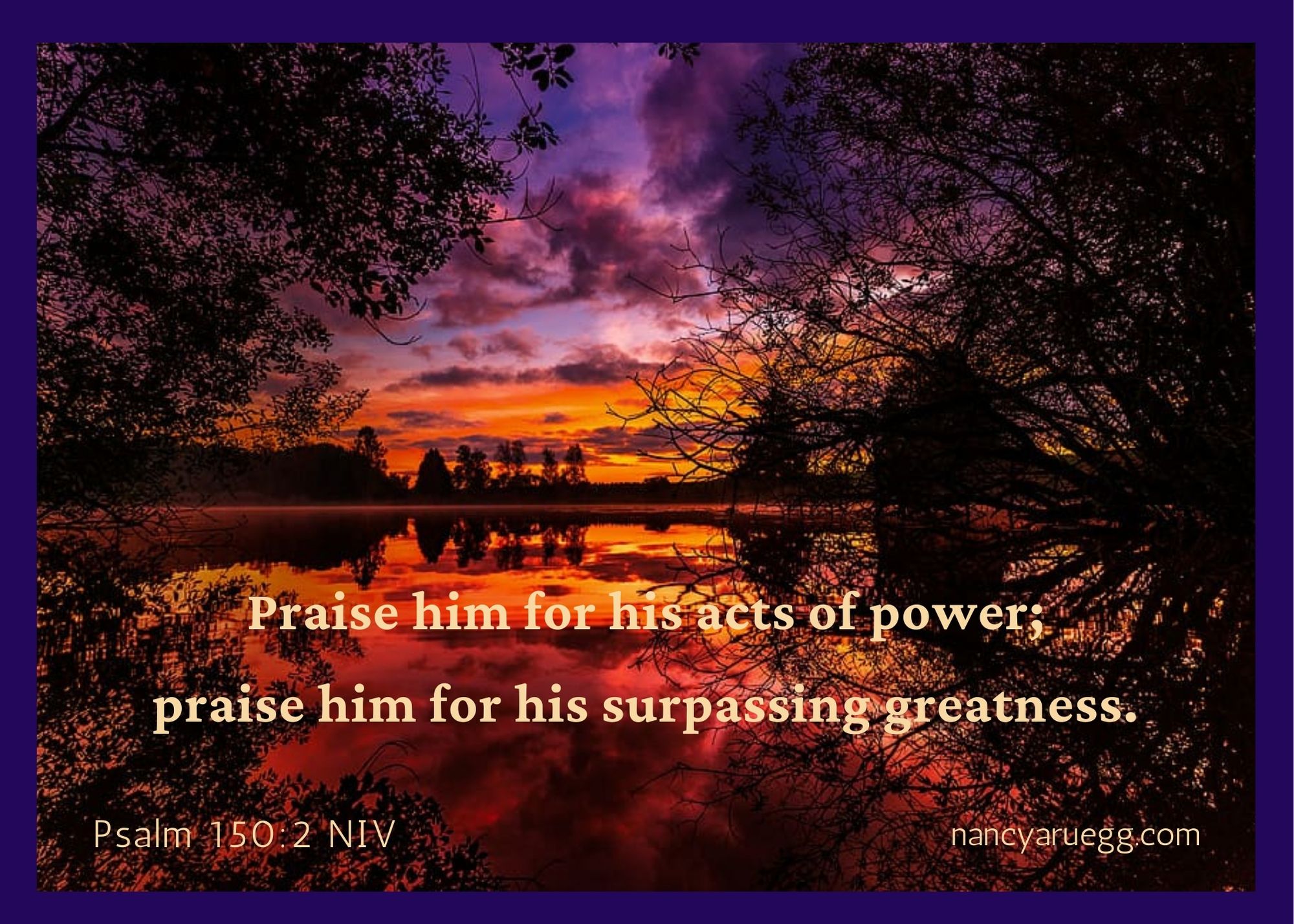
  • Scripture:  “Praise him for his acts of power; praise him for his surpassing greatness (Psalm 150:2).  What acts of God’s power and greatness have I witnessed or heard about recently?
  • Quote:  “When we are facing the impossible, we can count upon the God of the impossible” (Amy Carmichael).  Praise him for several impossibilities miraculously rendered—perhaps a need met, a problem rectified, a healing provided.  
  • Prayer starter: I praise you, O God, for the magnificence of your power—to create everything in the universe out of nothing, to keep it all functioning smoothly, to be present everywhere at the same time, to bring good out of every situation for those who love you, to change lives for the better, . . .  

Monday—God’s splendorous names and titles

Scripture: “Let the name of the Lord be praised, both now and forevermore” (Psalm 113:2).  Choose one or two to focus on each Monday.

  • Prayer starter for one name:  I praise you Jehovah-Nissi, The Lord My Banner. You are my focal point of hope and encouragement for every situation. How comforting to know that all of your attributes are always at work on behalf of your people.  I praise you for your marvelous promises of strength, provision, wisdom, and peace. . .

Tuesday—God’s wisdom and counsel

  • Scripture: “I will bless the Lord who has counseled me” (Psalm 16:7a NIV).  How has he counseled me recently as well as others?
  • Quote:  Praise God that his “infinite wisdom directs every event, brings order out of confusion, and light out of darkness, and, to those who love God, causes all things, whatever be their present aspect and apparent tendency, to work together for good”—J. L. Dagg.  Such glorious truths to hold close at heart! What else might I add?
  • Prayer Starter:  I also praise you, O God, for the gift of scripture to guide us through life with your truth and wisdom.  I praise you for your Holy Spirit who increases our understanding and enlightens our souls.  You never turn away anyone who seeks your wisdom! . . .

And what will be the result of such worship that enthusiastically affirms God’s transcendence?  Transformation—transformation of our prayers, transformation of our lives.

.

Nothing we do is more powerful

or more life-changing than praising God.

— Stormie Omartian

*from The Power of God’s Names

Image credits: http://www.canva.com; Nancy Ruegg; http://www.pxfuel.com; http://www.flickr.com; http://www.heartlight.org; http://www.pxfuel.com.

Read Full Post »

“This world can be saved from political chaos and collapse

by one thing only, and that is _______________.”

How would you fill in the blank?

A. Wise leadership?

B. Liberal generosity?

C. Open-hearted worship?

D. Unconditional love?

Before we consider the answer, let me introduce the author of that quote, William Temple, who served as Archbishop of Canterbury from 1942-1944.

220px-WTemple

You may remember those were three of the six years when Great Britain and her allies fought against the Nazis. In fact, when Bishop Temple took office, England faced the real possibility of a German invasion.

Temple did not cloister himself within the church walls. He worked to aid Jewish refugees from Nazi Germany, supported a negotiated peace (instead of the unconditional surrender that Allied leaders desired), and traveled frequently throughout England, encouraging British citizens to take courage in their fight against evil and hold onto hope in God.

It was part of a radio broadcast during those grim days of German air attacks that Bishop Temple spoke about “one thing only.” His last word of that statement was Answer C, worship.

Now how did he expect a bit of hymn singing, scripture reading, and a sermon in church to make a difference?

He didn’t. Bishop Temple was referring more to personal worship than public.

His own definition of worship clarifies what he had in mind:

CfTp0ojVIAAXMCN

Imagine a world where each person worshiped God by:

  • Submitting his conscience to God as David did, when he asked for a pure heart and steadfast spirit (Psalm 104:10).
  • Seeking to fill his mind with the truth of God’s Word, recognizing that all his commands are trustworthy (Psalm 119:86a).
  • Replacing negative, impure, unkind, and prejudiced thoughts with whatever is true, noble, pure, and admirable (Philippians 4:8).
  • Availing himself of God’s love and then imitating him—his mercy to forgive, his grace to provide, his benevolence to bless (Ephesians 5:1).
  • Putting aside selfish desires and focusing effort on what God would have him achieve (1 Corinthians 10:31).

Surely there would be less animosity and power-grabbing in our world.

But I can’t point fingers at others when the truth is, have yet to experience the fullness of what Bishop Temple asserted. An honest inventory of my life includes:

  • A heart not consistently pure, and a spirit not always steadfast.
  • Faith that sometimes falters in God’s trustworthy commands.
  • Thoughts that can grovel in the negative.
  • Choices and actions that do not always reflect God’s love.
  • Selfishness that still rears its ugly head.

On the other hand, guilt is not what God intended as the motivation for worship.

No, he designed it to be a delight, not a duty. He wants to expand our joy (Psalm 16:11), provide rest and refuge (Psalm 91:1-2), bestow his strength (Psalm 138:2-3), and more–through the acts of worship. We short-change ourselves by neglecting its pleasure each day.

Perhaps there’s a reciprocal relationship among all these processes. As we worship God with our adoration and appreciation, praise and prayer, might those other aspects of worship highlighted by Bishop Temple–submission, faith, a renewed mind, love-in-action, and selflessness–be the result?

Might there be an upward spiral effect because, the more a person worships, the more she’ll be transformed? And the more she’s transformed, the purer and more passionate her worship will become?

The influence of such a person—even against political chaos and collapse—knows no bounds, as God magnifies the impact.

One thing only is necessary from each of us: worship—with all its many facets.

God will do the rest.

(Art & photo credits:  www.wikipedia.org; http://www.twitter.comhttp://www.piqsels.comhttp://www.pixfuel.com.)

Reblogged from May 2, 2016.

Read Full Post »

« Newer Posts - Older Posts »

Sylvia Schroeder

Impressions Becoming Expressions

Mitch Teemley

The Power of Story

Still Traveling

Impressions Becoming Expressions

Living Our Days

Gaining a heart of wisdom

He Said What?!

I'm Patty, and my husband and I are living with our adult son who has autism and epilepsy. I love sharing lessons learned from life around me, especially life with Aaron.

Meditations of my Heart

Impressions Becoming Expressions

Linda Stoll

Impressions Becoming Expressions

Signora Sheila

Where faith meets la dolce vita

Heidi Viars

Finding the Image of God