Feeds:
Posts
Comments

Archive for the ‘Appreciation’ Category


Destroyed_Warsaw,_capital_of_Poland,_January_1945

(Warsaw, Poland, January 1945)


World War II reduced much of Western Europe to rubble. Homes, businesses, factories, and much of the infrastructure were damaged or destroyed. How could the region rehabilitate itself? It couldn’t. Even two years after the war ended, very little rebuilding had been accomplished. Many people were living in poverty. Government agencies, in chaos themselves, could offer little if any support.

America came to the rescue, helping to rehabilitate post-war Europe at the cost of $22 billion dollars.   That’s about $182 billion in today’s economy, to assist sixteen nations, including Germany, for six years (1946 to 1952) (1).

Granted, the investment provided a boon to our economy when those nations began to thrive and became strong trade partners with us. National security was undoubtedly enhanced as well.

But a nation such as ours, rich with resources and populated by creative, entrepreneurial people, could surely have survived quite well without their participation. Besides, think what America could have done with $22 billion.

No, greater than economic gain or national security was the importance of doing the right thing and providing humanitarian aid – even to our enemies.
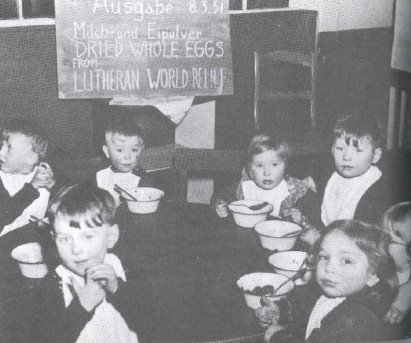
 

Picture of German Children receiving aid from LWR in 1951, taken from Together in Hope book by John Bachman.

German Children receiving aid in 1951, taken from Together in Hope book by John Bachman.


“Our policy is directed not against any country or doctrine but against hunger, poverty, desperation, and chaos,” said then-Secretary of State, George C. Marshall.

No other nation in history has offered such post-war assistance—and so generously. Now, nearly seventy years later, the foreign aid continues—still totaling billions of dollars every year. And not only does this aid go to our allies or other republics, but to nations of differing political doctrines, all over the globe.

Such generosity is one of our core values in America, contributing to our nation’s greatness. But it is not the only thing.

No other nation on earth offers so much humanitarian aid—much of it by volunteers. Think of the doctors and nurses, teachers and engineers, plus a multitude of non-profit organizations whose sole objective is to relieve suffering around the world and help others lead more productive, satisfying lives.

In 2013 just one agency, the American Red Cross, accomplished the following (among many other achievements).

They:

m6040129_514x260-our-supporters

  • Assisted millions of people in 24 countries, impacted by disaster.
  • Continued to aid 4.3 million earthquake victims in Haiti to rebuild their lives.
  • Helped vaccinate over 98 million children against measles.
  • Continued to develop disaster preparedness in 32 countries, so communities are not so vulnerable.
  • Helped to reconnect nearly 900 families separated by war or disaster (2).

Is it safe to say that, without America, the world would be a very different place? Our generosity and humanitarianism alone have produced significant results around the globe. But there is still more that sets us apart.

No other nation on earth provides such freedom, opportunity, and protection for its citizens.

In addition, recent immigrants often speak of the wonder and delight they experience upon coming to America. They marvel that: roads are regularly repaired, highway signs are clear and accurate, business practices are generally fair. They’re astonished by the volume and variety of goods available–things that most American take for granted, like shampoo, disposable diapers, and deodorant (3).

And what’s the foundation of all this goodness that has contributed to America’s greatness? It’s the values and principles most Americans still embrace–those laid out in the Bible.

For example:

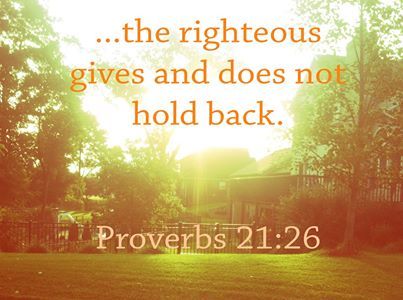
Our generosity can be traced back to Deuteronomy 15:7-8, Proverbs 21:26, and Matthew 25:34-40.
 

10f6940bb1a13a747e3a6c6c0928fed3


Our humanitarianism—even to our enemies—is rooted in the teachings of Jesus (Matthew 5:44) and Paul (Romans 12:20).

And our way of life, based on freedom, fairness, and adherence to law brings to mind the Golden Rule (Matthew 7:12), Romans 12:9-10, and many other scriptures upholding respectful treatment of all.

Granted, we’re not perfect. Selfishness, greed, and power-grabbing fester among us.  But the world is still a better place for the biblical principles named above which provide America’s foundation–whether folks acknowledge that truth or not.

Praise God for his influence through our founding fathers (many of whom were Christians) and self-sacrificing believers in Jesus throughout our 240-year history. It is on their shoulders we stand to do our part. to advance those attributes that make America great–like no other nation.


quote-america-is-great-because-she-is-good-if-america-ceases-to-be-good-america-will-cease-alexis-de-tocqueville-36-20-68


What do you think has contributed to America’s greatness?  Celebrate your appreciation for our nation in the comment section below!


Notes:

  1. usnews.com
  2. redcross.org
  3. heritage.org


(Art & photo credits:  www.wikipedia.org; http://www.lwr.org; http://www.redcross.org; http://www.pinterest.com; http://www.azquotes.com.)


Read Full Post »

Say the word, “blessing,” and what immediately comes to mind?

For me, it’s happy events and lovely gifts, engineered or bestowed by God out of his loving kindness.

But James, the brother of Jesus, saw a different side of blessing: “Consider it a sheer gift, friends, when tests and challenges come at you from all sides” (James 1:2, MSG, italics added).

Tests and challenges as gifts?! Sounds a bit daft—until we consider:

What-Seems-To-Us-As-Bitter-Trials-Are-Often-Blessings-In-Disguise

Take, for example…

THE CRAZY BLESSING OF WANT

Do you wish you had a bigger house? A newer car? Better furniture? Consider yourself blessed, that you’re not like King Solomon–the wealthiest person who ever lived. For all his striving to achieve and accumulate, Solomon discovered that when every desire is gratified, the end result was nothing but meaningless smoke (Ecclesiastes 1:2, MSG).

The blessing of want protects us from the pit of depression caused by self-indulgence.

The blessing of want fosters contentment, as we learn to enjoy and be grateful for what we already have.

THE CRAZY BLESSING OF DIFFICULTY

Difficulties provide a surprising number of positive opportunities. Here are ten:

  • To press in closer to God and trust him more completely.
  • To experience the adventure of God’s sufficiency (Philippians 4:13) as he enables us to endure—in ways we never thought possible.

Philippians4_13

  • To see how God will bring beauty out of ashes (Isaiah 61:3).
  • To discover more of who God is.
  • To witness the fulfillment of his never-failing promises.
  • To present a sacrifice of praise to God, beginning with the affirmation that he has our best interests at heart—in spite of what we see.
  • To be prepared for greater usefulness for God (John 15:2), which fosters greater fulfillment and satisfaction in our spirits.

46dd131cacc19b855d589b3358b83851

  • To have a compelling story to share, as encouragement for others. Years ago I heard a speaker say, “With no test there is no testimony.” In the final analysis, I’d rather have the latter. You, too?
  • To become mature, complete, not lacking anything (James 1:4). That doesn’t happen without trials.  As Thomas Carlyle wrote:

quote-no-pressure-no-diamonds-thomas-carlyle-31833

  • To love our Savior more passionately. Josif Trif, a pastor from Romania during the days of Communism, said, “If it weren’t for Communism, I would not have loved our Lord as much. I kissed the cross the Communists gave me” (1).

THE CRAZY BLESSING OF FAILURE

If failure served no purpose in our lives, God would not allow it to happen. But since he does, we can know that failure is either for our benefit or for God’s glory—often both.

Failure is the soil from which great success can grow, beginning with a crop of positive character traits, such as perseverance, humility, and greater reliance upon God.

Green-Bean-Sprouts1

Out of failure comes experience; from experience comes greater wisdom; and wisdom leads to a godly life.

“How blessed are those who are hungry and thirsty for righteousness, because it is they who will be satisfied (Matthew 5:6, ISV)!

*    *     *     *     *     *     *     *     *     *

Crazy as it sounds, I want to praise you, Father, for the blessings of challenges and tough times. Thank you for your loving attention that carries me through, transforming me and makes me a better version of myself.  I also praise you for the glorious promise that through trouble, hardship, disappointment, or pain–“overwhelming victory is ours through Christ” (Romans 8:37, NLT)!

What crazy blessing have you experienced in the crucible of trouble, hardship, disappointment, or pain?  Please join the conversation below!

(1) His Imprint, My Expression, Kay Arthur, Harvest House, 1993, p. 135.

(Art & photo credits:  www.imagesbuddy,com; http://www.wallpaper4god.com; http://www.pinterest.com; http://www.izquotes.com; http://www.pinterest.com; http://www.harvesttotable.com.)

Read Full Post »

every-day-we-should-hear-at-least-one-little-song-read-one-good-poem-see-one-e-403x403-nk4ndt


(“Every day we should hear at least one little song,

read one good poem, see one exquisite picture,

and, if possible, speak a few sensible words.”

–Johann Wolfgang von Goethe, 1749-1838)

Author and lawyer, von Goethe, was much too easily satisfied.

Yes, a day without music would be dreary.

Poetry does feed the soul and intellect in ways that prose does not.

An exquisite picture does lift the spirit.

It’s also true that sharing a few words of wisdom can be satisfying.

Yet, is that enough for one day?  What about:

  • Offering the music of “thank you” or “you go first” or “I love your smile?”
  • Reading and pondering several verses of scripture?  That will feed the soul and intellect even more than poetry.
  • Creating an exquisite picture of kindness by finding ways to be helpful and engaging?  Such artful living often impacts people more than we realize.
  • Speaking a few sensible words of encouragement, and feeling uplifted ourselves?

But beyond von Goethe’s suggestions of music, poetry, art, and wisdom are many more possibilities for a day full of delight.  We can:


scooter-girl


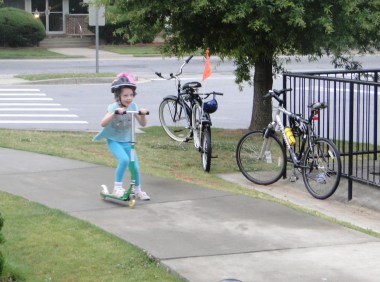
  • Savor a pleasurable moment or memory–better yet, when the two happen back-to-back.  Just today a neighbor girl whooshed by on her scooter, and I was reminded of happy, long ago days doing some whooshing of my own on bicycles or skates.  I smiled.
  • Make a discovery or learn something new.  Read.   Listen.  Think.  Recently in C. S. Lewis’s The Weight of Glory (Eerdman’s Publishing, 1949), I came across this statement:  “Obedience is the road to freedom, humility the road to pleasure, unity the road to personality” (p. 36).  Well deserving of some careful pondering, I think.
  • Celebrate at least one small miracle of nature:  a magnificent cloud formation, bright green growth on the tips of evergreen boughs, a cardinal’s song echoing through the woods.
  • Engage the creative side:  draw (even if it’s doodling), paint (even if it’s adding color to someone else’s art), or write (even if it’s in a journal that no one else will see).
  • Offer a smile–wherever we are.  “Every time you smile at someone, it is an action of love, a gift to that person, a beautiful thing.  Peace begins with a smile” (Mother Teresa).  Better yet, add words–a cheerful greeting, a compliment, a bit of gratitude.


1d01b85e5982b13020291f2742000bdc


  • End the day by counting blessings.  Drift off to sleep in an attitude of prayer–a prayer such as this:

*     *     *     *    *     *     *     *    *     *

Thank you, Father, for your gifts that offer daily delight–gifts like the warm pleasure of childhood memories bubbling to the surface unexpectedly, discoveries that challenge the mind and inspire the soul, and miracles of nature that amaze.

Thank you, oh God, for creating us in your image, including the ability to imagine, design, and produce.  Thank you for the deep satisfaction of the creative process.

And thank you for the astounding privilege to be a positive influence in this world, an ambassador for your Son.


50702841368e60c6ee2fb6cc62167f23

(Art & photo credits:  www.doublequotes.net; http://www.beactive.com; http://www.pinterest.com (2).

Read Full Post »


hqdefault


Back in the early 60s when I was a young teen, Dad took me to an Artur Rubenstein concert. For those of you too young to recognize that name, Mr. Rubenstein was a well-known pianist of the last century.

You’d think a thirteen-year old would be bored at a classical performance. Far from it. Mr. Rubenstein’s flying fingers held me spellbound. Sometimes he’d even come up off the bench, putting body and soul into the piece.

One selection in particular Dad and I will never forget. While performing “Ritual Fire Dance” by DeFalla, Mr. Rubenstein’s arms beat up and down like hummingbird wings, from head level to keyboard, in rapid succession. How could he possibly bring his fingers down to the right keys from such a height and at such speed? It was a marvel of power and precision—from a man who was seventy-five at the time.

(You can access a video of Mr. Rubinstein playing “Ritual Fire Dance” here:  https://youtu.be/3SDeN9ZrRRI.  To view just the DeFalla piece, skip ahead to minute #11; to see just the portion described above, skip to 11 minutes, 30 seconds.)

Yes, older folks can still fly—maybe not physically like Mr. Rubenstein’s fingers, but certainly attitudinally and spiritually.


stock-photo-7776807-laughing-senior-man-portrait


Our youth can be renewed like the eagle’s (Psalm 103:5).

The eagle enjoys a long life compared to many other animals–up to thirty years in the wild and fifty years in captivity. Each year its feathers are renewed, providing new strength for flight.

We can renew our strength attitudinally by focusing on the benefits of growing older.

Yes, research has uncovered a number of advantages, including:

  • Improved self-esteem, self-control, and selflessness.
  • Decreased sadness, anger, fear, and other negative emotions. Stress and worry also decline.
  • Less concern for the trivial; more focus on what’s important.
  • Increased wisdom, due to a wide base of experience and a broader perspective on life.
  • Less attention on the negative, more focus on the positive.

As a Christian senior, I’d have to add:

  • Increased faith in God as I’ve seen more evidence of God’s faithfulness.
  • Greater appreciation for the simpler things of life—each one a precious gift from my loving Heavenly Father.
  • The glorious hope of heaven as it grows closer to becoming reality.  John Newton said:


quote-i-am-still-in-the-land-of-the-dying-i-shall-be-in-the-land-of-the-living-soon-his-last-john-newton-37-35-68

(“I am still in the land of the dying;

I shall be in the land of the living soon.”)

I like his perspective.

We can also renew our strength spiritually with the help of God.

eagle-in-rainbow-small


Just as the eagle rides on the wind high above the earth, we too can ride above our infirmities on the wind of the Spirit. He provides renewal of faith, strength, and passion in numerous ways—through scripture, song, other biblical reading, strong teaching, mature Christians, and more. Then we can:

  • flourish and be fruitful (Psalm 92:14).
  • stand firm and immovable (1 Corinthians 15:58).
  • always give ourselves fully to God’s work (same verse).
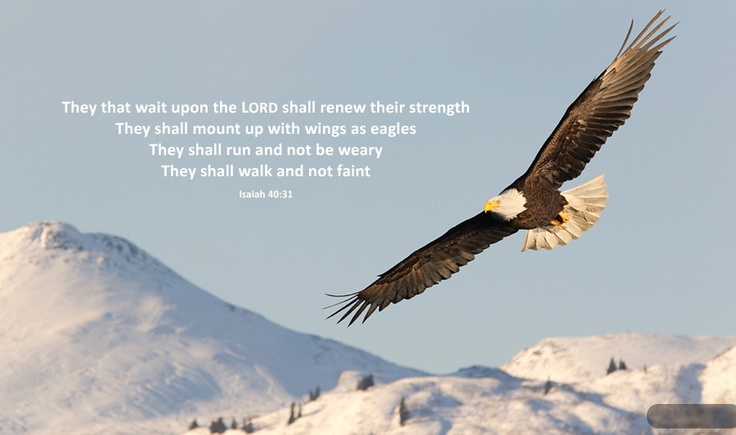
  • run and not be weary (Isaiah 40:31).


f9e249d4cf00edc142a701994e9771e6


Here’s an idea:  Let’s start a list of advantages we observe in growing older, to help keep us uplifted on wings of praise.

What “blessings of aging” have you noticed? Please share in the comments section below. (If you’re still enjoying the first half of life, tell us what you’ve observed in others, or what you’re looking forward to.)


“The last chapter in life can be the best!” – Vance Havner


(Art & photo credits:  www.youtube.com; http://www.freeimages.com; http://www.azquotes.com; http://www.wildlifeworkshops.com; http://www.pinterest.com.


Read Full Post »

41pJcI5AU1L


“Haste makes waste,” Benjamin Franklin wisely observed. And most of us would agree. When we hurry, we spill things, drop things, forget things, trip over things.

But Ben’s proverb may be true in a way he never intended.

Haste makes waste of the beauty around us, the joy and goodness to be found in the present moment.

 If we’re not careful, we rush right by such priceless splendors as:

  • Tiny leaves courageously reaching for sun in spite of snow


tulip-spears-in-snow


  • Evergreens encrusted with raindrop jewels


IMG_0545

  • The first butterfly of spring (‘Just spotted one like this yesterday!)


white butterfly


  • An impromptu hug from family member or friend


hug


  • A wisp of a bug living between flower bud and leaf


IMG_0564

(See it?  On the left side of the bud!)

  • A child’s giddy grin, wreathed in chocolate


boy-709943_960_720


But how do we become people who live aware—vigilantly watchful for beauty, goodness, and joy?

Ann Voskamp would say: begin a list of wonders. Many of you know she challenged herself to live aware and record One Thousand Gifts (the title of her book about the quest and its impact on her life). Somehow the act of collecting and writing helps us become more intentional.

Spring is the perfect time to practice living with joyful awareness.

Have you noticed the greening of the landscape, beginning at ground level with the grass, and working skyward through bush and shrub? The largest trees will be the last to unfurl their leaves in a grand display of emerald luxuriance.


spring-forest


Perhaps even more glorious is the splendor of the magnolia, dogwood, and redbud in full bloom. Their individual beauty can only be surpassed when clustered together.


50c5394d8fb4fdfd00476cf7b7962bd9


And of course, the blooming of flowers, the songs of birds and the scampering of squirrels give us much to savor.

But beautiful or joyful as these may be, what’s the value of paying attention to such details?

Heightened awareness of all these gifts (and more) fosters gratitude.   And gratitude positively impacts the way we see the world and experience life.

Of course, appreciation in itself is rather meaningless. How silly to say “thank you” to the air. No, gratitude must be expressed to someone. And all we have, all we enjoy, is due to the loving kindness of a singular Someone—our benevolent Father.

When we express our thankfulness to him, we’re ushered into his presence.  Yes, right into the throne room of Almighty God.

Now you may have been wondering as you skimmed this post, When is she going to get to the part about “How to Be Rich—Today?” (That was the title, in case you missed it!)

Here’s what we can do:

Focus on what we already have, not on what we lack.


111123-580x386


“It is only with gratitude that life becomes rich.”

(Dietrich Bonhoeffer)

You see?  We’re already rich.

*     *     *     *     *     *     *     *     *     *


Thank you, God, for countless, precious blessings every day—blessings that make me smile or gaze in awe at the wonders you’ve created. May your praise always be on my lips, as I seek to live aware of your bounty around me. And may my gratitude bring joy to your heart also.


(Art & Photo Credits:  www.amazon.com; http://www.tulipsinthewoods.com; Nancy Ruegg; http://www.scalar.usc.edu; http://www.hookedonthebook.com; Nancy Ruegg; ww.pixabay.com; http://www.freebigpictures.com; http://www.pinerest.com (2).

Read Full Post »

“Matt* and Loren* are coming to visit the weekend after next. Would you be able to join us for dinner that Saturday night?” I asked, Dave*, the worship leader of our church.

I had just arrived at ensemble practice.  Dave was already there organizing music.

“Yeah, I’ll come. It’ll be great to catch up with them.” Matt and Loren were mutual friends who had moved away.

“We’ll probably eat around six, but come early—say five? That’ll give us more time to chat,” I added.

Dave whipped a pen off the piano and wrote a note to himself—on his hand.

I had to smile. Dave was/is one of the most creative, musically talented young men I’ve ever met. Not only is he a concert-trained pianist, he’s a composer with a gift for turning artful melodies into worship.

But in those days, he would have been the first to tell you that keeping track of details or appointments was a challenge; thus the notes-on-the-hand habit. If the commitment was right there in front of him, he’d most likely remember to put it on his calendar later. The message wouldn’t be forgotten amidst all the ideas and musical themes racing through his head.

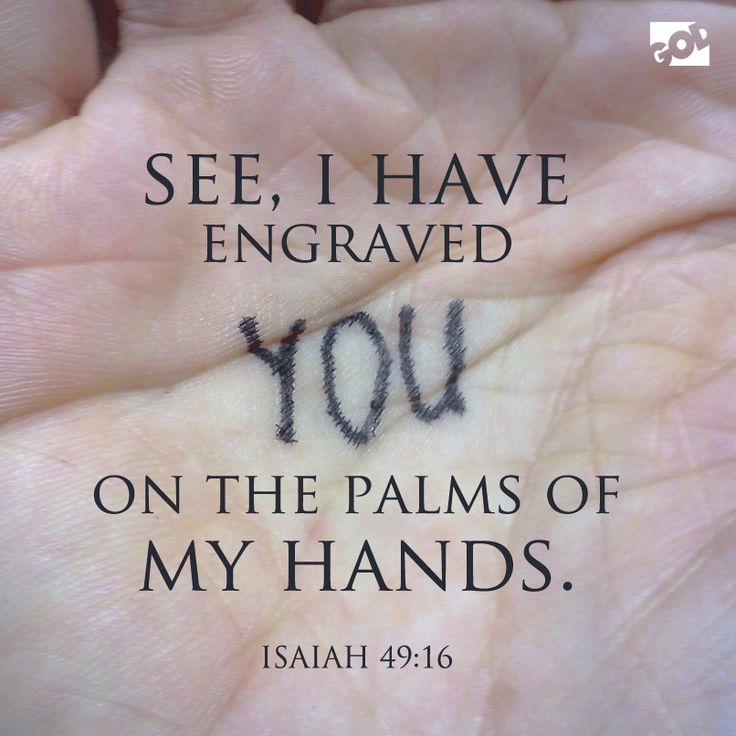
I know someone else who writes information on the palm of his hand. The information is your name and mine. The someone? Our Heavenly Father.


1660084f44a0e4b7a47d6c0c97fbbb65


(“See, I have engraved you on the palms of my hands.”

–Isaiah 49:16 NIV)

Of course, this assurance was addressed to the people of Israel, but it’s applicable to each of us, because: 1) those of us who believe in Jesus have been adopted into Abraham’s family (Galatians 3:6-9), and 2) God does not lose sight of the individual within the multitude (Luke 3:3-7).

“God loves each of us as if there was only one of us.”

–St. Augustine

But don’t think of God’s love as perfunctory or pity-driven.

You are a treasure to your Heavenly Father—the delight of his heart (Deuteronomy 7:6; Psalm 149:4).


28c54369c8dcb691a13ff44f54e136bf


You and I are constantly in his thoughts (Psalm 139 17-18).

And the imagery of our names engraved (cut, carved, or etched) on his palms brings to mind several important truths:

  1. God cannot and will not forget us or abandon us.
  1. His omniscient knowledge doesn’t just include our names, but also who we are—our personalities, dreams, circumstances, strengths and weaknesses—everything about us—is on his mind.
  1. Our images engraved on God’s palms represent an incredible role reversal. In ancient times, slaves bore the brand mark of their masters. But our Master has sacrificially submitted himself to inscribe our names on his palms.
  1. The image represents who we are becoming in God’s view, which is undoubtedly different from ours. “Reality is not what we see; reality is what God sees” (Biblical Illustrator). And that reality is perfection.


67bc5cb27ae7404c8049303ad1857bf5


(“By one sacrifice he has made perfect forever

those who are being made holy.”

–Hebrews 10:14 NIV)


Of course, that one sacrifice was Jesus, who bled and died on a cross so we might be made right with God and receive the gift of eternal life.

As a result, Isaiah 49:16 (about our names written on God’s palms)  has taken on new meaning:


“See, I have engraved you—in blood—on the palms of my hands.”


*     *     *     *     *     *     *   *     *     *

I praise you, Heavenly Father, that it is totally impossible for you to forget your own.  How humbling to realize I am engraved on your hands—hands that withstood the nails for me. But gratitude alone is terribly insufficient.

I want your name, Lord, engraved on my palms, so I might become that perfected reality you already see.


*Names have been changed.

Art & photo credits:  www.pinterest.com (3)


Read Full Post »

1-samuel-12-24-consider-the-lord-landscape_1956134444


Consider what great things [God] has done for you,”

(from the farewell address of Samuel the prophet,

to the people of Israel–1 Samuel 12:24b, italics added).


I wonder if Samuel paused after those words, to give the Israelites a moment of reflection.  God had blessed them in numerous ways by:

  • Miraculously bringing them out of slavery in Egypt.
  • Sustaining them during their wilderness journey to Canaan.
  • Providing laws and commands for them to assure an orderly, pleasant, and productive life.
  • Giving them victory over their enemies.
  • Sending prophets and judges to guide and encourage (vs. 6-15).


31118_000_025_15


And what might have been the Israelites’ response as they remembered those blessings?

Were they whispering prayers of praise, because God had cared for them so attentively?

Did they resolve to reverence him more intentionally and serve him more faithfully, as Samuel suggested (12:24a)?


132658d0c1661c211eb040ed8e8a8308


Surely both responses were called for.

I also wonder if we might similarly be impacted by considering daily the great things God has done for us.

My own pondering made me realize my life includes parallels to those of the Israelites (although in less striking ways). Perhaps you, too, have had similar experiences.

God has:

  • Brought me out of difficult situations. (One small example: When a teaching job opened up nearby, I no longer had to endure  a stressful 50-minute commute.)
  • Sustained me with a heightened sense of his presence through the wilderness of hurt and emotional pain.
  • Provided his Word of wisdom for an orderly, pleasant, and productive life. (Not that I’ve always taken advantage of that wisdom.)
  • Given me the final victory over Satan, through his Son, Jesus. One day I will enjoy life in heaven with my Savior.
  • Sent spiritual teachers, pastors, and mentors to guide and encourage me.


A group of young women bow their heads and pray with bibles.


But perhaps you feel excluded from God’s blessings. Any consideration of your circumstances makes you shake your head in disillusionment. After all, the evidence seems clear. While others are enjoying marriage and family, a satisfying career, good health and/or _______________ (fill in the blank), you’re not.

Perhaps another point of view would provide alternative evidence. Consider your circumstances and the blessings they do provide.

For example:


worldteach-guyana-500


  • Not married? You benefit from greater freedom in your life.
  • No children? You can invest fresh energy and enthusiasm into children-not-your-own, providing the parents a much-needed break.
  • Struggling in a wilderness of emotional upset right now? Draw near to God and he will draw near to you in new, profound ways. Look for him in creation and in his Word. Listen for him in a song or in the encouragement of a mature friend. Be watchful, because he reveals himself in highly creative ways.
  • Is Jesus a part of your everyday life? Then you have a constant Friend who loves you, cares for you, withholds no good thing, and will never leave you.
  • Are there mentors and models in your life, showing you the way to a God-enhanced life? How splendid not to be struggling alone.

The bottom-line consideration is this:

Do I want to wear a shroud of despair or a garment of praise (Isaiah 61:3)?


26054-field-girl-woman-armsout-praise.1200w.tn


Do I want to live selfishly or in grateful obedience to the One who has bestowed so much?

*     *     *     *     *     *     *     *     *     *

Amazing God, words fail to express my gratitude as I consider your countless blessings.  Nor can words sufficiently extol your grace that motivates such loving benevolence.  I long to be continually grateful and consistently obedient, as a love-gift back to you.  May thankfulness energize my obedience! 


(Art & photo credits:  www.wallpaper.knowing-jesus.com; http://www.lds.org; http://www.pinterest.com; http://www.fullsupply.org; http://www.americakeswick.org; http://www.transitionsabroad.com; http://www.crosswalk.com.)

Read Full Post »

(A personal psalm)


Oh, Lord God of creation,

I praise you for the glowing hues of your sunsets, the heavenly aroma of your lilacs, and the lyrical bird choruses you orchestrate in springtime.


kirtlands_usfwsmidwest_flickr


I praise you for endowing us with physical senses to experience these splendors and countless more.

John Calvin once described the world of nature as your glorious theater. How appropriate. Night and day you present a dramatic performance!

You bring out the starry host one by one, and call them each by name (Isaiah 40:26).


space-stars-open-cluster-ngc663


Astronomers can only estimate their number – perhaps up to 3,000 million billion. That’s a three followed by sixteen zeroes! And you know them all by name?!

Oh, Lord, your creative ability knows no bounds of size or number.

Men get excited about creating multi-story skyscrapers, each one a bit taller than the last.

You create galaxies.

In addition to the heavens, you have made everything on the earth and in the seas – from minuscule microbes to mighty mountains, from single-cell protozoa to humpback whales. You give life to everything (Nehemiah 9:6).


humpback_whale_margaret_river


And yet, your creative power, as well as your wisdom and engineering in preserving your work, are mere finger-play for you (Psalm 8:3a).

My heart swells with awe.

When I take note of your wonders, I realize that you love:

  • Variety – as seen in the myriad kinds of plants and animals around the globe
  • Organization – recognized in the sustainable food chains, predictable tides, and purposeful cycle of seasons
  • Pattern – revealed in the stripes of a zebra, the hexagons of a honeycomb, and the spiraled petals of a rose


il_214x170.800880640_66un


  • Color – artistically displayed on butterflies, birds, and even in the galaxies
  • Beauty – exhibited in majestic trees, aquamarine waters, and snow-topped mountains
  • Intricacy – demonstrated with lacy frost, coral reefs, and the DNA double helix found in almost all organisms


b52eb57e47496f3035eee50a5a468cd5


But why, Lord? What is the purpose of all this craftsmanship, all the attention to detail, all the grandeur?

Surely you chose to display your glory outside of heaven so that we might come to revere you (Psalm 33:6-9).

And one day we will join with the throng of heaven and proclaim you worthy to receive glory and honor and power, because you created all things (Revelation 4:11).

But there’s really no need to wait, is there?  Even if there is just one voice, you listen with parental joy and appreciation.

So I lift my one voice to praise you:

Lord of the universe, my mind cannot fathom that out of nothing you fashioned all the beauty, majesty, and complexity of the world.

With the mountains and hills I burst into song before you, with the trees of the field I clap my hands, because you are mighty in power, glorious in splendor, and loving toward all that you have made.


(Nehemiah 9:6; Isaiah 55:12; Psalm 147:5; Psalm 145:12, 17)

Photo credits:  michiganradio.org; http://www.stylespinner.com; http://www.animalians.wikispaces.com; http://www.etsy.com, http://www.pinterest.com.

Read Full Post »


IMG_0440-1

(John and me in our second home, 1957)


If I close my eyes, I can still see the various rooms of my three childhood homes in northern Illinois, but especially the one we moved to when I was ten–the one in which my parents still lived when Steve and I were married.

With great fondness, I remember reading in the box elder tree behind the house, playing Hotbox with Dad and my brother, watching television with a big bowl of popcorn on my lap, and the four of us eating dinner in the cozy banquette Dad built in the kitchen.

In all kinds of weather John and I walked or rode our bikes to school.  Before the bell rang each morning, one teacher supervised the entire student body of 400+ children as we arrived and played on the playground.  We learned Christmas carols in school and no one complained.

When not in school, John and I were out and about in the neighborhood, playing with the other kids, building snowmen and snow forts, riding our bikes to friends’ homes, to the library, and (in the summertime) to the pool.

I have to admit: my thick, rose-colored glasses cast a utopian hue upon those days. A person reaches a certain age and suddenly the decades of one’s youth become “the good old days”—far superior to the present.


IMG_0444

(1959)


After all, how many families today sit down together for dinner—with no television, ipads or phones interfering with conversation? What children can enjoy the freedom of riding their bikes clear across town without supervision? Where is there a public school that teaches children Christmas carols?

Times have changed.

To be honest, however, it’s doubtful those days of my youth were actually better.

It’s just my selective memory choosing the tranquil, happy moments. Overlooked are the arguments with my brother (and the teasing I did, for which I still feel deep regret!), those times Mom and Dad were being terribly strict or unfair (in my opinion), and the occasional upset at school or with friends.

I also have to remember:  the Greatest Generation that raised us Baby Boomers thought their good old days were far superior.

For example, in a book of Christmas literature we own, the editor wrote this intro for one selection: “This story is for those to whom the modern holiday season seems to get more glamorous and clamorous each year, but who still experience that old nostalgic feeling for the Christmas-time of a more quiet bygone era.” The year of publication? 1955.

Maybe we should put away our rose-colored glasses, unreliable as they are.

And yet, numerous scriptures encourage us to remember and rejoice in the good of the past—verses like these:


02

  • “…Rejoice in all the good things the Lord your God has given to you and your household” (Deuteronomy 26:11).
  • “Remember the wonderful works that He has done, His miracles…” (Psalm 105:5a).
  • “I will tell of the kindness of the Lord, the deeds for which He is to be praised, according to all He has done for us” (Isaiah 63:7).

So are flights of nostalgia right or wrong?

It depends.

Constant longing for the past creates dissatisfaction in the present. That’s obviously not healthy.

But remembering God’s blessings of the past strengthens our faith and creates a deep longing for more of him in the present. That’s obviously a good thing!

You know what else would be a good thing? To savor today’s blessings and not wait till a decade from now to enjoy them.


(Photo credits:  Nancy Ruegg and http://www.pinterest.com.)


Read Full Post »

hand-journal-diabetes-400x400


(Reblogged from 12-30-13)


A new year requires a new calendar. Don’t you just love the crisp, uncurled pages–the empty spaces for each day, filled with nothing but optimistic possibilities?

Perhaps you’re starting the new year with a fresh journal. Again, the pristine pages are filled with nothing but hope and expectation.

We might also desire to start the new year with:

New eyes—to see the glory of God around us.
New ears—to hear his still, small voice.
New resolve—to follow God’s direction.
New courage—to speak his truth boldly.
New faith—to live with confident trust in our Heavenly Father.

These abilities cannot be bought at Barnes & Nobles, like a calendar or journal. They are procured through prayer and discipline.

A good place to begin? David’s prayer in Psalm 51: “Create in me a pure heart, O God, and renew a steadfast spirit within me…Restore to me the joy of your salvation and grant me a willing spirit, to sustain me” (Psalm 51:10, 12).

Allow me to personalize it a bit.

Create in me a pure heart, O God (just as you created a perfect universe from chaos).

And renew a steadfast spirit within me (that my greatest desire might be to please you).

Restore to me the joy of your salvation (just as we experience in the euphoria of Christmas Eve)!

Grant me a willing spirit, to sustain me (throughout 2016).

The typical new year’s resolution is made, broken, and forgotten. Rarely does someone make a once-a-year promise and keep it faithfully for the next 364 days.

Perhaps we’d be wise to see each new day as a fresh opportunity for beginning anew. To repent of yesterday’s failures and forget them. To strain toward what is ahead—with enthusiasm, expectation, and hope (Philippians 3:13).

And gradually those new abilities we aspire after will begin to flourish.

God says, “Forget the former things; do not dwell on the past. See I am doing a new thing” (Isaiah 43:18-19a)!

* * * * * * * * * *

Thank you, Father, for your mercy to forgive the past, and your grace to provide for the future. Thank you that each morning is a fresh start, and each new day holds hidden opportunities. With great anticipation I turn the page!


(photo credit:  www.news.health.com.)

Read Full Post »

« Newer Posts - Older Posts »

Sylvia Schroeder

Impressions Becoming Expressions

Mitch Teemley

The Power of Story

Still Traveling

Impressions Becoming Expressions

Living Our Days

Gaining a heart of wisdom

He Said What?!

I'm Patty, and my husband and I are living with our adult son who has autism and epilepsy. I love sharing lessons learned from life around me, especially life with Aaron.

Meditations of my Heart

Impressions Becoming Expressions

Linda Stoll

Impressions Becoming Expressions

Signora Sheila

Where faith meets la dolce vita

Heidi Viars

Finding the Image of God