Feeds:
Posts
Comments

Archive for the ‘Maturity’ Category

desert

Last Thursday we pondered these promises from Isaiah 58:11:

 “The Lord will guide you always,” and

“He will satisfy your needs in a sun-scorched land.”

 Today, more discoveries and encouragement await as we meditate upon the last two promises:

  • “[He] will strengthen your frame.”
  • “You will be like a well-watered garden, like a spring whose waters never fail.”

garden-waterfall-design


Do you long for strength within your frame, that is, inner strength? Perhaps you’re moving as fast as you can, but never quite reaching the end of the to-do list. And you’re bone-weary from the effort.

Perhaps the stresses of life—difficult relationships, a high-pressure job, financial obligations—are squeezing in hard.

Perhaps boredom or depression surround you in a gray shroud, and you haven’t the energy to fight against them.

“He will strengthen your frame.”

But God doesn’t wave a magic wand over us and suddenly turn weakness into strength. Usually he invites us to be part of the process.   And his solutions are radical.

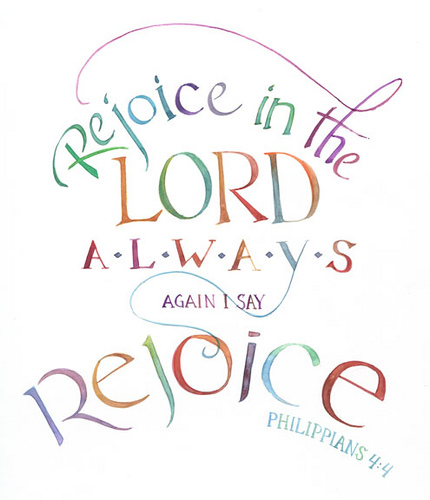
For example, celebrate anything and everything (Philippians 4:4).
3095781994_90a392c03f

Take joy in:

  • Your cozy robe to ward off the morning chill
  • That cute tuft of hair sticking up on your toddler’s head
  • A parking place opening up when and where you need it
  • Licking the stamp just as the mail carrier pulls up in her truck
  • An earring lost last week turns up between the counter and stove this week.

You see, joy and strength are closely related. Ezra told the people of Israel, “The joy of the Lord is your strength” (Nehemiah 8:10).

Those five examples above, and thousands like them, are gifts from your Heavenly Father. “Every good gift and perfect gift is from above, coming down from the Father of the heavenly lights” (James 1:17).

In the same way we can build up physical strength with exercise, we can build up spiritual strength with praise—by expressing gratitude and joy for every good and perfect gift.

And now, the last promise of this verse describes in metaphor the result of living according to God’s design.

“You will be like a well-watered garden, like a spring whose waters never fail.”

TotalChildCareVegetables7 

Visualize a flourishing garden, with rich, green plants overflowing with healthy, ripe produce.

Those can be descriptors of you and me.  We are:

  • Rich in God’s grace, which he has lavished on us with all wisdom and understanding (Ephesians 1:8).
  • Green and flourishing, because we spend time with the Master Gardener and allow him to cultivate our spirits (Psalm 1:2-3).
  • Healthy and prosperous of soul (v. 3). As we soak up God’s Word, we’ll produce actions and attitudes that honor God and bring us inner satisfaction.
  • Ripe and mature, lacking in nothing (James 1:3).

God offers us “a continual source of thirst-quenching, drought-ending, fruit-producing, spiritual hydration” (James MacDonald).

Doesn’t that sound refreshing?  Who could turn down such provision?

*     *     *     *     *     *    *     *     *     *

Thank you, Father, for the precious assurances of these promises: 

  • You are leading me along the path you preordained before time began.
  • Every day of this earthly journey I can count on you to supply my needs.
  • Every day you provide fresh strength. One way is through the exercise of praise.  
  • As I spend time in your presence, I will be transformed–like a garden replenished by hydration. In fact, I can grow into your likeness with ever-increasing glory!

 “Such knowledge is too wonderful for me. It is too lofty for me to attain.” Yet I know it to be true because these are truths from your reliable Word.  My heart overflows with wonder and gratitude.

(Psalm 139:16; Philippians 4:19; 2 Corinthians 3:18; Psalm 139:6)

(Photo and art credits:  www.dayofgrace.me; http://www.anativegarden.blogspot.com; http://www.flickr.com; http://www.naturalearning.org.)


Read Full Post »

“Who has known the mind of the Lord?” Paul asked (1 Corinthians 2:16).

That’s an easy question to answer: Nobody! His intellect and wisdom are far beyond our human ability to comprehend.

After all…

God has worked out the complexities of every living cell–with perfect precision.


yeast-front

(X-ray microscopy combine to picture interior of living cell)


He has engineered a staggering number of specialized plants and creatures, carefully interrelated in a web of reliance upon one another.


wshedcrosscut2


He has created the unfathomable reaches of the universe filled with countless heavenly bodies of immeasurable proportions.


hs-2007-41-a-small_web

(Spiral Galaxy M74)


Such intellect and wisdom to accomplish these feats is incredible.

Yet, at the end of that same verse above, Paul makes a statement even more astounding. In fact, at first glance it seems ludicrous.


Unknown

 “We have the mind of Christ.”


What? How is that possible? His knowledge and wisdom are infinite; ours is markedly limited.

But Paul makes clear:  we have the mind of Christ because he lives within us (Galatians 2:20).


Galatians-21


Not that we can know everything and respond with pure wisdom in all situations. Our perfection is a process that won’t be completed until Jesus returns (Philippians 1:6).

But my heart beats a little bit faster to realize that, each day and for all my tomorrows, I might think more like Jesus, understand more like Jesus, and react more like Jesus.

One particular action will encourage progress: spending time with him, especially in his Word.


Young woman reading bible


Here’s an analogy, though far from perfect. Steve and I have been married a very long time—forty-four years.  At this point, we can finish each other’s sentences, supply missing information or words in a conversation, and sometimes even know what the other is thinking.

It’s as if we’ve acquired a bit of the other person’s mind. And it’s happened bit by bit, over time.

So I repeat: We will have the mind of Christ as we spend time with him day by day– especially in his Word.

And how will we know that his way of thinking is becoming our way of thinking? After all, there’s no measuring stick for spiritual growth.


tapemeasure


Oswald Chambers, in My Utmost for His Highest, posed an excellent question that can help us determine our progress:

“Are other people beginning to see God in my life more and more (p. 78)?” Because a person with the mind of Christ will demonstrate Christ-like behavior.

Perhaps we could take an occasional inventory, based on the fruit of the Spirit (Galatians 5:22-23). The attributes listed in these two verses characterize a person with the mind of Christ–someone who is loving, joyful, peace-filled, patient, kind, good, and so on.  We could ask ourselves, how have I demonstrated these attributes this week?

And what will be the result of cultivating the mind of Christ? “The mind controlled by the Spirit is life and peace” (Romans 8:6).


Romans8_6


Life that is characterized by vitality and purpose.

Peace that includes inner-contentment, freedom from guilt, and security for eternity.

That sounds awfully good to me.

*     *     *     *     *     *     *     *     *     *

Heavenly Father, we praise you for taking us into the high places of blessing in Jesus. That includes this gift: the mind of Christ. And day by day you are transforming us into his likeness, with ever-increasing glory. May I seize this day and its opportunities to think like you, understand like you, and react like you.  

(Ephesians 1:3; 2 Corinthians 3:18)


Art and photo credits:  www.lbl.gov; http://www.chesapeakebay.net; http://www.hubblesite.org; http://www.crosspointenwa.com; http://www.pinterest.com; http://www.changingthefaceof christianity.com; http://www.footsoldier4christ.com; http://www.motivationalquotes.com.


Read Full Post »

‘Ever watch one of those television shows that provides a person with a complete makeover? By the end of the hour she (or sometimes he) has acquired a personalized, updated wardrobe, learned how to apply make-up, and received a new hair-do.  The physical transformation is always stunning.

However, there is a transformation even more amazing.  Paul explains it this way:

“If anyone is in Christ, he is a new creation; the old has gone, the new has come” (2 Corinthians 5:17).


new-creation


Those of us in Christ haven’t just been adjusted, primped, polished, or camouflaged.  We have become new people with clean slates, strong purpose, deep joy, and vibrant enthusiasm for life.

And that’s not all.  Each day we’re becoming better than the day before–a bit more perfected–if we remain in Christ.  Sarah Young (Jesus Calling) says we’re becoming more fully our true selves–the ones God designed us to be.  I like that.

Each day in Christ is an opportunity to grow more completely into his glorious image.  These changes have nothing to do with outward appearance.  They take place on the inside, impacting our personalities, emotions, minds, and spirits.

That expression, in Christ (also “in the Lord” and “in him”), occurs 164 times in Paul’s letters.  Such repetition would indicate the importance of the concept.

So how would we define the meaning of being “in Christ?”  Here are a few possibilities.

1.  In Christ means we live within his presence.  Now that’s a rather abstract concept. Perhaps an analogy would increase our understanding.

Picture yourself surrounded by trees in a forest.  The woods fill your senses—the sight of tall, stately trees, the sound of chirping birds, the aroma of pine and earth, the textures of rough bark and velvety moss, the taste of cold, clear water from a stream.


SunShiningThroughDustInWood

Similarly, the presence of Christ completely surrounds us as believers.  Christ fills the senses of our hearts, if we avail ourselves. We see more fully the glory of his creation, hear his truth, breathe in his love like a fine fragrance, feel his strength upholding us, and taste his goodness in the feast of blessings he provides.

Such sensations change who we are.  In Christ, we can become stable, contented, joy-filled people.

2.  In Christ means we are united with him, like a branch fused to the vine (John 15:1-8). He is the Source of everything we need, but we must stay in contact with him. How do we do that with Someone who’s invisible? Possibilities include prayer, praise, gratitude, and worship–throughout the day.

And when we’re united with him, his peace and strength are infused into us.

3.  In Christ means we’re in close relationship with him. Never should there “be day when we give ourselves a chance to forget him” (William Barclay).

And when we live in the presence of Christ, and in union with Christ, the inner transformation he has instituted will most definitely become visible. Jesus’ character will begin to flow through our attitudes and actions, just as sap flows through the vine into the branches. Attitudes like kindness, understanding, and forgiveness will give strong evidence that we’re living in Christ.


Woman praising with arms raised in the air


And what will the people around us see?  Folks who…

  • exude joy and optimism.
  • are gracious to others.
  • exhibit self-control.
  • make wise choices.
  • aim to express love–always.

Such delightful, purposeful living awaits those who center themselves  in Christ.

*     *     *     *     *     *     *     *     *     *

Thank you, Lord Jesus, for the supreme privilege of living in your presence.  You are the King of the universe, yet you want to be united with us in close relationship.  And as we avail ourselves, you infuse us with your attributes, your strength, your peace.  All praise to you, gracious Savior, the Author and Perfecter of our faith, as we abide in you.

(Photo credits:  www.brotherransome.com, http://www.wikipedia.org., and alishagratehouse.com.)


Read Full Post »

White_Oak-15_acorns


Elena, almost eighteen months old, loves to collect acorns. A grand oak tree on the church property across the street from her home provides perfect hunting grounds. She trundles along the edge of the sidewalk, her eyes on the grassy edge. Now and then she bends over, chooses a prime specimen, and clutches it tightly to her chest.

Yesterday was a banner day for acorns. Way too many shiny nuts with perfect caps. Her little hands couldn’t carry them all. I was given the honor of transporting a few of her treasures home. And this opportunity became the starting point for a train of thoughts.

You’ve no doubt noticed this yourself:  acorns do not appear capable of producing oak trees.  They’re too small and too hard.  How can the seeds inside even escape those tough shells?   Yet given the right soil, the right climate, and plenty of time, the miracle of growth occurs.  White oak trees can reach the height of 150 feet, growing twelve to fourteen inches per year.  Acorns do not appear until the twentieth year.  In the end, the majestic giant provides hundreds of benefits (www.arborday.org and http://www.ehow.com).


white_oak_5036-320


Now a few tall plants, like bamboo, grow very quickly. But not tall, strong trees.  I wonder why?

We humans are also slow-growing–in body and spirit. And I wonder about that, too.  Why didn’t God make us more like bamboo, able to reach maturity quickly? Instead, we progress through a protracted, sometimes painful learning process to become “mature, lacking in nothing” (James 1:4).

Perhaps God willed our development to happen slowly so we have many opportunities to follow his chosen path and fulfill the potential he’s especially prepared for each of us. A false step in the wrong direction can be corrected, just as a crooked tree can be straightened if attended to promptly.


 HardMaple1


Yes, there are those who choose not to mature, not to participate with God.

But we know that God is good, that what he does is good. I want him to train and teach me (Psalm 119:68). My guess is you feel the same.

Day by day, choice by choice, we can progress along the spectrum from self-centered to selfless, from impatient to patient, from lesser to greater.  But we have to realize: it happens slowly over time.

Here’s another possibility, even better than just accepting slow progress.  Let’s embrace it.

You see, our culture tends to look at time as a thief who steals away our youth, worth, mental acuity, and energy.

But what if we view time as a gift–a gift of countless opportunities provided day by day, choice by choice–to grow into the mature and gracious people God ordained? Instead of regretting the passage of time we can celebrate:

  • Our progress to become rooted and built up in Jesus, strengthened in our faith (Colossians 2:6).
  • The growing ability to bear fruit (the fruit of the Spirit, exemplary living, glorifying God to others)–even into old age (Psalm 92:14).
  • Becoming “oaks of righteousness, a planting of the Lord, for the display of his splendor” (Isaiah 61:3).

Oh, I like that last verse especially, don’t you?

And it can happen through  slow and steady perseverance, with God as our guide.


(Photo credits:  www.bio.brandeis.edu; http://www.treetopics.com; http://www.awesometools.com.)


Read Full Post »

time

Does it ever seem to you that God shows up late sometimes? Surely you’ve had it happen to you.  In spite of persistent prayer and patient waiting (OK, almost patient), God did not intervene in a timely manner.

For example:

  • Applications for grad school were turned down—three years in a row. Finally, the fourth year, acceptance was granted. Why?
  • The job you needed ASAP didn’t materialize for two years. Why?
  • The bracelet that had been your grandmother’s suddenly disappeared. Heartsick, you searched and searched and prayed to find it. No bracelet. Suddenly, months later, there it was–caught in a sweater you hadn’t worn in ages. Why?

Why the delay???

I know this sounds impertinent, but in all of these cases and many more, it would appear God was not paying attention.

Or…

…Could it be God operates in a different time frame, one not governed by days, months, or years?

After all, God is eternally the same, always was and always will be. Time is rather inconsequential to him. He lives in a dimension where past, present, and future are not separated.

Time for God is measured more in seasons. Paul included the concept in his persuasive address at Athens:

“From one man [God] made every nation of men, that they should inhabit the whole earth; and he determined the times set for them and the exact places where they should live” (Acts 17:26).

The Greek word Paul used in that verse is kairos. It means, “the suitable or appropriate time for something to occur or for something to be accomplished.”

In his speech, Paul was referring to the appropriate times certain people-groups would rise to power, such as the Egyptians, Assyrians, Greeks, and Romans.

The Greeks had a second word for time: chronos. This is the kind of time we measure with clocks and calendars. This is our comfort zone–the kind of time we know and understand best. Perhaps that’s why we anticipate God should operate within chronos.

But kairos is God’s time, as in “I choose the appointed time, it is I who judge uprightly” (Psalm 75:2).

Taking the definition of kairos into consideration, this verse would read:

“I choose the suitable and appropriate time to accomplish my purposes.”

And what would be the foundation of God’s choice of kairos?

His righteousness.

“Righteousness and justice are the foundation of your throne” (Psalm 89:15).

Everything God does is right, including when he does it.

His wisdom.

“Oh, the depth of the riches of the wisdom and knowledge of God! How unsearchable his judgments, and his paths beyond tracing out” (Romans 11:33)!

It’s been said: “If I had the power of God, there are many things that I would change; but if I had the wisdom of God, I would not change a thing.”

That would include the timing of events, too.

His love.

“God showed how much he loved us by sending his one and only Son into the world so that we might have eternal life through him” (1 John 4:9, NLT).

Would a God who loves like that fail to pay attention, and mess up the timing of his involvement?

Kairos implies “at just the right time.”

At just the right time, the door opened for grad school.

At just the right time, that job was provided.

At just the right time, the keepsake bracelet was found.

By not asking why we had to wait, perhaps we demonstrate a modicum of maturity.

(Art credit:  www.inscribewritersonline.blogspot.com.)

Read Full Post »


Unknown

(“Beautiful young people are accidents of nature, but beautiful old people are works of art.” – Eleanor Roosevelt)


Can I get an “Amen?”

For those of us who’ve reached the fifth decade and beyond, Eleanor’s words give us a worthy goal: to become lovely masterpieces as we age.

Obviously she’s not talking about the artistry of a plastic surgeon’s facelifts and tummy tucks. I don’t think such procedures were even being performed in her generation.   Besides, the most successful procedures provide only temporary changes. I’ve never seen a ninety-year old who looks twenty-one, have you?

But if you Google the phrase, “aging gracefully,” you’ll find a long list of articles about stalling the aging process—on the outside.  Eat right, exercise, get seven to eight hours of sleep each night, etc.  Where are the essays about becoming more lovely in heart and spirit as the decades pass?

No doubt Eleanor was referring to those who have achieved this kind of beauty–those gracious elders who listen, encourage, and speak positively.  And I dare say, such folks are most often Christians who have grown in faith and spiritual maturity over the years.

Their eyes twinkle from the Light within. And those radiant lines that fan out from the corners? Son-beams.

In fact, His name is often on their lips, because their thoughts turn to him so consistently. Jesus is an intimate Friend.

In addition, the joy of the Lord is their strength—perhaps not in body, but in soul. It shows in a delightful sense of humor and frequent smiles. Joy is also expressed in continual gratitude and praise.

These dear ones learned self-discipline along the way. Those ugly traits of bitterness, complaining and negativity are nowhere in sight. And never do you have to endure a long soliloquy that begins, “Back when I was young…”, that goes on about how much better or tougher life was decades ago.

Wise elders realize the value of influence, and the power of positive memories for the younger generations. They know that integrity and faith are best taught through example—examples that live on long after the elders graduated to heaven.

And as such saints delight in God and minister to others, they discover contentment—even as aches, pains, and deficiencies overtake their bodies.

They are true masterpieces, according to the definition: outstanding, superlative, ingenious works of art.

Masterpieces don’t just happen; they are the result of: 1) informed skill, 2) extended time, and 3) concentrated effort.

Similarly, beautiful seniors are the result of: 1) living by Biblical principles, 2) trusting in God day after day, and 3) practicing his presence moment by moment.


*     *     *     *     *     *     *     *     *     *


Father, thank you for taking up your paintbrushes and paints to create a pure and beautiful spirit within me (Psalm 51:10). But it’s also true I must be a willing and active participant. May I not lose heart and invite your Spirit to refresh me every day. May I be mindful that “what is seen [like outward beauty] is temporary, but what is unseen [a pure heart] is eternal (2 Corinthians 5:16-18). May I be focused on the latter.

(Photo credit:  www.groups.yahoo.com.)


Read Full Post »

If I asked you, “What’s the most popular flower?”, you’d probably get the answer right. It’s the rose. En masse on the bush, they provide a striking sight—dozens of large blooms framed by dark green leaves.


Rose-bush


But most of us can’t pass by a rose-bush without leaning in close to view the soft petals, and breathe in the singular scent. To study a blossom up close enhances our appreciation.


3513957969_384a6f45ac


We notice the varying colors, the delicate curl of each petal, the intricate, spiraling pattern. Our sense of wonder increases the more we gaze.

Might the same be true as we study the beauty of our God? That’s what David wanted to do:


1b799f481eab9b6e3bb2af8eab01c1dc

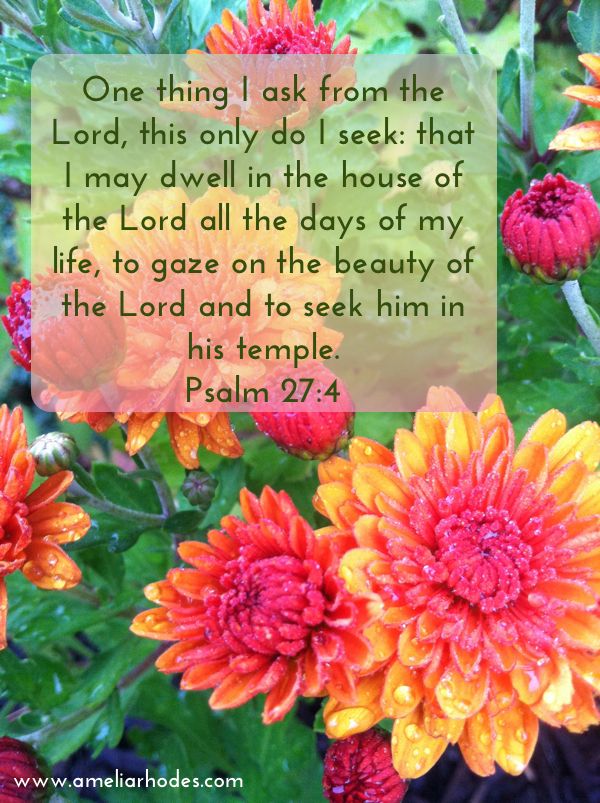
(“One thing I ask of the Lord, this is what I seek: that I may dwell in the house of the Lord all the days of my life to gaze upon the beauty of the Lord and to seek him in his temple” (Psalm 27:4).


But how can we gaze upon an invisible God? By contemplating all his glorious attributes. One commentator described the beauty of the Lord as the harmony of his perfections. I like that.

Just as the petals of a rose create a harmony of color, pattern, symmetry, and form, so the traits of our holy God manifest a harmony of perfect grace, holiness, triunity, and power.

And though we may be acquainted with a number of God’s attributes, appreciation of their beauty expands with a close-up view—through the lenses of scripture and personal experience.  For example:

God’s beautiful grace becomes visible in the story of the prodigal son, as we witness the father actually running to welcome his wayward son home.  He throws his arms around the filthy youth, even kissing him (Luke 15:11-20).

prodigal-son

God’s glorious holiness (purity, righteousness, and separateness from everything else in the universe) is highlighted in Revelation 4:1-11 as John strains for words to describe the Lord of heaven…

… ”Seated on the Throne, suffused in gem hues of amber and flame with a nimbus of emerald…Lightning flash and thunder crash pulsed from the Throne. Seven fire-blazing torches fronted the Throne (these are the Sevenfold Spirit of God)” — vs. 3-5, The Message.  

God’s harmonious triunity (Father, Son, and Holy Spirit) is celebrated in Ephesians 1. Paul reminds us that:

  • God the Father bestows all spiritual blessings upon us (v.3).
  • God the Son provided redemption and forgiveness of our sin (v.7).
  • God the Spirit guarantees our inheritance in heaven and gives us assurance (vs. 13b-14).

And God’s magnificent power is on display throughout scripture and creation, even in our personal lives.  Our Heavenly Father is a God of infinite wisdom, unfailing guidance, strong empowerment, attentive care, competent help,  rich blessings, and more.

We can contemplate each of these attributes as we would the individual petals of a perfect rose.  We can remember occasions when he has demonstrated each trait in our lives.  And perhaps we’ll burst into song as Moses did:


who-is-like-you

(“Who among the god is like you, O Lord?  Who is like you–majestic in holiness, awesome in glory, working wonders?” — Exodus 15:11).

*     *     *     *     *     *     *     *     *     *

My heart fills with wonder and praise, O Lord, because you are a beautiful, holy God.  No one is your equal in power, wisdom, creativity, splendor, or love.  No one else is perfect in all he does.  And you, in all your holy glory are  My.  Heavenly.  Father.   Such statements are too glorious to comprehend!  

But oh, how grateful I am that they are true.

(Photo & art credits:  www.dorsetcereals.com; http://www.flickr.com; http://www.ameliarhodes.com; http://www.luke-15.org; http://www.praisejesustoday.com.)

Read Full Post »

DSC05030b

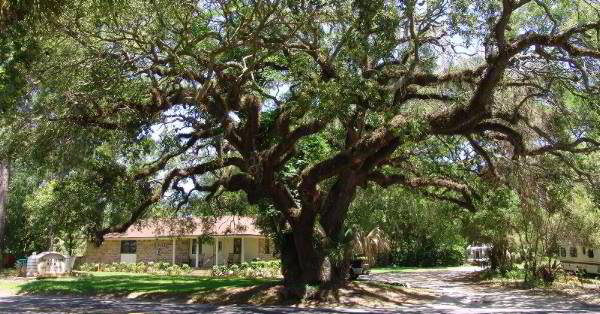
When Steve and I moved from South Florida to north of Tampa, we were delighted to see the abundance of live oak trees. Each one reaches wide with graceful, curving branches that outline intriguing free-form shapes.

Live oaks can grow to be eighty feet tall and just as broad over a life-span of hundreds of years.  The key to their longevity is their root system, which reaches down into the soil about four feet, and extends laterally to ninety feet. Such depth and width offers strong support for the tree.

Of course, roots also provide water and nutrients. A mature oak can take in more than fifty gallons of water per day, much of which evaporates and keeps the tree cool.

Such facts give me greater understanding and appreciation for Jeremiah 17:7-8.

“Blessed is the man who trusts in the Lord,

whose confidence is in him.

He will be like a tree planted by the water

that sends out its roots by the stream.

It does not fear when heat comes;

its leaves are always green.

It has no worries in a year of drought

and never fails to bear fruit.”

Doesn’t that sound satisfying and peaceful? Yet too often I’ve been more like a tumbleweed in the desert—dry, flitting here and there, and anything but peaceful.

Tumbleweed

How do I turn my tumbleweed self into a mature, flourishing tree?

The secret is in the roots. Oak tree roots grow wide and deep; tumbleweeds have none.

I have to send out my roots into the soil of God’s Word. That’s where the nutrients of strength, wisdom, and encouragement will come from. The deeper and wider my knowledge, the more empowered I’ll be to withstand the buffeting challenges of life.

The soil also represents God’s love (Ephesians 3:17-18). I must learn about my loving Heavenly Father and spend time with him in order to know him. As intimacy develops, trust grows.

And when roots grow deep into God’s Word and his love, when we practice his presence, we can remain strong when life turns up the heat…

  • When our kids make foolish choices
  • When the boss’s high expectations ratchet up a few more notches
  • When the paycheck will not stretch another penny
  • When a disagreement becomes an impasse
  • When a decision must be made and the pros and cons swim endlessly in our heads

We express our trust by affirming what we know about God. And we affirm our confidence in him by reviewing his promises–not once a day in a quick morning prayer, but moment by moment.

Roots are continually absorbing water and nutrients. We must do the same by praising and thanking God all day long. Even our concerns can be expressed with praise and gratitude:

“Father, I lift up _______ to you as he looks for another job. We are trusting you to provide, knowing that those who seek you lack no good thing (Psalm 34:10). Our hope is in you because no one who hopes in you is put to shame (25:3). I thank you that he is looking to you, God, and seeking your path. You are a good and upright God; you will instruct ______ in the way you have chosen for him (Proverbs 3:5-6).  Hallelujah!”

As our roots grow deep, our spirits can reach high and strong like live oak branches — in adoration and praise for our trustworthy God.

I am DONE with tumbleweed living!  How about you?

(Photo credits:  www.nativetreesociety.org; http://www.sonoragardensinc.com)

Read Full Post »

Book-NearingHome-BillyGraham-Sep2011


Those words, “Life, Faith, and Finishing Well,” are actually the subtitle of Nearing Home (2011), by Billy Graham.

Most Americans recognize that name immediately.  In fact, people around the world know of the famous preacher.  For nearly fifty years, he held mass meetings in numerous large cities, and introduced millions to Jesus.  His radio program, television broadcasts, and writings have further expanded his renown.

After such a long, fruitful ministry, Dr. Graham has earned the right to tell us how to live well during our remaining days.

He includes practical advice, to answer such questions as:  When should I retire? What should I keep in mind as I plan for the golden years?  What legal issues should I settle so my children won’t have to?

Dr. Graham also inspires us with his wisdom:

  • ” Look for the Lord’s purpose in every circumstance and in every face or voice you encounter daily, for the time He has given you is not without purpose” (p. 38).
  • “Whatever you do, keep your mind and your body occupied; don’t give laziness or boredom a chance to take root in your soul” (p. 47).
  • “God designs transitions and provides the grace to embrace what follows” (p. 165).

M-m-m.  Such advice would be helpful for the high school graduate heading off to college or the workplace, just as much as the senior citizen!

Billy also offers up much encouragement.  He names numerous senior citizens of the Bible and draws attention to the work God gave them to do.

The record of some we know well:

  • Abraham was 100 when Isaac was born, and the foundation for the Israelite nation was finally established.
  • Moses was 80 when he led the Israelites out of Egypt.
  • Daniel was still serving as prime minister of the Medo-Persian empire, at age 80.

Others are not so familiar:

  •  Barzillai,  age 80, helped to save the life of King David and his men (2 Samuel 17:28-29).
  • Jeremiah remained faithful to his prophet-calling, probably into his nineties
  • Haggai wrote his book of prophecy at age 70.

These men had probably slowed down a bit, compared to their energetic youth.  (Moses is the only exception.  Deuteronomy 34:7 tells us that, when he died at age 120, “his strength was not gone.”)  All of us, sooner or later, experience that life-shift from speed to sputter!

But slowing down is not the same as stopping.  “Retirement should not put us on a shelf,” says Dr. Graham (p. 28).  One option:  lift up others who are carrying heavy loads.  We can pray, encourage, and offer help as we’re able.

What else contributes to aging gracefully?  Age gratefully.   Follow Paul’s instruction, Philippians 4:8:

“You’ll do best by filling your minds and meditating on things true, noble, reputable, authentic, compelling, gracious–the best, not the worst; the beautiful, not the ugly; things to praise not things to curse” (The Message).

Again, just as applicable to a teenager as an octogenarian–and all of us in between.

Because no matter how old each of us might be, our foundations of faith can always use reinforcing.

(photo credit: http://www.homecomingmagazine.com.)

Read Full Post »

Those of us who believe in Jesus are on a faith journey.

Sometimes we fly.

He carries us on eagles’ wings.


One example from scripture is God’s deliverance of the Israelites from Egypt.  He said, “You yourselves have seen what I did to Egypt, and how I carried you on eagles’ wings and brought you to myself” (Exodus 19:4).

The Israelites had done nothing to secure their release from Pharaoh.   God caused the plagues, God opened the Red Sea for the Israelites’ escape, and God destroyed the Egyptian army.

Moses and his sister, Miriam, sang a song to the Lord, to celebrate their deliverance.


“Who among the gods is like you, O Lord?  Who is like you–majestic in holiness, awesome in glory, working wonders?” (Exodus 15:11).

Has your heart soared on the euphoria of an awesome and glorious miracle?

We have.  A number of times.  One day D. called to announce she wanted to buy us a car.  Arrangements were made with a dealership; all we had to do was go and pick one out.

“Oh–and get leather seats,” she insisted.  “They’re so much more comfortable.”

Can you imagine?  What an incredible blessing!  Our hearts soared for weeks on that miracle.   Even now, more than thirteen years later, that car is a constant reminder of God’s supernatural provision.  (Yes, it’s still running smoothly!) Through D., God proved unequivocally his love and power.

Sometimes we soar; sometimes we runon supernatural strength.

We feel the supernatural power of the Spirit coursing through our veins, providing strength and passion for the task at hand.  It is a spontaneous sprint, energized by omnipotent God.

New Christians are often empowered for a running start in their burgeoning faith. Eagerly they soak up Bible knowledge in small groups and personal Bible study.

In other cases, God places a special call on someone’s life to fulfill a need.  And with the call comes supernatural strength to meet the challenge.

That’s what happened to J.B.  God infused him with a passion to upgrade the sound system of our church.  Night after night, he worked at rewiring the sanctuary.  Much of that time was spent climbing about in the rafters.  This after working each day at his business.

When I asked J.B. about exhausting himself, he assured me  he was having fun!  He didn’t feel worn out at all.  God was giving him the strength to complete the project.

Yes, it’s exhilarating to fly on eagles’ wings of miracles and run on supernatural strength.  But…

…most of the time on our faith journey, we walk.

Step by step.  Choice by choice.  Slowly approaching the destination—the day of Christ Jesus (Phil. 1:6).  Sometimes the path is uphill and rocky.  We strain with effort to make progress.  Some days the path is winding, and we cannot see ahead.

Yet in spite of struggle and uncertainty, the walk can still bring much pleasure to the heart.  “Blessed are those…who walk in the light of your presence, O Lord” (Psalm 89:15).  You see, we do not walk alone.  The Company we keep makes all the difference.

Walking in faith involves plenty of ordinary tasks and days without miracles. Children to care for.  Laundry to do.  Meals to cook.  Calls to make.   Students to teach.  Sales to close.

But!  Whatever needs to be accomplished, we can walk through it and not collapse under the repetition and frustration.  How?  By inviting God to walk with us.


Years ago, when our three children were young, my life was a routine of laundry, cleaning, cooking, errands, and child care.  I was not one of those mothers who derived great fulfillment from these tasks.  Instead of walking joyfully through each day,  I often plodded.

Then I came across Colossians 3:23-24.  “Whatever you do, work at it with all your heart, as working for the Lord, not for men, since you know that you will receive an inheritance from the Lord as a reward.  It is the Lord Christ you are serving.”

In the margin of my Bible, next to those verses, I wrote, “including housework!”  I wanted Who I served to be more important than what I was doing.  Plodding didn’t end once and for all, but I learned to walk at a believer’s pace more frequently, as I invited God to cook, clean, and launder with me!

Those verbs–soar, run, and walk–are found in Isaiah 40:31, in that order:


“Those who hope in the Lord will renew their strength.  They will soar on wings like eagles; they will run and not grow weary, they will walk and not be faint.”

Perhaps soaring is first because  the euphoric wonder of flying on eagle’s wings seizes our attention with intensity.

Running is second.  Adrenalin runs high during spurts of divinely inspired growth and service.

And walking is last.  Did God save the most important until the end?  Because it’s in the persevering that we become strong.  It’s in the trusting  that our faith grows deep.  And it’s in practicing his presence that we learn consistency of character.

So revel in occasional soaring.  Rejoice in periodic  running.  But take deep satisfaction in the day-by-day walk on the paths of righteousness (Psalm 23:3).


“Come…let us walk in the light of the Lord” (Isaiah 2:5)!

(photo credits:  www.betterphoto.com; http://www.linksterdiversions.blogspot.com; http://www.BlackburnNews.com; http://www.foxnews.com; http://www.photobucket.som/user/jamiesolome/media.com; http://www.faithgateway.com; http://www.pinterest.com)

Read Full Post »

« Newer Posts - Older Posts »

Sylvia Schroeder

Impressions Becoming Expressions

Mitch Teemley

The Power of Story

Still Traveling

Impressions Becoming Expressions

Living Our Days

Gaining a heart of wisdom

He Said What?!

I'm Patty, and my husband and I are living with our adult son who has autism and epilepsy. I love sharing lessons learned from life around me, especially life with Aaron.

Meditations of my Heart

Impressions Becoming Expressions

Linda Stoll

Impressions Becoming Expressions

Signora Sheila

Where faith meets la dolce vita

Heidi Viars

Finding the Image of God