Feeds:
Posts
Comments

Archive for the ‘Appreciation’ Category

(An imaginary conversation between God and me.)

ME:

You know me, Lord. If I’m not careful my mind can slide into fear and worry, especially about the needs and struggles of loved ones. Or I can slip backward into hurts or regrets of the past. Release from such thoughts is not always easy.

But I’ve heard it said, “What is IM-possible is HIM-possible” (Unknown).

So when negativity seeks to pull me down, I want to be quick to remember who YOU are, your promises, and what you can do that make all things HIM-possible.

GOD:

Indeed, nothing is IM-possible with me (Luke 1:37).

Here are four important truths to keep in mind that make for HIM-possible-living:

I am greater than your fears.

Think on My sovereignty and might.

I am in control of all things. I have established My throne in heaven and My kingdom rules over all. Therefore, the one who fears Me need not fear anything else [1].

I am all-wise and all-powerful, always with you and ready to offer counsel.

I am your all-sufficient Father, able to provide everything and anything you’ll ever need.

ME:

I praise You, Lord, for equipping me to contend with whatever circumstances unfold. You are the Mighty Warrior who saves!

(Psalm 103:19; 1 John 4:18a; Romans 11:33; Psalm 15:3, 46:1; Ephesians 3:20; Zephaniah 3:17)

GOD:

I am greater than your troubles.

Remember My power and strength.

Out of My omnipotence, I promise to supply you with strength sufficient for the day. Each morning I provide a fresh supply of all my mercies.

No matter what the future may hold, you can keep on bearing all things through My Son, Jesus Christ, who constantly infuses you with His strength.

Every trouble produces benefit–strong, honorable character in you, and blessing for others as they see My peace and joy reflected in you.

ME:

I praise you, Lord, for being a present-and-active help in times of trouble.

(2 Chronicles 20:6; Psalm 18:32; Lamentations 3:22-23; Philippians 4:13;

Romans 8:28; James 1:2-4; Matthew 5:16; Psalm 46:1)

GOD:

I am greater than your hurts.

Remember my love and tenderness, my grace and kindness.

I provide a solid foundation on which to rest, even when wave after wave of challenge sweeps through your life [2].

I am your Great Physician. Cling to Me by immersing yourself in My Word and find the cure for your heartache.

I am patiently transfiguring all the notes of your life into the song of My Son, Jesus . . . All is grace, as your hurts and heartaches become tools in My hands, to transform you into the image of Christ [3].
ME:

I praise you, Lord, for your devoted, attentive care.

(Isaiah 66:13a; Psalm 86:15; Psalm 147:3; Psalm 119:49-50; 2 Corinthians 3:18)

GOD:

I am greater than your regrets.

Remember my compassion and forgiveness.

Dwell on regrets and you’ll stir up a whirlpool of excruciating details. It’s an easy place to drown [4].

Leave the irreparable past in My hands, and step into the irresistible future with Me [5]. You’ll find joy replacing remorse and peace replacing agitation.

When thoughts of your failures do push their way into your consciousness, allow my total forgiveness to relieve your pangs of guilt. Then offer Me praise for accepting you just as you are, thanking Me for growing you into more than you were yesterday [6].

ME:

I praise you, Lord, for your mercy to forgive and your grace that meets me where I am but does not leave me where it found me [7].

I praise you that victory over fears, troubles, hurts, and regrets is more than HIM-possible with you!

(Psalm 103:8, 13; Romans 8:37)


[1] The fear of God in the original language doesn’t mean to be afraid. It means sustaining a joyful, astonished, awe and wonder before Him—Timothy Keller.

[2] Jane Fryar, Be Blessed, 34-35.

[3] Ann Voskamp, One Thousand Gifts, 100; Kay Arthur, His Imprint, My Expression, 180.

[4] Based on a David Powlison quote, https://www.sgclouisville.org/blog/2024/01/16/sermon-quotes-what-do-we-do-with-regret.

[5] Oswald Chambers, My Utmost for His Highest, Dec. 31.

[6] Ruth Bell Graham, Blessings for a Mother’s Day, 101.

[7] Anne Lamott, GRACE Eventually.

Art & photo credits: http://www.canva.com; http://www.heartlight.org; http://www.pxhere.com; http://www.canva.com; http://www.heartlight.org; http://www.dailyverses.net; http://www.rawpixels.com.

Read Full Post »

Sunday evening at our son’s house we reveled in a rare musical experience—a private mini-concert by a gifted violinist, Jenny Armor. She happens to be the daughter of friends, and they’d joined us for dinner.

Not only is Jenny able to play ultra-challenging music with superb technique, she plays from her heart. This week Jenny graduates from a music conservatory in Canada; in the fall she’ll begin a two-year master’s program in Europe.

Here’s a link to a video of Jenny playing a Schoenfeld trio for clarinet, violin, and piano, recorded two years ago.

You can imagine what two more years of training and practice have achieved. But one thing has been apparent since Jenny was very young: making beautiful music brings her blessed happiness.

Of course, Jenny’s violin experience didn’t begin with the works of Schoenfeld, Brahms, or Tchaikovsky. Most likely it was “Twinkle, Twinkle, Little Star.” But as she’s grown in knowledge and then put that knowledge into practice (lots of practice!), the pleasure Jenny derives from playing has only expanded.

The same could be said for many endeavors. The journey to become an expert in any field is to increase the pleasure of that activity along the way.

Even in the spiritual realm, a close parallel can be drawn:

Someone might ask, “How can just knowing the stories of Jesus increase my happiness?”

First, familiarity with the biblical accounts can provide pleasure. Who doesn’t enjoy a good story?  But the delight expands as we identify Christ’s attributes-in-action and then realize they also impact us

Those attributes would include:

  • Compassion—upon those who came to hear him teach and those who approached him for healing (Matthew 14:14; Mark1:40-41, et al.)
  • Mercy and grace to forgive sins (Matthew 9:2; Mark 2:5, et al.)
  • Respect and kindness for all people, including hated Samaritans (John 4), Roman occupiers (Luke 7:1-10), and disregarded pagans (Matthew 15:21-24)
  • Selflessness, ultimately expressed as he endured crucifixion (Matthew 20:26-28)

And as we develop awareness, we see more and more evidence of such attributes at work in and around us. Think of it: The King of the universe is participating in our lives (Revelation 17:14; Philippians 2:13)! And growing appreciation leads to greater joy.

The next question becomes, how might we see more evidence of his presence, in order to experience fresh delights? One way is meditation.

Meditation on Christ is what turns knowledge about him into an intimate relationship with him. It begins with slow, prayerful reading of New Testament verses or passages. Questions such as these can guide our thinking:

  • What does this text reveal about my relationship with Christ?
  • What am I learning about God the Son in this passage, about his character and/or activity?
  • What encouragement or instruction would he have me internalize and apply to my life?
  • What insights might I make a matter of prayer?

And if we record responses in a notebook or journal, we’ll deepen our reflection and receive even greater benefit, because oftentimes to write is to discover.

We can conclude our meditations with praise, for who our Savior is, what he has done, and the understandings brought to light by the Spirit. This prayer might also be written, to augment its imprint on our hearts.

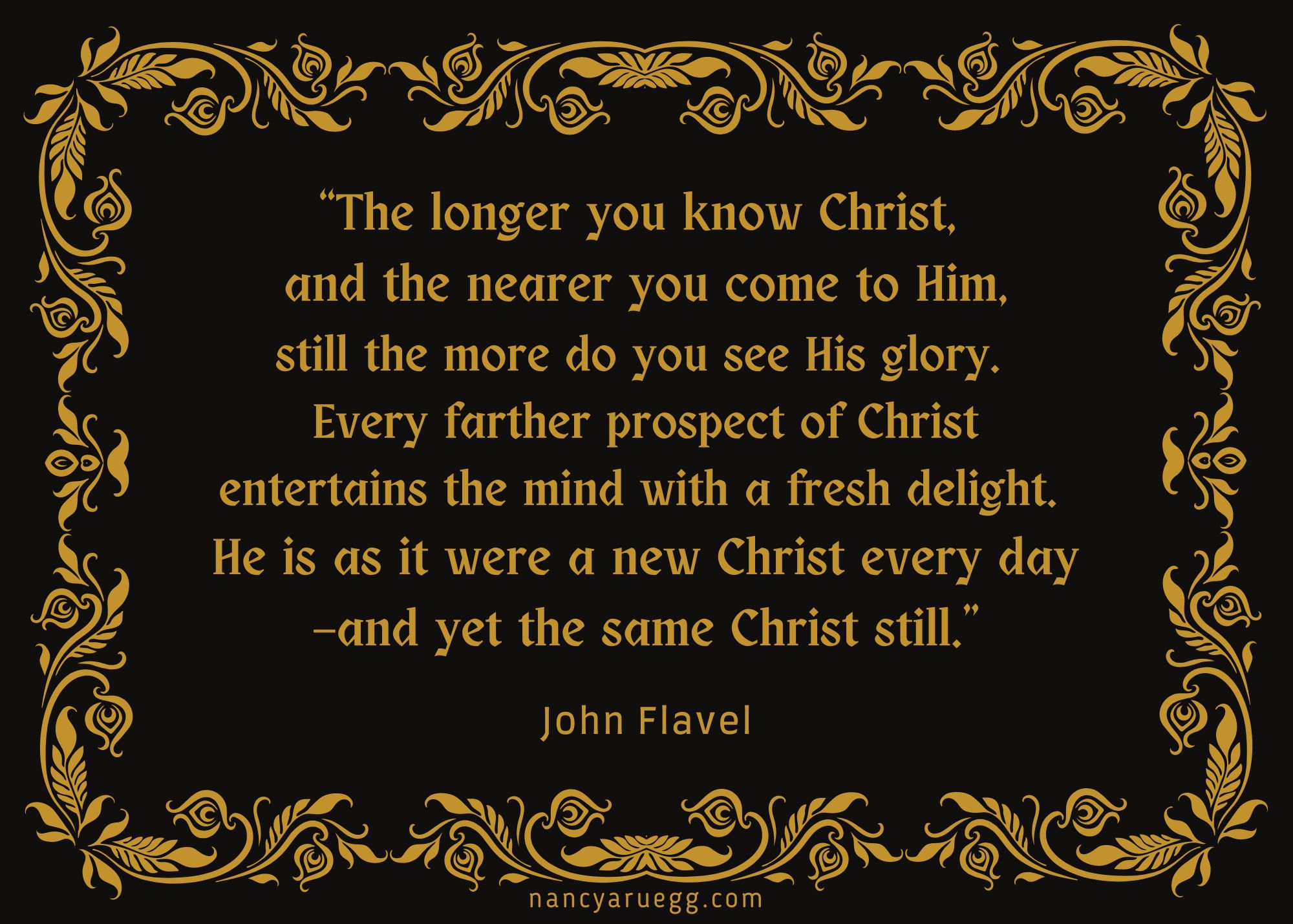
And then, with Puritan minister and author John Flavel, we’ll be able to affirm:

Just as our young friend Jenny surely experiences happy blessedness as she pursues her violin studies, how much more will we experience fresh delight and happy blessedness in Jesus as we study him.

Art & photo credits: http://www.flickr.com; http://www.freerangestock.com; http://www.canva.com

Read Full Post »

How would you finish this statement?

Nothing we do is more powerful or life-changing than _____________.

Some would suggest taking better care of ourselves, or setting goals that include a plan for completion, or training our minds to focus on the positive. And the argument could be made that all of these actions create beneficial influence in our lives.

But according to author Stormie Omartian, “nothing we do is more powerful or life-changing than praise[1]. Others would likely agree with her, having cited numerous benefits themselves:

  • Prayers of adoration calm any fear, lift the spirit, and fill us with indescribable joy [2].
  • Praising God reduces our cares, levels our anxieties, and multiplies our blessings [3].
  • Continual praise is what changes the emotions, lifts the darkness, offers hope, frees the mood, and blesses God so that evil is driven out. It changes everything [4].
  • When we choose to practice adoration anyway in the midst of whatever we are feeling, our words lift us over that barrier and into a deeper connectedness with God [5].

But how could simple words produce such life-changing results? Psalm 69:30 offers a clue:

To magnify God is to make larger our view of him and his attributes, which lessens our view of the problems we face. The more often we focus on God, the more our faith thrives, and that in turn leads to less worry and fretting.

For example, see if these statements don’t boost your confidence in God for what you’re facing right now:

  • Praise God he is all-sufficient, all-knowing, and all-powerful. He has everything under control (Isaiah 55:11; Romans 11:33-36; 1 John 3:20b).
  • Praise God he is forever faithful, always working out his overall plan, always fulfilling his purpose (Lamentations 3:22-23; Job 42:2). 
  • Praise God he is continually gracious and good, full of love and compassion (Psalm 145:8-9).

The longer we gaze at him, arrayed in such glorious attributes, the less insurmountable our problems become.

And with an unknown Puritan of old we too can affirm:

“When I think upon and converse with Thee, ten thousand delightful thoughts spring up, ten thousand sources of pleasure are unsealed, and ten thousand refreshing joys spread over my heart, crowding every moment with happiness” [6].

That is the power of praise.

But the enemy of our souls is well aware of this power. He’ll do everything he can to keep us from developing the habit of praise. What might help?

Habit-stacking. Have you heard of it? The practice involves adding a new habit to some action that’s already a fixed routine.

For example, we might add more praise to our days while making the bed in the morning, completing some household chores, commuting to and from work, walking from place to place, waiting for the microwave, chopping fruit or veggies.

What routines are established in your life? Which ones lend themselves to spending a few minutes praising God for who he is and what he’s done?

Another possibility for adding praise to our lives comes from C. S. Lewis: “Make every pleasure into a channel of adoration.” He suggested several ideas to get us started: a beautiful mountain valley, delicious food, a great book, or a piece of music [7].

And you know what happens as we praise God for these blessings?

One’s mind runs back up the sunbeam to the sun [8].

Isn’t that lovely imagery?  

And is there any better place for our mind to be?


[1] Values for Life, 160.

[2] Kristine Brown (https://www.ibelieve.com/christian-living/prayers-of-adoration-to-fill-your-heart-wonder.html).

[3] Suzanne Dale Ezell, Values for Life, 160.

[4] Arnold Prater, Bonding with God, 78.

[5] Sara Hagerty, Unseen, 151.

[6] From The Valley of Vision, Puritan prayers and devotions compiled by Arthur Bennett, 1975.

[7] Quoted by Timothy Keller in Prayer: Experiencing Awe and Intimacy with God, 197.

[8] C. S. Lewis, Letters to Malcolm: Chiefly on Prayer, 89-90.

Art & photo credits: http://www.pickpik.com (2); http://www.canva.com; http://www.freeimageslive.co.uk; www,pxhere.com; http://www.canva.com.

Read Full Post »

Most visitors to an art museum spend fifteen to thirty seconds looking at a painting, but art enthusiasts insist that’s not near long enough to fully enjoy each work.

Take for example da Vinci’s world-famous Mona Lisa. You’ve seen photographs; some of you may have viewed the original at the Louvre. Besides the model’s haunting expression, what makes this painting stand out from others?

First, note da Vinci’s use of shadow to give contour to the face and clothing. As a result, daVinci achieved more realism than other painters of his time.

Second, enlarge the image above and study da Vinci’s masterful attention to detail—the intricate gathers of the bodice, the graceful tendrils of her hair, the next-to-nothing veil.

Third, focus on the background. Mona Lisa appears to be sitting in front of a window with a lovely view of mountains, trees, and a lake. Da Vinci used a technique called foreshortening to condense the wide scene onto his narrow canvas.

Fourth, note the hazy atmosphere, created as da Vinci blurred the edges of his almost undetectable brushstrokes.

Of course, additional features also contribute to Mona Lisa’s magnificence. Yet even this short list makes clear: there’s more to the Mona Lisa than most of us realize.

And to know more makes us appreciate more and enjoy more. But such results require close observation through slow looking.

The same principle applies to God. To know God more will allow us to enjoy and appreciate him more.

But how do we observe closely Someone who’s invisible?

We begin with evidence of the Unseen. One example, his presence and character traits revealed in the events of our lives:

  • Caring protection from harm on numerous occasions
  • Generous provision of countless necessities, gifts, and blessings
  • Perfect wisdom, as certain desires of our hearts haven’t come true, recognized in hindsight
  • Unfailing faithfulness to see us through disappointment, difficulty, and uncertainty
  • Gracious goodness in every joyful moment, every delightful surprise. They all come from him.

Every day provides much evidence of his benevolent presence in the lives of each of his children. The more we look, the more we’ll find. And as each discovery is turned into praise our spirits fill with joy.

Another way to practice slow looking is to spend time in God’s presence, learning more about him through his Word.

It makes sense: “Delight in God cannot occur in an intellectual vacuum” [1].

“But I don’t know where to start!” someone might say.

The internet offers a variety of reading plans, and once a plan is in place, we apply the practice of slow looking as we read.

Writing the answers to such questions as these hones our observation skills:

  • What does this passage say about God and his character?
  • What truths does he teach?
  • What does God promise here that offers hope and encouragement?
  • Is there a prayer that applies to my life? (Write it out, perhaps in your own words, and personalize it.)
  • Has God included an example to follow or not follow [2]?

Slow looking through the act of writing also helps deepen our understanding and appreciation, expanding our capacity to enjoy God.

Another benefit? Taking joy in God and all his excellencies increases our strength to endure.

What moment of slow looking has led you to a recent discovery about God? Please share in the comment section below!


[1] Sam Storms, http://www.gracequotes.org

[2] Denise J. Hughes, Deeper Waters, 76.

Photo credits: http://www.pxhere.com; http://www.wikipedia.org; http://www.rawpixel.com; http://www.pexels.com; http://www.heartlight.org; unknown.

Read Full Post »

More than likely you’ve never seen the item pictured above. At first glance, you might think it’s a noisemaker used in primitive worship ceremonies. Others might say it looks like a musical instrument or the paddle for some game.

In actuality, it’s a model of an ancient Aztec weapon, a macuahuitl (MAC-wah-wick).

Strange-looking, isn’t it?  How could a wooden paddle be deadly enough for warfare? The key lies in those black protrusions on the sides. They were made from obsidian and filed razor sharp, capable of creating gaping slash wounds.

Here’s another strange-looking weapon. They remind me of the jacks some of us played with as children. These are called caltrops, with each spike measuring 2 1/2-to-3 inches.

Caltrops were designed so that, when thrown on the ground, one point would always land facing up.

Spread hundreds of these around your camp at night, and protect your soldiers while they rest. Or hide them in the area before the opposing army approaches, and cause crippling injury to many men and beasts as they charge.

But why all this talk about ancient weapons?

In the spiritual battles of life, we too have at least two strange-but-effective weapons at our disposal.

At first glance, they might appear useless against our adversary Satan. But these weapons have the power to defeat his minions of discouragement, disappointment, envy, frustration, and more.

The first weapon is gratitude. Yes, just uncomplicated gratitude.

For example, consider each of the negative emotions named above and how gratitude might incapacitate them:

  • When discouraged by lack of recognition at work, I can be thankful God sees.
  • When dissatisfied with my paycheck, I can be thankful that God will provide.
  • When disappointed by my child’s behavior, I can be thankful for the life-lessons taught through consequences that will benefit him in the future.
  • When envious over the lovely new house of an acquaintance, I can be thankful for our low mortgage, friendly neighbors, and the memories that have turned our house into a home.
  • When frustrated by a day of one-step-forward-and-two-steps-back, I can thank God for the strength and patience to see me through [1].

And as we wield our weapon of gratitude we’ll discover: “The truly thankful person is a truly peaceful person” [2].

But how do we manufacture deep-down satisfaction when life is full of difficulty and stress?

Luci Swindoll suggests: “Consider who you are and be satisfied with that. Consider what you have and be satisfied with that. Consider what God is doing and be satisfied with that” [3].

One way to employ contentment is to meditate on one of the praise psalms, like Psalm 103 or 145. While reading each verse, consider what it says about who you are, what you have, and what God is doing. Brandish your discoveries in the face of the enemy of your soul.

Even one simple statement can generate a whole journal of responses. For example:

In this moment, consider:

  • What goodness do you see, hear, taste, smell, or feel (externally and internally)? Praise God for these gifts [4]
  • What recent events have brought you joy? Praise God for engineering those events.
  • Who has blessed you lately? Praise God for these people.
  • What are you looking forward to? What hopes do you have for the future? Praise God that, because of his unfailing love and faithfulness, we always have hope (Lamentations 3:21-23).
  • What evidence of God’s thrilling presence have you noted? Praise him for revealing himself in so many different ways [5].

Perhaps a thick fog of trouble makes it difficult to see much goodness. British writer and scholar Alexander Smellie (1857-1923) would have us affirm:

“The Lord knows what is best for me, and my surroundings are determined by Him. Wherever He places me, He does so to strengthen my faith and power, and to draw me into closer communion with Himself. And even if confined to a dungeon, my soul will prosper.”

Those are fighting words of contentment we can take into battle, my friends!


[1] Job 28:24; Philippians 4:19; Hebrews 12:11; Habakkuk 3:17-19; Philippians 4:13

[2] Lysa Terkheurst, Embraced, 256.

[3] Joy Breaks, 79.

[4] A previous post Mindfulness PLUS may prompt your thoughts.

[5] Another post Heart-to-Heart offers examples.

Photo credits: http://www.worldhistoryencyclopedia.org; http://www.picryl.com; http://www.heartlight.org; http://www.canva.org; http://www.pxhere.com.

Read Full Post »

Summer 2021

A happy family is

but an earlier heaven.

–George Bernard Shaw

We’ve been enjoying an earlier heaven this week as our three children, their spouses, and three grandchildren have gathered. (Steve’s sister and brother-in-law joined us for a day also.)

Because such occasions happen only now and then, I totally agree with Kathleen McGowan, who wrote:

The only thing sweeter than union

is reunion.

–Kathleen McGowan

Indeed, we treasure these times of togetherness, just as Wanda Hope Carter advocates:

Family and friends are hidden treasures.

Seek them and enjoy their riches.

–Wanda Hope Carter

A Spanish-American philosopher came close to describing why we find treasure in familial relationships:

The family is one of

nature’s masterpieces.

–George Santayana

I’d amend his statement to: “The family is one of God’s masterpieces.” After all, family is God’s idea, established at the beginning of time (Genesis 1:28).

Author Dillon Burroughs adds this viewpoint:

When we think of our family,

our spouse, parents, or children,

let us see them as a gift from God.

–Dillon Burroughs

Indeed! I am supremely grateful to my Heavenly Father for giving us the gift of a family that loves, supports, and takes joy in one another.

They make my soul blossom.

Let us be grateful to people who make us happy;

They are the charming gardeners who make our souls blossom.

–Marcel Proust

Read Full Post »

Cincinnati Museum Center

When our daughter Heather and her family from Washington State come to visit us here (including her two brothers and their families), we take the two granddaughters to the Cincinnati Museum Center.

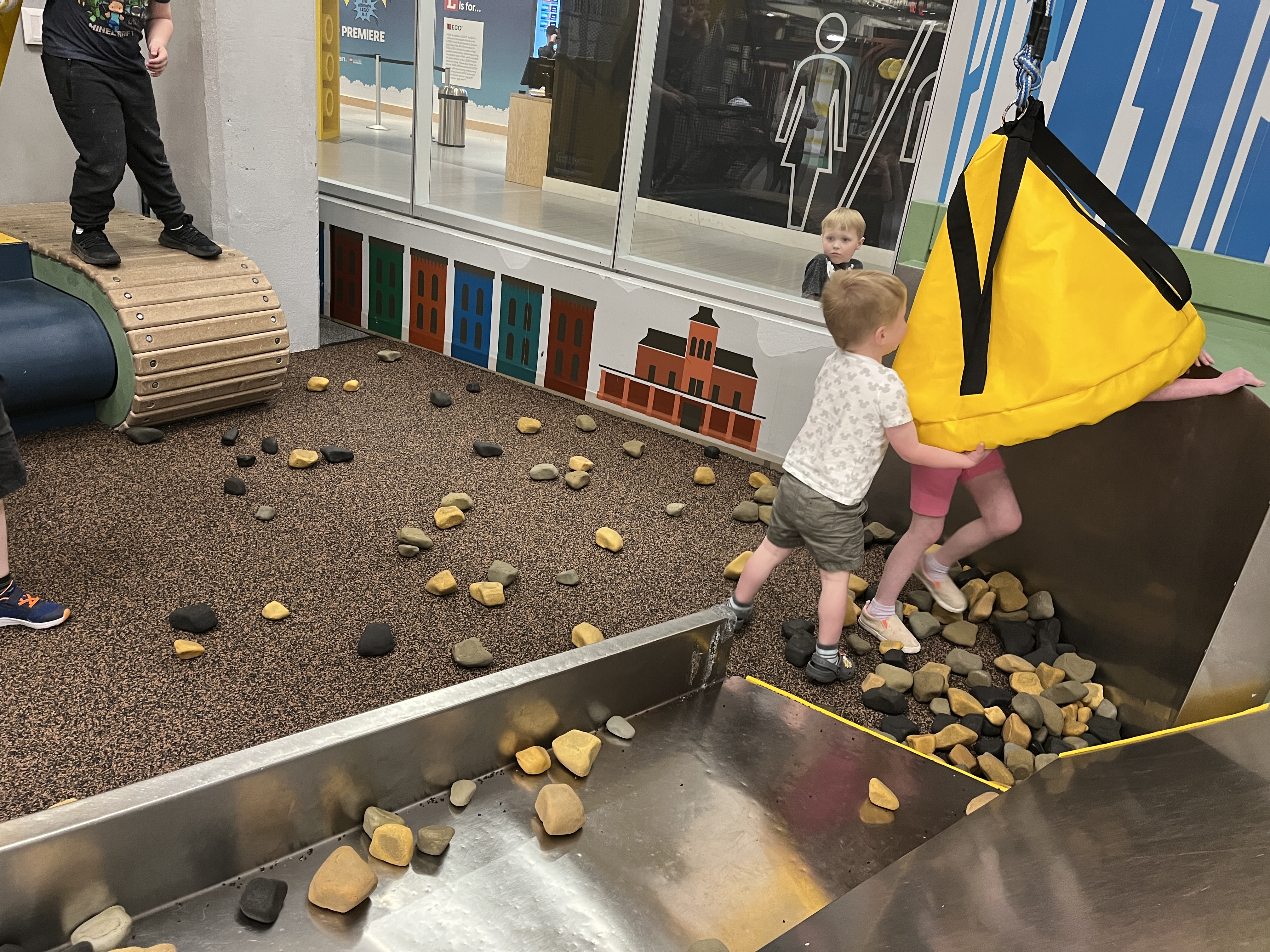
This last time, Sophie (age eight) particularly enjoyed the simulated rock quarry, where children can learn about simple machines. Tools like shovels and wheelbarrows are part of the equipment provided.  (That was three year-old Elena’s speed.)

NOT Elena, but another little quarry worker

Some of the equipment is more complicated, including, a rope-and-pulley scoop for picking up foam rocks then lifting them off the ground, and a crane to move the scoop over to a dump truck.

By trial-and-error Sophie figured out how to adjust the ropes for maneuvering the scoop into the pile of rocks, then tilt it upright. A tall, brawny, football-player-in-the making came along to join in the play. He was probably about ten years old. I watched to see if he would use his size to take over the operation.

Instead, he and Sophie began to work together. He would pile foam rocks for her to scoop, then jump up to the heavy crane that would transfer the scoop over to the truck. He never bossed, but spoke respectfully. They had a grand time experimenting and problem-solving.

Or you can play Frustrate-Your-Sister!

Once or twice the boy spoke to his mom. She was very busy keeping track of a younger son and toddler daughter who liked to go in opposite directions. My thoughts returned to the exhausting days when our three children were young.

On our way out of the quarry-area, Heather, the girls, and I passed by that busy mom.

“Your son is a fine gentleman,” I said, then shared with her my observations.

A beautiful smile transformed her face. “Oh, thank you!” she enthused. “You never know if they’ll remember their manners.”

“Well, he sure is minding them this morning. You’re doing a great job!” And with a light squeeze on the young mother’s arm, I hurried to catch up with my girls.

That’s when I noticed the atmosphere had changed; the air seemed purer.   Those positive words meant to bless a busy mom had blessed me too, and an afterglow of refreshing joy filled my heart–just for trying to make someone else’s day a bit brighter.

Those wise words of Solomon proved true again:

Of course, more important is the affirmation-afterglow in the life of that young mother. My prayer is our little conversation provided her with encouragement and confidence to press on in her conscientious child-rearing.

I’m very hopeful of a such a result, based on my own experience at that stage of life. At least a couple of times when our children were small, a stranger stopped at our table in a restaurant and commended them for their calm behavior.

Now, more than thirty years later, I still remember those spirit-lifting, confidence-building comments. (Although I must confess: at home they were anything but calm!)

I, for one, want to grow as an encourager—to strengthen the hearts of others as they face life’s challenges. Maybe you do too.

Just how might we achieve that goal? Possibilities include:

  • Share positive words based on our observations—even with strangers like that mom at the museum, or with diners at a restaurant.
  • Be specific and give examples about the positive traits we see.   Folks are often blind to their own commendable behaviors.
  • Express appreciation for anything and everything. (We’ve mentioned this behavior before, but need the reminder.) We can also increase the power of a thank-you by adding a smile, eye contact, and maybe even a touch on the arm if appropriate.
  • Show interest in the thoughts and activities of others. Validation is even more powerful than praise.
  • Encourage the encouragers! We can tell others how their words have blessed us, to keep determination and confidence flowing among us.
Quotefancy-167343-3840x2160

Encouragement is indeed a powerful force, fostering perseverance, strength, and hope.

Best of all, it brings glory to God as we affirm his character in those around us.

*     *     *     *     *     *     *     *     *     *

Thank you, Father, for the privilege of ministering encouragement, for the delight you engineer in the heart of the one who receives and the one who gives. May I breathe strength, hope, and confidence into others wherever I go.

Art & photo credits:  www.commonswikimedia.org; http://www.visitflyovercountry.com; http://www.inventorsoftomorrow.com; http://www.stocksnap.io; http://www.wallpaperflare.com; http://www.pxfuel.com;  http://www.quotefancy.com.

(Revised and reblogged from August 1, 2016 while we enjoy family house-guests.)

Read Full Post »

No matter how many sunrises a person might witness over a lifetime, who could tire of the majestic spectacle, with its mesmerizing shades of lavender, scarlet, apricot, and golden yellow—all aglow with the backlight of the sun, and each dawn different than all those before.

I’m filled with wonder as the morning sky begins to fill with light and “the heavens proclaim the glory of God. The skies display his craftsmanship”[1].  He is the supreme Artist.

My favorite sunrise-displays are those when clouds are positioned just right to create magnificent gleaming rays reaching into infinity.

Perhaps God inspired the prophet Malachi with just such a sunrise as he wrote: “The Sun of Righteousness [our Messiah] will rise with healing in his wings for you people who fear my name”[2].

Wings refers to sunbeams, bringing to mind the unending healing of God’s forgiveness, available to all who put their trust in Jesus. He provides for us the dawning of a new day as we choose to move out of darkness and into his marvelous light [3].

Sunrise is also God’s daily reminder that his faithfulness is great and his mercies begin anew each morning . Perhaps he wanted us to understand that his faithfulness to us is as certain and consistent as the sunrise, yet full of surprise and creativity as well [4].

The dawn brings hope, reminding us that:

  • Just as the sun is bigger than any planet in our solar system, so God is bigger than any challenge we might face.
  • Just as the sun always shines whether in full view or behind clouds, God is always with us whether we sense his presence or not.
  • Just as the sun never fails to rise, so the Son will never fail to rise, bringing the light of his salvation, truth, and wisdom.
  • Yesterday’s disappointments and failures are past; a new day with fresh blessings and possibilities has dawned [5]!

In addition to hope, fresh joy comes with the morning light.

But to see the dawn and experience its pleasure, a person must look at the sunrise. If we’re going to see joy and experience its pleasure, we must look to the Son, the source of joy [6]. Then, each day becomes an opportunity to live in wild, blissful amazement of God.

When you do witness a glorious sunrise doesn’t it make you smile—if not on your face, then in your spirit? We can augment that joy with gratitude—not just for a breath-taking dawn, of course, but for all the beautiful, remarkable, and pleasurable things God generously bestows.

Author Roman Payne wrote in celebration of the sun: “O, Sunlight! The most precious gold to be found on Earth!” And surely we’d agree, a golden sunrise especially proves his point.

But just such a sunrise might better serve as a reminder to celebrate the Son:

O SonLight, more precious than all the gold to be found on Earth!

*     *     *     *     *     *     *     *     *     *

I praise you, God the Father, Son, and Holy Spirit, for your light that is brighter than the brilliance of a sunrise! You are the source of all blessing, the brightness of our days, and our guiding Light to show the way. Without you, life is like twilight with dark night ahead. But with you, it is the dawn of morning with the light and warmth of a full day ahead.

(Psalm 84:11 PTP; James 1:19; 2 Samuel 22:29; Psalm 119:105;

last sentence based on Philip Schaff quote.)


[1] Psalm 19:1 NLT

[2] Malachi 4:2a

[3] 1 Peter 2:9

[4] Lamentations 3:23, and an idea inspired by Eugene Peterson, Run with the Horses, pp. 115-116.

[5] Philippians 4:13; Psalm 23:4; 27:1; 119:105, 130; Ecclesiastes 2:13

[6] John 15:11

Photo credits: http://www.pixabay.com; http://www.peakpix.com; http://www.canva.com (2); http://www.rawpixel.com.; http://www.peakpix.com.

Read Full Post »

Recently I’ve been listening to Christian comedians on YouTube while exercising. They help distract me during this most distasteful half-hour of each day.

The best part of exercise: when it’s over.

So far I can recommend the humor of Tim Hawkins, Jim Davis, Kenn Kington, and Ted Cunningham to keep one entertained.

However, be forewarned: it’s impossible to do crunches while laughing.

Here’s a sample of Kenn Kington. Start the video, start crunching, and you’ll see what I mean.

https://www.youtube.com/watch?v=3YZ8tAbI5fw

No doubt you’ve heard some of the benefits of laughter that researchers have identified, including:

  • Decreased tension
  • Lowered blood pressure
  • Improved immune system
  • Increased feel-good endorphins
  • Renewed energy [1]

Laughter is good medicine, just as God inspired King Solomon to write eons ago (Proverbs 17:22). It also produces healthy servings of joy into our spirits.

But laughter isn’t the only action that produces health benefits and joy. So do gratitude and praise.

According to the Mayo Clinic, gratitude:

  • Decreases depression
  • Lessens worry
  • Improves sleep
  • Enhances immunity
  • Reduces chronic pain [2]

The ability to express gratitude and praise is a gift from God, intended to accomplish much good for mind, body, and spirit.

So what might we give thanks and praise to God for today?

A quick perusal of my gratitude journal provides the following possibilities that anyone can embrace:

  • Watching children on a playground, running, climbing, sliding, and whooping with glee—and finding my own glee expanded
  • Tackling a challenging project and reveling in the moment when it’s finally complete
  • Partaking a delicious meal with family and/or friends, enhanced by caring conversation, shared memories, and of course, laughter!
  • Marveling at the masterpieces of nature: the wings of a butterfly, the camouflage of a deer, the leap-and-grab abilities of a squirrel
  • Delighting in a bargain purchase that God surely provided (James 1:17)

Both of these practices, laughter and gratitude, will take us only so far into health and joy without one all-important element: faith.

When Paul wrote from prison to his dear friends at Philippi, he hoped to be released and visit them soon. His heart’s desire was to contribute further to their spiritual growth and to their joy in the faith (Philippians 1:25), considering its numerous benefits.

Which come first to your mind? See if your thoughts correspond with a few of these blessings:

  • God’s unfailing grace, compassion, and love
  • His inexplicable peace, comforting presence, and absolute strength
  • The wisdom of his Word to guide us through every situation
  • God’s promises that offer hope
  • His help that sometimes manifests itself in a surprising God-incident
  • His encouragement at unexpected moments through unexpected sources
  • The undeserved gift of eternal life yet to come

Researchers have verified that faith in God also provides physical benefits, including:

  • Reduced stress
  • Lowered blood pressure
  • Enhanced mental health
  • Improved emotional health
  • Decreased depression [3]

It stands to reason, the stronger our faith in a God–who provides so much–the greater our contentment.

And when enthusiastic laughter, heartfelt gratitude, and praise-charged faith are part of every day, we’ll find ourselves overflowing with a sense of well-being and joy—an overflow that also impacts others.


[1] https://www.helpguide.org/articles/mental-health/laughter-is-the-best-medicine.htm.

[2] https://www.mayoclinichealthsystem.org/hometown-health/speaking-of-health/can-expressing-gratitude-improve-health#:~:text=Expressing%20gratitude%20is%20associated%20with,pain%20and%20risk%20of%20disease.

[3]https://www.bethesdagardensloveland.com/blog/the-health-benefits-of-faith#:~:text=The%20health%20benefits%20of%20faith%20have%20been%20a%20hot%20topic,reduced%20dependency%20on%20addictive%20substances and https://relevantmagazine.com/life5/surprising-links-between-faith-and-health/ and https://www.christiantoday.com/article/believing.in.god.is.good.for.your.health/27902.htm.

Photo credits: http://www.rawpixels.net; Nancy Ruegg; http://www.canva.com; http://www.heartlight.org; http://www.pexels.com (Sidney Lima); http://www.canva.com.

Read Full Post »

Discouragement bombards us from every direction—from disheartening newscasts to difficult neighbors, from incompetent coworkers to family frustrations.

Secular sources offer strategies like these to combat despair:

  • Let go of anger and accept people as they are. (Easier said than done!)
  • Stand up straight—good posture helps. (Help, perhaps. Absolute remedy? Seems doubtful.)
  • Learn something new; do something fun! (And when the distraction is over, what then?)

An anonymous psalmist offers us this God-inspired example instead:

Can you affirm that our sovereign God is a mighty, majestic, and miracle-working God?

If so, you’ll agree with this assertion:

“As long as our eyes are on God’s majesty

there is a bounce in our step!”

–Max Lucado [1]

Look up majesty in a thesaurus and you’ll find such awe-inspiring synonyms as magnificence, glory, awesomeness, and superbness.

But how can we keep our eyes on the majesty of a God who’s invisible?

We can see its manifestations–they’re all around us.

For example:

We See God’s Majesty in Creation

While reading on the deck one afternoon, a house wren landed at one end of the rail, then dashed across its length before pausing and flying away. Never would I have expected such a small bird to run so fast. You’d think she had wheels, not legs!

And I marveled at this work of God: a small, nondescript bird with the extraordinary gift of great speed.

We See God’s Majesty in Circumstances

H. asked if I’d like to join her for a church-sponsored concert that she knew we’d both enjoy. I purchased my ticket online, only to learn later the transaction hadn’t completed, even though the last page on the website announced a successful purchase. The ticket was never emailed.

Kicking myself for not taking a screen shot, I contacted the credit card company, but there was no record of the payment yet. My husband urged me to attend the concert anyway. Upon arrival we learned there’d been a problem with the website. They graciously invited those of us without tickets to attend free of charge!

We See God’s Majesty in Scripture

Not long ago I let myself slip into a cesspool of self-pity while cleaning the house—a task I deplore. Suddenly God broke through my negativity and redirected my thoughts with this gem of advice: “Rejoice in the Lord always. I will say it again, rejoice” (Philippians 4:4).

He reminded me why I was cleaning. I could rejoice that our younger son and daughter-in-love were coming to visit. And I prayed, “Help me practice gratitude, Father, and enjoy your company—even as I clean.”

(Please revive my attitudes also, Lord!)

We See God’s Majesty in Jesus

No one is as glorious and majestic as our righteous King! And yet he concerns himself with us.

He is:

Our Priest to atone

Our fountain to cleanse

Our Intercessor to plead

Our Foundation to support

Our Counselor to advise

Our Prophet to teach

Our Sun to enlighten

Our Bread to nourish

Our Father to provide

Our Shepherd to protect

Our Emmanuel to attend

Our Peace to comfort

Our Lord of glory to reign![2]

May such truths as these help to dispel discouragement and put a bounce in our step–today and always!

What truths would you add to this starter-list? Please share in the comments!


[1] Grace for the Moment, 289.

[2] V. 1: Hebrews 2:17; Zechariah 13:1; Romans 8:34; 1 Corinthians 3:11. V. 2: Isaiah 9:6; Deuteronomy 18:15; Malachi 4:2; John 6:35. V. 3: Isaiah 9:6; John 10:11; Matthew 1:22-23; 2 Thessalonians 3:16, 1 Corinthians 2:8.

Art & photo credits: http://www.pexels.com, Yan Krukau; http://www.canva.com; http://www.publicdomainpictures.net, Sheila Brown; http://www.canva.com; http://www.publicdomainpictures.net, Lynn Greyling; http://www.wallpaperflare.com.

Read Full Post »

« Newer Posts - Older Posts »

Sylvia Schroeder

Impressions Becoming Expressions

Mitch Teemley

The Power of Story

Still Traveling

Impressions Becoming Expressions

Living Our Days

Gaining a heart of wisdom

He Said What?!

I'm Patty, and my husband and I are living with our adult son who has autism and epilepsy. I love sharing lessons learned from life around me, especially life with Aaron.

Meditations of my Heart

Impressions Becoming Expressions

Linda Stoll

Impressions Becoming Expressions

Signora Sheila

Where faith meets la dolce vita

Heidi Viars

Finding the Image of God