Feeds:
Posts
Comments

Archive for the ‘Meditation’ Category


On June 3, 1953, millions of people watched the inauguration of Queen Elizabeth II on television. Amidst much fanfare and pomp she slowly and elegantly processed down the aisle of Westminster Abbey. Behind her trailed a robe of royal purple velvet, eighteen feet long. Six maids of honor supported the weight of the magnificent train.

But even Queen Elizabeth’s grand, stately robe does not begin to compare to one mentioned in scripture:

“In the year that King Uzziah died,

I saw the Lord seated on a throne,

High and exalted,

And the train of his robe

Filled the temple.”

(Isaiah 6:1)

I have to wonder: What might the train of the Lord’s robe symbolize? Is there significance to the expansiveness of this robe? Why would Isaiah include the detail that it “filled the temple?”

A bit of research revealed interesting, heart-stirring answers.

The train of his robe: In ancient times, the flowing train on a monarch’s robe was a symbol of glory and splendor. To understand the importance of a train, we have to remember that in those days, all clothing had to be constructed “from scratch”—fibers of cotton, linen, or wool had to be spun into thread, threads had to be woven into cloth, cloth had to be cut and sewn into garments by hand. It was a time-consuming process.

Only the rich and powerful could afford to add extra length to their robes. The longer the train, the more glorious and splendid the king. And as he paraded past his subjects, the length of his robe was meant to impress.

Filled the temple: Isaiah’s statement conveys the magnitude of God’s glory compared to any earthly king or queen. Symbolically, the robe represents God’s infinite splendor and majesty—his glory. As one preacher explained, “air is the atmosphere of earth, God’s glory is the atmosphere of heaven.”  One day we will breathe God’s glory!  That gives me goosebumps.

God’s glorious robe that fills the temple signifies:

his absolute authority. “There is no room for anyone else in this high-exalted place. God is all in all” –Selwyn Hughes (1928-2006, Welsh pastor, theologian, author).

his divine perfections. There is no one else who is all-powerful, all-knowing, unhindered by the limitations of time and space, and absolutely righteous in all he does.

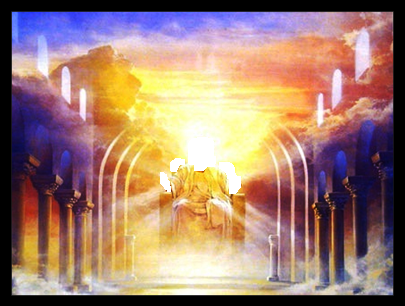
his incomparable splendor. Isaiah, Ezekiel, Daniel, and John the Revelator gave us glimpses of their heavenly visions.  They saw a high and exalted throne encircled by an ethereal rainbow, seraphs crying “Holy, holy, holy,” lamps blazing, lightning flashing, thunder rumbling, angels and saints worshiping.

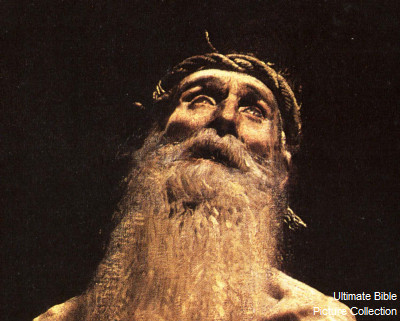
Artists have tried to imagine the sight:


441495a7b7e000ac4e649a52998c0a9f


But God’s authority, perfection, and incomparable splendor are not only on display in heaven. His glory is on display in creation–all around us. Consider these few examples:

• The delicate wing of the butterfly, emblazoned with brilliant colors in intricate patterns.


MM7820_090523_20124_xgaplus


• The intriguing double-spiral of sunflower seeds—one spiral in a clockwise direction, the other, counter-clockwise.


george-grall-close-up-of-a-sunflower-showing-the-spiraling-center-filled-with-seeds


• Lacy feathers of frost gathering on a window.


frost-patterns-on-windows-1387971944JG1


• The graceful curl of the wentletrap shell.


Epitonium_scalare_shell


• The jewel-like qualities of grains of sand.


Scala_dei_Turchi_Sand_062313


“Our God is lavish in splendor.  His creative fullness spills over in excessive beauty” (John Piper, pastor and author).

And why is that important to embrace and celebrate? Because we are so often distracted by the concerns of life.  We allow them to consume too much of our attention.  There’s a better way to live that many people never discover.

“Many people gaze at their problems and glance at the Lord.  But I tell you to gaze at the Lord and glance at your problems” (Ted Smith, pianist for Billy Graham Crusades).

Let’s visualize God’s grandeur–every day, as we prepare ourselves to pray.  Let’s become enthralled in the throne room of heaven, in the splendor and majesty of Almighty God.  And let’s bow down in humble gratitude that this magnificent God is also our loving Heavenly Father.  Think of it.  The glorious, all-powerful King of the universe is our Abba–our Dad!  Can any realization be more comforting, strengthening, or empowering than that?

*     *     *     *     *     *     *     *     *     *

Dearest Abba, too often my thoughts are a tangled mess of concerns.  I need a fresh vision of your glory to supersede the “what-ifs.”   Remind me that with you, the God of all authority and might, I have nothing to fear.  You are all I need.

(Photo and art credits:  www.wikimedia.com; http://www.pinterest.com; http://www.forums.thesims.com; http://www.allposters.com; http://www.publicdomainpictures.net; http://www.wikipedia.org; http://www.wikimedia.com.)

Read Full Post »

 picture-uh=715ce81d4af48c56d62e992073bfe9-ps=3da463e4536b201b56c385877e59a7

 (Photo from http://www.trulia.com.)

“There it is, Mom, “ Steve remarked, as he pointed to a little white house in the middle of a city block. “That’s where we lived when I was growing up.”

“Oh, yes,” she replied. But did Mom really remember?

We were on an excursion through Columbus, Ohio, taking Steve’s mother past the landmarks of her life. Alzheimer’s disease had already stolen away much of her vibrancy and warmth, and, of course, her memory.

 corner

Steve drove by West High School and continued his commentary. “That’s where we all went to school, you, Dad, Karen, and me. You were the very first homecoming queen.  How about that?  No wonder Dad asked you out.”

She murmured assent to Steve’s comments, but added nothing of her own.

 unnamed

We drove past the brick ranch they built out in the country in 1966. Horses used to reside beyond the back fence. Just a few houses had dotted the area back then. By this time, however, they had been swallowed up by dozens more. The saplings Mom and Dad had planted were now tall shade trees.  And the glorious flower beds and window boxes that Mom had tended were gone. She registered no recollection.

 unnamed

But when we approached her childhood home, a white Dutch Colonial on a quiet street, all of a sudden she perked up.  Pointing to a second-story window, Mom stated firmly, “That was my room, right up there.”

In the midst of the fog that is Alzheimer’s, one memory–one glimmer of light–shone through that morning. Steve and I almost gasped at the wonder of the moment. Mom remembered!

And the rarity of her memories pointed to the preciousness of this ability. Memory is a gift to be treasured. The older I grow, the more I appreciate the miraculous power of the brain to store millions of memories—with astounding detail–and yet access a particular one in a mille-second.

 1033249144001_2034162247001_900944612-159-1355440419795

Not only do sights trigger memories, but also smells. Researchers say this sense is the most powerful memory-inducer. For me, the aroma of fresh-baked bread always takes me back to my grandmother’s kitchen.

Sounds trigger memories as well—particularly music. Tastes and textures work the same phenomenon.

But surely God had more purpose in mind for giving us memory than the pleasant pastime of reminiscing.

Indeed.

Memories foster gratitude, as we contemplate God’s goodness to us in the past:

  • His countless blessings (even when we haven’t been a blessing to him).
  • Those times he led us through the shadow of death, so that we might experience more completely the glory of his light.
  • Moments when we almost gave up hope, and God surprised us with his creative, abundant provision.
  • Leaving behind what we once were and celebrating what we have become, solely because of his Son, Jesus.

Memories foster faith, as we remember how God has met our needs in the past. See if each phrase from Psalm 103 doesn’t trigger a memory in your mind, and a song of praise in your heart:

“Oh, my soul, bless God,

Don’t forget a single blessing!

He forgives your sins—every one.

He heals your diseases—every one.

He redeems you from hell—saves your life!

He crowns you with love and mercy—a paradise crown.

He wraps you in goodness—beauty eternal…

…God makes everything come out right.

He puts victims back on their feet…

…God is sheer mercy and grace;

Not easily angered, he’s rich in love.

He doesn’t treat us as our sins deserve,

Nor pay us back in full for our wrongs.

(Psalm 103:2-10, The Message)

Memories inform the present and provide hope for the future. As we meditate on all those times God has wrapped us in his goodness (v. 5), we are strengthened for what we face today. As we consider the many times he made everything come out right (v. 6), we can trust he will continue to make our paths straight.

Of course, there are some memories we would like to erase—those that generate sadness, hurt, or regret. How do we deal with those? Here are a few suggestions I’ve collected over the years:

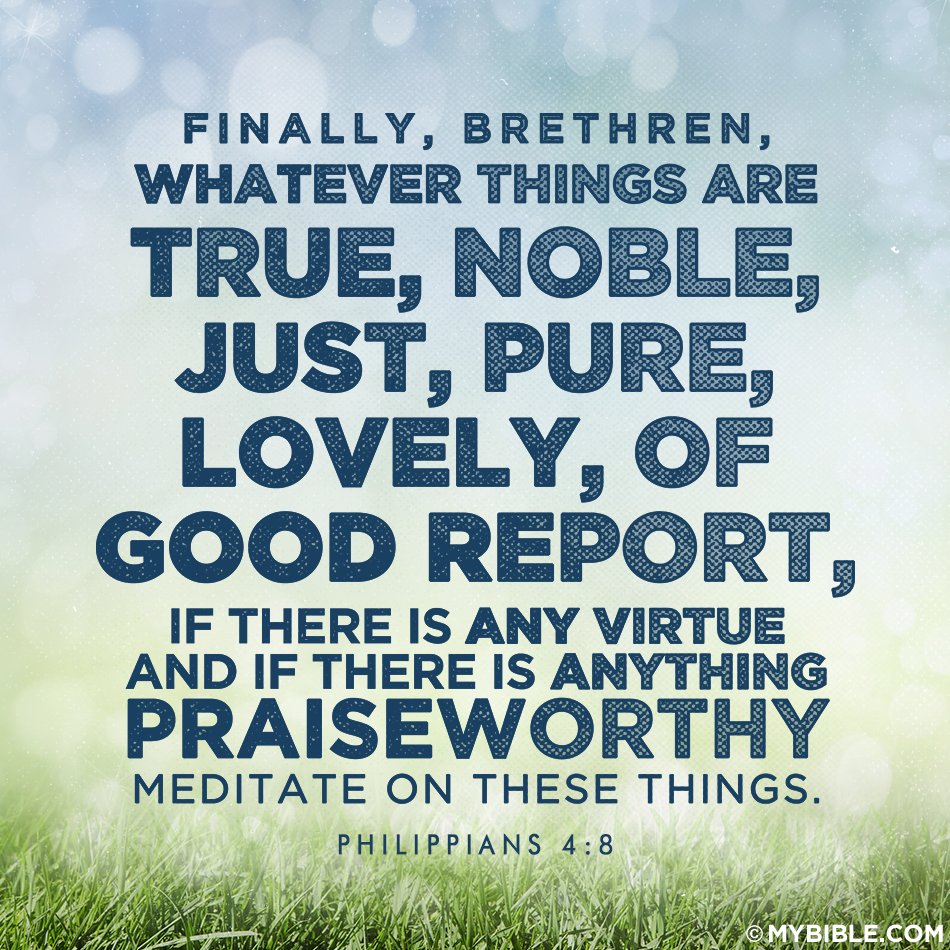
  1. We must resist self-pity—even in our thought life. Nowhere in scripture do we read that rehashing the negative is therapeutic. God’s way is to focus on the positive (Philippians 4:8).

Phil-4-8


  1. We can follow Paul’s example. He forgot what was in his past and pressed on to what lay ahead (Philippians 3:13). Not that amnesia had set in. Paul simply did not allow past failures to cripple his relationship with God and his service for God. God had forgiven and forgotten; Paul did too. No doubt he applied Philippians 4:8, not only to self-pity, but also to guilt. 
  1. We can leave the past in God’s hands. Oswald Chambers said it so well:

 c6d7d32bbdc18d2507a48f8aefa26359

(“Leave the irreparable Past in His hands, and step out into the Irresistible Future with Him”

–My Utmost for His Highest, Dec. 31.)


*     *     *     *     *     *     *     *    *     *    

Father, I do thank you for the gift of memories—the ability to remember with joy and appreciation the people, places, and experiences of the past. I even thank you for the not-so-good memories, knowing that you use every difficult situation for the development of my maturity (James 1:2-3). And may I take advantage of the wisdom gained in the past to guide me in the present, and lead me into the Irresistible Future with you.


Art & Photo credits:  www.trulia.com; http://www.westhighalumni.com; Steve’s photo collection; http://www.allrecipes.com; http://www.god.com; http://www.pinterest.com.

Read Full Post »

 d30200c131346a4ffed9f197bbee764d

(“You thrill me, Lord, with all you have done for me!  I sing for joy because of what you have done” — Psalm 92:4 NLT.)

God lavishes his gracious kindness upon us in countless ways, doesn’t he?

In appreciation for all he’s done, I have a suggestion. Let’s each write him a personal psalm for Valentine’s Day.  A love gift, on a love-focused holiday, for our loving God.  (You have more than a week to prepare your gift!)

Is that an overly sentimental idea?

Perhaps the timing is, but the matter of creating personal psalms has nothing to do with sentimental poetry.

I can hear some of you already. “Me—compose a psalm? I struggle to put a personal message on a birthday card!”

If that sounds like you, “Be strong and courageous. Do not be terrified; do not be discouraged, for the Lord your God will be with you” (Joshua 1:9)!

God waits with eager anticipation for you to enjoy an intimate Father/child relationship with him (2 Corinthians 6:18).

f2c43794cde3dc013fef692a6c7eabf1

 And what parent is not overjoyed when a son or daughter shares his/her innermost thoughts and feelings?

Remember, a psalm is simply a heartfelt prayer or song.  Key word: heartfelt.  Our psalms do not have to rhyme. We don’t have to use fancy literary devices like metaphors, imagery, or parallelism unless we want to.

These psalms are for our Heavenly Father.  He takes great pleasure in the sincere, unpretentious efforts of his children, just as all parents do.  We can even ask for his help to string the words together that will express our hearts.

Sometimes the hardest part is getting started—that first thought. An easy solution is to use a biblical psalm as a model.

?????????????????????????

To begin, you might choose a favorite verse. Read it slowly, several times. Rewrite it in your own words.  These questions might help to push your thinking further:

  • Is there a phrase or word that stands out?   Explain to God why it is important to you.
  • Do you feel a connection with this particular verse?  Add a personal experience when God’s activity in your life made this verse especially meaningful for you.

Following is one way to create a personal psalm, based on Psalm 3:3a: “You are a shield around me, O Lord.”

f74d4bae680c7ed0bb80f31d68a4bd72

1.  Choose a key word.  “Shield” is an obvious choice.

2.  Use the question-words who, what, where, when, why, and how to jump-start your thought processes.  Not all of them will spark an idea, but several will.  For example:  How is God a shield for me? What is he shielding me from? Why is it important for me to remember that he is my shield?

3.  Prayerfully and thoughtfully answer your questions. Meditate for a moment, then begin to write. One word can become the basis for the first sentence. A word or idea from that sentence can be expanded upon and become another sentence.

Before you know it, a psalm is born!


I praise you, oh God, for being like a shield

when disturbing thoughts are hurled my way.

You deflect those poisoned-arrows

with your shield of scriptural truth

and tender compassion.

Help me remember

you are all-powerful and all-wise.

There is no circumstance or emotional battle

that you cannot handle.

Your strong shield protects me

from the assault of Satan and his cohorts—

those negative, discouraging thoughts

that try to attack the peace and joy you’ve given me.

You are my almighty Warrior-God,

unsurpassed in power.

Satan cowers in your presence!

Help me avail myself of your protection

at every onslaught.


Once your psalm is complete, it’s time for presentation.  Read your psalm out loud to God. You will sense his presence as he comes to listen! How do I know?

OLYMPUS DIGITAL CAMERA

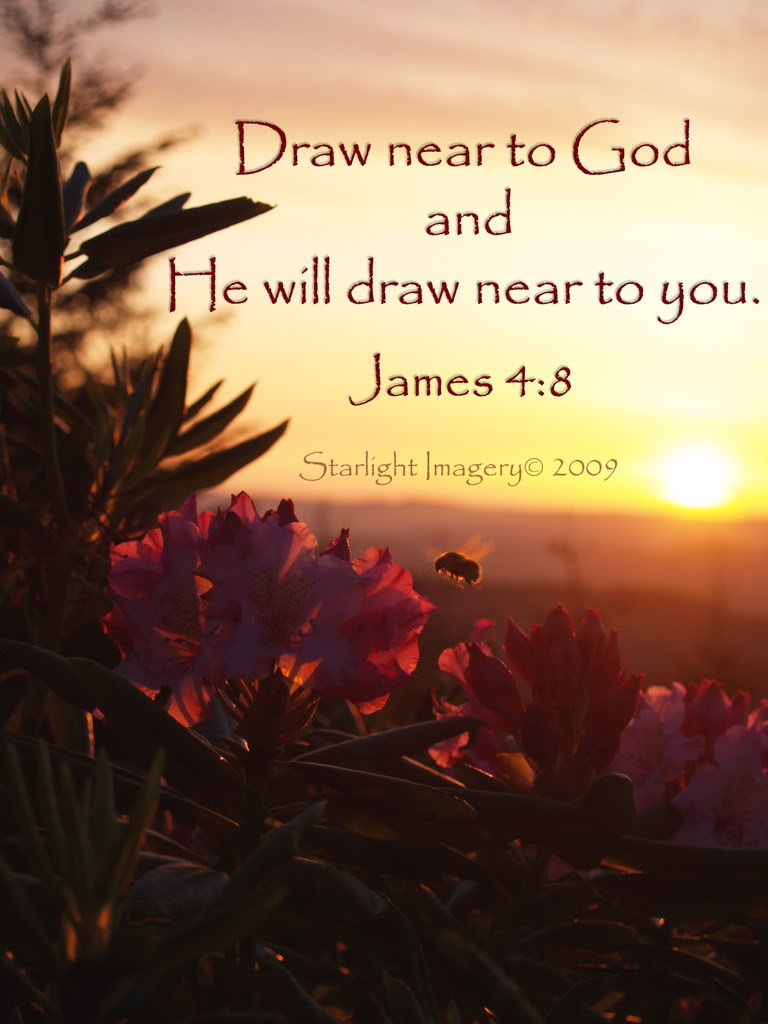
(“Come near to God and he will come near to you” — James 4:8.)

Keep your journal or notebook handy. Further thoughts may occur to you as you read, or afterward as you reflect. One more question to consider: In what ways has your relationship to God been impacted through this composing process?  You may wish to write about that, too.

I must confess, I’ve written a number of personal psalms. But recent reading on the subject has inspired me to pursue new avenues of this form of worship.

In future psalms I want to increase my reflection time, be more specific, add more detail, and actually read my psalms out loud.  I’m looking forward to expressing the depths of my heart more openly and discovering new depths of my Heavenly Father.

If you already write personal psalms, or should decide to write one, I’d love to hear about your experience!


(Art and photo credits:  www.pinterest.com; http://www.healthcentral.com; http://www.dwellingintheword.wordpress.com.)

Read Full Post »

41VdqTVobWL._SY344_BO1,204,203,200_


“Advent:

the time to listen for footsteps –

you can’t hear footsteps

when
 you’re running yourself.”

Bill McKibben


Are you caught up in the Holiday Hurry yet? I’m talking about the decorating–baking– card-writing—shopping—wrapping—parties—rehearsals—event-participation and attendance. No doubt I omitted a few items on your list.

Perhaps you’re craving a bit of quiet this Christmas. Time to enjoy the presence of your Savior. Time to reflect on Bethlehem blessings—those gifts we enjoy as a result of Christ’s advent into the world.

But how can we stop running long enough to hear our Savior’s footsteps? How can we avail ourselves of his peace and strength when our days are doubly-busy?

May I recommend the devotional book, Let Every Heart Prepare Him Room (Barbour Publishing, 2014), by my good blogger-friend, Jean Wise?

First, the soft, leather-like cover is a pleasure to hold. The thick, gilded pages are a delight to turn. And the subtle, star-studded border on each page adds beauty to the text.

Jean has provided four weeks of quieting devotionals, offering a perfect start for each day. Each week has its own theme: 1) Preparation, 2) Pause, 3) Ponder, and 4) Promise.

Each reading includes a brief devotional, appropriate scriptures, well-chosen quotes, suggestions for a more meaningful Advent season, and a closing prayer.

I’ve just begun reading and internalizing this book myself. But already my spirit has been calmed by Jean’s soothing words. For example:

“We drink in His presence and linger in His light for warmth and nourishment. We quench our thirst at His well” (p. 27).

Doesn’t that sound refreshing and rejuvenating? So “take a deep breath and enjoy the journey,” Jean recommends. Embrace moments of stillness, thank God for the gift of His Son, express gratitude, and rest.

Jean also provides gentle challenge. She well knows the tyranny of the to-do list at this time of year. A pointed question steers our focus in the right direction:

“What are we clinging to so tightly we can’t reach out to God” (p. 16)?

And then there are those readings where God’s wisdom flows through Jean’s words.

In the devotional entitled, “Advent Assignments,” she reminds us that our role in the Christmas season is not to be the perfect hostess or flawless decorator, and not to portray the ideal family.

“Preparing our hearts for the Lord implies knowing our boundaries and acknowledging our limitations…Focus on the manger in the center of the stage of our hearts (p. 32).”

Each day Jean encourages me to “reduce the clutter.” Her words bring me to the center of the stage of my heart, to “spend less time on busy work and more time with God” (p. 12).

Time to reflect. Time to listen. Time to savor the presence of my Savior.

Won’t you join me?

(You may order the book on http://www.barnesandnoble.com or purchase at a Family Christian bookstore and at Christian Book Distributors.) 


Read Full Post »

desert

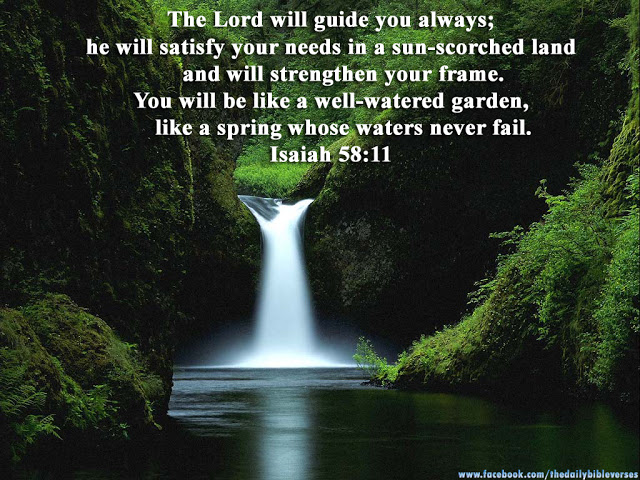
Last Thursday we pondered these promises from Isaiah 58:11:

 “The Lord will guide you always,” and

“He will satisfy your needs in a sun-scorched land.”

 Today, more discoveries and encouragement await as we meditate upon the last two promises:

  • “[He] will strengthen your frame.”
  • “You will be like a well-watered garden, like a spring whose waters never fail.”

garden-waterfall-design


Do you long for strength within your frame, that is, inner strength? Perhaps you’re moving as fast as you can, but never quite reaching the end of the to-do list. And you’re bone-weary from the effort.

Perhaps the stresses of life—difficult relationships, a high-pressure job, financial obligations—are squeezing in hard.

Perhaps boredom or depression surround you in a gray shroud, and you haven’t the energy to fight against them.

“He will strengthen your frame.”

But God doesn’t wave a magic wand over us and suddenly turn weakness into strength. Usually he invites us to be part of the process.   And his solutions are radical.

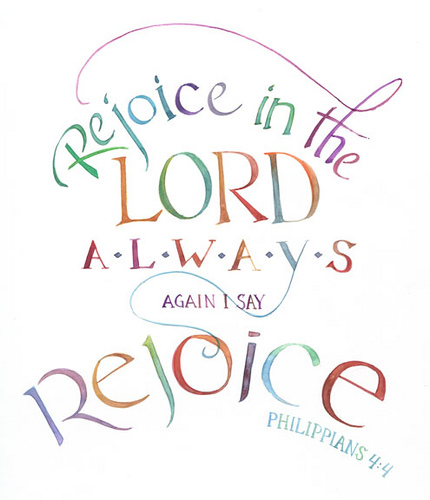
For example, celebrate anything and everything (Philippians 4:4).

3095781994_90a392c03f

Take joy in:

  • Your cozy robe to ward off the morning chill
  • That cute tuft of hair sticking up on your toddler’s head
  • A parking place opening up when and where you need it
  • Licking the stamp just as the mail carrier pulls up in her truck
  • An earring lost last week turns up between the counter and stove this week.

You see, joy and strength are closely related. Ezra told the people of Israel, “The joy of the Lord is your strength” (Nehemiah 8:10).

Those five examples above, and thousands like them, are gifts from your Heavenly Father. “Every good gift and perfect gift is from above, coming down from the Father of the heavenly lights” (James 1:17).

In the same way we can build up physical strength with exercise, we can build up spiritual strength with praise—by expressing gratitude and joy for every good and perfect gift.

And now, the last promise of this verse describes in metaphor the result of living according to God’s design.

“You will be like a well-watered garden, like a spring whose waters never fail.”

TotalChildCareVegetables7 

Visualize a flourishing garden, with rich, green plants overflowing with healthy, ripe produce.

Those can be descriptors of you and me.  We are:

  • Rich in God’s grace, which he has lavished on us with all wisdom and understanding (Ephesians 1:8).
  • Green and flourishing, because we spend time with the Master Gardener and allow him to cultivate our spirits (Psalm 1:2-3).
  • Healthy and prosperous of soul (v. 3). As we soak up God’s Word, we’ll produce actions and attitudes that honor God and bring us inner satisfaction.
  • Ripe and mature, lacking in nothing (James 1:3).

God offers us “a continual source of thirst-quenching, drought-ending, fruit-producing, spiritual hydration” (James MacDonald).

Doesn’t that sound refreshing?  Who could turn down such provision?

*     *     *     *     *     *    *     *     *     *

Thank you, Father, for the precious assurances of these promises: 

  • You are leading me along the path you preordained before time began.
  • Every day of this earthly journey I can count on you to supply my needs.
  • Every day you provide fresh strength. One way is through the exercise of praise.  
  • As I spend time in your presence, I will be transformed–like a garden replenished by hydration. In fact, I can grow into your likeness with ever-increasing glory!

 “Such knowledge is too wonderful for me. It is too lofty for me to attain.” Yet I know it to be true because these are truths from your reliable Word.  My heart overflows with wonder and gratitude.

(Psalm 139:16; Philippians 4:19; 2 Corinthians 3:18; Psalm 139:6)

(Photo and art credits:  www.dayofgrace.me; http://www.anativegarden.blogspot.com; http://www.flickr.com; http://www.naturalearning.org.)


Read Full Post »

blog-prayer-woman


How would you finish this prayer: 

“Oh, Lord, what I need most right now is ____________________.”

What word would you put in the blank?

Guidance?

Provision?

Strength?

Purpose?

One glorious Bible verse tucked into Isaiah presents four comforting promises that cover each of those needs:


Isaiah58.11 

“The Lord will guide you always;

He will satisfy your needs in a sun-scorched land

And will strengthen your frame.

You will be like a well-watered garden,

Like a spring whose waters never fail” (58:11).

Lots of truth packed into five short lines. Each phrase warrants careful consideration. For example:


1.  The Lord will guide you always.


He’s not a life coach, counselor, or psychologist. The almighty God of the universe promises to be your guide—free of charge! And he’s available 24/7. Think, too, of his astounding attributes that make him the perfect guide:

  • God is omniscient—He knows everything (Psalm 139:1-6), including every detail of your situation and the people involved.
  • God is righteous—Everything he does is good (Deuteronomy 32:4). He can be relied upon to lead you down a perfect path.
  • God is merciful—He responds in loving compassion (Psalm 116:5). He’s your understanding Father, your strongest ally.
  • God is truthful—All that he says can be trusted (Titus 1:2). He will not lead you astray.
  • God is faithful—He keeps his Word (Psalm 33:4). God does not lie or forget what he said. Neither does he change his mind.

Notice that first phrase says God will always be your guide. Not every once in a while when you’re really in a quandary, but always. You are never left alone to your own devices—unless that’s the way you want to live. God is a gentleman; he leaves the choice up to you.


2.  He will satisfy your needs in a sun-scorched land.


Not he might satisfy your needs if he feels like it. He will. 

No matter what the landscape of your life looks like, God will see that your needs are met.

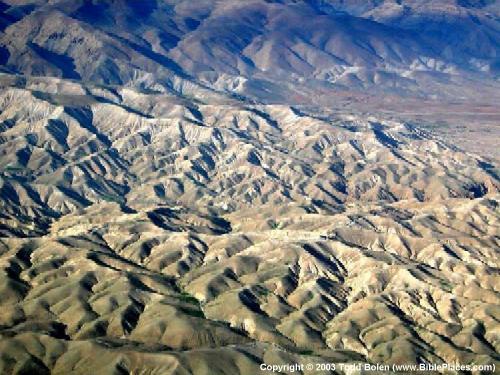
Have you ever been surrounded by sun-scorched land, perhaps a desert or wilderness where no life is visible?

Steve and I visited Israel a number of years ago. One of our tour stops was in the Judean wilderness—a desolate and foreboding sight to behold. Not a single tuft of grass. No bushes or plants of any kind—not even cactus. Only two things are visible when standing in the midst of this desert: sky and pale gray-brown mountainous rock, as far as the eye can see.


judean_wilderness_west_of_jericho_ariel_tb_q010_03


Should you decide to live there, you’d have to bring with you everything necessary for survival: all your food, water, and clothing. For shelter, you might find a cave.

Ah! But what if there was Someone there ahead of you? Someone who already had at his disposal the supplies you required? And they would never run out? That’s the life-giving, unfailing provision of your Heavenly Father.

Let’s you and me rest in the assurance that the essentials—and even many delights!—will be generously supplied. If something is meant to be, he will take care of it—just as he’s been doing since each of us was born.

Think how he has led you through the wilderness of broken relationships and difficult circumstances. His grace has been sufficient for every challenge (2 Corinthians 12:9), right?

Now project that assurance into the future. Even if we walk through the valley of the shadow of death, we have no need to fear. Our all-powerful God is with us (Psalm 23:4)–guiding and providing.

(Please remind me of that when I come to a wilderness-patch, will you?)


*     *     *     *     *     *     *     *     *     *


Heavenly Father, I praise you that day by day, moment by moment, you are delighted to guide us in perfect wisdom. You generously provide for our needs and lovingly care for us body, soul, and spirit. Thank you for your compassion, your faithfulness, and grace to see us through the wilderness valleys. “I trust in you, O Lord; I say, ‘You are my God. My times are in your hands.’” (Psalm 31:14-15a).  


Please come back on Monday. We’ll meditate on the second half of Isaiah 58:11.


(Photo credits:  www.hischurchwomen.com; http://www.freerepublic.com; http://www.biblestudytools.com.)


Read Full Post »

Woman with piggy bank at rainy window


“Save for a rainy day,” financial experts advise.  And they’re right.  It is smart to have funds set aside in case of emergency.

But we would also be wise to save up for another kind of rainy day:

  • The day great disappointment shatters our joy
  • The day the doctor begins a consult by saying, “I’m terribly sorry, but…”
  • The day a loved one calls with disturbing news

What could we possibly save up that would help in such circumstances?

Consider: monetary deposits in a bank account insulate us against financial emergencies.

Similarly, we can make faith-statement deposits into our soul-accounts, to insulate us against life’s emergencies.  A healthy soul-account offers peace of mind, confidence, and a sense of well-being.

The most valuable faith statements are those straight from scripture, since the Bible is our source of truth.

Statements such as these are worthy starting points:

  • God is with me, even in the midst of trial.

“Those who know Your name will trust in You, for You, Lord, have never forsaken those who seek You” (Psalm 9:10).

  • God is my stronghold in time of trouble, offering help and deliverance.

“The salvation of the righteous comes from the Lord; he is their stronghold in time of trouble.  The Lord helps them and delivers them” (Psalm 37:39-40).

  • He will supply all my needs.

“My God will meet all your needs according to his glorious riches in Christ Jesus” (Philippians 4:19).


Sometimes God makes deposits in our soul-accounts through other reading.  Here are a few examples I’ve collected:

  • “God makes good things out of the hard times.” – Erica Hale
  • “Difficulties are sent to make us grow. Move from complaining to proclaiming what God is doing through the problem. Remind yourself, for every Calvary, there is an Easter.” – Barbara Johnson
  • “When we understand that life is not about us, we learn to overlook the trivial and fix our gaze on the eternal. What is an offense compared to His love? What is a rejection compared to His unconditional acceptance? What is a momentary trial compared to an eternity with Him?” – Emmanuelle Gomez


Faith statement deposits also come through experiences, such as:

  • The spontaneous hug of a good friend who knows of our struggles. That’s God’s way of assuring us…

…We are not alone.

  • An answered prayer—and the answer is far beyond what we asked for. That’s God’s way of showing us…

…His love and blessing never fail, even in the midst of difficulty.

  • A transformed spirit through worship.  Worry becomes faith. Fear becomes courage. Depression becomes gladness. That proves…

…The joy of the Lord is our strength (Nehemiah 4:8).


Faith-statements, deposited in our souls even before we have need of them, provide a deep, sweet sense of security.

When difficulties arise, and the time comes to make withdrawals, we can praise God for each truth. Praise will fill our hearts with song and drown out the voices of worry and fear.

*     *     *     *     *     *     *     *     *     *

Your faithfulness, O God, is unwavering and unfailing.   Oh, how I want to be faithful to you, especially during difficult circumstances.  You have provided the tools.  I praise you for the deposits your Spirit makes into my soul account, offering solace, perspective, strength, and wisdom.   Help me to avail myself of your gracious provision.  


(Photo credit:  www.dailyfinance.com.)


Read Full Post »

“Who has known the mind of the Lord?” Paul asked (1 Corinthians 2:16).

That’s an easy question to answer: Nobody! His intellect and wisdom are far beyond our human ability to comprehend.

After all…

God has worked out the complexities of every living cell–with perfect precision.


yeast-front

(X-ray microscopy combine to picture interior of living cell)


He has engineered a staggering number of specialized plants and creatures, carefully interrelated in a web of reliance upon one another.


wshedcrosscut2


He has created the unfathomable reaches of the universe filled with countless heavenly bodies of immeasurable proportions.


hs-2007-41-a-small_web

(Spiral Galaxy M74)


Such intellect and wisdom to accomplish these feats is incredible.

Yet, at the end of that same verse above, Paul makes a statement even more astounding. In fact, at first glance it seems ludicrous.


Unknown

 “We have the mind of Christ.”


What? How is that possible? His knowledge and wisdom are infinite; ours is markedly limited.

But Paul makes clear:  we have the mind of Christ because he lives within us (Galatians 2:20).


Galatians-21


Not that we can know everything and respond with pure wisdom in all situations. Our perfection is a process that won’t be completed until Jesus returns (Philippians 1:6).

But my heart beats a little bit faster to realize that, each day and for all my tomorrows, I might think more like Jesus, understand more like Jesus, and react more like Jesus.

One particular action will encourage progress: spending time with him, especially in his Word.


Young woman reading bible


Here’s an analogy, though far from perfect. Steve and I have been married a very long time—forty-four years.  At this point, we can finish each other’s sentences, supply missing information or words in a conversation, and sometimes even know what the other is thinking.

It’s as if we’ve acquired a bit of the other person’s mind. And it’s happened bit by bit, over time.

So I repeat: We will have the mind of Christ as we spend time with him day by day– especially in his Word.

And how will we know that his way of thinking is becoming our way of thinking? After all, there’s no measuring stick for spiritual growth.


tapemeasure


Oswald Chambers, in My Utmost for His Highest, posed an excellent question that can help us determine our progress:

“Are other people beginning to see God in my life more and more (p. 78)?” Because a person with the mind of Christ will demonstrate Christ-like behavior.

Perhaps we could take an occasional inventory, based on the fruit of the Spirit (Galatians 5:22-23). The attributes listed in these two verses characterize a person with the mind of Christ–someone who is loving, joyful, peace-filled, patient, kind, good, and so on.  We could ask ourselves, how have I demonstrated these attributes this week?

And what will be the result of cultivating the mind of Christ? “The mind controlled by the Spirit is life and peace” (Romans 8:6).


Romans8_6


Life that is characterized by vitality and purpose.

Peace that includes inner-contentment, freedom from guilt, and security for eternity.

That sounds awfully good to me.

*     *     *     *     *     *     *     *     *     *

Heavenly Father, we praise you for taking us into the high places of blessing in Jesus. That includes this gift: the mind of Christ. And day by day you are transforming us into his likeness, with ever-increasing glory. May I seize this day and its opportunities to think like you, understand like you, and react like you.  

(Ephesians 1:3; 2 Corinthians 3:18)


Art and photo credits:  www.lbl.gov; http://www.chesapeakebay.net; http://www.hubblesite.org; http://www.crosspointenwa.com; http://www.pinterest.com; http://www.changingthefaceof christianity.com; http://www.footsoldier4christ.com; http://www.motivationalquotes.com.


Read Full Post »

Unknown


Two weeks ago Steve and I enjoyed a visit with friends we’ve known since college. Last week it was with two other couples we’ve also known for many years.  Shared memories include experiences at church, exceptional dinners at restaurants, excursions to other locales, watching each others’ children grow up, and more. Every time we get together, there’s much story-telling, teasing, laughter, and reminiscing.

One special delight of old friends is the “memory back-up” they offer.

  • “Who was the guy that…?
  • “Where were we when…?”
  • “What was the name of that restaurant where…?”

Have you experienced the flow of feel-good endorphins after such a reunion? Believe it or not, research has verified that our psyches benefit greatly from nostalgia.

New research from the University of Southampton shows that feeling nostalgic about the past increases optimism about the future.  The research examined the idea that nostalgia is not simply a past-orientated emotion, but its influence extends into the future, with a positive outlook.” (http://www.southampton.ac.uk/mediacentre/news/2013/nov/13_202.shtml )

Might that positive outlook grow even stronger if God is included in the remembering?  After all, he’s the one responsible for everything good that happens (James 1:17). He certainly deserves our gratitude for delightful memories.  Each one is a manifestation of his loving care and provision.

With the remembering, we can give God praise: “The Lord has done great things for us, and we are filled with joy” (Psalm 126:3).


AnExtraordinaryDay.net-Psalm-126-verse-3-The-Lord-has-done-great-things-and-we-are-filled-with-joy.-Woodland-photo


And with the remembering, we can strengthen our faith for the future.

On the other hand, all of us have unpleasant memories, too.  Difficulty, hurt, and failure are part of the human experience.  But even in contemplating those times, we can augment a positive outlook as the psalmists did (long before any research validated their strategy).  They often reaffirmed how God had ministered to them in the midst of trials:

  • He did not forsake those who sought him (Psalm 9:10).
  • He encouraged and listened to their cries (10:17).
  • He delivered them from all their fears (34:4).
  • He offered refuge (61:3).
  • He helped and comforted (86:17).

*     *     *     *     *     *     *     *     *     *

Oh, Lord, as I think about my life journey or read my blessings journal, I see your faithfulness displayed again and again.  Thank you for the gift of nostalgic remembering, which expands our joy, encourages our spirits, and grows our faith.


(Photo credits:  http://visualphotos.com ; http://www.anextraordinaryday.net.)

Read Full Post »

 frazzled-career-woman


Ever had a pending appointment you didn’t want to keep? A person you didn’t want to encounter? A task you didn’t want to complete?

Some days are filled with unpleasantries. And if I’m not careful, it’s an easy slide down into a gloomy funk.

How does that happen?

My thoughts provide the slippery slope…

What a lousy day this is going to be. I sure hope So-and-So is in a good mood for that meeting this afternoon. Last time he was as irritable as Oscar the Grouch. And while I’m looking forward to that (Ha-Ha!), look at this impossible to-do list. Talk about crazy. And then there’s our double-date tonight with that new couple from church. I am in no mood to be sociable. All I want to do is go home, put on my sweats, and park on the couch!

 Can you identify my problem here? I’m focusing on the negative. The solution is obvious: turn my thoughts to the positive.

But some days that is next to impossible. It’s as if the problems and challenges are shouting giants, jumping up and down, with arms waving no less. They block any view of the positive.

Making the effort to think about praiseworthy things works for a while, but those negative thoughts often return, unbidden and oh, so unwanted. To make matters worse, I feel guilty for allowing those giants access to my mind and spirit.

Why can’t I get rid of them once and for all?

Maybe I’m not supposed to. Maybe God wants me to become more watchful, to learn perseverance, and to practice proactive behaviors, like gratitude and praise.

But one strategy for fighting the giants is particularly important: Get out my sword.

I’m talking about the Sword of the Spirit, which is the word of God (Ephesians 6:17).

Scripture is full of wisdom and encouragement for doing battle, like Psalm 73.

Asaph writes about his challenge: arrogant and wicked people (v. 3) who scoff and speak malice (v. 8).

“What is going on here?” he writes. “Is God out to lunch? Nobody’s tending the store. The wicked get by with everything; they have it made…When I tried to figure it out, all I got was a splitting headache” (vs. 11-14, The Message).

Sounds like the giants of negativity had been pestering Asaph, too.

But at the end of the psalm, Asaph affirms what he knows about God and his ways:


“You [God] hold me by my right hand.

You guide me with your counsel,

And afterward you will take me into glory.

Whom have I in heaven but you?

And earth has nothing I desire besides you.

My flesh and my heart may fail,

But God is the strength of my heart

And my portion forever.”

(Psalm 73:23-26)


I need to meditate on Asaph’s affirmations and make them my own:

  1. My loving Heavenly Father holds me by the hand, offering protection and security.
  1. He guides me with wisdom, especially through his Word, infusing me with comfort and strength.
  1. God gives me perspective for my earthly troubles as I look forward to blissful eternity with him.
  1. He is all I need.


Thank you, Asaph. I’m going to memorize those verses so they’re ready to draw like a sword—on a moment’s notice!


(photo credit:  www.ideas.tome.com.)


Read Full Post »

« Newer Posts - Older Posts »

When the House is Quiet

Impressions Becoming Expressions

Mitch Teemley

The Power of Story

Still Traveling

Impressions Becoming Expressions

Living Our Days

Gaining a heart of wisdom

He Said What?!

I'm Patty, and my husband and I are living with our adult son who has autism and epilepsy. I love sharing lessons learned from life around me, especially life with Aaron.

Meditations of my Heart

Impressions Becoming Expressions

Linda Stoll

Impressions Becoming Expressions

Signora Sheila

Where faith meets la dolce vita

Heidi Viars

Finding the Image of God